• Armed Revolution May Soon Be Necessary


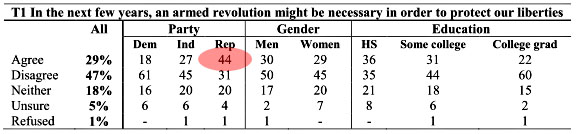
    I don’t really know how seriously to take this, but here’s a question from the latest Fairleigh Dickinson poll. Apparently, nearly half of all Republicans believe that we might need an armed revolution in the near future to “protect our liberties.” Hell, even a fifth of Democrats think the same thing. Is this the effect of brain rot caused by listening to Rush and the NRA too much, or is it just a bit of harmless affinity mongering? I’m not sure. Either way, though, I’d sure like it a lot better if this number were somewhere south of 5 percent.

  • Sohel Rana is Now the Most Hated Man in Bangladesh


    The New York Times reports today on Sohel Rana, owner of the factory building that collapsed last week and now the most hated man in Bangladesh:

    To build Rana Plaza, Mr. Rana and his father bullied adjacent landowners, the landowners themselves say, and ultimately took their property by force. His political allies gave him a construction permit, despite his dubious claims of title to the land, and a second permit later to add upper floors that may have destabilized the building.

    ….Then on April 23, a problem arose. Workers on the third floor were stitching clothing when they were startled by a noise that sounded like an explosion. Cracks had appeared in the building. Workers rushed outside in terror.

    By late morning, Mr. Rana’s representatives had brought in Abdur Razzaque Khan, an engineer. Taken to the third floor, Mr. Khan examined three support pillars, and became horrified at the cracks he found. “I became scared,” Mr. Khan said. “It was not safe to stay inside this building.”

    He rushed downstairs and told one of Mr. Rana’s administrators that the building needed to be closed immediately. But Mr. Rana was apparently not impressed; he was holding court with about a dozen local journalists. “This is not a crack,” he said, according to Shamim Hossain, a local newspaper reporter. “The plaster on the wall is broken, nothing more. It is not a problem.”

    Will this become the Triangle Shirtwaist Fire of Bangladesh? Possibly, though it’s worth remembering just how long and how hard the battle for safer working conditions was even after the Triangle disaster. To get a sense of just how difficult it’s going to be to change things in Bangladesh, click the link and read the whole sordid story.

  • Albany is the Most Average City in America


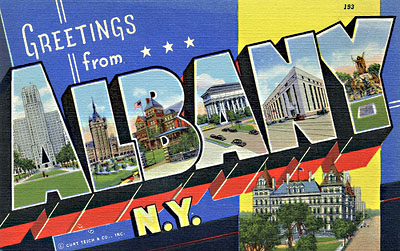
    Annie Lowrey asks: What is the most perfectly average place in America? Tyler Cowen nominates Knoxville. Matt Yglesias nominates Jacksonville. As a former marketing weenie, I say we should let the free market decide. Back in 2004, Acxiom ranked the top 150 consumer test markets in the United States based on their overall characteristics: age, marital status, home ownership, estimated income, etc. America’s Fortune 500 companies put their money where their mouths are by conducting expensive and critical tests of their yummy new products in these aggressively average cities. Here are the top ten:

    1. Albany, NY
    2. Rochester, NY
    3. Greensboro, NC
    4. Birmingham, AL
    5. Syracuse, NY
    6. Charlotte, NC
    7. Nashville, TN
    8. Springfield, OR
    9. Wichita, KS
    10. Richmond, VA

    In fairness, there’s more than just averageness that makes for a good test market. You also want a place that’s not too big and has reasonable advertising rates. Here is Neeli Bandapudi of Ohio State University explaining on NPR why Columbus is a pretty good test market:

    So Columbus, Middle America, it was the idea that it truly was representative of the broader trends of the nation. And, of course, it’s not just that. You want to make sure that it’s a location where it’s not dominated by one employer or one cause, because you want to get a variety of opinions there. Maybe it’s the demographics of the people that you’re trying to reach and also a variety of shopping outlets and a variety of media outlets, so you can see how it would actually play.

    Because advertising — there’s no point in just putting it in the store. You got to let people know it’s there.

    Indeed. Without that, you know, you might not be very successful.

    Anyway, there you go. The free market has answered this question for us. Isn’t the free market wonderful?

  • Quote of the Day: House Republicans Have Completely Melted Down


    From Jake Sherman of Politico, on the chaotic state of the House Republican caucus these days:

    The inability to find unifying principles is sometimes in plain view: House Republicans spent two days last week passing legislation that extended the authority of the government’s helium reserves, which Democrats would’ve allowed them to pass by unanimous voice vote.

    Here’s a bit more:

    The GOP leadership is dealing with an unprecedented level of frustration in running the House, according to conversations with more than a dozen aides and lawmakers in and around leadership. Leadership is talking past each other. The conference is split by warring factions. And influential outside groups are fighting them.

    ….The House simply isn’t interested in the agendas being pushed by the president and Democratic Senate. Most Republicans aren’t looking for a big legislative push on gun control. GOP leaders are skeptical that they can arrive at a framework to negotiate a budget agreement with Senate Democrats. And tax reform and an immigration overhaul, while broadly supported, are still seen as long shots.

    Members of leadership have trouble staying on the same page. Cantor is anxious to move on his agenda, but McCarthy needs to gather support in a House Republican Conference that’s filled with lawmakers constantly divided on leadership’s priorities.

    Much to the chagrin of GOP leadership, outside groups — Club for Growth and Heritage Action — oppose top Republicans at every turn. Those groups claim they don’t ever hear from Boehner, Cantor and McCarthy. The conservative groups — natural allies who could give cover to the House Republican Conference — feel they have no buy-in to their agenda from the House GOP leadership.

    Apparently there are now two groups of Republicans in the House. First, there’s a group of firebrand conservatives headed by Eric Cantor, which, as near as I can tell, is mostly dedicated to finding slightly more slippery language to sell its usual right-wing agenda of school vouchers, block granting Medicaid, increased tax credits, and gutting labor laws. Second, there’s a group of insane, frothing-at-the-mouth conservatives who think of Cantor as Nancy Pelosi’s lapdog and are basically uninterested in anything other than repealing Obamacare, slashing taxes even more, ending the welfare state, and making speeches about how Obama is destroying America. It’s quite a little group that John Boehner has up there.

  • Keep Calm and Go F*** Yourself


    I guess this is old news in Britain, but I learned about it for the first time this morning:

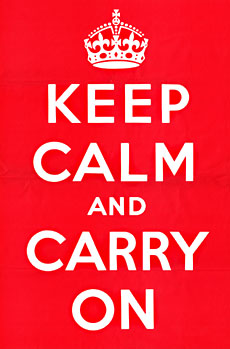
    Thirteen years ago, Stuart Manley stumbled upon a slightly faded red poster tucked at the bottom of a box of books he had bought at auction. Unfolding it, he found himself staring at a relic of World War II, a long-forgotten piece of government propaganda bearing the logo of the British crown and this pithy message:

    Keep calm and carry on.

    ….The Manleys and other traders are caught in a spat with an enterprising Englishman who, after launching his own line of “Keep calm and carry on” products, trademarked the phrase with European authorities two years ago….The businessman, a former TV producer named Mark Coop, insists he’s simply protecting the interests and brand of the company he has worked hard to build since 2007. His foes accuse him of trying to monopolize a piece of history.

    ….After Coop was granted his trademark, an online petition campaign quickly sprang up calling for it to be revoked — and for nasty fates to befall him….”The trouble and everything it’s caused has not been worth it,” Coop says. “I didn’t expect that people would react in such a venomous, vicious way.”

    Right. Who could have guessed that anyone would react negatively to such an obviously predatory bit of trademark abuse?

    In any case, I have decided to popularize and widely market a set of kitschy objects emblazoned with the slogan “Tippecanoe and Tyler Too.” I figure I can make millions, and thanks to my upcoming trademark of the phrase, all the rest of you are forbidden from ever using it again. Don’t like it? Well, you should have come up with the brilliant idea of putting it on toilet seat covers first. But you didn’t, did you?

  • 401(k) Retirement Funds Are a Rip-Off


    Matt Yglesias has a dyspeptic take on how the 401(k) retirement industry works:

    • Poor people get absolutely nothing.
    • Wealthy people who would have had large savings anyway get a nice tax cut that offers no meaningful incentive effect.
    • For people in the middle, the quantity of subsidy you receive is linked to the marginal tax rate you pay—in other words it’s inverse to need.
    • A small minority of middle class people manage to file the paperwork to save an adequate amount and then select a prudent low-fee broadly diversified fund as their savings vehicle.
    • Most middle class savers end up either undersaving, overtrading, investing in excessively high-fee vehicles or some combination of the three.
    • A small number of highly compensated folks now have lucrative careers offering bad investment products to a middle class mass market based on their ability to swindle people.

    Dyspeptic but basically accurate! The first four bullets are, unfortunately, just business as usual in America. It’s the last two that really rub salt in the wounds. But it’s simply a fact that a great number of 401(k) funds are extremely poorly suited as retirement vehicles and suck up far more in fees than can possibly be justified.

    But the news is even worse than that! Last year the Labor Department issued new rules that forced funds to disclose their fees in an easily understood manner. The idea was that if they’re going to rip you off, at least now you’ll know how much they’re ripping you off and maybe switch to a more honest fund. But it didn’t do much good:

    After the new fee disclosure statements went out, roughly the same percentage—half!—of participants said that they still do not know how much they pay in plan annual fees and expenses, according to a recent survey by LIMRA, an association of insurance and financial services organizations.

    ….For those 401(k) participants who said they thought they knew how much they paid in fees, most of them were way off base. One out of four participants thought they paid 25% or more in fees, 16% thought they paid between 10% to 24% in fees, and 30% thought they paid between 2% and 9% in fees. Only 28% of participants thought their fees were less than 2%.

    That group is the closest to reality. On average fees and expenses range between 1 to 2 percent, depending on the size of the plan (how many employees are covered) and the employees’ allocation choices (index funds versus actively managed funds), says LIMRA.

    Basically, this suggests that people have no idea what “fees” even means, which bodes ill for the power of disclosure to have any effect. If you think that 2 percent is really low, then you’re getting ripped off even though you do know the fee structure of your fund.

    The era of the defined-benefit corporate pension is gone, and it’s not coming back. People switch jobs too frequently for it to work anyway. The only real options are either private plans like 401(k)s, which ought to be reformed to make them better, more honest retirement vehicles, or higher Social Security payments. Most likely, both. The former would help the middle class and the latter would help the poor and the working class. The upper middle class and the wealthy can fend for themselves. They’re doing pretty well already.

  • High-Speed Trading Fairy Tales Come to Chicago


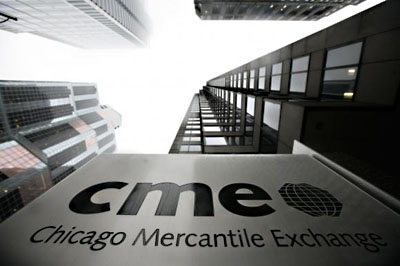
    The Wall Street Journal reports today that high-speed traders on the Chicago Mercantile Exchange are exploiting the ability to get confirmation of their own trades a few milliseconds before the rest of the public. Here’s an example of how it works:

    Firms can use their early looks at CME trading data in several ways. One strategy is to post buy and sell orders a few pennies from where the market is trading and wait until one of the orders is executed. If crude oil is selling for $90 on the CME, a firm might post an order to sell one contract for $90.03 and a buy order for $89.97.

    If the sell order suddenly hits, the firm’s computers detect that oil prices have swung higher. Those computers can instantly buy more of the same contract before other traders are even aware of the first move.

    I’ve read enough about high-speed trading that I can’t even get too worked up about this. The rich get richer, regular traders pay the price, etc. etc. What really makes this story worthwhile is hearing the high-speed traders try to justify what they do:

    Officials with Virtu Financial LLC, a high-speed trading firm in New York, view a slight head start as good for the overall market, according to a person familiar with their thinking. The person said the data helps traders who buy and sell futures contracts throughout the day manage risk and post more quotes that benefit other buyers and sellers. The person said Virtu doesn’t use the information to amplify its profits by anticipating moves elsewhere in the market.

    Proponents say eliminating the ability of parties in a trade to get information slightly in advance could lead to less-liquid markets because some firms would be inclined to trade less due to the greater risks.

    Yep, you read this right. Giving a few select traders an unfair advantage over everyone else is actually good for everyone else! Why? Because if these lucky traders didn’t have an unfair advantage they wouldn’t make lots of extra sure-thing trades, and these sure-thing trades benefit the entire market because…..

    Um, liquidity! It’s the last refuge of the scoundrel and the first refuge of the high-speed trader. They create liquidity, baby, and without that, the entire commodities market, which is famously liquid and always has been, might just seize up and die. Seriously. That’s their story.

    I don’t even have the energy to mock this lame nonsense right now. Maybe Felix Salmon will do it in the morning. In the meantime, I’ll just leave you with a further fascinating little nugget. It turns out that the time advantage for high-speed traders is different for different commodities: 2.4 milliseconds for silver futures, 4.1 milliseconds in soybean futures and 1.1 milliseconds for gold futures. Feel free to speculate on why this might be in comments.

  • Quote of the Day: Let’s Go To War In Syria


    From John McCain and Lindsey Graham, beating the drums for yet another military intervention in the Middle East:

    There are many options at our disposal, including military options short of boots on the ground in Syria, that can make a positive impact on this crisis, which is destabilizing the region.

    I have one question for McCain and Graham about this: what if these “options” don’t work? What’s next? Have they given this even a moment’s thought?

    I know this is hardly a novel insight, but the crisis in Syria has really rubbed my nose in just how capriciously conservatives have come to treat war. They no longer even consider it an especially difficult decision to make, let alone a last resort. It’s just a routine extension of foreign policy.

    The chances that an American intervention could have a positive outcome in Syria strike me as close to zero. Nevertheless, the war crowd is raring to dive in anyway. They have no idea what we should do; no idea what the outcome might be; and most importantly, seemingly no idea of how many ways the entire operation could go wrong. All they know is that there’s a bad guy somewhere in the vicinity of Israel, so we ought to go in and kick his ass.

    It’s astonishing. I’m no isolationist, and I’m no pacifist. But at the very least I think war should be treated as a deadly serious matter. When did it become such a casual thing?

  • New Obamacare Application Demonstrates the Power of Framing


    You may have heard that after receiving mountains of criticism for its 21-page first draft, HHS released a new, streamlined application form for Obamacare today. So, hooray, right? Sort of. Here’s my take on the original form:

    In fairness, there’s a single 2-page section you have to fill out, and then there are five more 2-page sections for other members of your family. So sure, it might be long if you have a big family, but a lot of it is repetition. And if you’re just a single earner? Then aside from instructions, there’s really only about four pages (five if you’re an American Indian or Alaska Native): one page of basic contact information, two pages of income information, and one page of current insurance information.

    And here is Ezra Klein’s description of the new form:

    Where the draft form was a hefty 21 pages, the new form is a svelte 5 pages….The new form is short because it’s only for a single adult. But if you head to the HHS Web site, you can find the new form for family coverage. It, too, is shorter: A mere 12 pages rather than 21. But it only includes the forms for two people. If your family includes more than two people, the form advises you to “make a copy of Step 2: Person 2 (pages 4 and 5) and complete.”

    The result is that the new form for a family of six is 20 pages long and includes a substantial amount of time spent in front of a copier.

    In other words, the new form is actually about the same as the old form. The fact that it seems shorter is merely an example of the power of framing. The default for the old form was 21 pages, which could be reduced to four if you were a single earner. The default for the new form is five pages, which can be expanded to 20 if you have a big family. Which one sounds better?

  • More Than Likely, President Obama Isn’t an Idiot


    President Obama said today that he believes there are some Republicans in Congress who’d like to compromise with him to enact “common sense” solutions to America’s problems:

    But they’re worried about their politics. It’s tough. Their base thinks that compromise with me is somehow a betrayal. They’re worried about primaries. And I understand all that. And we’re going to try to do everything we can to create a permission structure for them to be able to do what’s going to be best for the country. But it’s going to take some time.
    Ed Kilgore isn’t impressed:

    Good luck with that, Mr. President. I suppose “permission structure” means assembling enough conservative support, and/or framing legislation so that it addresses the concerns of “the base” (e.g., border enforcement on immigration) in a way that makes bipartisanship possible. But as we saw in the supreme example of the Affordable Care Act, even adopting conservative policy prescriptions right out of the Heritage Foundation playbook, as implemented by the man who would become the next GOP presidential nomination, didn’t prevent them from being demonized as representing the imposition of an alien “European-style” “government takeover of health care” aimed at totalitarianism and the slaughter of old people.

    I’m sympathetic, because I agree. I don’t think that Republicans have declined to make a budget deal because Obama didn’t schmooze them enough, or because they didn’t understand what he was offering, or because Democrats haven’t framed their compromise proposals quite right. Republicans have declined to make a deal because they don’t like any of the deals Obama is willing to make. Full stop.

    Unfortunately, I think Ed falls into the same trap when he suggests that Obama’s dinners with senators have gone quite far enough, thankyouverymuch. Instead, he says, “I’d recommend about four straight speeches about filibuster reform, followed by four straight speeches on what the sabotaging of the Affordable Care Act will actually mean for actual people. At a minimum, a Plan B to deploy if his umpteenth effort at bipartisanship fails is in order.”

    The problem is that this almost certainly won’t work either. Obama made a full-court speechifying press on gun legislation, for example, and it had no effect at all. It wasn’t enough to pass even the watered-down Manchin-Toomey amendment, a bill that threw in so many goodies for gun owners that it might actually have been a net negative for gun control.

    All of which gets us to the guts of the problem: most likely, nothing is going to work. But if you’re the president, you can’t say that. You can’t even act like it. You have to go out day after day after day insisting that progress is possible and deals can be made. This gets you lots of flak from fellow lefties who think it displays terminal naiveté, but what choice do you have? Obama pretty obviously understands everything that his lefty critics understand—he’s not an idiot, and this is hardly rocket science, after all—but he also understands one other thing: he can’t admit it. I imagine it’s frustrating as hell. But like it or not, presidents have to keep their chin up in public and keep trying to make things happen, even if they know perfectly well that success is unlikely. Welcome to hell.