• Friday Cat Blogging – 26 April 2013


    I’m told that this quilt is an Amish pattern and uses Amish colors. However, it’s the one quilt in the house that Marian didn’t make herself (she won it as a door prize, I think), so we’re not sure. In any case, the colors are so Domino-like that you might not even know she was there if I hadn’t used Photoshop to brighten her eyes a bit.

    Now then. Do you love Domino? Of course you do! Do you want me to continue Friday catblogging? Yes you do. Are you afraid I might stop if you don’t help us out with our fundraiser this week? Maybe just a little afraid? I’m not saying I would stop, mind you. That would be wrong. I’m just saying.

    Seriously, though: we do a lot of great journalism here at Mother Jones, and reader donations are a pretty important part of what keeps us going. If you can afford a few dollars, now’s the time to make a contribution. Here are the links:

    Thanks in advance. Believe me, your donations will be well spent.

  • Cap-and-Trade in Europe is Working Just Fine


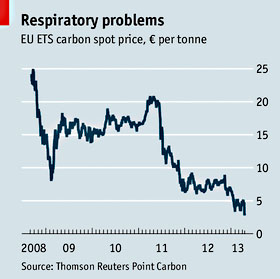
    Several years ago Europe instituted a continent-wide cap-and-trade system for carbon emissions called ETS. It was decidedly imperfect, and has gone through several revisions since it started. Recently, however, energy demand has declined, which has left Europe awash in carbon permits. As a result, the price of carbon permits has dropped off a cliff, and they’re now so cheap that they’re having virtually no effect. So does this mean the whole program is a failure? David Roberts asks everyone to calm down:

    First off, the ETS is not a mess/broken/dying, it’s working like it’s supposed to. The goal of a cap-and-trade system is not to create a high price on carbon, or a low price on carbon, or any particular price on carbon. It is to reduce carbon emissions along a pathway specified by a series of targets (17 percent by 2020, etc.). The EU is on that pathway. Emissions are expected to come in under the cap, which means the cap-and-trade program is working.

    Now, as it happens, the recession is what did most of the work to put the EU on that pathway. Complementary clean-energy policies (renewable energy mandates, feed-in tariffs) also played a big role. That just didn’t leave much work for a carbon price to do. The EU doesn’t need a high price on carbon to stay on the emissions-cutting pathway, at least in the short term, so the short-term price on carbon is low. Presumably, when the EU economy picks back up, there will be more work for a carbon price to do. If so, the price will go up. Cap-and-trade programs are designed to be responsive to circumstances.

    Lemme just emphasize: Insofar as you are happy with the carbon pathway your cap-and-trade system prescribes, the fact that carbon is cheap is good news. Who wants high prices for high prices’ sake?

    Everyone has always known about the basic tradeoff between a carbon tax and a cap-and-trade system. The virtue of a tax is that it’s predictable: everyone knows both the current and future tax rates and can make investments based on them. The downside is that you have to take a guess at what tax rate will produce the level of carbon emissions you want, and you might guess wrong.

    Cap-and-trade is exactly the opposite. Its virtue is that it will unquestionably keep you below your carbon cap. The downside is that carbon prices will jump up and down depending both on energy demand and on technology advances. This makes business planning tricky.

    I’ve always preferred cap-and-trade because I think the virtue of targeting the thing we actually care about—the amount of carbon emitted—is more important than guaranteeing businesses a known tax level decades into the future. Businesses already put up with large changes in the price of energy itself, and I suspect they can handle price changes in carbon permits too.

    But I’ll add one more virtue that David doesn’t mention: cap-and-trade is countercyclical. During a recession, demand for permits will go down and therefore so will permit prices. This is good, because it has a stimulative effect on the economy. Conversely, during economic expansions, demand for permits will go up and so will permit prices. This is also good, because it will tend to cool down the economy a bit. In neither case will the effect be huge, but it’s still a net positive.

    I’ve got no problem with a carbon tax. The arguments between a tax and a permit trading plan strike me as pretty finely balanced. Nonetheless, the fact that permit prices have fallen during a recession isn’t evidence that cap-and-trade doesn’t work. On the contrary, it’s evidence that it’s working exactly the way it should.

  • Pigford II and the Eternal Problem of How to Prove Discrimination


    The New York Times has an epic piece today about fraud in a government program originally designed to compensate black farmers who had been unfairly denied Agriculture Department loans in the 80s and 90s. The original compensation program, usually called Pigford after the class-action lawsuit that got it going, eventually led to a second settlement, Pigford II, that covered a broader class, including women, Hispanics, and Native Americans:

    Some 66,000 claims poured in after the 1999 deadline. Noting that the government had given “extensive” notice, Judge Friedman ruled the door closed to late filers. “That is simply how class actions work,” he wrote.

    But it was not how politics worked. The next nine years brought a concerted effort to allow the late filers to seek awards….Legislators from both parties, including Mr. Obama as a senator in 2007, sponsored bills to grant the late filers relief.

    ….Congress finally inserted a provision in the 2008 farm bill allowing late filers to bring new lawsuits, with their claims to be decided by the same standard of evidence as before. The bill also declared a sense of Congress that minority farmers’ bias claims and lawsuits should be quickly and justly resolved.

    Congress overrode a veto by Mr. Bush, who objected to other provisions in the bill. But as Mr. Bush left Washington, Congress had appropriated only $100 million for compensation, hardly enough to pay for processing claims.

    Within months of taking office, President Obama promised to seek an additional $1.15 billion. In November 2010, Congress approved the funds. To protect against fraud, legislators ordered the Government Accountability Office and the Agriculture Department’s inspector general to audit the payment process.

    The problem here is one that’s common in discrimination cases: even after you’ve agreed that illegal discrimination happened in general, how do you decide which individuals were discriminated against? Proving individual discrimination is incredibly hard, because in most individual cases there are plenty of plausible reasons for the discriminatory action. This was doubly hard in the Pigford cases because the Agriculture Department simply didn’t keep records of lots of the loan applications in questions, and there were never any applications in the first place for people who were flatly turned down before they could even apply.

    Given that, you have two choices. You can either set a high bar for evidence of discrimination, knowing that it will unfairly deny compensation to lots of people who were treated wrongly. Or you can set a low bar, knowing that this will unfairly give money to lots of people who don’t deserve it. Roughly speaking, it sounds like the government chose the second course, and lots of money has been paid out to people who never farmed, never applied to farm, and never had any intention of farming. But it was raining money, so they put out their hats.

    It’s hard to know what to think of this. Obviously it’s hard to understand why the Agriculture Department didn’t adopt a stricter standard, one that wouldn’t have paid out thousands of fraudulent claims to people who didn’t deserve it. At the same time, it’s hard not to think of the flip side: all the valid discrimination cases that have been brought over the years, but tossed out because the evidentiary bar was too high and it was impossible to prove that discrimination actually took place. Those kinds of cases don’t get a lot of headlines, but they’re every bit as bad.

    So I don’t know. You’d think there would be some kind of reasonable middle ground, but we sure do seem to have a hard time finding it. And while there’s obviously plenty to criticize about how Pigford II has been handled, I have to say that I’m sure not looking forward to the inevitable ugliness this is going to generate.

  • Today in Conservatism

    Apparently this is serious, not just some weird leftover from April 1:

    The Heritage Foundation and Franklin Center for Government & Public Integrity presented the second annual Breitbart Award to Michelle Malkin, syndicated columnist and Fox News Channel contributor….The Breitbart Award honors those who advocate for the truth — a quality that Malkin exemplifies. As the founder of three successful conservative blogs — michellemalkin.com, Hot Air (now owned by Salem Communications), and Twitchy — has changed the way Americans consume media. Malkin dedicates her life to tackling the issues others often shy away from.

    So there you have it. Michelle Malkin is now officially one of the best and the brightest of conservative journalism. Seriously.

  • Keep it Short


    They say brevity is the soul of wit. Austin Frakt says it’s also the soul of persuasion. To prove it, he points us to Tim Harford, who summarizes an experiment in which various versions of a letter were sent to people who might qualify for a refund on a product they bought:

    [Four] tweaks had substantial effects: first, cutting a paragraph of waffle that had helped to bury the message about the refund; second, pointing out that a five-minute phone call would suffice to make a claim; third, sending a follow-up letter. And twice as large as any of these effects was adding a couple of bullet points in bold at the top with the key message: you may deserve a refund; if so, call us.

    Of course, we already knew this, right? It’s why journal abstracts exist. It’s why blogs exist. It’s why haiku exists. Come on! We’re busy people around here.

    On the other hand, it doesn’t explain the appeal of those endless, rambling, conspiracy theory laden letters that people like Glenn Beck and Ron Paul send out. What’s the deal with those, anyway?

  • I Am Tired of People Calling Me On the Phone


    I’ve been getting a ton of telemarketing calls lately. They’re all over the map: some are from people I’ve done business with before, some are cold calls, some are illegal robocalls, some are from opinion pollsters, etc.  But one way or another, I get at least half a dozen every day, and sometimes as many as twice that number.

    I’m curious: is this just me? Or are lots of people noticing a big uptick in this stuff?

  • George Bush Was No Dummy, But How About if We Leave it at That?


    Thanks to the opening of his presidential library, this is officially “Be Nice to George Bush Week,” and we’ve had quite a few entries in an ongoing competition among conservatives to persuade us that Bush was really a whole lot better than we used to think he was. One of the most widely linked is an essay by Keith Hennessey titled “George W. Bush is smarter than you.”

    And that may well be. I always thought Bush was a reasonably smart guy, and anyway, above a certain level it doesn’t matter much. Other character traits become a lot more important. Still, Hennessey is trying to convince us that Bush is really, really smart, and I’m afraid I remain unconvinced. Here are three examples he provides to demonstrate Bush’s high IQ:

    [He] was incredibly quick to be able to discern the core question he needed to answer. It was occasionally a little embarrassing when he would jump ahead of one of his Cabinet secretaries in a policy discussion and the advisor would struggle to catch up.

    ….We treat Presidential speeches as if they are written by speechwriters, then handed to the President for delivery. If I could show you one experience from my time working for President Bush, it would be an editing session in the Oval with him and his speechwriters. You think that me cold-calling you is nerve-wracking? Try defending a sentence you inserted into a draft speech, with President Bush pouncing on the slightest weakness in your argument or your word choice.

    ….On one particularly thorny policy issue on which his advisors had strong and deep disagreements, over the course of two weeks we (his senior advisors) held a series of three 90-minute meetings with the President. Shortly after the third meeting we asked for his OK to do a fourth. He said, “How about rather than doing another meeting on this, I instead tell you now what each person will say.” He then ran through half a dozen of his advisors by name and precisely detailed each one’s arguments and pointed out their flaws. (Needless to say there was no fourth meeting.)

    This is really unpersuasive. The first example suggests not smarts, but impatience. Bush always thought of himself as a conviction politician, so it’s natural that he’d frequently want to skip the policy details and instead focus exclusively on what he considered the “core” question.

    The second example doesn’t even come close to demonstrating smarts. It demonstrates, once again, impatience. Bush is the kind of guy who wants to say what he wants to say, and he doesn’t want a speechwriter trying to twist his words or add some nuance he’s not interested in.

    The third example—surprise!—also demonstrates impatience (justifiably, it sounds like). In this case, Bush has been in three meetings over the course of two weeks, and his advisors are wrangling over the same issues again and again and again without making any progress. So he’s tired of it. He repeats their arguments back to them, says he doesn’t need to hear them yet again, and heads off to make a decision.

    None of this suggests that Bush is a dumb guy. But it doesn’t demonstrate a ton of analytical depth either. It suggests that (a) he has a good memory, (b) he’s perfectly able to understand policy arguments when he wants to, but (c) most of the time he had little patience for this stuff and instead simply wanted to do what his political instincts told him to do. He’s smart enough, but his intellectual curiosity was limited, and his willingness to allow his instincts to be overridden by policy concerns was minimal.

    Maybe you think that’s good, maybe you think it’s bad. But it is what it is. There’s really no need to pretend that Bush was some kind of unappreciated intellectual superman.

  • The Real Problem With Obamacare


    Last night I read a Politico article about Congress trying to exempt itself from Obamacare. I couldn’t make heads or tails of it. Obamacare doesn’t even apply to big employers, so what’s to exempt?

    Well, it turns out that Congress wrote a special provision into the law that ended its own participation in the Federal Employees Health Benefits Program and instead requires anyone working on Capitol Hill to buy health insurance through an Obamacare exchange. So that explains that. But it still wasn’t clear what the problem was. As the law stands, they have to choose a health plan through the exchange. So what?

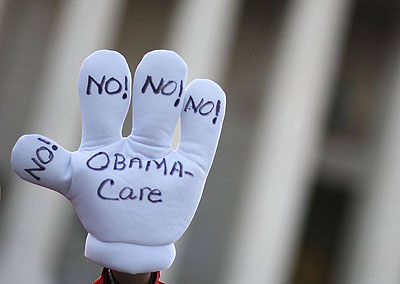
    This morning, Ezra Klein explains. The whole thing started back in 2009 when Republicans decided to embarrass Democrats by proposing an amendment that forced members of Congress to use Obamacare. Democrats then surprised them by agreeing to it. The problem, it turns out, is that because the amendment was originally intended to be only for show, it was poorly drafted. Big employers aren’t even allowed to use the Obamacare exchanges until 2017, so there are no rules for how to handle their premium contributions:
    That’s where the problem comes in….It’s not clear that the federal government has the authority to pay for congressional staffers on the exchanges, the way it pays for them now in the federal benefits program. That could lead to a lot of staffers quitting Congress because they can’t afford to shoulder 100 percent of their premiums.

    ….You’ll notice a lot of hedged language here: “Ifs” and “coulds”. The reason is that the Office of Personnel Management — which is the agency that actually manages the federal government’s benefits — hasn’t ruled on their interpretation of the law. So no one is even sure if this will be an issue. As the Politico article notes, some offices, like that of Rep. Henry Waxman (D-Calif.), interpret the language of the law such that there’s no problem at all. Others are worried it could be an issue, and are trying to prepare ways around it. The staffs I talked to stressed this worrying was preliminary, and felt the Politico article was jumping the gun. “This whole Politico story is based on a ruling that hasn’t even come down yet,” one griped.

    So there you have it. But why am I spending time this morning providing you with an explanation for a problem you probably didn’t even know existed? Because it allows me to make a point, of course.

    But which point? Jon Chait, for example, pairs this up with another story and suggests that Politico is a little too dedicated to covering politics as theater and should try a wee bit harder to understand the actual policy it writes about. Fair enough!

    But the point I want to make isn’t about Politico, it’s about Obamacare itself, and my biggest fear for its future. My biggest fear is not about the various implementation problems that Obamacare is going through right now. Conservatives are making plenty of hay over these obstacles right now, but the truth is that any big law will go through growing pains. When you dig into them, it turns out that most of the problems conservatives are crowing about are either (a) bogus or (b) not really very serious. A single small union complaining about the law, for example, is just not that big a deal, no matter how much Rush Limbaugh tries to pretend otherwise. Ditto for Max Baucus’s concerns about marketing; conflicts with university health plans; a supposed increase in workers being forced into part-time work, and so forth.

    No, my biggest concern is what happens after 2014. No big law is ever perfect. But what normally happens is that it gets tweaked over time. Sometimes this is done via agency rules, other times via minor amendments in Congress. It’s routine. But Obamacare has become such a political bomb that it’s not clear that Congress will be willing to fix the minor problems that crop up over time. There’s simply too big a contingent of Republicans who are eager to see Obamacare fail and are actively delighted whenever a problem crops up. This has the potential to be a problem that no other big law has ever had to face.

    We’ll see how this works out. Maybe after 2014 things will cool down a bit and normal horse trading will start up again. But I’m not so sure anymore. After all, I figured that might happen after the November election, and when John Boehner acknowledged that “Obamacare is the law of the land,” it seemed like a good sign even with all the hedging he put around it.

    But nothing has changed. Republicans are still fervently determined to destroy Obamacare any way they can, and this means that tweaks and fixes are unlikely. Instead, they’re going to dig in their heels and gleefully watch as people suffer because of minor implementation glitches that could be easily avoided. In the end, I suspect this strategy won’t work. But you never know. It might.


  • Banks Continue to Scaremonger Over Nonexistent Down Payment Requirements


    Are banks refusing to make loans unless buyers put up a big down payment? Apparently so. Will this hurt the recovering housing market? Maybe. Is this all due to restrictive Dodd-Frank rules that ought to be discarded? Nope. Read on for the real story.

    It turns out that Dodd-Frank allows banks to make any kind of loans they want. What it does say, though, is that if a loan fails to conform to its rules—one of which is a 20 percent down payment—then the issuing bank can’t just bundle up the entire loan and immediately sell it off. It has to keep a 5 percent stake. Felix Salmon comments:

    The question about high down payment mortgages is a relatively arcane backwater of financial underwriting, and we can leave it to the statisticians and bond investors to decide just how much, if at all, such down payments reduce defaults. Instead, we should be concentrating on the banks here, the institutions which seem to be entirely unwilling to underwrite any mortgage at all, unless and until they’re allowed to flip the entire thing, 100%, to bond investors, for a quick, risk-free profit.

    This violates common sense. If the bank is underwriting the loan, the bank should retain at least a tiny amount of the risk in that loan. Indeed, if I were a bond investor, I would as a matter of course require extra yield on any loans which were sold by a bank without any skin in the game at all. After all, there’s not much point in being assiduous about your underwriting if you’re just going to sell the entire loan anyway.

    Right. The whole point here is not to prevent banks from making whatever kind of loans they want. The point is to force them to have some skin in the game. If they want to lower their underwriting standards, that’s fine. But if they do, they have to keep some of the risk for themselves. This acts as an incentive to be careful about who they make loans to, instead of returning to the Wild West of the aughts, when underwriting standards went completely to hell and fraudulent loans were made by the millions. That happened because the loan issuers didn’t care: they were just going to bundle up the loans and sell them off anyway. Now they can’t. As Felix says, if banks don’t like this, we really ought to be asking, “Why not?”