• New York Times is a Killjoy Over Obama’s Dinner Party


    In the New York Times today, Jeremy Peters delivers some major buzzkill about President Obama’s friendly little dinner with all those Republican senators last night:

    Lawmakers in both parties say the president’s efforts may make him a few new friends, but he is not going to change ideologies. Others privately complained that convening such a high-profile meeting seemed like an effort to distract from his failure to help forge a solution to avert the automatic budget cuts that went into effect last week.

    Asked Thursday morning about the president’s new social schedule, Speaker John A. Boehner chuckled before saying he hoped the talks would produce real compromise….“I think it’s a sign, a hopeful sign. And I’m hopeful that something will come out of it. But if the president continues to insist on tax hikes, I don’t think we can get very far.

    Those who have studied the relationship between presidents and Congress doubt seriously whether Mr. Obama’s latest outreach will yield much. “It’s a rather shallow notion,” said George Edwards, a political scientist at Texas A & M University and an expert who has written extensively on presidential power. “You’re not going to get committed conservatives to change their long-held ideological commitments because you play a round of golf or invite them to the White House.”

    Roger that. And how did Phase 2 go on the other side of Capitol Hill today?

    On Thursday, Obama’s charm offensive set the table for one of the hardest nuts to crack — the top Republican budget expert, Rep. Paul D. Ryan of Wisconsin, who as the GOP vice presidential candidate tried to evict Obama from the executive mansion where he was invited to lunch.

    Ryan, chairman of the House Budget Committee, and his Democratic counterpart, Rep. Chris Van Hollen of Maryland, sat down with Obama for lentil soup and sea bass in a meeting that Ryan described as a “frank” and the White House called “constructive.”

    We all know what “frank and constructive” means, right? Usually it means that no fistfights broke out, but only barely.

    We’ve been through a dotcom bubble, and then a housing bubble. Right now, I feel like we’re in a presidential schmoozing bubble. I don’t think there’s much question that Obama could stand to improve his social skills, just as there’s no question that he might do himself some good by making sure his positions—and his concessions—are better understood in the halls of Congress. But the boomlet of excitement we’re seeing over a few dinners and lunch meetings with the opposition is hard to fathom. Maybe we’re all so desperate for something—anything—to convince us that our political system isn’t completely broken that we’re willing to latch on to even a routine bit of socializing as a lifeline of hope. Unfortunately, I suspect this says more about how miserable we all feel than it does about the possibility of Republicans ever agreeing to higher taxes.
  • Quote of the Day: Joe Scarborough vs. Joe Scarborough


    Compare and contrast. Here is Joe Scarborough during his debate with Paul Krugman on Monday:

    Q: Would you support an extra $200 billion a year in spending on infrastructure and education right now?

    A: Oh yeah. I talk about it all the time. I go around and I talk to Republicans all the time.

    And here is Scarborough writing with Jeffrey Sachs in the Washington Post today:

    Both of us opposed the [2009] stimulus package, the increased spending in Afghanistan and Washington’s fixation on short-term thinking. We said that the only result of this short-termism would be exploding deficits. And well before Obama himself acknowledged the point, we said that there was no such thing as “shovel-ready” projects worthy of public investment in the 21st century.

    I’m confused. During the worst of the financial crash, with GDP plummeting like a rock, Scarborough opposed stimulus spending and believed that there were no infrastructure investments worth pursuing. But today, with the economy fragile but recovering, he thinks it would be great to spend $200 billion more on infrastructure and education.

    Something ain’t right here. And I have to say, for a guy who talks about this extra spending “all the time,” he sure missed a chance to do it again in today’s op-ed. I wonder what Joe really thinks?

  • Eric Holder Watches Filibuster, Replies


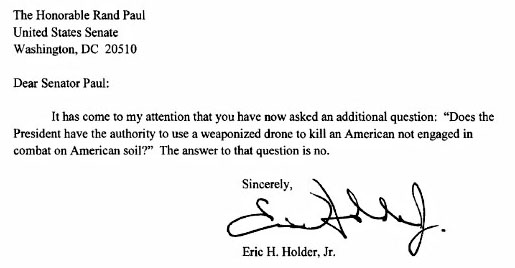
    I see via TPM that Attorney General Eric Holder has written a new letter to Sen. Rand Paul. Here it is:

    Points for drollery, I suppose. You have to appreciate the opening line: “It has come to my attention…..”

    But this is still a weird reply. Or maybe just deliberately opaque, like the previous replies. If the president can’t use a drone to kill an American not engaged in combat, then he can’t use any other weapons to do this either. Right? There’s nothing special in the law about drones, after all. So why not say so?

    In addition, of course, the definition of “engaged in combat” is obviously key here. Without much more detail on that, this probably doesn’t really tell us anything new.

    But maybe I’m overanalyzing this, or being too harsh. Rand Paul says he’s “quite happy” with this letter, so perhaps “combat” is precisely defined elsewhere. My cynicism level is fairly high based on the administration’s game playing over the meaning of “imminent” in their white paper about drone strikes overseas, but maybe it’s now a little too high. Comments?

  • John Roberts and Black Voter Turnout: A Followup


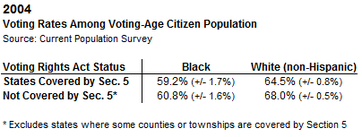
    Earlier this week I blogged about Chief Justice John Roberts’ contention, during oral arguments over the Voting Rights Act, that black voting rates are now higher in Mississippi than in Massachusetts. My take: statistically speaking, he was probably right. Today, Nate Silver dives a little deeper and adds some important detail. First, on a purely analytical basis, he notes that Roberts was apparently referring to 2004 Census data, so that’s what we should take a look at too. Second, because any single state might be cherry picked, we really ought to compare all states covered by the VRA to all states not covered. This also reduces our margin of error. Here are the results:

    States covered by the VRA clock in at a 59.2 percent black voting rate, while non-VRA states clock in at 60.8 percent. Silver comments:

    So did Chief Justice Roberts misconstrue the data? If he meant to suggest that states covered by Section 5 consistently have better black turnout rates than those that aren’t covered by the statute, then his claim is especially dubious. However, the evidence does support the more modest claim that black turnout is no worse in states covered by Section 5. There don’t seem to be consistent differences in turnout rates based on whether states are covered by Section 5 or not.

    But there’s more to it than this:

    The fact that black turnout rates are now roughly as high in states covered by Section 5 might be taken as evidence that the Voting Rights Act has been effective….If the Voting Rights Act has been important in facilitating the changes, how many of the gains might be lost if the Section 5 requirements were dropped now?

    These are difficult questions that the Supreme Court faces. They are questions of causality — and as any good lawyer knows, establishing a chain of causality is often the most difficult chore in a case. Statistical analysis can inform the answers if applied thoughtfully. But statistics can obscure the truth when they become divorced from the historical, legal and logical context of a case.

    This, of course, is the key question. Are black voting rights now secure in VRA states? Or are they only secure because of the VRA? This is the key question, and it’s difficult to see how the Supreme Court can—or should—be the arbiter of this.

  • Americans Might Think They’re Healthier Than They Really Are


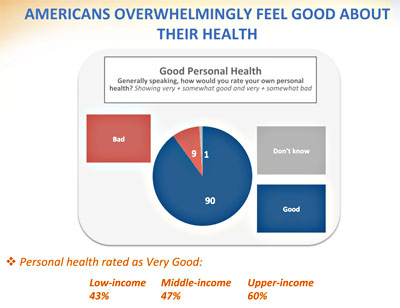
    A new national poll from the Atlantic shows that 90 percent of us think we’re in “very good” or “somewhat good” health. Sarah Kliff is skeptical:
    This flies a bit in the face of what public health research tells us about how healthy Americans are. More than one-third are obese, according to the most recent Centers for Disease Control numbers. About 10 percent of Americans live with a chronic condition, like diabetes or high blood pressure. This data suggests there’s some space between how healthy we think we are, and how healthy we actually are.

    Hmmm. The data is presented hazily in that slide, but it looks to me like things break down about like this:

    • Very Good: 50 percent
    • Somewhat Good: 40 percent
    • Bad: 9 percent

    That doesn’t sound so far off. I have high blood pressure controlled by meds, but I’d still describe my health as “somewhat good.” And while we can argue about definitions and effects of obesity, I don’t think I’d automatically put someone with a BMI of 31 in the “bad health” category.

    I dunno. Am I just grading on a curve here? Is “somewhat good” overoptimistic for a lot of us?

  • Presidents Have Lots of Options for Killing People


    I know this is pretty obvious, but I just want to ask a question—or maybe make a point—very clearly: when it comes to the authority of the president to assassinate American citizens on American soil, drones are just a sideshow, right?

    What I mean is that if the president wants to kill someone on American soil, he already has loads of options. This is because, unlike Yemen or Pakistan, we control our own territory. If Obama wants to kill someone at no risk to U.S. troops, he can scramble jets; use a sniper; order a helicopter strike; lob some mortars from a safe distance; or fire off a missile from a shoulder-mounted rocket launcher.

    Right? There’s really nothing new here. Presidents have always had the physical means to kill people safely, and the availability of drones doesn’t really change anything. It’s just one more weapon in their arsenal.

    Or am I missing something? Is there something truly special and different about drones that I’m not getting?

  • Rand Paul’s Semi-Serious Filibuster


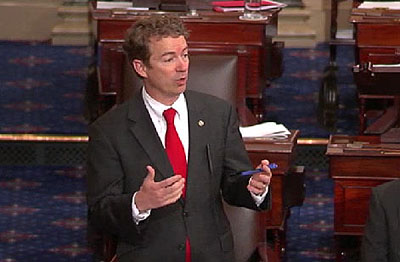
    Rand Paul’s old-school talking filibuster about drone strikes on American soil lasted until just after midnight yesterday, and it won lots of praise. At least it was a serious filibuster, after all, one that required some serious effort. It wasn’t one of those faux filibusters where you just announce that you’re requiring 60 votes and that’s the end of it. But Sarah Blinder isn’t quite so impressed:

    First….The motivation of recent reformers has been to reduce filibustering by raising the costs of obstruction for the minority….But as [Jonathan] Bernstein points out, Paul believes in his cause, and it plays well with his constituencies. On the physical front, the tag-team of GOP senators rallying to Paul’s cause also lessened the burden on Paul (as would have a pair of filibuster-proof shoes). That said, today’s filibuster was a little unusual. The majority seemed unfazed by giving up the day to Paul’s filibuster, perhaps because the rest of Washington was shutdown for a pseudo-snow storm.

    ….Second, keep in mind that this was a double-filibuster day. The nomination of Caitlin Halligan for the DC Court of Appeals was blocked, failing for the second time to secure cloture….On a day with two successful minority filibusters (at least in consuming floor time and deterring the majority from its agenda), we can see why the majority might be reticent to make senators talk.

    Third, let’s not lose sight of the target of Rand’s filibuster: The head of the CIA. Although the chief spook is not technically in the president’s cabinet, the position certainly falls within the ranks of nominations that have typically been protected from filibusters. Granted, that norm was trampled with the Hagel filibuster for Secretary of Defense. But rather than seeing the potential upside of today’s talking filibuster, I can’t help but see the downside: In an age of intense policy and political differences between the parties, no corner of Senate business is immune to filibusters.

    Rand Paul’s talking filibuster was good theater, and it got high marks from liberals partly because he happened to be talking about something they care about too. Keep in mind, though, that one of the reasons it was effective was precisely because this is so rare. If talking filibusters became the norm, you wouldn’t end up on the front page of the Washington Post for conducting one. What’s more, tag teaming makes it easy enough to keep talking that the majority would know they had no real way to fight back. On non-snow days, they’d just cave in immediately and we’d essentially be back to where we are now, where the mere threat of a filibuster is all it takes.

    Reid and the others let Paul talk because they didn’t really care all that much, and because they knew they had the votes to invoke cloture whenever they wanted to. For his part, Paul ended his filibuster because he never intended to keep it going forever in the first place. He wanted publicity, and never really thought that he could block John Brennan’s nomination. So Blinder is right: this isn’t much of a test case. If talking filibusters became the norm, it’s unlikely that very much would change in practice.

  • Countdown to Catblogging


    Anniversary-wise, the big news right now is the upcoming 10th anniversary of the invasion of Iraq. I’ll have a bit more to say about that later. But there’s another milestone that’s right around the corner too: the 10th anniversary of Friday Catblogging.

    The actual anniversary is still a few days away, but I figure you want the whole catblogging story, don’t you? So this is where it started: with the post on the right ten years ago today. The world seemed awash in troubles that day, but when I looked outside, Inkblot seemed to have the whole thing all figured out. Just snooze your troubles away! So I took a picture and put it on the blog. Four days later that led me to the next fateful step on the road to Friday Catblogging. I’ll have that for you on Monday.

    NOTE: Many thanks to my old friends at the Washington Monthly, for helping recreate these historic blog posts, which had sadly fallen into disrepair over time. The internet, as we all know, is not an archival-quality medium.

  • The President Breaks the Ice With Republicans


    The presidential charm offensive is in full swing:

    Obama invited 12 GOP senators to dinner Wednesday at the Jefferson Hotel in downtown Washington, where they dined for two hours. Obama picked up the tab personally, and two of his guests, Sens. John McCain (Ariz.) and Tom Coburn (Okla.), emerged flashing a thumbs-up.

    “I think what he is really trying to do is just start a discussion and break the ice, and that was appreciated,” Mike Johanns (Neb.) told reporters as he left the dinner. “His goal is ours — we want to stop careening from crisis to crisis and solving every problem by meeting a crisis deadline.”

    Obama picked up the tab personally! I don’t quite get that, but whatever.

    This will be an interesting experiment. It certainly can’t do any harm, and in any case, it’s obviously something Obama should have been doing all along. Just part of the job, you know. At the same time, I doubt very much that it will accomplish anything. LBJ’s legendary schmoozing, the touchstone for this kind of thing, has always been overhyped, but even at the height of his powers he would have had little luck with the kind of Congress Obama has to deal with. It’s true that there have long been a few Republican senators willing to break ranks on taxes, but there’s little reason to think the rest of them will be swayed by any kind of sweet talk or detailed white papers. And that goes double for the House. It’s just not in the cards. This stuff is driven by policy and ideology, not by personalities.

    But we’ll see. If this works, I’ll be gobsmacked, and all the pundits who kept demanding that Obama “lead” will be proven right. Anybody want to take bets?

  • Republicans Vote to [Oops….No They Didn’t]


    See update below. Basically, you can ignore this entire post.

    The original idea behind the sequester was simple: It was something so horrible that eventually a deal would be cut to replace it. Why was it so horrible? For Democrats, because of all the domestic spending cuts. For Republicans, because of all the defense spending cuts.

    The flaw with this has always been the fact that if Congress wants to, it can simply choose to rescind some of the cuts but not others. “You can always put money back in for defense,” Tom DeLay remarked a few weeks ago, and that possibility makes the sequester a lot less scary for Republicans than it otherwise would be. Sure enough, Dave Weigel reports that House Republicans have already started the process:

    It wasn’t even close. Shortly after 1 p.m., with plenty of time to catch flights home, Republican members of the House voted to approve the continuing resolution to fund the government through September. As written, it plussed up the defense funds that had been stricken by sequestration….Almost all Republicans, 214 of them, voted aye, and a Republican aide announcing the vote to reporters reminded them that they only needed 210 votes to pass it.

    The bill could have passed with no Democratic votes, but 53 Democrats voted for it anyway. If there are enough Democratic defense hawks in the Senate—or even just senators afraid of being attacked for voting against the Pentagon—it’s possible that the defense cuts could get restored and the sequester would then turn into a pure domestic spending cut. Would Obama sign it if that’s the bill he gets? Or would he risk a government shutdown by vetoing it? We’ll have to wait and see how that goes.

    UPDATE: According to the Washington Post, “The measure the House passed on Wednesday would provide new flexibility to the Pentagon to manage the sequester’s deep spending cuts, but would otherwise leave the reductions in place for the year.” Both the LA Times and the Wall Street Journal agree: the defense cuts are still in place, but the House bill gives the Pentagon a little more flexibility in where to apply them.