• Republicans Make An Offer Democrats Can Easily Refuse


    So here’s the latest brainstorm from the tea party wizards in the House:

    Sure, that’ll work. The idea here is to fund a small handful of the most public casualties of the government shutdown as a way of easing public anger over the consequences of Republican hostage taking. Of course Democrats will be eager to help out with this. And they’ll be especially eager to do this because Republicans have made it clear that they’ll refuse to fund anything that Democrats care about:

    “We’re going to start picking off those priorities that are important,” said Rep. Marlin Stutzman (R-Ind.), as lawmakers prepared to vote to reopen the national parks and services for veterans. “The IRS was last on the list. The EPA was right above it.”

    Gosh. Why wouldn’t Democrats take Republicans up on a deal like this? They make it sound so attractive.

    Just fund the government, guys. Democrats have already agreed to your spending levels. They’re not going to save you from yourselves by giving you anything more.

  • Why Are So Many People in a Blind Rage These Days?


    Paul Waldman, as he so often does, says what I’ve been thinking:

    I wish I could write something optimistic as we begin the government shutdown. I wish I could, but I can’t. In fact, this morning I can’t help but feel something close to despair….The reason for my despair isn’t about this week or this month. It’s the fact that this period in our political history—the period of lurching from absurd crisis to absurd crisis, with no possibility of passing a budget let alone legislation to address any serious problems we face, with a cowardly Republican leadership held hostage by a group of insane political terrorists who think it’s a tragedy if a poor person gets health insurance and it’s a great day when you kick a kid off food stamps, a period where this collection of extremists and fools, these people who think the likes of Michele Bachmann and Steve King are noble and wise leaders—this awful, horrific period in our history, when these are the people who control the country’s fate, looks like it will never end.

    Roger that. But then he adds this:

    In June of last year, Obama expressed the belief that if he was re-elected, “the fever may break, because there’s a tradition in the Republican Party of more common sense than that.”….But it was never going to happen. That’s not only because of their white-hot hatred of him, but also because, generally speaking, the crazier a Republican member of Congress is, the less they have to worry about political consequences from their craziness. The most radical members come from the most conservative districts, where the only question determining who gets elected is which candidate in a Republican primary is the most extreme, hates Barack Obama the most, and can talk with the most contempt about liberals and government and all the “thems” his constituents despise so much.

    This is conventional wisdom, of course. The reason the tea party caucus isn’t willing to compromise is because there’s no pressure on them to compromise. Their constituents are as crazy as they are. They want the safety net slashed, taxes cut, the EPA put out of business, and the Fed eliminated. They believe that Obamacare is the thin edge of the wedge that’s driving America into decline and ruin. They believe this so strongly that they’re willing to do anything to turn the country around. If that means government shutdowns and financial panic, so be it.

    But why? There’s always been a faction of right-wing craziness in America. It’s part of our DNA. But how did it become so widespread? The usual answer involves the rise of conservative think tanks, conservative talk radio, Fox News, the Christian right, and racial resentment toward a black president. And maybe that’s it. Somehow, though, it doesn’t feel quite sufficient. But if it’s not, then what’s going on? What’s happened over the past decade or two to spin up so many Americans into a blind rage?

    Complaining about tea party congressmen misses the big picture. The problem is the people who voted them into office. What happened to them?


  • Can Someone Please Shut Down the US Customs Agency?


    I woke up in the middle of last night enraged by this story. I do not thank Ta-Nehisi Coates for bringing it to my attention and ruining my night, but as long as he did, I’m going to ruin yours too.

    Thanks to a combination of executive branch policy and Supreme Court indifference in the post-9/11 era, US Customs and Border Protection has become a rogue agency, answerable to no one and run by sociopaths who take grim pleasure in harassing and torturing citizens they disapprove of just because they can. The evidence for this is now legion. If Congress actually wanted to do something useful, that’s what they’d spend this week working on.

  • You Might As Well Wait a Bit Before Signing Up For Obamacare


    Sarah Kliff reports that Obamacare websites are getting pretty high traffic in their first few hours of business. The New York Times confirms this: “Heavy volume contributed to technical problems and delays that plagued the rollout Tuesday of the online insurance markets at the heart of President Obama’s health care law, according to state and federal governments, with officials watching closely for clues to how well the system will work and how many people will take advantage of it.”

    Probably nobody is interested in my advice, but here it is anyway: Wait a week. Wait two weeks! Any insurance you buy on an exchange won’t start until January 1, so there’s really no point in being a guinea pig while everyone is still trying to work out the opening-day glitches in their systems.

    I checked the California site this morning just to see how it was working, and it seemed OK. A little slow, and there were a couple of UI choices I wouldn’t have made, but it was basically responsive and fine. Still, the hassle factor will be lower once the web traffic eases, the sites are tweaked, phone traffic dies down a bit, and everyone has a few days of experience under their belts. So you might as well wait a bit.

  • The Public Sure Doesn’t Seem to Be on the GOP’s Side


    I’m about the 500th person to mention this, but it’s really kind of gobsmacking that the latest “strategy” from the House GOP caucus regarding the budget is to demand a conference committee with the Senate. These are the same guys who have been resolutely refusing to go to conference for months—despite plenty of begging from Patty Murray—because they were afraid that a conference committee might not guarantee that they’d get 100 percent of their demands met.

    But now they suddenly think a conference is a great idea. Why? Who knows. I imagine they’ve decided (a) they don’t have a lot of other options left, and (b) now they want a compromise. They must be figuring that if they go to conference with defunding Obamacare as their demand and passing a budget as the Democrats’ demand, then the public will buy the idea that, say, delaying Obamacare for a year is a reasonable halfway compromise. Or something.

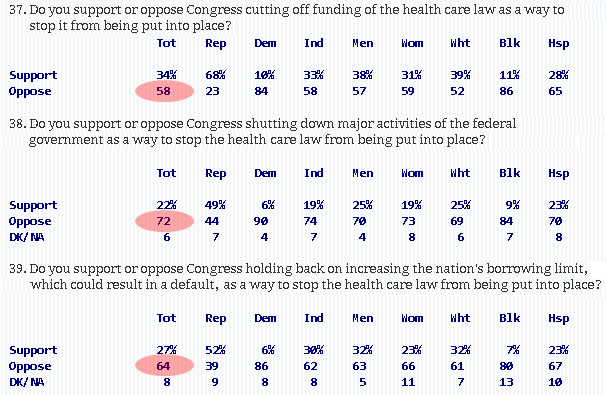
    But the latest Quinnipiac poll sure doesn’t seem to back that up. The only thing more unpopular than defunding Obamacare outright is to use a shutdown or a debt ceiling crisis as extortion to defund Obamacare. Whether they like the law or not, the vast majority of the public just flatly doesn’t approve of hostage taking to accomplish something that Republicans couldn’t accomplish by winning elections.

  • Russia Has Had a Good Month, But That’s About It


    Dan Drezner wants everyone to cool it with the nonsense that Vladimir Putin has managed to humiliate President Obama and turn Russia into the geopolitical equal of the United States:

    Even with a good month of Russian diplomacy and a United States that seems bound and determined to kamikaze governance, Moscow is not even remotely close to being the geopolitical equal of the United States. The only place that is true is the magical world of Punditland.

    ….Russia’s influence in Europe is on the wane, Russia’s projection of power in South Asia and the Pacific Rim is fading, and Russia has zero geopolitical influence in Africa and Latin America….The truth is that outside of Central Asia, Russia matters primarily when the United States lets it matter. If the United States finds a core national interest threatened and acts unilaterally, then Russia can do exactly nothing to stop it. If the U.S. wants to act through multilateral channels that burnish policy legitimacy, then Russia becomes important. Not surprisingly, there are some issues where the U.S. wants to act multilaterally — because acting unilaterally is a greater drain on scarce resources.

    Yep. There’s no reason to panic every time a U.S. president decides to take multilateralism seriously, or decides that it’s better to work with Russia than against it. Russia retains a fair amount of influence in the stans that border it, but beyond that it’s got (a) lots of gas and oil and (b) a UN Security Council veto. That makes it more influential than Saudi Arabia, but that’s about it. There’s no need to panic.

  • Sorry, Republicans, Obamacare Just Went Live


    Here’s the current graphic being displayed at healthcare.gov, guaranteed to produce aneurysms in every member of the congressional tea party caucus. Obamacare is now live. Huzzah!

    And here’s an interesting tidbit. I was watching TV earlier this evening, and one of our local news channels was promoting themselves as “your exclusive source” for information about Covered California (our version of Obamacare). They had a hotline number, and promised that certified insurance counselors would be available on Tuesday to answer questions. That was sort of interesting. I wonder if this is the kind of thing that news stations around the country will be doing?

  • Chart of the Day: We’re Still Living With the Toxic Political Legacy of 9/11


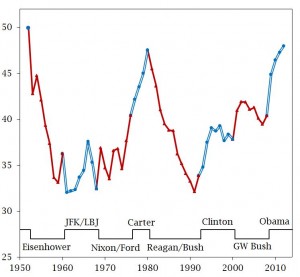
    Via Larry Bartels, here’s an interesting chart from James Stimson that tracks the public’s level of conservatism over the past 60 years. You can click the link to read about his methodology, but what this chart basically shows is that “the public tends to act as a ‘thermostat,’ shifting to the left when the political climate in Washington shifts to the right and to the right when policy shifts to the left.” In other words, when the president is a Republican, the public tends to tire of conservatism and become more liberal. When the president is a Democrat, the public tends to tire of liberalism and become more conservative.

    Until recently, the only real exception to this was the 60s. But now there’s a second one: the George W. Bush administration. And this is interesting, I think, because it shows the enduring effect of the war on terror. My interpretation of this chart is that Bush managed to avoid the normal public backlash during his first three years in office, and the obvious explanation for this is 9/11 and the Iraq War. Eventually, the political mood did start to trend more liberal, but because of the initial 9/11 effect, the public ended up in 2008 about where it had started in 2000. As a result, Obama began his presidency with an unusually conservative public. Thus, instead of merely bouncing back from the previous presidency in the usual yo-yo fashion, the conservative backlash against Obama took us into the right-wing stratosphere.

    There may be other explanations for this. Have at it in comments. But George Bush did everything he could to politicize 9/11, and it looks to me like it paid off. Whether we realize it or not, we’re still living with the toxic legacy of 9/11 and the war on terror.

  • We Hit the Debt Ceiling Months Ago. Nobody Cared.


    Here’s another quick reminder for everyone: It’s not true that we’ll hit the debt ceiling on October 18. We’ve already hit it. This happened first on December 31 of last year, and then, after a few months of legislative maneuvering, again on May 19. The Treasury Department has been taking extraordinary measures—withholding payments to pension funds, taking money from the Exchange Stabilization Fund, etc.—to keep the government running ever since.

    I only mention this to illustrate how far things have degenerated. Nobody even cares about actually breaching the debt ceiling anymore. We did that months ago, and it was just a date on the calendar. It’s only when the Treasury has exhausted its ability to rob Peter to pay Paul, with all the attendant chaos this produces, that we’ve “really” hit the debt ceiling. Welcome to the new normal, courtesy of the Republican Party.