• The US Is Drifting Farther and Farther Apart From the Rest of the World


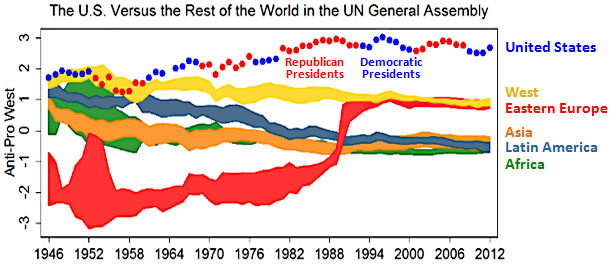
    Here’s a fascinating chart from Erik Voeten. It’s sort of the international equivalent of those charts that track congressional votes to show how Democrats and Republicans have become more polarized over the years. In this case, Voeten is looking at votes in the UN, and tracking how far apart the U.S. is from everyone else.

    When the Iron Curtain fell, Eastern Europe almost immediately adopted the views of the West. Aside from that, however, the lines show that the U.S. has been steadily moving in one direction while every other region has been moving in the opposite direction. In the 1950s, the US, Africa, Latin America, and Western Europe were all quite close. Today, Western Europe has drifted away, and Africa and Latin America are actively opposed to US positions.

    You can’t really blame this on the end of the Cold War, either. All of these trends have been steadily visible for over half a century. Voeten surveys a few possible explanations for this, but none of them are entirely persuasive. In the end, it’s a little bit of a mystery why this has happened.

  • We Can Reduce Poverty If We Want To. We Just Have To Want To.


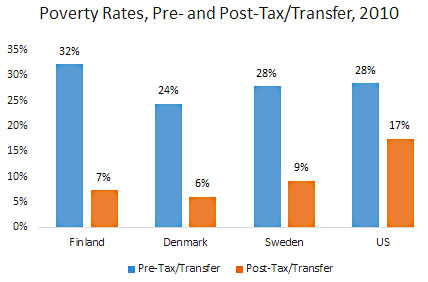
    Jared Bernstein makes an important point today: Several Nordic countries have made great strides in ending poverty, but it’s not because they have some kind of magic bullet. It’s because they give poor people more money and more services.

    The chart on the right shows raw poverty levels in blue. The Nordic countries are basically about the same as the United States. There’s no Scandinavian miracle that provides high-paying jobs for everyone. However, once you account for government benefits, the poverty rate in the Nordic countries is about half the rate in America. Universal health care accounts for some of this, and other benefits account for the rest. Some are means-tested, others are universal. There’s no single answer. The only thing these countries have in common is a simple commitment to taking poverty seriously and doing something about it. Bernstein approves:

    In the age of inequality, such anti-poverty policies are more important than ever, as higher inequality creates both more poverty along with steeper barriers to getting ahead, whether through the lack of early education, nutrition, adequate housing, and a host of other poverty-related conditions that dampen ones chances in life.

    This situation is only going to get worse as automation improves. Still, we’re plenty rich enough to address it if we want to. There’s nothing stopping us except our own will to do it.

  • A Question for House Republicans


    I’m curious about something. House Republicans have issued a list of demands that they want met before they’ll agree to raise the debt ceiling. Obviously President Obama is opposed to all their demands. So has anyone asked any of these House Republicans why they think Obama should accept their proposal?

    To be clear, my question to them is: Why should Obama care about raising the debt ceiling? Why not just let it stay where it is? Has anyone asked them this?

  • Yet Another Heartwarming Tale of Corporate Virtue


    Suppose you were a manufacturer of OxyContin, and you had strong evidence that certain doctors were illegally selling huge quantities of your pills to all comers. Keith Humphreys asks, What Would You Do?

    • (A) Report these doctors to the authorities?
    • (B) Insulate yourself by not sending your representatives to these doctors anymore, but continue to pocket the huge profits they generate from writing countless prescriptions for your products?
    • (C) Keep a secret list of these doctors but publicly promote the idea that painkiller abuse is not driven by wayward doctors but by other sources, such as pharmaceutical robberies?
    • (D) Reveal the list of doctors to authorities years later only because at that point it could stop a competitor from introducing a new generic medication that might cut into your own sales?
    • (E) A combination of B, C and D, but certainly not A.

    You’ve already guessed the answer, haven’t you? I can’t put anything over on you guys. Click the link if you want the gory details.

  • Republicans Are Blowing Up Yet Another Governing Norm


    I was chatting with a friend last night about the breakdown of governing norms in American politics. You know the drill: routine filibusters, mid-decade redistricting, flat refusals to allow votes on executive appointments, etc. But now there’s a new one on the scene. It’s a little more subtle than the others, though, so permit me an analogy.

    If I ask my neighbor for a cup of sugar and he tells me to get lost, everyone agrees that he’s being a dick. Under our usual social norms, that’s a pretty reasonable kind of favor to ask. On the other hand, if I ask him to give me his car because I totaled mine, everyone agrees that I’m the one being unreasonable. That goes well beyond the kind of favor you’d normally expect from a neighbor.

    The problem with this norm is that it’s not really provable. Is asking for a cup of sugar really a reasonable request? Says who? Conversely, why can’t I have your car? I say that’s perfectly reasonable. Sometimes stuff like this ends up in court, but for the most part we rely on a social norm of reasonableness to adjudicate things like this. It’s the only practical way to keep society humming along.

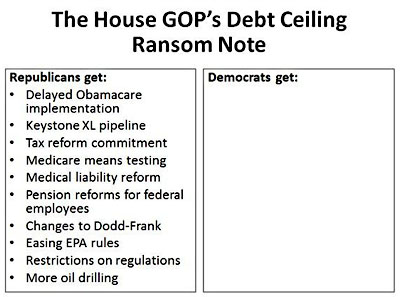
    But this is the latest norm to go down for the count in Washington DC. House Republicans have decided to issue a laundry list of demands in return for raising the debt ceiling that go way, way beyond the usual bargaining norms of Washington. If they had proposed, say, a cut in SNAP funding, that would be politics as usual, to be fought along the usual lines. But demanding the elimination of a historic piece of social welfare legislation? Or the absurd ransom note on the right, courtesy of Steve Benen? That’s just not the same thing and everyone knows it. Unfortunately, the norms of the press don’t really allow them to say that. So you get story after story about all the previous government shutdowns, or about the various hobbyhorses that have been attached to debt ceiling legislation in the past, with the strong implication that, really, what’s happening today isn’t all that unusual.
    It is, though, and everyone knows it perfectly well. But you can’t prove it. So reporters end up in he-said-she-said mode and the public ends up evenly divided about whether Republicans are bargaining in good faith.

    And with that, yet another governing norm is on life support. The problem is that in any complex culture, norms are every bit as important as formal rules—something that, in other contexts, conservatives harangue us about constantly. They should think a little harder about why they feel that way as they go about their business of blowing up Capitol Hill. There might actually be a good reason that all these norms have evolved organically over the past couple of centuries.

  • Repeat After Me: The Deficit Is Falling. The Deficit is Falling.


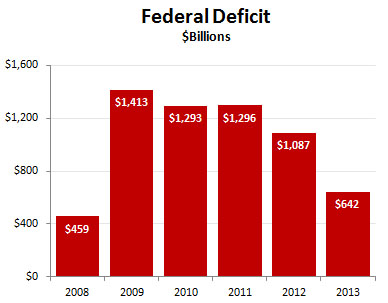
    Dave Weigel notes a conundrum today: according to a new poll, 54 percent of the public disapproves of Barack Obama’s handling of the deficit. And yet, as the chart on the right shows, the deficit is shrinking dramatically. Last year it dropped by $200 billion, and this year, thanks to a recovering economy, lower spending from the sequester, and the increased taxes in the fiscal cliff deal, it’s projected to fall another $450 billion.

    Weigel notes that this has deprived conservative yakkers of one of their favorite applause lines: “You don’t hear Republicans lulz-ing at Obama for failing to ‘cut the deficit in half in my first four years,’ because he basically did this, albeit in four and a half.” That’s true. It’s also true that contrary to Republican orthodoxy, it turns out that raising taxes on the rich does bring in higher revenues and therefore reduces the deficit.

    Bottom line: It’s unfortunate that the deficit is falling so fast. It’s a headwind against the recovery that we don’t need. Nonetheless, the deficit is falling fast, and no one seems to know it yet. The chart above is one that deserves much wider distribution. Be sure to show it to your conservative friends at every opportunity.

  • $25 Billion Mortgage Relief Program Hasn’t Worked Out So Great


    Remember that $25 billion mortgage settlement with five big banks last year? The idea was to use the money to help underwater homeowners, and the best way to do that is via debt forgiveness. So how did that work out? A new report from UC Irvine law professor Katherine Porter, who was appointed to study the issue by California’s attorney general, says that the program hasn’t worked out so great:

    The vast majority of the aid to borrowers, it turns out, came in the form of short sales and forgiveness of second mortgages. Just 20% of the aid doled out under the national settlement went to forgiveness of first-mortgage principal, the kind of help most likely to keep troubled borrowers in their homes. In terms of borrowers helped, just 15% of the total received first-mortgage forgiveness

    The five banks collectively delivered twice as much aid using short sales, in which owners sell their homes for less than the amount owed and move out, with the shortfall forgiven.

    ….Bruce Marks, founder of Neighborhood Assistance Corp. of America, a major housing counseling group, had a [harsh] assessment of the lack of aid to keep people in their homes. “It just shows you that the banks are running the government,” Marks said. “There’s virtually no benefit to borrowers, and yet you give the banks credit for short sales and getting second liens wiped out — something they were going to have to do anyway.”

    In the end, this was better than nothing, but not nearly as good as it could have been. I’d be rich if I had a nickel for every time I’d said something like that.

  • Here’s a Kinda Sorta Map of All the Nearby Earthlike Planets


    Here’s a cool graphic from New Scientist with their best estimate of how many habitable planets there might be in the galaxy. They started with the 3,588 planets discovered by the Kepler space telescope and then pared this back to only smallish planets in the “habitable zone”—not too near their star to boil over and not too far away to be iceballs. That got them down to 51 planets. But that only counts the planets we could see because our view from Earth was directly on their ecliptic. Extrapolating to all the rest produces 22,500 Earthlike planets. And since Kepler only covered 0.28 percent of the sky and only looked out 3,000 light years, extrapolating yet again produces a final estimate of 15-30 billion possibly Earthlike planets.

    That’s too many to show, so the picture below is a guesstimate of all the Earthlike planets “visible with a good pair of binoculars on a dark night.” The grid in the lower right is the area of the sky mapped by the Kepler telescope. The rest is extrapolation. It probably doesn’t mean much, but it’s kind of a pretty picture.

    But if there are really that many planets, where are all the people?

  • Obamacare Subsidies Act Like an Effective Marginal Tax of About 15 Percent as Your Income Goes Up


    Atrios:

    Something I’m looking for and not finding is an estimate of the effective marginal tax rates on people in the exchanges who are eligible for subsidies. A problem with means-testing programs is that as you earn more income, your benefits go away, meaning that effectively you’re paying a pretty high tax on each additional dollar earned. Your company giveth, and Uncle Sam taketh away.

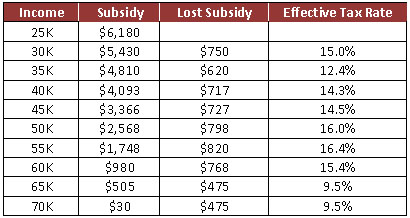
    That got me curious. The subsidies are calculated so that you never have to pay more than a certain percentage of your income in health premiums. That percentage rises with income according to a formula, so it’s pretty easy to figure out the subsidy at different income levels and then calculate the effective marginal tax rate caused by the fact that the subsidy level goes down.

    I used the Kaiser subsidy calculator to get the subsidy for a family of three at various income levels. (The exact subsidy level varies depending on family size, but this provides a pretty good estimate for an average family.) As you can see, as you gain more income, you get less subsidy, which produces an effective marginal tax rate of 12-16 percent at most income levels. When your income gets high enough, the subsidies are so low that there isn’t much left to lose, so the effective marginal rate goes down. At 400 percent of the poverty level, the subsidies decline to zero.

    The moral of this story, of course, is that you should avoid means testing if you can, since it provides a negative incentive to earn more money. Unfortunately, means testing is often the only practical way of providing benefits to the poor, so we put up with it even though everyone agrees it’s suboptimal. However, in the case of health care we could solve this problem easily by simply adopting a national health care plan that provided coverage for everyone at no charge. Since it’s a flat benefit, it wouldn’t distort work incentives. Taxes would have to go up to pay for this, of course, but those taxes would almost certainly produce less distortion at low income levels than Obamacare does.

    Someday we might have a sensible system like that. Someday.

  • The Way We Live Today: From Tweet to Meme in 14 Hours


    The political branch of the intertubes today has been consumed by the question of whether the media is hopelessly biased because it treated Wendy Davis’ abortion filibuster more sympathetically than Ted Cruz’s kinda-buster on Obamacare. The whole fuss is so mind-crushingly inane that it’s enough to make one fear for the future of the human race, but still I’m curious: where did this meme get its start?

    It apparently went mainstream in a Dylan Byers column posted today at 10:00 am. Dave Weigel says the meme was “codified” in a Tim Carney column posted a few minutes earlier at 9:44 am. Tom Kludt of TPM noted the invention of the meme an hour before that, at 8:57 am. He’s got tweets from Erick Erickson and Byron York from even earlier in the morning, and one from Richard Grenell late last night. But the earliest mention is from Laura Ingraham, who tweeted about this an hour before Grenell, at 8:20 pm last night.

    But wait! Ingraham was retweeting Chad Seiter, who was responding to a dismissive tweet from Jennifer Rubin. Seiter’s tweet went up at 8:10 pm:

    So as near as I can tell, that’s where it came from. A guy in Kentucky with 187 followers on Twitter got retweeted by Laura Ingraham, and by the next morning his tweet had morphed into a media bias meme that went viral. Congratulations, Chad! You won the internet today. Isn’t social media remarkable?