• The Robot Revolution Will Not Be a Rerun of the Industrial Revolution


    Eliezer Yudkowsky asks Tyler Cowen today why he thinks the coming robot revolution1 will be a problem for employment. After all, the Industrial Revolution automated a lot of work too, and it worked out fine for employment. The answer to this, I think, is simple: the robot revolution will automate cognitive work, not just manual work. A machine that can literally do anything a human can do will certainly boost economic growth, but it won’t create more human employment in the process. It will just create more robot employment. For a little more detail on this, you can read a short version of the argument here and a longer version here.

    But Cowen suggests that you don’t need to buy this to believe that robots are going to create big employment shocks anyway. You just need to look at the history of employment during the Industrial Revolution in a little more detail than we usually do:

    I would challenge the notion that it went fine. Think of the machines of the industrial revolution as getting underway sometime in the 1770s or 1780s. The big wage gains for British workers don’t really come until the 1840s. Depending on your exact starting point, that is over fifty years of labor market problems from automation.

    ….A second point is that now we have a much more extensive network of government benefits and also regulations which increase the fixed cost of hiring labor. Insofar as automation creates short-run adjustment problems, those problems are more likely to show up in the form of decreased labor force participation than they did in previous eras. We are living in a time where the long-run trend is for labor force participation to fall in any case, and that was not in general the case during those earlier episodes.

    Extrapolating a bit from Cowen’s point, the problem here is that the robot revolution is likely to be a lot shorter than the Industrial Revolution. Back then, we endured 50 years of employment problems and then things started to get better. But 50 years from today, the robot revolution is likely to be all but over. By the time we might start to expect wage gains, robots will be advanced enough that no more than a tiny percentage of human work is still relevant.

    What this means, of course, is that we’d better start thinking about how we’re going to divvy up all the goods and services we produce when virtually none of them are the result of human labor. Call it Economics 3.0. We aren’t there yet, but we might want to start getting ready for it.

    1Assuming that it really does come, of course, which we’re assuming for the purposes of this blog post.

  • More Good News on Health Care: Medicare Costs Are Down, Down, Down


    I’ve written before about my belief that health care costs in the United States have been trending downward for a long time. Not just during the aughts (which everyone seems to agree about), but since the early ’80s. Click here for a refresher.

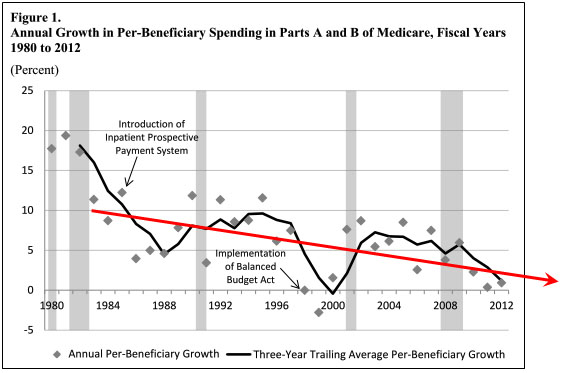
    Last week brought some confirmation of this from the Congressional Budget Office. Michael Levine and Melinda Buntin took a look at Medicare spending per beneficiary over the past three decades and came to a very similar conclusion: “Growth in spending per beneficiary in the fee-for-service portion of Medicare has slowed substantially in recent years. The slowdown has been widespread, extending across all of the major service categories, groups of beneficiaries that receive very different amounts of medical care, and all major regions.”

    Their basic chart is below. It starts in 1980, but I think it’s better to omit 1980-82. Inflation was very high in those years, which makes Medicare spending growth look artificially high and the subsequent decline artificially steep. However, consumer inflation has been pretty low and steady since then (at around 2 to 3 percent), so inflation doesn’t muddy the picture much after 1983. I’ve drawn an eyeball regression line starting then and it still tells much the same story:

    This is good news, but in fact, it’s even better news than it seems at first glance. There are two reasons for this. First, Medicare plays a big role in setting rates and spending priorities for the entire health care industry. So the fact that Medicare spending growth is slowing down suggests that spending growth in the broad health care industry should slow down too.

    The second reason is more intriguing. Levine and Buntin note that there have been two previous major declines in Medicare spending, and in both cases they were driven by legislative changes. But over the past decade, we’ve seen another steady decline with nothing to explain it:

    The current slowdown cannot be so easily ascribed to a set of changes in payment policy or program structure. As described above, legislation governing payment rates probably did slightly less to restrain growth in the second part of the decade than it did earlier on.

    The financial crisis and economic downturn […] do not appear to explain much of the slowdown. First…from 2000 to 2005, the growth in the average payment rate programwide was similar to growth in the CPI-U. Second, we did not find evidence to suggest that beneficiaries’ considerable loss of wealth and reduced income growth significantly affected their collective demand for care. Third, it is not clear whether the recession played a role in reducing the rate at which providers purchased new, cost-increasing technologies. Finally, and in contrast, some evidence suggests that high unemployment during the recession boosted providers’ incentives to deliver services to Medicare beneficiaries by reducing the demand for care in the private sector, though we could not empirically confirm the mechanisms by which unemployment might have had such an effect.

    The lack of a single big legislative explanation suggests that there’s something more organic going on. And with Obamacare’s cost controls set to kick in over the next decade, we could be entering a virtuous circle of reined-in health care spending for years to come.

    Levine and Buntin acknowledge that there’s considerable uncertainty in their analysis. There are a lot of moving parts here, and the truth is that a decade isn’t really a very long time frame to hang your hat on. (Remember all those economic models that assumed housing prices could never fall because they were based on the previous decade’s worth of data?) And it’s worth keeping in mind that even if spending per beneficiary stabilizes, Medicare is still going to have a lot more beneficiaries over the next half century as baby boomers retire and our population ages.

    Nonetheless, evidence is mounting all over the place that the spiraling growth of health care costs, which has been a serious bogeyman for the past few decades, might finally be receding. Since health care costs are by far the biggest component of future concerns over federal spending and federal deficits, this suggests that our future may be brighter than we think.

  • Britain Votes Against Military Action in Syria


    There will be no British support for a punitive strike against Syria:

    British MPs have voted to reject possible military action against the Assad regime in Syria to deter the use of chemical weapons. A government motion was defeated 285 to 272, a majority of 13 votes.

    Prime Minster David Cameron said it was clear Parliament does not want action and “the government will act accordingly”. It effectively rules out British involvement in any US-led strikes against the Assad regime.

    I haven’t seen any breakdown of the vote yet, but Cameron obviously lost at least a few of his fellow Tories in addition to a large number of Labour and Lib Dem votes. Here is the U.S. response:

    President Obama is prepared to move ahead with a limited military strike on Syria, administration officials said on Thursday, even with a rejection of such action by Britain’s Parliament, an increasingly restive Congress, and lacking an endorsement from the United Nations Security Council.

    How very Bush-like. Or Bush-lite, I suppose.

  • Feds Agree Not to Hassle Smallish Marijuana Vendors in Colorado and Washington


    We’ve all been wondering for a while about the fate of new laws in Colorado and Washington that legalize the sale of recreational marijuana. After all, pot is still illegal under federal law, so the state laws don’t mean much if DEA agents are going to prosecute vendors under federal law. Today, they said they wouldn’t:
    The Justice Department said it will not seek to veto new state laws in Colorado and Washington that legalize the recreational use of marijuana, and it will not bring federal prosecutions against dispensaries or businesses that sell small amounts of marijuana to adults. A department official stressed, however, that marijuana remains illegal under federal law, and that U.S. prosecutors will continue to aggressively enforce the law against those who sell marijuana to minors and to criminal gangs that are involved in drug trafficking.

    I’m not sure what “small amounts” means in practice, and the guidance DOJ issued to U.S. Attorneys leaves some questions unanswered:

    U.S. Attorneys will individually be responsible for interpreting the guidelines and how they apply to a case they intend to prosecute. A Justice Department official said, for example, that a U.S Attorney could go after marijuana distributors who used cartoon characters in their marketing because that could be interpreted as attempting to distribute marijuana to minors.

    But the official stressed that the guidance was not optional, and that prosecutors would no longer be allowed to use the sheer volume of sales or the for-profit status of an operation as triggers for prosecution, though these factors could still affect their prosecutorial decisions.

    I guess this means that if vendors in Colorado and Washington keep a fairly low profile, they won’t be hassled. If they don’t, they might be. Overall, this is probably about as good as we could have expected.

  • U.S. Intelligence Spending Now Higher Than During the Cold War


    Barton Gellman and Greg Miller have just released yet another document from the Snowden cache: a classified breakdown of U.S. intelligence spending.

    The $52.6 billion “black budget” for fiscal 2013, obtained by The Washington Post from former intelligence contractor Edward Snowden, maps a bureaucratic and operational landscape that has never been subject to public scrutiny. Although the government has annually released its overall level of intelligence spending since 2007, it has not divulged how it uses those funds or how it performs against the goals set by the president and Congress.

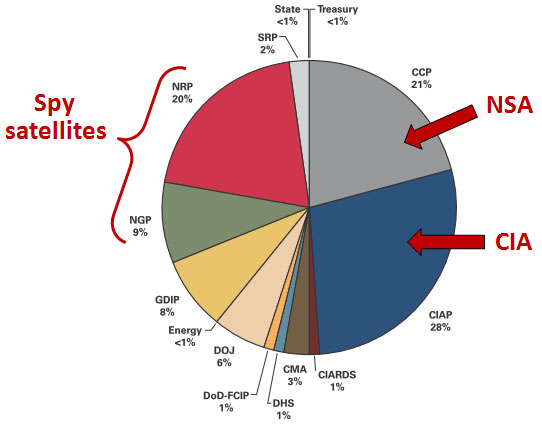
    Huh. I wonder how long the Post has been holding onto this? In any case, here’s the basic breakdown of the $52 billion we’re spending this year:

    Unsurprisingly, the CIA, NSA, and reconnaissance satellites collectively account for nearly 80 percent of our total civilian-ish intelligence spending. Another $23 billion goes to “intelligence programs that more directly support the U.S. military.” That’s a total of $75 billion. Adjusted for inflation, Gellman and Miller say this exceeds our peak spending during the Cold War. Here are a few of their main takeaways:

    • Spending by the CIA has surged past that of every other spy agency, with $14.7 billion in requested funding for 2013. The figure vastly exceeds outside estimates and is nearly 50 percent above that of the National Security Agency, which conducts eavesdropping operations and has long been considered the behemoth of the community. Here are four of the main takeaways:
    • The CIA and NSA have launched aggressive new efforts to hack into foreign computer networks to steal information or sabotage enemy systems, embracing what the budget refers to as “offensive cyber operations.”
    • In words, deeds and dollars, intelligence agencies remain fixed on terrorism as the gravest threat to national security, which is listed first among five “mission objectives.” Counterterrorism programs employ one in four members of the intelligence workforce and account for one-third of all spending.
    • The governments of Iran, China and Russia are difficult to penetrate, but North Korea’s may be the most opaque. There are five “critical” gaps in U.S. intelligence about Pyongyang’s nuclear and missile programs, and analysts know virtually nothing about the intentions of North Korean leader Kim Jong Un.

    More at the link, including a few pages from the document itself. As for the rest, “Sensitive details are so pervasive in the documents that The Post is publishing only summary tables and charts online.”

  • How the Rest of the World Views the American Military


    Paul Waldman lays out a list of significant US military actions over the past 50 years, and it adds up to 15 separate episodes, ranging from full-scale wars (Vietnam, Iraq, Afghanistan) to smaller incursions (Grenada, Haiti, Panama). For those of you who are math challenged, this means we’ve launched a significant overseas assault every 40 months since 1963. Waldman explains what this means:
    Some of these operations worked out very well, others didn’t. And just to be clear, this history doesn’t tell us whether bombing Syria is a good idea or a bad idea. But if you’re wondering why people all over the world view the United States as an arrogant bully, reserving for itself the right to rain down death from above on anyone it pleases whenever it pleases, well there you go. It doesn’t matter whether you think some or even all of those actions were completely justified and morally defensible. From here, we tend to look at each of these engagements in isolation, asking whether there are good reasons to go in and whether we can accomplish important goals for ourselves and others. But when when a new American military campaign begins, people in the rest of the world see it in this broader historical context.

    This is a perspective that’s sorely missing from most mainstream discourse. Too many Americans have a seriously blinkered view of our interventions overseas, viewing them as one-offs to be evaluated on their individual merits. But when these things happen once every three years, against a backdrop of almost continuous smaller-scale military action (drone attacks, the odd cruise missile here and there, sending “advisers” over to help an ally, etc.), the rest of the world just doesn’t see it that way. They don’t see a peaceful country that struggles mightily with its conscience and only occasionally makes a decision to drop a bunch of bombs. They see a country that views dropping bombs as its primary means of dealing with any country weaker than we are.

  • Quote of the Day: Republicans Are No-Shows at Civil Rights Anniversary


    From civil rights leader Julian Bond, on why there were no Republicans at yesterday’s 50th anniversary of the March on Washington:

    “They asked a long list of Republicans to come, and to a man and woman they said no.”….Bond did credit Cantor for trying hard to find a replacement speaker, but, ultimately, the leader was unable to find a single Republican to attend the event.

    That last sentence is maybe the saddest of all. It’s not just that Republicans didn’t come. It’s worse than that. Even with Eric Cantor twisting arms he couldn’t find a single Republican willing to attend. I guess they were all afraid that Fox News would televise it and some of their constituents might find out they were there.

  • Second Quarter GDP Revised Way Up


    Here is today’s good economic news:

    Real gross domestic product — the output of goods and services produced by labor and property located in the United States — increased at an annual rate of 2.5 percent in the second quarter of 2013….The GDP estimate released today is based on more complete source data than were available for the “advance” estimate issued last month. In the advance estimate, the increase in real GDP was 1.7 percent.

    That’s quite a revision. GDP growth was actually half again as large as the BEA originally estimated, which is about as big a relative revision as I can remember. It still doesn’t show the economy roaring ahead or anything, but it certainly shows a good deal more strength than we thought.

    And just think: If it weren’t for this year’s round of austerity, growth might have been just a few ticks below 4 percent. That would have been a genuinely positive number. It’s too bad we’ve chosen instead to deliberately sabotage the economy.

  • Are Charter Schools Successful Because They Make Teachers Work Long Hours?


    Motoko Rich writes in the New York Times that charter school teachers tend to turn over pretty quickly. The average charter teacher has only a few years of experience, compared to 14 in traditional public schools. However, even though everyone agrees that teachers with five-plus years of experience are better than those with only three or four years, charter school outcomes are pretty similar to those of public schools. Matt Yglesias wonders what’s going on:

    Given that these charters are really held back by having such a large share of first- and second-year teachers, how is it that they’re able to produce decent educational results? The evidence isn’t airtight, but the natural inference to make from the turnover data is that the experience-adjusted quality of the charter school teachers is substantially higher than of the traditional public school teachers.

    ….If kids in charter schools were on average clearly learning less than kids in traditional public schools, then it’d be easy to finger the teacher turnover issue as the culprit. But they’re not doing worse, despite charter schools’ problems with hanging on to teachers for more than a few years. The interesting question is what accounts for that.

    I have a different guess. Charter school teachers might very well be the cream of the crop, but I suspect the real key to their success is long working hours. This is also what accounts for the turnover. Charter schools tend to demand that their teachers work very long hours and remain on call for students during the evening. That’s grueling stuff, and very few people are willing to do it for long. If you’re young, idealistic, unmarried, and have no kids, it might be rewarding for a while. After a while, though, it just gets to be a grind.

    Even though I basically support experimenting with charters, this is the single biggest reason I’m skeptical of the charter model. Obviously some of them do very well, but if expanding the model nationwide requires an army of high-quality teachers willing to work long hours for modest pay, where are they going to come from? This is why I’d really like to see more examples of the charter model working with teachers—either young or old—who put in normal hours. That’s a scalable model and might give us some insight into what it takes to improve our schools. Conversely, if the answer turns out to be “bright young kids willing to work long hours for lousy pay,” we haven’t really learned much. I don’t doubt that it can work, but I do doubt that it can work for more than a small fraction of our children.

  • Nearly 100 Representatives Now Asking Obama to Consult With Congress Over Syria


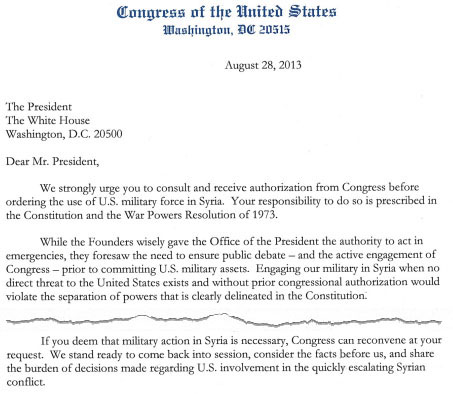
    Rep. Scott Rigell (R–Virginia) reports that as of a few minutes ago his letter urging President Obama to consult Congress before launching an attack on Syria is “Inching…toward…100… 81 Republicans and 16 Democrats have signed on to our letter so far…” That’s good. But I sure wish more Democrats were willing to get on board.

    There are legitimate issues surrounding the powers of the president and the extent to which Congress can micromanage military attacks. But this is something that Congress should actually spend some time debating, instead of just folding up and letting the president do whatever he wants with nothing more than a bit of muttering about separation of powers. The president may be commander-in-chief, but that doesn’t mean the U.S. military is his personal plaything. It’s past time to make that clear.