• Which Economic Models Are Más Macho?


    A few days ago Alex Rosenberg and Tyler Curtain wrote an op-ed titled “What Is Economics Good For?” In a nutshell, their answer was “not much.” Paul Krugman begs to disagree:

    Rosenberg and Curtain completely misunderstand what’s been going on at the Fed. They also misunderstand the nature of economists’ predictive failures. It’s true that few economists predicted the onset of crisis. Once crisis struck, however, basic macroeconomic models did a very good job in key respects — in particular, they did much better than people who relied on their intuitive feelings….Wonks who relied on suitably interpreted IS-LM confidently declared that all this intuition, based on experiences in a different environment, would prove wrong — and they were right. From my point of view, these past 5 years have been a triumph for and vindication of economic modeling.

    Something about this passage has been niggling at me since I read it yesterday, and I just now figured out what it is. Krugman has been banging this drum for quite a while, and regular readers know that I’m basically on his side. Basic Keynesian macro has done a pretty good predictive job in the aftermath of the financial crisis, and it’s fair to wonder why skeptics continue to be skeptics even after years of solid results from textbook macro.

    But here’s the thing: I’m on Krugman’s side in hindsight. A better question is whether it was obvious in 2008 that “suitably interpreted IS-LM” was likely to be the best model for dealing with the post-crisis recovery. Maybe it was. Krugman makes the case, for example, that RBC models should have been abandoned decades ago for not fitting the data. But conservative economists would argue that Keynesian macro was quite justifiably thrown out even earlier for failing during the 70s. That’s obviously a matter of contention, but it’s certainly the case that the Keynesianism of the 70s has since been retooled into the New Keynesianism of the 90s and beyond. But that makes it a fairly new theory. So again: how obvious was it before the fact that Krugman’s preferred models were likely to be the best ones for 2008-13?

    This is light years above my pay grade, so I’m throwing it out mostly in the hopes that some real economists will essay an answer. I’m not even sure I’m framing the question entirely properly. But the basic problem is that economists change their models the way most of us change our television viewing habits, and the best models often seem to be very dependent on a particular place and time. Wait a couple of decades, or examine a different kind of economy, and suddenly the old models don’t work so well anymore. So how do we know in advance? Can Krugman legitimately say that his models have had a long track record of success in different environments, and therefore should have been the obvious incumbents when the economy went kablooey in 2008?

  • How a Giant Arrow Gets You to Eat More Fruits and Vegetables*


    From the things-I-did-not-know file:

    “In retail, the customer tends to go to the right,” said Tim Taylor, the produce director for Lowe’s, Pay and Save, a regional grocery chain that let the scientists in to experiment with their arrows and mirrors. “But I watched when the arrows were down, pointing left, and that’s where people went: left, 9 out of 10.”

    First things first: what’s the name of this supermarket? Pay and Save? Or Lowe’s? Good question! According to Wikipedia, Lowe’s Market, founded in 1940 in Littlefield, Texas, operates grocery stores under the names Lowe’s, Shop N Save, Food Jet, Super S, Big 8, Super Save, and Avanza. But not Pay and Save. Or do they? Comments from residents of El Paso, where this test store is located, are welcome on this score.
    Now then. Do people really tend to go to the right in retail stores? How about in other settings? Do left-handed people tend to go to the left? What’s going on here?

    I’m a little less interested in the fact that if you lay giant arrows down on the floor, people follow them. We’re all pretty used to following arrows, after all. Still, the upshot of all this is that a pair of enterprising researchers were able to get people to buy more fresh produce by putting arrows on floors, duct tape in baskets, and placards in shopping carts telling people that bananas are big sellers. But if they put arrows on the floor and placards in the shopping carts, it didn’t work. Too pushy, apparently. People won’t buy healthy food if they glom onto the fact that they’re being badgered into doing it.

    Personally, I’d like to see how this fares over a longer time scale. I have a feeling the effect might start to wear off. Plus there’s the problem of persuading grocery stores to do any of this stuff in the first place. Having spent billions on figuring out how to market crap to us, why would they suddenly turn around and start trying to market fresh produce to us? The Times suggests that produce actually has higher margins than crap, which is another surprise. I didn’t know that either. But if that’s really true, I’m a little surprised that big chains haven’t already spent billions trying to increase sales of apples and broccoli. Why are they relying on a couple of professors from New Mexico State University?

    *Technically, the giant arrows only get you to buy more fruits and vegetables. Whether the guinea pigs in this experiment actually eat them is a whole different question.

  • Fidel Castro Says Edward Snowden is a Hero


    Some people like to gossip about Miley Cyrus. I prefer gossip about Fidel Castro. Today he responds to the suggestion that Cuba caved in to pressure from the U.S. and told Russia that it would refuse to let an Aeroflot flight land in Havana if Edward Snowden were onboard:

    “It is obvious that the United States will always try to pressure Cuba … but not for nothing has (Cuba) resisted and defended itself without a truce for 54 years and will continue to do so for as long as necessary,” Castro wrote.

    ….”I admire the courageous and just declarations of Snowden,” Castro wrote. “In my opinion, he has rendered a service to the world, having revealed the repugnantly dishonest policy of the powerful empire that is lying and deceiving the world,” Castro continued.

    ….Castro did not speculate as to why Snowden skipped the Aeroflot flight.

    OK then.

  • Chart of the Day: Which Countries Snoop on Facebook Users the Most?


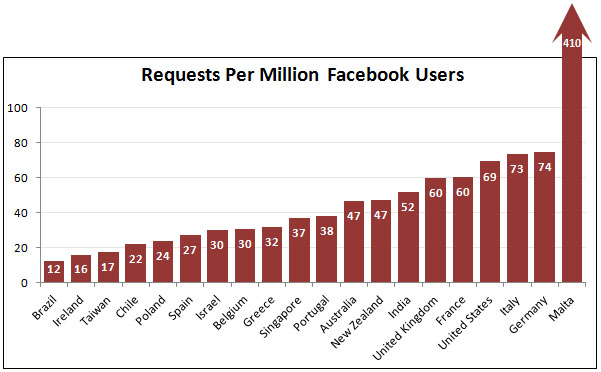
    Today Facebook released its first Global Government Requests Report, which tells us how many requests for user data they received during the first six months of 2013. It’s broken down by country, and you’ll be unsurprised to learn that the United States earned the top spot: a total of about 11,000 requests covering 20,000 individual accounts.

    But wait. The United States is a big country, so the fact that it made more requests than, say, Ireland, doesn’t tell us much. A more useful metric would adjust for population, telling us how many requests were made per million Facebook users (data here). That’s far from perfect, since data requests can cover users from any country, but I think it tells us a little more than just looking at the raw number of requests.

    The chart below shows the top 20 among countries that made more than ten requests—which obviously doesn’t include countries like China and Iran, where Facebook is banned. So who came in #1? The answer may surprise you:

    Malta! I imagine that this is explained by Malta’s status as a tax haven for Russian oligarchs, who are perhaps a little too eager to show off their riches on their Facebook pages. Or something.

    The weirdness of Malta aside, the real takeaway from this chart is that the United States isn’t really very unique in its desire to spy on people. When you adjust for their smaller size, Germany, France, Italy, and the UK are all in the same league. These countries may not intercept phone calls on the scale we do, but if Facebook nosiness is any clue, that’s only because they don’t have the technical capability, not because the idea outrages them.

    In any case, you can draw your own conclusions from this. But I think it gives us a decent idea of which countries are the most active and dedicated when it comes to internet surveillance.

  • In Syria, the Middle Course Is Our Worst Possible Option

    In the LA Times today, Ken Dilanian writes that plenty of foreign policy experts are skeptical about the effectiveness of lobbing a few cruise missiles against Syria:

    Punitive strikes ineffective, even counterproductive, analysts say

    In two major episodes in 1998, the U.S. government unleashed a combination of bombs and cruise missiles against its foes — Osama bin Laden’s Al Qaeda and Saddam Hussein’s government in Iraq. In a more distant third case, in 1986, the U.S. bombed Moammar Kadafi’s Libya.

    The bombs and missiles mostly hit their targets, and the U.S. military at the time declared the attacks successful. But in the end, they achieved little. Two years after the U.S. bombed Tripoli, Pan Am Flight 103 exploded over Lockerbie, Scotland, killing 270 passengers and crew. Investigators later concluded that the U.S. attack was a primary motive for Kadafi to support the Lockerbie bombing. Al Qaeda killed nearly 3,000 people in attacks in the United States on Sept. 11, 2001. Hussein kicked out international weapons inspectors and survived despite sanctions until a U.S.-led invasion deposed him in 2003.

    ….“If the U.S. does something and Assad is left standing at the end of it without having suffered real serious, painful enough damage, the U.S. looks weak and foolish,” said Eliot Cohen, a professor at the Johns Hopkins School of Advanced International Studies, and a former State Department official in the Bush administration, who has long been skeptical about reliance on air power.

    This is the fundamental problem. All the evidence suggests that Obama is considering the worst possible option in Syria: a very limited air campaign with no real goal and no real chance of influencing the course of the war. You can make a defensible argument for staying out of the fight entirely, and you can make a defensible argument for a large-scale action that actually accomplishes something (wiping out Assad’s air force, for example), but what’s the argument for the middle course? I simply don’t see one. It’s the act of a president who’s under pressure to “do something” from the know-nothings and settles on a bit of fireworks to buy them off and show that he has indeed done something. But it’s useless. The strike itself won’t damage Assad much and it won’t satisfy the yahoos, who will continue to bray for ever more escalation.

    If Obama wants to intervene in Syria, then he needs to make the case that we should intervene in Syria. But if he does, I hope he listens to this short video first:

  • Has the Internet Raised or Lowered Healthcare Costs?


    Matt Yglesias writes about the awesome power of information technology to diagnose illnesses and save a trip to the doctor:

    I was having a kind of weird problem with my left thumb over the course of the past few days….Finally I figured out that it looked to me like an infection of the cuticle….That brought me to a Wikipedia page….”paronychia”….led to a bit more Googling….typically happens to habitual fingernail biters (guilty) or people who’ve recently been in the water a lot (swimming pool on vacation).

    Everyone basically agrees that this isn’t a huge deal and that you can obtain some physical relief by occasionally soaking the thumb in hot water while waiting for it to clear up. I took that advice starting yesterday morning, and today I feel a lot better….So there we have it. In a small but real way, information technology reduced the cost of this particular health care service. Productivity for the win.

    Obviously there are lots of things we aren’t going to treat in this way, but I’m quite optimistic that information technology in the health care sector is going to do us a lot of good.

    Obviously Matt is being a bit tongue-in-cheek here even as he makes a serious point. But I’d still like to know if his serious point is actually correct. Not about information technology in general—everyone knows how I feel about the future of robots—but about the effect of the internet on healthcare costs.

    On the one hand, we have success stories like Matt’s: The internet allowed him to self-diagnose his case of paronychia and avoid wasting a doctor’s time. On the other hand, we have all the people who head to the internet and convince themselves that their finger is sore not because they hit it with a hammer last week but because they have some rare immune disorder whose symptoms on Wikipedia are eerily similar to theirs. So they head out to the doctor and demand a bunch of expensive tests.

    How would you measure this? Good question. Perhaps there are places where internet service became available in half a neighborhood for some random reason but not the other half. Then you could compare the change in healthcare costs over the next few years between the two halves. Or something like that.

    Alternatively, you could survey doctors. Are your patients better informed these days thanks to WebMD? Or have they become bigger hypochondriacs thanks to WebMD?

    Anyway, I’m curious. A quick Google search turned up a couple of old studies that were moderately negative (basic findings: people are idiots and doctors don’t like being challenged), but nothing even remotely definitive. As for myself, I’m not sure which way I’d bet. However, based on (a) my theory that the internet makes smart people smarter and dumb people dumber, and (b) the empirical fact that there are more dumb people than smart people, I guess I have a modest belief that the internet has been a net negative. Surely this is worth a closer look?

  • This Time Around, Obama Really Won’t Negotiate Over the Debt Ceiling


    Treasury Secretary Jack Lew said again this morning that President Obama’s resolve on the debt ceiling is firm:

    “What we need in our economy is some certainty. We don’t need another self-inflicted wound,” Lew said in a “Squawk Box” interview. “Congress should come back and they should act.”

    ….The president is “not going to be negotiating over the debt limit,” Lew told CNBC. “Congress has already authorized funding, committed us to make expenditures. We’re now in a place where the only question is, will we pay the bills that the United States has incurred?” Answering his own question, Lew stressed there can be no question about that.

    As part their budget-reduction strategy, Republicans have been trying to repeal and defund the president’s health-care law. But Lew said the White House won’t accept any delay or defunding of Obamacare.

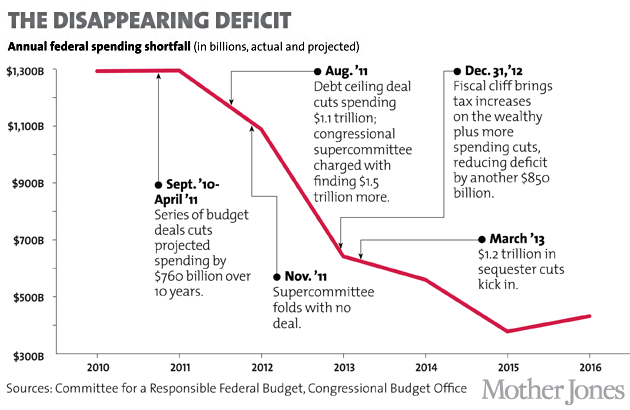
    It’s pretty obvious that Obama regrets negotiating over the debt ceiling back in 2011, thus giving Republicans an expectation that he might do it again. At the time, I think Obama was genuinely eager to pass a Grand Bargain on long-term deficit reduction and viewed the debt ceiling as a good pretext, one that would make both Democrats and Republicans more likely to come to an agreement. In the end, that failed, and this time around there’s really nothing Obama wants from Republicans. They had their chance at a serious debt-reduction deal and turned it down, and Obama obviously has no desire to waste his time with that again. Besides, with the deficit already plummeting, he doesn’t need a deal anymore and couldn’t get congressional Democrats to support one even if he did.

    So he can stand firm pretty easily because there’s nothing much Republicans can offer him. The only leverage they have is a government shutdown, and that isn’t much of a threat. Both Obama and John Boehner know perfectly well that a shutdown would hurt Republicans more than it would hurt Democrats.

    But that’s logic, and logic is selling at a deep discount these days. The fever swamp wants a debt ceiling default, and there’s a pretty good chance they’re going to force one through. Boehner just doesn’t have the clout or the influence to stop his lemmings from racing over the cliff. At this point, the most germane question probably isn’t whether Republicans are going to force a default, but how long they’ll hold out after they’ve done it. Just how badly do global markets have to panic before they finally come to their senses?

    I don’t know. But as long as we’re on the subject, I’d like to add one pre-emptive note. The debt ceiling crisis is likely to renew calls for Obama to settle the whole thing unilaterally by issuing a trillion-dollar platinum coin. As you all know, my own view is that this is plainly illegal, but my view doesn’t matter. What matters is that the platinum coin option only works if the Fed is willing to accept it on deposit, and this is something they’ve already said they wouldn’t do. Like it or not, this means there is no platinum coin option. So let’s not spill too much ink on it this time around, OK?

  • The Debt Ceiling Is Suddenly Only 8 Weeks Away


    Remember that debt limit donnybrook we were all expecting this December? Turns out everyone was being a wee bit too optimistic about that:

    Treasury Secretary Jacob Lew told Congress on Monday that after mid-October, the government would be able to make payments “with only the cash we have on hand on any given day.” In a letter to House Speaker John Boehner (R., Ohio), Mr. Lew projected the Treasury would have roughly $50 billion on hand by mid-October, and said this level “would be insufficient to cover net expenditures for an extended period of time.”

    Mr. Lew also said that “on certain days, net expenditures could exceed such a cash balance,” which might mean the government couldn’t pay all its bills.

    ….The mid-October time frame is sooner than many on Capitol Hill had anticipated….Some believed that the government’s improving fiscal condition, bolstered by rising tax revenue and money coming in from Fannie Mae and Freddie Mac, could give the Treasury even more time, potentially until sometime in December.

    Politically, this means that Republicans don’t really have the option of quickly passing a 2014 budget (or a short-term continuing resolution) and then taking some time off to plan for their latest round of debt ceiling hostage-taking at the end of the year. If mid-October really is the drop-dead date, it means that budget negotiations in late September and debt ceiling negotiations in early October pretty much run right into each other. It’s Fiscal Cliff v2.0.

    I don’t quite know what this does to John Boehner’s fragile attempts to keep the lunatic wing of his party under control. Nothing good, probably. I’m also not sure what it does to President Obama’s promise not to negotiate over the debt ceiling. If all of this stuff get munged together, then everyone’s going to get mighty hazy mighty fast about what exactly is being negotiated.

    So that’s that. Hazy is the new outlook. Stay tuned.

  • Repeat After Me: Always Adjust for Inflation. Always Adjust for Inflation.


    If I told you that the American economy grew by more than 50 percent during Jimmy Carter’s presidency, you’d probably think I must be pulling a fast one. And you’d be right: inflation was high during Carter’s term in office, so most of that growth is an illusion. Adjusted for inflation, the economy grew 13 percent.

    Likewise, if I told you that California has more violent crime than Washington DC, you’d be equally skeptical. And rightly so: California just has a lot more people than Washington DC. Adjusted for population, DC’s crime rate is three times higher than California’s.

    This is why reporters really, really need to stop writing stuff like this:

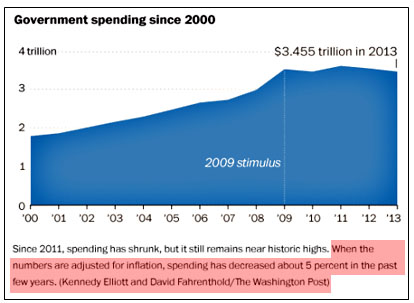
    After 2½ years of budget battles, this is what the federal government looks like now: It is on pace, this year, to spend $3.455 trillion.

    That figure is down from 2010 — the year that worries about government spending helped bring on a tea party uprising, a Republican takeover in the House and then a series of ulcer-causing showdowns in Congress. But it is not down by that much. Back then, the government spent a whopping $3.457 trillion.

    This is just flatly deceptive. Adjusted for inflation and population growth, federal spending has declined by 8 percent since 2010. In current dollars, it’s fallen from $11,800 to $10,900 per person.

    The excerpt above comes from David Fahrenthold of the Washington Post, who wants to make the point that for all the screaming and shouting over the budget during the past few years, the size of government hasn’t really changed much. And that’s fine. If he wants to, he can make that point by noting that all the fuss has produced only an 8 percent decline from record highs. But what he can’t do—not honestly, anyway—is present nominal numbers in his lead and then again in a big chart, with only a tiny footnote to alert readers that he hasn’t accounted for inflation, let alone population growth.

    I don’t have quite as big a problem with the rest of Fahrenthold’s story as some do. He’s basically making the point that Congress has a hard time cutting federal spending, and that’s perfectly true. If the Post thinks its readers are interested in why that is, fine. But along with the usual collection of horror-story anecdotes (roads to nowhere, tiny subsidized airports, etc.) they have an obligation to present the big picture honestly. They didn’t.

  • Conservatives Are Finally Admitting What Voter Suppression Laws Are All About


    North Carolina’s new voter ID law is ostensibly designed to reduce voter fraud. That’s the official story, anyway. But if that’s the case, why did North Carolina also pass a whole bunch of other voting restrictions, including limits on early voting? Phyllis Schlafly, the doyen of right-wing crankery, explains that the reason was simple: “Early voting plays a major role in Obama’s ground game….[It] is an essential component of the Democrats’ get-out-the-vote campaign.” Steve Benen comments:

    Have you ever heard a political figure accidentally read stage direction, unaware that it’s not supposed to repeated out loud? This is what Schlafly’s published column reminds me of.

    For North Carolina Republicans, the state’s new voter-suppression measures are ostensibly legitimate — GOP officials are simply worried about non-existent fraud. The response from Democrats and voting-rights advocates is multi-faceted, but emphasizes that some of these measures, including restrictions on early voting, have nothing whatsoever to do with fraud prevention and everything to do with a partisan agenda.

    And then there’s Phyllis Schlafly, writing a piece for publication effectively saying Democrats are entirely right — North Carolina had to dramatically cut early voting because it’s not good for Republicans.

    Remember, Schlafly’s piece wasn’t intended as criticism; this is her defense of voter suppression in North Carolina. Proponents of voting rights are arguing, “This is a blatantly partisan scheme intended to rig elections,” to which Schlafly is effectively responding, “I know, isn’t it great?”

    Actually, I doubt that Schlafly was very far off the reservation here. Generally speaking, I think conservatives have gotten tired of keeping up the pretense about the purpose of their voter suppression laws. Why bother, after all? It might make sense if they needed to convince a few Democrats to join their cause, but that’s obviously hopeless. Alternatively, it might be necessary if they needed to maintain a legal fig leaf for future court cases, but the Supreme Court has ruled that purely partisan motivations for voting laws are A-OK. Finally, they might care about public opinion. And they probably do. But not much.

    At this point, the jig is up. Everyone knows what these laws are about, and there’s hardly any use in pretending anymore. In fact, the only real goal of the voter suppression crowd now is to provide a plausible legal argument that what they’re doing isn’t intentionally racist. That’s really the only thing that can derail them at this point, and the best way to fight back is to shrug their shoulders and just admit that they’re being brazenly partisan. That’s what Texas attorney general Greg Abbott did in his brief supporting his state’s voter suppression laws, and he did it with gusto. But if that’s the official argument that you have to make in your legal briefs, there’s not much point in denying it in other forums. You might as well just go with it.

    Schlafly wasn’t reading stage directions. She was reading from the script. It’s just a new script, that’s all.