• If You’re On Trial, You’d Better Hope Goldman Sachs is on Your Side


    In the case of former Goldman Sachs trader Fabrice Tourre, the U.S. government was able to secure only a weak civil judgment. But in the case of former Goldman Sachs programmer Sergei Aleynikov, the U.S. government succeeded in winning a sentence of eight years in prison even though their case was so weak it was overturned almost immediately on appeal. What was the difference? After reading Michael Lewis’ Vanity Fair piece on Aleynikov, Felix Salmon explains:

    The big difference between the two cases is that while Tourre was defended by Goldman Sachs, Aleynikov was prosecuted by them: Lewis leaves the reader in no doubt that the decision to prosecute, along with all the supporting arguments, while nominally taken by the FBI, was essentially made by Goldman Sachs itself. The irony is painful: the government, acting against Goldman Sachs, could only manage a civil prosecution. But Goldman Sachs, acting through the government, managed to secure itself a highly-dubious criminal prosecution, complete with an eight-year prison sentence.

    Lewis doesn’t delve too deeply into the jurisprudence here. But it’s obvious that the case would never have been brought without Goldman’s aggressive attempt to cause as much personal destruction as possible to Aleynikov.

    Emphasis mine. Aleynikov is not 100 percent innocent in this case. He’s close, though. And even now, after his sentence has been overturned, Goldman Sachs has managed to continue its persecution of Aleynikov by getting the Manhattan D.A.’s office to arrest him on some brand new charges, for no apparent reason except to make sure the guy has a criminal record. (He’s already served enough time that he wouldn’t return to prison even if he were convicted.)

    So there you have it. In a nutshell, these two cases tell you who really runs things here in the land of the free. Both Lewis’s article and Salmon’s summary are well worth a few minutes of your time.

  • Republicans Holding Firm So Far on DC Court Filibuster Threat


    Apparently Republicans are holding firm on their threat to filibuster every single nominee ever to the DC Circuit Court. Every single Democratic nominee, that is. Not because they have any particular objections to them, but just because they don’t want to lose the current Republican majority on the DC Court.

    (Technically, their argument is that the DC Court is “underworked” and all its open seats should be permanently eliminated. This is so obviously specious there’s no real need to pretend to take it seriously.)

    In any case, Ed Kilgore wonders if this will ignite any summer recess passion among progressives:

    The question is whether […] Democratic senators leery of a general position opposing filibusters of life-time judicial nominations might make an exception if the filibusters are being advanced on this type of specious ground rather than objections to the qualifications of individual judges.

    The timing, with three DC Circuit nominations heading towards the Senate floor immediately after the August recess, is interesting. Will senators hear about this relatively obscure issue when they are back home? That’s hard to say….It would be nice if Democratic senators known to be wobbly on filibuster reform–ranging from outright opponents like Carl Levin to more questionable cases like Mark Pryor and Reid himself–heard from progressives on this issue in August. I see no particular merit in the counter-argument that countenancing filibusters to preserve the overall ideological character of this or that federal panel is a weapon Democrats might want to use in the future. The kind of judges a Republican president is likely to nominate any time in the near future are going to have the track records and associations that make them debatable on their individual merits; our conservative friends will make damn sure of that.

    OK, then. You have your marching orders. Go raise some hell.

  • Tax Reform This Year is Just a Charade


    Bruce Bartlett argues today that tax reform is a nonstarter this year. It’s insanely complicated; nothing exists even in draft form yet; and House Ways and Means Committee Chairman Dave Camp is busy thinking about a plan to run for the Senate in 2014:

    Consequently, the idea that there will be a tax reform bill for the House to consider by the time it must raise the debt limit is ludicrous….Personally, I think Mr. Camp knows full well that he can’t do tax reform this year or next. He just wants a bill for Congress to consider so that there will be many opportunities to meet with lobbyists about their objections to one provision or another. This will help him raise campaign contributions for his very expensive Senate race.

    This is your cynicism alert for the day. Which isn’t to say it’s wrong, of course.

  • Chart of the Day: Net New Jobs in July


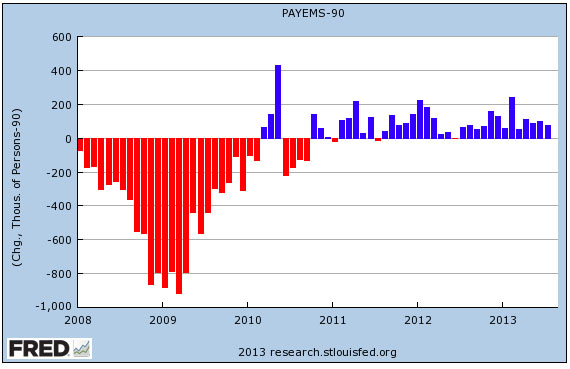
    The American economy added 162,000 new jobs last month, but about 90,000 of those jobs were needed just to keep up with population growth, so net job growth clocked in at 72,000. That’s about the same as last month. In fact, it’s about the same as every month for the past year: OK, but not great. The headline unemployment number declined to 7.4 percent, mostly due to more people getting jobs, but partly due to more people dropping out of the labor force.

    There’s really not much else to say. There are no big stories here about any particular industry, or about government employment, or anything else. Wages are flat, as they have been for the past couple of years. We’re just stuck treading water: The economy isn’t in horrible shape, but neither is it showing any signs of accelerating into a genuine recovery. Or, to put it another way: the economy isn’t bad enough to persuade Republicans to do something about it, but neither is it good enough to be producing lots of new jobs on its own. As always, we need to keep on hoping that nothing catastrophic happens in China or Europe or anywhere else, because right now we’re not in good enough shape to ride it out.

  • Why Is Murder Down in São Paulo? The Answer is…

    Members of the Police during a security operation at the ParaisOpolis shanty in Sao Paulo, Brazil.Sebastio Moreira/Zuma


    By now, you’ve all read my story about the link between the decline of leaded gasoline and the decline of violent crime, right? Here’s an update from an unexpected source: the state of São Paulo in Brazil.

    Obviously the United States isn’t the only place that got rid of leaded gasoline, which means the United States isn’t the only place that should have seen declines in violent crime. But other countries made the switch at different times, which means their declines in violent crime should also have taken place at different times. Rick Nevin has done a lot of work on crime trends outside the U.S., so after my piece appeared, I asked him for his predictions for other parts of the world. Here was one of them: “Crime will also plummet over the next 10 to 20 years in Latin America, where leaded gasoline use and air lead levels fell sharply from around 1990 through the mid-1990s.” (Crime rates generally start to decline about 20 years after unleaded gasoline is introduced.)

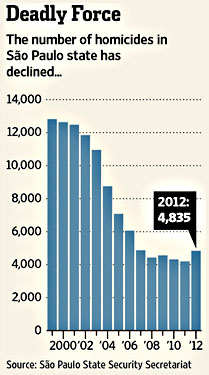
    Well, guess what? A few days ago the Wall Street Journal ran a piece about killings by police in São Paulo state. As an aside, they printed the chart on the right, which shows São Paulo’s homicide rate, and as you can see, it’s declined considerably since 2000.

    Is this another triumph for unleaded gasoline? Sort of, but the story is actually a little more interesting than that. Here’s Nevin, after noting that air lead levels in São Paulo declined by 65 percent in the early 80s, earlier than in most other Latin American regions. But why?

    The 1980-1985 drop in São Paulo air lead was not the result of a deliberate effort to reduce lead exposure: It was the side effect of efforts to reduce Brazil’s dependence on imported oil. Brazil started its gasoline substitution program in 1975, and began large-scale production of E95 (lead-free) fuel ethanol for vehicles running on straight alcohol in 1979. By 1984, E95 fuel accounted for almost one-third of all vehicle fuel in Brazil, and E95 accounted for almost half of all vehicle fuel in Brazil in 1987.
    Why the murder decline in São Paulo, when the rest of Brazil hasn’t seen similar results? “Ethanol production in Brazil surged from 1976 to 1986, but most of that growth was in São Paulo state, where ethanol distilleries are heavily concentrated, and where sales of E95 fuel were heavily concentrated in the 1980s.”

    There’s more in Nevin’s full paper, including some bad news for one Latin American country: “Venezuela did not even introduce unleaded gasoline until 1999, and was one of the last countries to eliminate leaded gasoline, in 2005. In 2010 and 2011, Venezuela had the fourth highest national murder rate in the world. Nobody should be surprised if it records the highest national murder rate sometime in the next few years.” So be careful if you plan to visit Caracas anytime soon.

  • The Media Loves a Scandal, But Loses Interest When the Scandal Turns Out to be Bogus


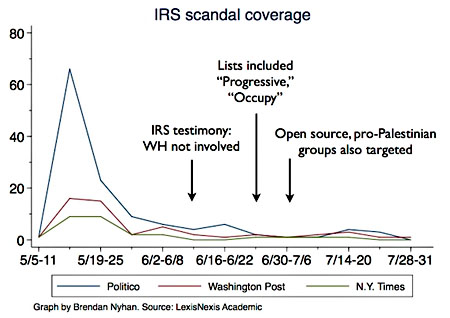
    This probably won’t come as any surprise, but it turns out that media outlets pay a lot of attention when a shiny new scandal erupts, but a whole lot less attention when the scandal turns out to be a nothingburger. As an example, Brendan Nyhan presents this chart showing coverage of the IRS scandal:

    As Nyhan says, this is sort of a subset of the general tendency of the media to pay lots of attention to a new event when it first erupts, and then less as time goes by. This is perfectly normal: public interest in something like the Sandy Hook massacre or the Boston bombings only lasts so long, after all. Eventually there’s nothing new to report and we all move on.

    But in the case of an event like the IRS scandal, this can leave the public with a serious misimpression. Everyone heard about it when it first happened, but a month later hardly anyone heard about the new revelations that turned it into a non-scandal. This means that an awful lot of people are left thinking it was a big scandal even though it wasn’t.

    I think the most interesting followup question about this is whether this is just normal behavior or whether it’s driven by the fact that conservative media promoted the original story heavily but didn’t promote the followups. Perhaps a bit of both. Stories don’t last forever, and the followup coverage tends to be a lot less exciting than the original allegations. So diminishing attention is hardly surprising. At the same time, it’s hardly plausible that coverage of the followup stories would have been so meager if the Fox/Drudge/Limbaugh axis had been promoting them heavily. Try as it might, the liberal media still doesn’t have the same kind of clout when it comes to driving media narratives.

  • Does the FBI Monitor All Your Google Searches?


    UPDATE: The Suffolk County Police Department says today that they recently received a tip “from a Bay Shore based computer company regarding suspicious computer searches conducted by a recently released employee.” Based on that, they paid him a visit. The FBI apparently wasn’t involved, and neither was any kind of surveillance of Google searches. More here.


    Doug Mataconis passes along a blog post from Michele Catalano about a recent visit her family got from six agents belonging to a joint terrorism task force. It turns out that she had been googling for pressure cookers, her husband had been googling for backpacks, and her son had been googling for news about the Boston bombings. This raised some red flags and produced the JTTF visit. Mataconis comments:
    As Catalano notes in her post, as well as in several Tweets regarding the incident collected by Gizmodo, the agents were respectful of her family and didn’t disturb the house in any significant way while conducting their “search.”….Nonetheless, it does raise some interesting questions about exactly what kind of Internet surveillance is going on out there. Quite obviously, the FBI would not have shown up at the Catalano home if some connection had not been made between Google searches conducted several weeks in the past, their IP address, and eventually their home address. On a basic level, this would seem to require; (1) that there is a program out there monitoring seemingly random Google searches by American citizens, (2) that this program allows the government to track IP addresses, or obtain them from Google by some means, and (3) that they were then able to connect the IP address to a home address, presumably with information obtained from whichever company happens to provide the Catalano’s with their internet access.

    All of this raises several legal questions, of course. For example, under what legal authority is the Federal Government monitoring the Google searches/Internet activity of American citizens, presumably without a warrant?….More important, though, is how the FBI managed to get its hands on this information and on the Catalano’s home address. Was there a FISA warrant issued?….Was there any warrant issued at all?

    Why yes, those are good questions! They’re especially good since the agents told Catalano’s husband that they make about 100 visits like this each week. Inquiring minds would like to know more.

  • Shell Says Shale Oil Reserves “Difficult to Find and Develop”


    Here’s an interesting tidbit from today’s Wall Street Journal:

    Royal Dutch Shell PLC on Thursday posted a 60% drop in second-quarter profit, largely because the oil and natural-gas giant wrote down the value of its North American shale assets by more than $2 billion after tax, highlighting the difficulties that energy companies face in finding new oil they can pump at a profit.

    ….Shell cited disappointing drilling results at its North American shale assets, which it said turned out to contain less oil than it had hoped. Even excluding the charge on those assets, Shell’s earnings fell well short of analysts’ expectations as the company struggled with production declines and rising costs.

    I wouldn’t make too much of a single report like this, but it does fall in line with other evidence suggesting that although North America has a lot of shale oil, it probably doesn’t have quite the gargantuan quantities that some people think. What’s more, the shale oil we do have has turned out to be fairly expensive to get at. Plus shale oil deposits tend to deplete rapidly. Bottom line: don’t get too caught up in the shale oil hype.

    POSTSCRIPT: Keep in mind that we’re only talking about oil here. Natural gas fracking from shale is a different story. There’s probably some hype there too, but it’s of a different kind.

  • The Economy is Better, Except that No One Has a Job


    The LA Times reports on the economy today:

    Improving economic data is making the prospects more likely that the Federal Reserve will start tapering its massive bond buying next month, a move that suggests the recovery is on solid ground….Economic growth unexpectedly picked up in the second quarter, though it still remained relatively weak. Corporate earnings are largely stronger. Consumer confidence is back to pre-recession levels.

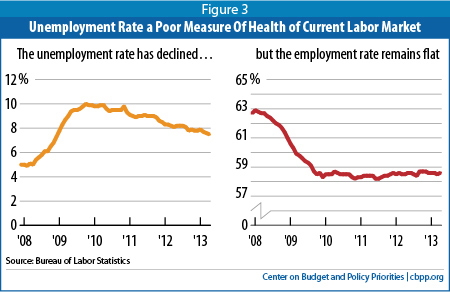
    This is all true, and it’s all conventional wisdom. But it really shows how low our expectations have gotten. Take a look at the following two charts. The first one, from CBPP, shows that although the headline unemployment rate is down, this is mostly due to large numbers of people dropping out of the workforce and not being counted anymore:

    The second one, from Pew, shows the employment rate specifically for workers under 30:

    The employment rate of young people cratered between 2007 and 2010, and it hasn’t rebounded since. The same report shows that young people are increasingly living at home—hardly a surprise if they can’t find a job. And yet, our recovery is supposedly on solid ground. If this isn’t the soft bigotry of low expectations, I don’t know what is.

  • Price Wars for Books Are Probably Bad News for Authors


    Is heavy book discounting bad for authors? Matt Yglesias is puzzled:

    Buzzfeed has a baffling article up about how Amazon and Overstock are waging a price war on physical books featuring deep discounting and huge wins for consumers. According to Andy Meeks this leaves authors “authors caught in the crossfire.”….[But] authors are paid by publishers, who hand out advances and royalty checks. The royalties are based on a percentage of publishers’ gross revenues so the retail price of the books sold doesn’t mean authors get less money. If anything, retailer discounting is good for authors and publishers because it boosts book sales.

    I think there’s a fairly straightforward way that this could be bad for authors. Amazon has been waging a battle for years now to get consumers accustomed to low prices on both e-books and physical books. So far, this means only that Amazon doesn’t make any money on books. So far.

    But what happens when Amazon drives everyone else out of business and there’s no one left but Amazon selling books? One possibility is that prices go back up to their old level. Another is that consumers have become so accustomed to price-war pricing that they just won’t pay more. Amazon, however, will no longer be willing to lose money on books, so it will demand lower wholesale prices from publishers. The publishers will have little choice but to agree, and authors will get squeezed.

    Nobody knows if this is how things will eventually shake out. But there’s not much question that Amazon really, really wants to train consumers to expect low prices for books. Unless you believe that Amazon is doing this out of a sense of public spiritedness and will continue losing money on books forever, eventually the piper is going to be paid. That’s likely to be bad news for authors.