
• Has Larry Summers Changed His Regulatory Spots?


    I mentioned a couple of weeks ago that my main objection to Larry Summers as chairman of the Fed was his record on financial regulation. Today, Cass Sunstein uses his Bloomberg column to tell me I have nothing to worry about:

    I worked with Summers in the Obama administration, and I can report that in internal discussions, he was one of the most uncompromising advocates for financial regulation. Of course, he supports the free-market system and wants to avoid unnecessary regulatory burdens. But time and again, he insisted that the events of 2008 required everyone, including him, to re-evaluate their views about regulating the financial industry. He contended that banks can’t police themselves any more than polluters can be trusted to protect the environment or pharmaceutical companies can be trusted to ensure that drugs are safe.

    Building on these analogies, Summers vigorously argued on behalf of a consumer financial protection agency, and he supported strong safeguards designed to reduce the risk of another economic meltdown. Intensely focused on the problem of “too big to fail,” he was one of the earliest and most forceful advocates of promoting financial stability by requiring banks to have enough capital to withstand an economic downturn.

    All of this might be true. Perhaps Summers really has changed his tune after living through the 2008 financial crisis. I’m not a White House insider, so there’s no way for me to know.

    But I will say this: over the past decade I’ve become far, far more skeptical of reports based on private knowledge. It seems like there are always plenty of people around to tell us what the great and the good are “really” thinking based on conversations at Davos or Jackson Hole or the West Wing of the White House. Sometimes they’re right. But more often, if you want to know what someone really thinks, the best guide by far is their past actions and statements. There’s seldom any good reason to make things more complicated than that.

    Now, it so happens that Janet Yellen, the other main candidate for the position, doesn’t have much of a track record on financial regulation. So it’s not as if this is a black-and-white competition. Nonetheless, I’d be very cautious about thinking that someone with long experience and well-considered views is likely to become a born-again regulator. With the immediate crisis out of the way, Summers’ regulatory temperament is probably about the same as it’s always been.

    That said, and despite the remarkable amount of heat this appointment has generated, I can’t say that I have super strong feelings about the whole thing. I think Yellen has more relevant experience and a better track record of being right on the big questions, while Summers has well-known social problems and a dubious track record on financial regulation. That makes Yellen a better choice. But honestly, they aren’t very far apart on the big issues, and it’s unlikely that either one is head and shoulders above the other. If Obama nominates Summers, it would be just another case of him choosing someone I thought was second best. A minor disappointment, but that’s about it.
  • The Federal Government Should No Longer Subsidize 30-Year Fixed-Rate Mortgages


    President Obama is set to outline his plan for reforming the federal role in the home mortgage market today. Here’s one of his requirements:

    An acceptable measure also must specify the government’s role and liabilities for Fannie Mae and Freddie Mac, the officials said, and — unlike legislation in the Republican-controlled House — must ensure Americans’ continued access to a 30-year mortgage at a fixed interest rate.

    Dean Baker is unimpressed:

    In fact, government backing is not necessary for 30-year mortgages, as is shown by the existence of the 30-year jumbo mortgages which are too large to be eligible for government guarantees. The interest rate on these mortgages is typically 0.25-0.50 percentage points higher than the interest rate on conforming loans that can be purchased by Fannie Mae and Freddie Mac.

    So the story here is not really about the existence of 30-year mortgages, but rather the price. The program being pushed by President Obama effectively subsdizes mortgage interest rates by subsidizing mortgage backed securities. If the goal to make homeownership more affordable for moderate income people, this is an extremely inefficient way of doing so.

    Under the Obama administration’s proposal the vast majority of the subsidy would go to higher income homeowners since there will be a bigger subsidy for people who take out bigger mortgages.

    A few years ago I think I would have believed that the 30-year fixed-rate mortgage was worth saving. But I now suspect I was just being a slave to path dependence. I grew up with the 30-year fixed-rate mortgage as the “standard” mortgage, so it naturally seemed worth saving. But other countries get along fine without it, and as Baker points out, the jumbo mortgage market gets along fine without any federal guarantees. You can still get a jumbo 30-year fixed, but you’ll have to pay a bit more for the security.

    The same would likely happen in the conforming market if federal guarantees were ended: 30-year fixed loans would continue to be available, but they’d cost a bit more than ARMs. And even if they did go away completely, it’s not clear what harm would be done. As with so many other things, we’d just have to get used to living in a world where pretty much everything is indexed to inflation.

    Speaking for myself, I’d get the feds out of the business of deciding which kinds of mortgages should be available. This is something where the market works perfectly adequately. Instead, federal regulations should be all about minimizing fraud, maximizing transparency, and setting rules necessary to keep the broad mortgage market stable (down payment minimums, HELOC regulation, balloon payments, ability to pay, etc.). That’s where the real bang for the buck lies.

  • Fact-Checking Is a Doomed Enterprise: Federal Deficit Edition


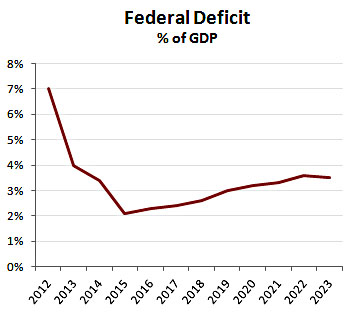
    On Sunday, Eric Cantor told Fox News that Congress needed to stay focused on our “growing deficit.” But Cantor is wrong: the deficit is shrinking, not growing. PolitiFact took a look at this and ruled that Cantor’s statement was half true. Why? Because the deficit is shrinking now, but it might start growing again in 2016.

    Steve Benen and Paul Krugman give PolitiFact the going over they deserve on this, but this affair mostly just confirms my belief that the whole fact-checking enterprise is misguided. As usual, the problem here isn’t so much facts per se, but how you interpret them and which facts you think deserve the most attention. In Cantor’s case, he initially brought up the deficit in the context of the “underlying problem” of “entitlement programs and unfunded liability.” A few seconds later he mentioned again that the “real problem” is entitlements, and then a few seconds after that he said it was time for us all to come together “and try and tackle the real problem which is the entitlements.”

    It was only in his next reply that he talked about “the ultimate problem, which is this growing deficit.” This is technically wrong, but in the context of Cantor’s repeated concern with entitlements, it’s not really a stretch to believe that by “ultimate” he was referring to the long-term deficit trajectory.

    So what is PolitiFact‘s role here? If you think it’s very narrow fact-checking, then Cantor is just dead wrong and he deserves their worst score. If you think they should try to take into account the context of his statement, then Cantor wasn’t deliberately trying to mislead anyone but gets dinged for not being a little clearer.

    Which is it? The problem is that once you get into context and interpretation, you can’t really say you’re fact-checking anymore. But if you take the narrow view, you’re going to end up constantly nitpicking over trivia. Occasionally things will be easy and you’ll catch a flat-out whopper, but most of the time political lies are more sophisticated than that. 

    There’s really no great answer here. I wrote a piece recently for the magazine (on newsstands soon!) about austerity and deficits, and one of the charts included with the story shows the deficit declining from 2010 through 2016. Is that misleading? Should I have included a chart that goes through 2023 so that everyone can see that deficits are likely to start increasing in a few years? I don’t think so, because my piece wasn’t about long-term deficits. It was about austerity right now and its effect on recovery from the 2008-09 recession, which meant I was only concerned with the trajectory of the deficit right now. But someone with a more hostile reading of my piece could say that I was cherry picking to make the deficit look less scary than it really is. In the end, it’s a judgment call.

    Not everything is a judgment call. Some stuff is just flat wrong. But most of the time, what’s important is which facts you choose to highlight, which you choose to ignore, the context of the facts, the intent of the speaker, and the values both speaker and audience think are most important. That’s not stuff you can fact-check, it’s just stuff you can explain.

  • Word of the Day: Desheeting


    The rich are doing great these days. The rest of us, not so much. And yet, the rest of us still have to buy toilet paper even if our jobs are precarious and money is tight:

    For them, Kimberly-Clark Corp. and other tissue makers have a special strategy:

    “Desheeting.”

    A word that top executives of personal-care conglomerates are proudly bandying about because it speaks of their corporate spirit of relentless innovation. And it cropped up during Kimberly-Clark’s second-quarter earnings call….Sales, at $5.267 billion, were down fractionally year over year….Yet Kimberly-Clark continues to eke out “adjusted earnings” growth — 8% per share in the second quarter. What gives? All manner of cost cutting, product-mix changes, and that word.

    “Well, we took some desheeting in the quarter,” explained Mr. Buthman. The company was reducing the sheets on each roll of toilet paper and in each box of Kleenex. He called it an “innovation” that would lead to a “more positive” price. At the same time, volume, which the company counted in thousands of sheets, would decline. “Which net net, for us, works out to be a positive,” he said.

    ….Part of the innovation is to fluff up the tissue without adding more materials — 15% “bulkier,” it said on a box of Kleenex that had 13% fewer sheets in it, the Wall Street Journal discovered. In the Cottonelle line, sheet counts dropped by 5.7% to 9.6%. Fewer but fluffed up sheets, lower input costs for the company, and consumers who “don’t care about” that. A perfect solution — and a variation on an ancient theme — for hiding hefty price increases.

    A regular reader passed this along today via email. “The American zeitgeist in one word,” he said. Quite so.

  • Reuters: NSA Secretly Helping Drug Agencies Target US Persons


    Yesterday, the New York Times informed us that the Drug Enforcement Agency wants greater access to the NSA’s treasure trove of surveillance, but so far they haven’t gotten it. Today, Reuters tells us that this isn’t really true:

    A secretive U.S. Drug Enforcement Administration unit is funneling information from intelligence intercepts, wiretaps, informants and a massive database of telephone records to authorities across the nation to help them launch criminal investigations of Americans.

    ….The unit of the DEA that distributes the information is called the Special Operations Division, or SOD. Two dozen partner agencies comprise the unit, including the FBI, CIA, NSA, Internal Revenue Service and the Department of Homeland Security.

    ….”Remember that the utilization of SOD cannot be revealed or discussed in any investigative function,” a document presented to agents reads. The document specifically directs agents to omit the SOD’s involvement from investigative reports, affidavits, discussions with prosecutors and courtroom testimony. Agents are instructed to then use “normal investigative techniques to recreate the information provided by SOD.”

    ….A former federal agent in the northeastern United States who received such tips from SOD described the process. “You’d be told only, ‘Be at a certain truck stop at a certain time and look for a certain vehicle.’ And so we’d alert the state police to find an excuse to stop that vehicle, and then have a drug dog search it,” the agent said.

    This is not surprising. As you may recall, NSA is allowed to surveil foreign nationals but not US persons. If US persons are “inadvertently” caught up in the surveillance net, their communications have to be discarded. However, there are exceptions for domestic communications that “contain usable intelligence, information on criminal activity, threat of harm to people or property, are encrypted, or are believed to contain any information relevant to cybersecurity.” Drug offenses are criminal activity, so presumably NSA is allowed to keep any drug-related conversations it collects and pass them along to the relevant law enforcement agencies.

    Does this give NSA an incentive to “accidentally” collect communications on US persons, so that they can trawl through them to find stuff they’re allowed to keep? Perhaps. Either way, though, it appears that NSA is more involved in drug investigations—and more eager to keep it a secret—than we’ve been led to believe.

  • RNC Chair Pretends to Be Outraged Over Hillary Miniseries


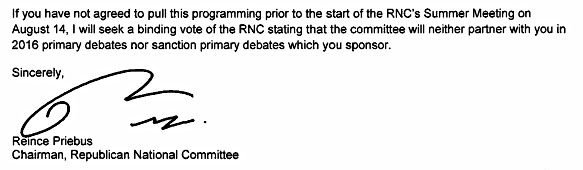
    Speaking of Republicans trying to work the refs, here’s their latest effort: a letter to NBC demanding that they cancel their planned Hillary Clinton miniseries, which RNC chair Reince Priebus calls a “thinly-veiled attempt at putting a thumb on the scales of the 2016 presidential election.” Here’s the final paragraph of the letter:

    That kind of swagger goes over well with the base, but in the real world it accomplishes nothing except to ensure that NBC doesn’t accede to their demands. But I guess that’s probably the point. I doubt that Priebus really cares much about the miniseries, which is likely to have a near-zero effect on the 2016 race. But he does care about rallying the troops. This should accomplish that nicely. I expect this to generate plenty of chatter in the Fox/Drudge/Rush echo chamber over the next few days.

  • “Uncertainty” Is Gone, But the Sluggish Recovery Is Still With Us


    Why has the economy recovered so sluggishly since the 2008-09 recession? Reasonable people can point to lots of reasons: debt overhang, the zero lower bound on interest rates, loss of housing wealth, and too little fiscal stimulus, among others. But if none of those actual reasons suit your political agenda, you can always just make something up. Republicans, for example, found it convenient to blame “uncertainty.” The business community was just so stonkered by the blizzard of new rules and regulations from the Obama administration that it was unwilling to invest in the future.

    Never mind that business investment has actually recovered fairly nicely. Never mind that outside the financial sector (which is doing just fine, thankyouverymuch), Obama hasn’t introduced any more regulations than other recent presidents. Never mind that lack of consumer demand was more than enough to explain whatever reluctance businesses might have had to build new factories.

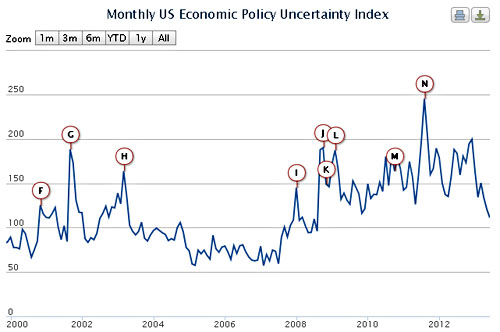
    Never mind all that. Republicans wanted to blame the sluggish recovery on mountains of red tape from the business-hating Obama administration, and the press played along. This means that “uncertainty” got a lot of media attention, which in turn means that if you have an “uncertainty index” based partly on media mentions, it would have shown persistent elevation during 2010-12, the heyday of the uncertainty campaign. Sure enough, that’s exactly what it showed:

    Amazingly enough, the index suggests that economic uncertainty was higher in mid-2012 than it was during mid-2008, when the entire global financial system was collapsing around our ears. And just as amazingly, it’s plummeted ever since. Today it’s only barely higher than its 2000-07 average.

    On a substantive basis, the fact that uncertainty spiked during the debt ceiling crisis (labeled with an N on the chart) makes sense. The rest of the high level of uncertainty between 2010 and 2012 really doesn’t. However, if instead you read the last few years on this chart as basically measuring the strength of the Republican campaign to pretend that Obama was strangling business growth with his tsunami of rules and regulations, then it makes perfect sense. Republicans had plenty of incentive to promote that theme during campaign season, and now that it’s over they don’t. So the index goes down.

    This comes via Jim Tankersley, who points out that if uncertainty really was driving the sluggish recovery, we’d expect to be seeing a hiring boom now that it’s declined. But there’s really been no sign of this. As we knew all along—and as the media should have known all along—”uncertainty” was just an invented partisan talking point. It no longer serves any purpose, so now it’s gone. But the sluggish recovery is still with us.

  • Test Scores in New York City Are Nothing to Write Home About


    New York City is about to introduce new, more difficult school testing based on the Common Core curriculum, and that means average scores are likely to go down. Mayor Michael Bloomberg is getting ready to take some heat:

    The mayor’s telling of history is poised to receive one of its most vigorous challenges yet on Wednesday, when New York State is expected to report drastic drops in student performance across the state because of a new set of tougher exams.

    In New York City, the proportion of students deemed proficient in math and reading could decrease by as many as 30 percentage points, city officials said, threatening to hand Mr. Bloomberg a public relations problem five months before he is set to leave office.

    ….As his mayoralty winds down, Mr. Bloomberg has sought to burnish an image as a savior of a school system rife with racial and socioeconomic disparities. But several of the Democratic candidates for mayor have rejected that portrayal, seizing on anger among some parents rankled by what they say is his unilateral approach to governing.

    Politics is politics, but the rest of us don’t really need to pay any attention to this. Nor do we have to pay attention to New York’s own testing, which may or may not be afflicted by dumbed-down tests that are about to get dumbed back up. Nor do we have to guess. Instead, we can just look at TUDA, the subset of the national NAEP test aimed at urban districts. New York City has participated in TUDA for Bloomberg’s entire mayoralty, and the basic results are below:

    New York City’s test scores have increased over the past decade, but they’ve increased less than in most other big cities (2 points vs. 6 in reading, 6 points vs. 12 in math). On the 4th grade test, New York City has done about the same as other big cities. This isn’t a massive failure, but it doesn’t look like any kind of outsized success either.

  • For Once, the Public Is a Winner in a Bureaucratic Turf War


    While all the rest of us are fretting over the NSA’s mind-bogglingly wide surveillance powers, it turns out that the rest of the intelligence community is fretting that they aren’t quite wide enough. The New York Times reports:

    Agencies working to curb drug trafficking, cyberattacks, money laundering, counterfeiting and even copyright infringement complain that their attempts to exploit the security agency’s vast resources have often been turned down because their own investigations are not considered a high enough priority, current and former government officials say.

    ….At the drug agency, for example, officials complained that they were blocked from using the security agency’s surveillance tools for several drug-trafficking cases in Latin America, which they said might be connected to financing terrorist groups in the Middle East and elsewhere.

    ….The security agency’s spy tools are attractive to other agencies for many reasons. Unlike traditional, narrowly tailored search warrants, those granted by the intelligence court often allow searches through records and data that are vast in scope. The standard of evidence needed to acquire them may be lower than in other courts, and the government may not be required to disclose for years, if ever, that someone was the focus of secret surveillance operations.

    Needless to say, this is precisely what a lot of us are concerned about: that every drug investigation in the world will suddenly become linked to “financing of terrorist groups,” and therefore authorized to trawl endlessly through NSA’s information pool and take advantage of rubber-stamp FISA warrants that cover anyone who meets a certain profile. For now, at least, I think we can be grateful that bureaucratic turf wars have apparently kept that under tight control.

  • Friday Cat Blogging – 2 August 2013


    Remember that great picture of Domino sitting on the front porch silhouetted against our garden a couple of months ago? Well, this is actually one of her favorite spots—mainly because we recently bought a new doormat that’s kind of stiff and bristly, and she loves going out there to roll around and scratch her chin on it. Whenever she does, I grab my camera and take a few pictures, hoping someday to get a shot where she’s actually looking at me instead of away from me. This is surprisingly hard, because when she’s looking in my direction, I normally only get one shot off before she sees the lens and bustles over to demand some human attention.

    Anyway, I am nothing if not determined, in a lazy sort of way, and for weeks now I’ve been doing this late in the day when the sun backlights both garden and cat. Finally, a few days ago, I got a decent picture. Just this one. Enjoy.