Chart of the Day: Being Poor Is Bad for Your Health


Hypoglycemia is an ever-present threat among diabetics who are being treated with insulin injections. Generally speaking, it’s caused by inadequate nutrition leading to dangerously low blood sugar, and it can usually be fixed by simply eating enough. But what if you’re poor, and at the end of the month you don’t have enough money left to buy adequate food? Adrianna McIntyre passes along this devastatingly simple chart that shows exactly what happens:
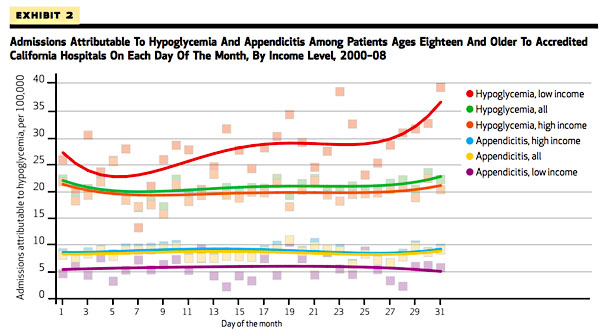
Take a look at the top three lines. Among those with high incomes, the risk of hypoglycemia is about the same all month long. But the red line shows the incidence of hypoglycemia among the poor. It goes down at the beginning of the month, when money is available for food, rises a bit in the middle of the month, and then jumps dramatically in the final week when money is tight. As a check to make sure that tight budgets really are at fault, the authors ran the same test on the incidence of appendicitis, which should be unrelated to income. It was.

McIntyre uses this as an object lesson: although policy wonks tend to focus a lot of attention on insurance and health care financing, there are plenty of other things that affect health. What’s more, solutions aren’t simple:

These findings also illustrate the difficulty in finding policy solutions to address health disparities. The authors note that food pantries and soup kitchens already ramp up staffing and resources toward the end of the month. We could explore different ways to distribute existing benefits, but that may have other negative impacts (ie: making it harder to pay rent or bills at the beginning of the month).

Nothing is ever easy.
DECEMBER IS MAKE OR BREAK

A full one-third of our annual fundraising comes in this month alone. That’s risky, because a strong December means our newsroom is on the beat and reporting at full strength—but a weak one means budget cuts and hard choices ahead.

The December 31 deadline is closing in fast. To reach our $400,000 goal, we need readers who’ve never given before to join the ranks of MoJo donors. And we need our steadfast supporters to give again—any amount today.

Managing an independent, nonprofit newsroom is staggeringly hard. There’s no cushion in our budget—no backup revenue, no corporate safety net. We can’t afford to fall short, and we can’t rely on corporations or deep-pocketed interests to fund the fierce, investigative journalism Mother Jones exists to do.

That’s why we need you right now. Please chip in to help close the gap.

DECEMBER IS MAKE OR BREAK

A full one-third of our annual fundraising comes in this month alone. That’s risky, because a strong December means our newsroom is on the beat and reporting at full strength—but a weak one means budget cuts and hard choices ahead.

The December 31 deadline is closing in fast. To reach our $400,000 goal, we need readers who’ve never given before to join the ranks of MoJo donors. And we need our steadfast supporters to give again—any amount today.

Managing an independent, nonprofit newsroom is staggeringly hard. There’s no cushion in our budget—no backup revenue, no corporate safety net. We can’t afford to fall short, and we can’t rely on corporations or deep-pocketed interests to fund the fierce, investigative journalism Mother Jones exists to do.

That’s why we need you right now. Please chip in to help close the gap.

We Recommend

Latest

Sign up for our free newsletter

Subscribe to the Mother Jones Daily to have our top stories delivered directly to your inbox.

Get our award-winning magazine

Save big on a full year of investigations, ideas, and insights.

Subscribe

Support our journalism

Help Mother Jones' reporters dig deep with a tax-deductible donation.

Donate