• One More Time: No, the Fort Lee Lane Closures Were Not Part of a Traffic Study


    From Chris Christie’s radio interview about Bridgegate yesterday:

    You still don’t know at this point whether there was a traffic study?

    Well, what I’m saying, Eric, did this start as a traffic study that morphed into some political shenanigans, or did it start as political shenanigans that became a traffic study?

    Oh come on. If this started as a legitimate traffic study, there would be two pieces of routine evidence for it. First, there would be some kind of planning document from the Port Authority engineering department. Second, there would be some kind of report on the results of the study. This is the absolute bare minimum that would accompany a genuine traffic study, especially one that involved a major lane closure.

    If either of these documents exists, Christie would have produced it long ago. He hasn’t, and it’s simply not plausible for him to continue pretending that we don’t know if there was a real traffic study that prompted this affair. There wasn’t.

    POSTSCRIPT: Robert Durando, general manager of the George Washington Bridge, has testified that data was collected during the days when the Fort Lee access lanes were closed. This is meaningless. It was tolls data, which is collected routinely every day. The fact that this is the only data that was collected is evidence against the the notion that there was a real traffic study being conducted, not evidence for it.

  • Here’s Why the CBO Thinks Obamacare Will Reduce Employment Among the Poor


    The Congressional Budget Office has updated its estimate of the effect of Obamacare on employment:

    CBO estimates that the ACA will reduce the total number of hours worked, on net, by about 1.5 percent to 2.0 percent during the period from 2017 to 2024….Because the largest declines in labor supply will probably occur among lower-wage workers….CBO estimates that the ACA will cause a reduction of roughly 1 percent in aggregate labor compensation over the 2017–2024 period, compared with what it would have been otherwise.

    Why will Obamacare reduce employment? Because it’s a job killer? Because employers will push lots of workers into part-time positions? Because its taxes on the well-off will crater the economy?

    No. Those effects are tiny at best. It’s much simpler than that. Obamacare will reduce employment primarily because it’s a means-tested welfare program, and means-tested programs always reduce employment among the poor:

    Subsidies that help lower-income people purchase an expensive product like health insurance must be relatively large to encourage a significant proportion of eligible people to enroll.

    ….For some people, the availability of exchange subsidies under the ACA will reduce incentives to work both through a substitution effect and through an income effect. The former arises because subsidies decline with rising income (and increase as income falls), thus making work less attractive. As a result, some people will choose not to work or will work less—thus substituting other activities for work. The income effect arises because subsidies increase available resources—similar to giving people greater income—thereby allowing some people to maintain the same standard of living while working less. The magnitude of the incentive to reduce labor supply thus depends on the size of the subsidies and the rate at which they are phased out.

    If, for example, earning $100 in additional income means a $25 reduction in Obamacare subsidies, you’re only getting $75 for your extra work. At the margins, some people will decide that’s not worth it, so they’ll forego working extra hours. That’s the substitution effect. In addition, low-income workers covered by Obamacare will have lower medical bills. This makes them less desperate for additional money, and might also cause them to forego working extra hours. That’s the income effect.

    This is not something specific to Obamacare. It’s a shortcoming in all means-tested welfare programs. It’s basically Welfare 101, and in over half a century, no one has really figured out how to get around it. It’s something you just have to accept if you support safety net programs for the poor.

    It’s worth noting, however, that health care is an exception to this rule. It doesn’t have to be means tested. If we simply had a rational national health care system, available to everyone regardless of income, then none of this would be an issue. There might still be a small income effect, but it would probably be barely noticeable. Since everyone would be fully covered no matter what, there would no high effective marginal tax rate on the poor and no reason not to work more hours. Someday we’ll get there.

  • Israel Is Learning the Price of Contempt


    The New York Times reports that AIPAC has lost several highly public battles with the White House over the past year:

    Its top priority, a Senate bill to impose new sanctions on Iran, has stalled after stiff resistance from President Obama, and in what amounts to a tacit retreat, Aipac has stopped pressuring Senate Democrats to vote for the bill.

    ….But Aipac’s headaches go beyond Iran. In September, it threw an army of lobbyists behind an effort to win a congressional mandate for Mr. Obama’s threatened military strike on Syria. Facing certain failure in Congress, the president pulled the plug on the effort. Earlier last year, it came under fire from the right for not publicly opposing Mr. Obama’s nomination of Chuck Hagel as secretary of defense, because of what critics said was his anti-Israel record.

    OK, I guess that’s surprising. But what makes it really surprising is the context. Here’s the story’s lead:

    The last time the nation’s most potent pro-Israel lobbying group lost a major showdown with the White House was when President Ronald Reagan agreed to sell Awacs surveillance planes to Saudi Arabia over the group’s bitter objections.

    That was in 1981. Basically, AIPAC hadn’t lost an important fight in over three decades. Now they’ve suddenly lost two—or maybe even three, if you count the Hagel confirmation.

    With any luck, this will provide Israel with some incentive to take John Kerry’s peace initiative more seriously. They just can’t treat an American administration with the contempt that they’ve treated Obama’s and expect to retain broad public support here. When Israel’s leadership becomes practically an extension of the tea party, as it has over the past few years, they’re going to start bleeding domestic support. AIPAC’s recent losses are a canary in the coal mine.

    The really astounding thing about all this is how gratuitous the Netanyahu administration’s contempt has been. They could have given Obama nearly everything he’s asked for, and it almost certainly wouldn’t have made a difference since the Palestinians are unlikely to agree to any plausible deal that Kerry can cook up. And yet the contempt has not just continued, but escalated. That’s been a huge mistake.

  • The American Economy in a Nutshell: Flat Revenues, Great Earnings


    The Wall Street Journal reports that American firms are struggling with falling prices due to weak consumer demand:

    With about half of companies reporting year-end earnings, Thomson Reuters estimates revenue for companies in the S&P 500 stock index rose just 0.9%—capping two years of lackluster revenue growth and tying the third-weakest quarterly sales growth since the fall of 2009….The persistent weakness in revenue also prompts companies to cut back costs and plow their spare cash into share buybacks instead of investments like new factories and hiring. Fourth-quarter earnings, as a result, are expected to be up 9.4%.

    There you have it. Earnings are up nearly 10 percent—because companies are cutting staff—and revenues are essentially flat—because workers have no money. This is the American economy in a nutshell. Solutions welcome.

  • Lead and Crime: It’s a Brain Thing


    When I wrote my big piece last year about the connection between childhood exposure to lead and rates of violent crime later in life, one of the big pushbacks came from folks who are skeptical of econometric studies. Sure, the level of lead exposure over time looks like an inverted U, and so does the national rate of violent crime. But hey: correlation is not causation.

    I actually addressed this in my piece—twice, I think—but I always felt like I didn’t address it quite clearly enough. The article spent so much time up front explaining the statistical correlations that it made the subsequent points about other evidence seem a bit like hasty bolt-ons, put there mainly to check off a box against possible criticism. That’s not how I intended it,1 but that’s how it turned out.
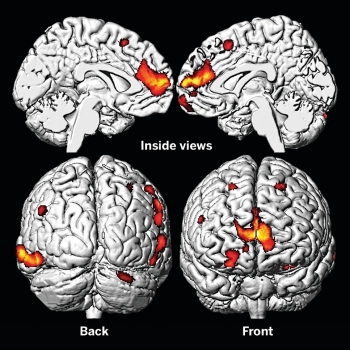
    For that reason, I’m pleased to recommend Lauren Wolf’s “The Crimes Of Lead,” in the current issue of Chemical & Engineering News. It doesn’t ignore the statistical evidence, but it focuses primarily on the physiological evidence that implicates lead with higher levels of violent crime:

    Research has shown that lead exposure does indeed make lab animals—rodents, monkeys, even cats—more prone to aggression. But establishing biological plausibility for the lead-crime argument hasn’t been as clear-cut for molecular-level studies of the brain. Lead wreaks a lot of havoc on the central nervous system. So pinpointing one—or even a few—molecular switches by which the heavy metal turns on aggression has been challenging.

    What scientists do know is that element 82 does most of its damage to the brain by mimicking calcium. Inside the brain, calcium runs the show: It triggers nerve firing by helping to release neurotransmitters, and it activates proteins important for brain development, memory formation, and learning. By pushing calcium out of these roles, lead can muck up brain cell communication and growth.

    On the cell communication side of things, lead appears to interfere with a bunch of the neurotransmitters and neurotransmitter receptors in our brains. One of the systems that keeps popping up in exposure experiments is the dopamine system. It controls reward and impulse behavior, a big factor in aggression. Another is the glutamate system, responsible in part for learning and memory.

    On the brain development side of things, lead interferes with, among other things, the process of synaptic pruning. Nerve cells grow and connect, sometimes forming 40,000 new junctions per second, until a baby reaches about two years of age. After that, the brain begins to prune back the myriad connections, called synapses, to make them more efficient. Lead disrupts this cleanup effort, leaving behind excess, poorly functioning nerve cells.

    “If you have a brain that’s miswired, especially in areas involved in what psychologists call the executive functions—judgment, impulse control, anticipation of consequences—of course you might display aggressive behavior,” says Kim N. Dietrich, director of epidemiology and biostatistics at the University of Cincinnati College of Medicine….“Overall, the evidence is sufficient that early exposure to lead triggers a higher risk for engaging in aggressive behavior,” says U of Cincinnati’s Dietrich. “The question now is, what is the lowest level of exposure where we might see this behavior?”

    There’s more, including a number of items I didn’t include in my article. The whole thing is worth a read if you’d like to learn a bit more than my piece covered about the brain science behind lead and crime.

    1So why did I write it the way I did? No good reason, really. Partly it’s because I told the story chronologically, and the really compelling parts of the brain science story are fairly recent. Partly it’s because it just seemed to be easier to explain things doing it in the sequence I did it.


  • For Republicans, Immigration Reform Is Unavoidable


    Should Republicans support immigration reform this year? From a purely political perspective, there are good reasons not to:

    • It would anger the conservative base, which is dead set against any kind of comprehensive immigration reform that allows undocumented workers to stay in the country legally (i.e., a “path to citizenship” or a path to legal residence of some kind).
    • Even outside the tea party base, most Republicans oppose immigration reform.
    • It almost certainly wouldn’t help Republicans in this year’s midterm elections. It might even hurt them.

    What about the other side? In my view, there’s really only one good reason for the Republican leadership to forge ahead despite all this:

    • In the long term, it would be good for the party. Opposition to immigration reform is a festering sore that prevents the GOP from appealing to the fast-growing Hispanic population, something that they’ll have to address eventually.

    In the simplest sense, then, this is an issue of timing. At some point, Republicans will have to bite the bullet and do this. They just can’t keep losing the Hispanic vote 70-30 and expect to ever win the presidency again. It’s a simple question of brute numbers. The question is how long they can hold out.

    My own guess is that now is just about as good as it’s going to get for Republicans. With a House majority, they have a fair amount of leverage to get the kind of bill they can live with. In fact, if they play their cards right, they might end up with a bill that fractures Democrats even more than Republicans. But what if they wait? Passing a bill is hopeless in 2015, with primary season for the presidential election so close. It’s possible that Republicans will be better off in 2017, but that’s a long shot. Democrats are certain to do well in that year’s Senate races, and are probably modest favorites to win the presidency again. Republicans would have less leverage than ever if that happens.

    And even if the long shot pays off, what good would it do them? Immigration reform of the kind that would pass muster with the tea party base wouldn’t do the GOP any good. In fact, it would probably give Democrats an opening to get Hispanic voters even more riled up. What Republicans desperately need is a bill that (a) is liberal enough to satisfy the Hispanic community, but (b) can be blamed on Democrats and a few turncoat moderate Republicans in November.

    I’m not optimistic about getting a decent bill passed this year, but what optimism I do have is based on this simple-minded analysis. If Republicans are smart, they’ll get this monkey off their backs now, when it won’t do them too much harm in the midterms but will give them time to start mending fences with Hispanics in time for 2016. Unfortunately, smart is in short supply these days.


  • Raw Data: Charter School Attendance in Florida Increases Earnings Later in Life


    Via Alex Tabarrok, here’s a new paper studying the effect of charter schools in Chicago and Florida on college attendance and earnings later in life. I’m especially interested in long-term studies of earnings, which I consider more useful than test scores (which may or may not predict anything) and even college attendance (ditto, though it’s more meaningful than test scores). The research team in this case was able to collect earnings data for about 2,500 charter students in Florida and compare it to similar non-charter students.

    This is not a lottery-based approach, which is the gold standard for this kind of research.1 Instead, the researchers compared charter students to students who had attended charters up until 8th grade and then transferred to other schools. They also did all the usual controls for race, gender, family income, etc. This approach has all sorts of well-known problems with hidden variables, but it was the best available to them.
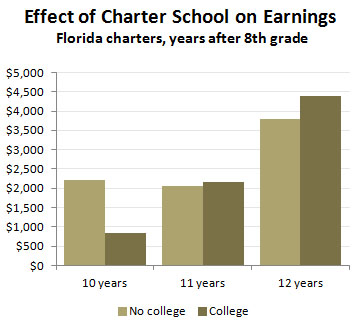
    With those caveats, the results were substantial. Twelve years after 8th grade—i.e., by age 23-25, when most college-bound students have graduated—college students who attended charters were earning $4,400 more than college students who didn’t attend charters. Among non-college students, the charter kids were earning $3,800 more than non-charter kids.

    As always, take this with a grain of salt. It’s one small study, and the methodology is so-so. But the effects are large, and suggest that experimentation with charter schools can produce valuable results.

    1In a lottery approach, kids apply to charters and are chosen by lottery. The winners are then compared to the losers, who attend public schools. This eliminates much of the charter improvement that’s solely because charter kids come from families that are highly motivated to value education.

    UPDATE: A regular reader writes in to point out something I didn’t mention:

    What I want to flag isn’t the concerns you raised. The major concern is the years the study took place over (1998-2003). Charter schools were still a small part of the market then and they were usually community based….Since then the industry has multiplied and there are have been a flood of crappy charter school chains into the market, many of them for-profit (this is especially true in Florida where Jeb Bush loosened charter school laws.)

    This year the national association of public charter schools estimates that there are 625 charter schools in Florida, up from 176 in 2002. There have been lots of change and lots of issues with quality as chains have expanded.

    Obviously longitudinal studies like this one always suffer from being out of date, and you can only work with the data you have. Still, this is probably another reason to be cautious about accepting these results until we have quite a bit more corroboration.

  • The Vicious Circle of Cabinet Decay in US Politics


    Keith Humphreys describes how Washington has changed in the era of the supercharged White House staff and the relentless marginalization of cabinet secretaries. Imagine, he says, that the president has just appointed you to a cabinet position:

    You come to Washington D.C. wanting to launch what you think is a terrific new initiative and some Jonah Ryan-type staffer who is just learning how to shave says there is no space for your stupid idea in the President’s budget. You are officially obligated to vigorously defend your boss’s budget, but your chief policy advisor, who used to work for Senator Backslap, hints obliquely that he’d be happy to pass along your quiet support for the initiative on Capitol Hill, where it has a good shot of attracting budgetary support despite the President’s opposition.

    You know you should resist. But then you think of the look on the face of that smartassed little wanker who is half your goddamn age and how he and the other countless snot-nosed whippersnappers at 1600 Pennsylvania Avenue are always blaming you in the press when the white house staff screw up, and you say to your policy advisor, “Well (cough) if the Senator really supports my — I mean the — initiative, then (cough), obviously it’s the Congress that writes the budget and if (cough), they choose to go forward I would of course fulfill my responsibilities to (cough) execute their wishes enthusiastically.”

    If the White House discovers your treachery, they will say “See, we cannot trust these people. Let’s hire more staff and bring more cabinet functions into the building where we can control them”. This bureaucratic response leads cabinet members to become so impotent and so distrusted that they contribute little to the administration and feel resentful towards it, feeding the cycle further.

    I don’t have anything to add to this, really. I just enjoyed reading it and thought I’d pass it along. However, it certainly reinforces my bafflement that anyone in their right mind would accept a cabinet position outside of the Big Four these days. Sure, I guess it will look good in your obituary some day, but other than that, what’s the point?

  • No, Anti-Abortion Laws Aren’t Responsible for the Decline in Abortion


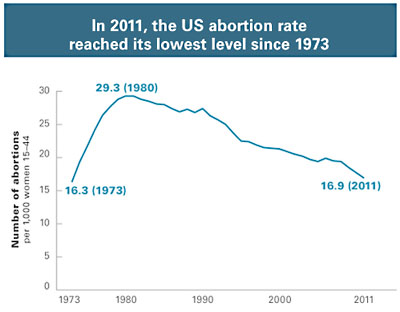
    You’ve probably heard that the abortion rate in 2011 dropped to its lowest level since 1973. You may have also heard that pro-lifers are adopting the inane talking point that this is due to the big raft of anti-abortion bills passed in red states after Republicans won their landslide victory in the 2010 midterms. There are two problems with this theory.

    First, the drop in 2011 came before any of these new laws were passed. Second, as you can see in the chart below, the abortion rate has been falling steadily ever since 1980.

    Better contraceptives are part of the reason for the declining abortion rate. Lower teen pregnancy rates are part of the reason. Changing sexual mores might be part of the reason. But laws restricting abortion? That might succeed in making lots of poor women miserable, but it has nothing to do with declining abortion rates. Not yet, anyway. More details here from Dana Liebelson and Molly Redden.

  • Your Weekend PSA: Using Date Ranges in Google Search


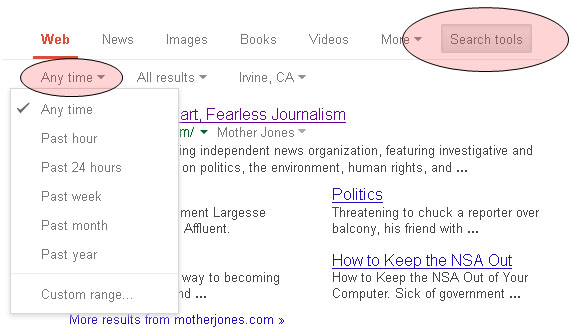
    This is a public service announcement about a feature of Google search that few people seem to know about: date ranges. This is useful in a couple of ways. First, I sometimes want only pages that are really recent, and it’s handy to be able to restrict results to the past hour or the past day. Alternatively, sometimes I’m looking for something old, which is hard to find because Google heavily prioritizes recent results. A specific date range fixes that.

    In any case, it’s easy to specify a date range. After your results come up, click Search tools at the top of the page. Then click Any time and choose an option from the dropdown list. That’s it.