• Let’s Blame Obamacare For Everything!


    AOL has decided to change the way it handles 401(k) retirement accounts. Instead of matching employee contributions monthly, it will make one lump-sum match at the end of the year. This screws employees and makes more money for AOL in two ways. First, they no longer contribute any matching funds at all for people who leave in the middle of the year. Second, employees don’t earn interest on their matching funds throughout the year.

    So what’s behind this Scrooge-like nickel and diming? Can you guess? Can you? Here’s CEO Tim Armstrong:

    In the CEO chair, let me give you an example of the decisions we have to make as a company: Obamacare is an additional $7.1 million expense for us as a company….As a CEO and Management Team, we had to decide “Do we pass the $7.1 million of Obamacare costs to our employees or do we try to eat as much of that as possible and cut other benefits?”

    It’s Obamacare’s fault! The all-purpose punching bag gets the blame again. AOL’s health care expenses went up this year, just as they have every year since the company was founded, but this time it’s Obamacare’s fault. Why? Well, why not? It’s a mighty handy excuse, isn’t it? And it certainly distracts everyone from the fact that AOL is shafting its employees even though it just announced its best results in a decade.

  • Why Are Republicans Shooting Themselves in the Foot With a Health Care Bill?


    Ed Kilgore points me to The Hill today, which reports that House Republicans plan to draft a genuine Obamacare replacement bill later this year:

    For years, Republicans have promised a “repeal and replace” strategy on ObamaCare, but have never coalesced behind one plan. President Obama has repeatedly mocked the GOP for not delivering an alternative.

    [Eric] Cantor intends to move a repeal-and-replace bill before the midterm elections in November, according to a source familiar with the situation. He broached the issue at the House GOP retreat in Cambridge, Md., late last week.

    “I think it is very likely that we’re going to have it before the election, we’re going to give the people — or at least we are going to try to give the people — a clear distinction of who we are versus who the Democrats are,” Florida Rep. Tom Rooney (R) said.

    I’m genuinely baffled by this. Why bother? Republicans have spent years screaming “Repeal and Replace!” without ever offering up a replacement, and it’s worked fine. Sure, it invites mockery from folks like me, but has that ever done them any harm? Not that I can see.

    On the flip side, any actual bill will be divisive within their own caucus and provide a rich target for Democrats at the same time. When it’s all just hazy smoke, Dems have nothing to get a handle on. Once there’s actual legislative language, all they have to do is find the least popular bits, twist them into granny-killing death panels, and go to town.

    If there were an actual chance of passing this bill, it might be worth it. But there’s not, and as near as I can tell, it’s literally 100 percent downside and no upside. What on earth is the point?

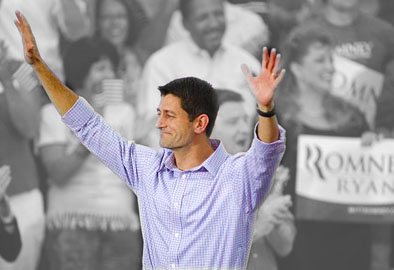
  • Paul Ryan Is the Odds-On Favorite to Win the Republican Nomination in 2016


    There’s been a lot of blathering about who the front-runner for the 2016 Republican presidential nomination is, and so far I’ve resisted taking part. But I guess I’m kind of curious: Is there much of a case to be made for anyone other than Paul Ryan?

    On the substantive side, Ryan sure seems like he’s setting himself up for a run. There’s his steady series of “unheralded” anti-poverty outreach trips that always manage to be just heralded enough to get sympathetic press coverage. He brokered a budget deal with Patty Murray that was businesslike and low-drama but didn’t alienate the tea party crowd too badly. Today, in a hearing about the CBO’s report on Obamacare, he acknowledged that the report didn’t say that employers would be cutting jobs—points for intellectual honesty!—while also calling Obamacare a “poverty trap”—points for demagoguery! This is all stuff that seems very delicately calculated to stay in the good graces of the tea party base while building up plenty of policy substance cred that will keep him attractive to moderate voters.

    On the flip side, who are his big competitors? Chris Christie is toast. Marco Rubio is inexperienced to begin with, and then muffed his chance for statesmanlike glory when he staked his reputation on immigration reform and came up empty. Jeb Bush can’t even get his mother’s endorsement. Scott Walker is getting buzz, but he strikes me as having too much baggage. Rand Paul and Ted Cruz are novelty candidates, not to be taken seriously. And although I used to think Bobby Jindal might have a chance, he’s had a rough past couple of years.

    Maybe I’m dismissing all these guys a little too glibly. Walker and Bush are certainly serious possibilities. And I admit that Ryan doesn’t always give off a vibe that says he’s running for president. And of course, we’re still a couple of years away from 2016, anything can happen, blah blah blah.

    Still, ol’ blue eyes sure looks like the favorite to me right now. Anyone want to make a case for one of the others?

  • Gregory Clark Says We Humans Suck at Social Mobility


    Gregory Clark writes interesting books. His last one, A Farewell to Alms, made a contentious argument about why, after a hundred centuries of zero average economic progress, growth suddenly exploded around 1800 in the tiny island of England and then spread throughout Europe and the world. Basically, Clark argues that the Industrial Revolution started in England because of “accidents of institutional stability and demography….and the extraordinary fecundity of the rich and economically successful. The embedding of bourgeois values into the culture, and perhaps even the genetics, was for these reasons the most advanced in England.”

    Bourgeois values! Genetics! Rich people reproducing faster than poor ones! That was bound to piss off some people. I myself found it pretty fascinating, but I also felt like Clark was drawing some pretty spectacular conclusions from some pretty scant data. Sadly, I read Farewell to Alms on one of the original Kindle reading devices, and thus found it virtually impossible to follow. It relies heavily on tables and charts, and those rendered so poorly that I had a hard time following Clark’s argument. Shortly after that I ditched my Kindle.

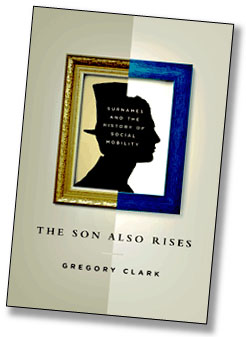
    I’ve since replaced it with a succession of tablets, all of which render the book just fine. But I’ve never gone back to reread it, and now Clark has a new book out, The Son Also Rises.1 His latest big idea is that status is remarkably stable over periods of centuries. Families that were well off in 1700 are, on average, still pretty well off. Basically, we suck at social mobility. Josh Harkinson interviewed him for Mother Jones:
    MJ: How do you measure status?

    GC: I have a number of different measures for different societies. So for England, where we have some of the best data, we know everyone who went to Oxford and Cambridge from 1200 to the present. That tells us who the educational elite were in England over 800 years, and then we can ask, “What are the names that are showing up in that elite, and how persistent is their appearance in this elite?”

    ….We find that there is a very strong persistence of elite families at the universities. In recent years, the universities have tried to become more meritocratic and more democratic: They admit students based on performance on national exams. They don’t give any privilege to the fact that your parents went there. And public financing for tuition is now available. But what we find is that elite families persist at Oxford and Cambridge at the same rate as they did in the 19th century. It hasn’t managed to change the rate of social mobility.

    Clark uses this strategy of following family names in other countries as well, and comes to similar conclusions. Is this legit? Are family names enough to figure out who’s going up and who’s going down? I have my doubts, but I haven’t read the book. And I have to say that my personal experience is a data point in favor of Clark’s thesis. Many years ago I got interested in genealogy and started digging up my family tree. Roughly speaking, I managed to go back about 200 years through most of my branches. And one of the things that intrigued me was just how homogeneous it all was. Some of my ancestors were better off than others, but mostly within a pretty narrow band. As near as I can tell, none of them were destitute and none of them were rich. They were small farmers, shopkeepers, linen drapers, sign painters, electricians, and stonecutters. Over seven or eight generations, social mobility has been pretty close to zero.

    So maybe there’s something to this. I’ll let you know what I think if I end up reading the book.

    1Yes, he’s apparently stuck on Hemingway puns. This is undoubtedly a rich vein for economists. Next up: To Have and Halve Not. Followed by For Whom the Swell Toils and The Gold Plan and Me.

  • There’s One Group of Voters Who Likes Chris Christie More Than Ever


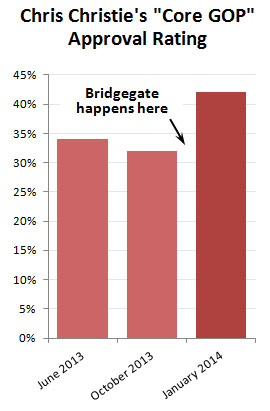
    Jonathan Bernstein notes today that Chris Christie’s poll numbers have actually risen among one particular group of voters: tea partiers. It’s a small sample from a single poll, so you don’t want to take this to the bank until we get confirmation. And yet:
    If true (and again: see caveats above), it’s a fascinating finding, confirming that for at least some non-trivial group of Republicans, all a politician has to do to win their favor is to get attacked by anyone outside of the conservative bubble.

    Which is, to put it bluntly, pathetic.

    But it does suggest — at least a little — the appeal of a Sarah Palin or a Herman Cain….Or, for that matter, the continuing appeal of Newt Gingrich to some conservatives despite his frequent and major deviations on public policy over the years. If the core credential for being a Real Conservative is to be attacked (by liberals? by the “neutral” news media? by prosecutors?), then demagogues, charlatans and the inept have a real advantage over responsible, competent politicians. Which really is a problem for the Republican Party, but beyond that, is an even more important problem, I would think, for actual ideological conservatives — that is, people who care about public policy and ideology, as opposed to being purely concerned with tribal allegiances.

    Partisans are always susceptible to circling the wagons when one of their own is attacked. But conservatives have turned victimization into a high art over the past few years—led, as Bernstein points out, by the high priestess of grievance and victimization herself, Sarah Palin. When reports surface that make you look bad, just spin them as desperate attacks against real American values by East Coast elitists and you’re golden. After all, if the lamestream media says you did something bad, then you must actually be doing something very, very good, amirite?

  • Quote of the Day: GOP in a Tailspin Over Debt Limit Increase


    From an anonymous Republican “leadership aide”:

    We are mulling other options and trying to figure out the best way forward on this.

    The topic here is the upcoming debt limit increase. Everyone in the Republican caucus with a room-temperature IQ knows that provoking yet another debt ceiling crisis would be a debacle. It didn’t work before, and it won’t work now. What’s worse, it takes attention away from Obamacare and reinforces the public view of Republicans as irresponsible grandstanders who are willing to risk the good credit of the United States for no reason except to kowtow to a bunch of know-nothing tea partiers.

    But it turns out that those know-nothings aren’t willing to accept reality yet. They’ve rejected the latest plan—which already demanded more than they were ever likely to get—and now the GOP leadership is stuck. The yahoos won’t let them back down further regardless of how much damage it might do. As a result, it looks an awful lot like Republicans are going to incite yet another debt ceiling crisis a few weeks from now, whether they want to or not. Buckle your seat belts.

  • EU Concludes Google Antitrust Action With a Whimper, Not a Bang


    The European Union has announced an agreement with Google that resolves a longstanding antitrust action. If you search for, say, gas grills, you’ll no longer see a results page with a bunch of Google ads for gas grills. You’ll see ads from both Google and others. Tim Lee explains:

    Instead of showing six Google-selected ads for gas grills, the results would show three gas grills from Google’s product search engine and another three ads from competitors. Google will be allowed to charge these competitors for including these ads at regulated rates comparable to those Google charges for inclusion in its own product search engine. Similar changes will be required in other cases where Google includes results from a specialized search engine in its general search results.

    Let me get this straight. There will now be two categories of ads. One will be “Google shopping results,” which you pay Google to be included in. The other will be “Alternatives,” which you pay comparable rates to Google to be included in. Both will be displayed next to each other.

    That’s not nothing, I guess, especially since advertisers will have more control over the presentation of their products in the “Alternatives” section. And there are some other tidbits in the agreement that also represent improvement, though they’re mostly things Google had previously agreed to implement. Unless I’m missing something, this seems like fairly small potatoes. School me in comments if I’m wrong about this.


  • Let’s Get Our Obamacare Story Straight, Folks


    Having just berated the nation’s news media for credulously reporting that Obamacare would result in the “loss” of 2 million jobs, I want to push back a bit in the other direction too. Here is Paul Krugman explaining that Obamacare doesn’t destroy jobs, but it does give people more freedom to work fewer hours without fear of losing access to the health care system:

    The basic point here is that we started with a system in which incentives were already strongly distorted by the deductibility of employer-paid health insurance premiums. This was a significant benefit, but one in general available only to full-time workers….What we had here was [] a system in which subsidies were available only if you worked more than a certain amount, surely leading some people to work more than they would have wanted to otherwise.

    And that’s not a hypothetical — I know a fair number of people in just that situation. I also know some people in “job lock” — feeling trapped in their current job because they aren’t sure they could get implicitly subsidized health insurance if they moved.

    Plenty of other liberals have made similar points, and there’s no question that there’s a kernel of truth to it. Someone who’s 62 might retire early because they know they can buy health insurance while they wait for Medicare to kick in. A young worker who wants to start up her own company might be more likely to do it knowing that she can still get coverage for a pre-existing condition. People who lose their jobs might hold out longer for good replacements if they know they can continue to get affordable health coverage while they look.

    But the CBO report was pretty clear that this is not really the main channel by which Obamacare reduces employment. It mostly reduces total hours of employment among the poor, which is why it estimates that employment will go down 2 percent but total compensation will only go down 1 percent. And the channel for this reduction is straightforward: workers lose Obamacare subsidies as their incomes go up, which makes it less attractive to work more hours. For instance, if you go from 135 percent of the poverty line to 140 percent of the poverty line—something that could happen by the addition of a mere two or three hours of work a week—you might lose access to Medicaid.

    More generally, the problem is that Obamacare subsidies decline smoothly as your income goes up. Here’s an example. If you and your partner earn $10 per hour and your family income is $30,000, you’ll pay about $1,250 out of pocket for health insurance. Subsidies cover the rest. But if you work an extra six hours a week and increase your income to $33,000, your premium cost goes up to about $1,600. That’s not a huge difference, but it means that effectively you’re only making $8.80 for each of those extra hours you work. At the margins, there will always be a few people who decide that’s not worth it, and will decide to keep their old hours. That’s especially true since their family now has health coverage and doesn’t have to worry quite so much about catastrophic expenses.

    You can decide for yourself whether this is good or bad. In any case, it’s not something unique to Obamacare. It’s a feature of every means-tested welfare program ever. And it’s the main reason that employment will decline. Not because of early retirees or folks who are now free to tell their bosses to take this job and shove it. It’s mainly because it will cause a certain number of poor people to decide that working extra hours doesn’t pay enough to be worth it.

  • How Did the Media Blow It So Badly on Yesterday’s CBO Report?


    Yesterday the CBO released a long-term budget analysis that included a chapter about the effect of Obamacare. Among other things, the report concluded that in 2017 and beyond, it would have the effect of reducing employment by about 2 million jobs. This produced a gigantic raft of misleading headlines—some from outlets like Fox News, of course, but also from a wide variety of mainstream news sources. Among many others, Glenn Kessler of the Washington Post then explained what the CBO report really meant. Erik Wemple tells the story:
    For a while [Tuesday] morning, the Internet was hopping with job-killing hype, when in fact the truth was vastly different. Obamacare’s impact, the CBO concluded, would lessen the supply of labor by encouraging certain folks not to work: “The estimated reduction stems almost entirely from a net decline in the amount of labor that workers choose to supply, rather than from a net drop in businesses’ demand for labor, so it will appear almost entirely as a reduction in labor force participation and in hours worked. . . .”

    For someone approaching retirement, notes Kessler, Obamacare could well mean that they needn’t hold onto a bad job just to keep health insurance. That’s a far different dynamic from job-killing.

    To illustrate just how the media had handled the CBO study, Kessler’s post included a number of headlines harvested from the Internet this morning, amid a backlash highlighting the finer points of the CBO report. In some cases, headline changes ensued; in others, news outlets stuck to their original phrasing. Below, we chronicle some of the action….

    This is a debacle. I came into this story pretty cold, reading about the CBO report and then clicking on a link to take a look at it. At the time, I hadn’t read any news accounts, so I just scrolled down to the chapter on Obamacare and spent about ten minutes browsing through it. And here’s the thing: the CBO’s conclusions were crystal clear. The report explained in simple language what effect Obamacare was likely to have and what channels it worked through. It even had a handy bullet list showing the most important causes of lower employment.

    And yet, lots of reporters and headline writers got it wrong. It’s crazy. This is policy 101, not some deeply technical report that you need a data sherpa to understand. Obamacare doesn’t kill jobs. It makes people more secure and thus less likely to keep a job they don’t want—or to work more hours than they need to just to stay eligible for health insurance. It also, like all means-tested programs, provides a modest disincentive for poor people to work more hours, since extra income will be accompanied by lower subsidies.

    This is easy stuff. How is it that so many folks blew it? Obviously Fox News deliberately wanted to put the worst spin possible on this report. But why did everyone else go along? What’s the deal here?

  • If Hillary Runs, What Exactly Will She Run On?


    Hillary Clinton may be the 800-pound gorilla among Democratic presidential candidates for 2016, but Andrew Sullivan thinks she has two big weaknesses:

    What are her defining issues? Will she run on Obamacare—ensuring its success? Will she run on climate change? Or protection of entitlements? How would her foreign policy differ from Obama’s? Until we get a sense of where she is headed as far as policy is concerned, she runs the risk of appearing as some kind of large juggernaut that simply has to be elected, well, just because. Maybe being the first woman president would render all these other issues moot. But at some point, she will have to enter the fray. I’m not sure she’s actually fully prepped for that. Her campaigning and speaking skills are not as impressive as Obama’s.

    But more importantly for me is the inability of her supporters to answer a simple question. I was having dinner with a real Clinton fan the other night, and I actually stumped him (and he’s not easily stumped). What have been Hillary Clinton’s major, signature accomplishments in her long career in public life? What did she achieve in her eight years as First Lady exactly? What stamp did she put on national policy in her time as Senator from New York? What were her defining and singular achievements as secretary-of-state?

    I count myself as an admirer of Hillary Clinton, but I agree about this. As first lady, she was the driving force behind health care reform, but that failed miserably. And now that Obamacare has been passed, it’s not an issue big enough to base a campaign on. As senator, she was known for working well across the aisle and being an effective representative for New York, but there are no big legislative victories to her name. And as secretary of state, she once again gained a reputation as diligent and effective, but not as a game changer. John Kerry may or may not end up accomplishing any more than Hillary did, but at least he’s showing some ambition.

    And Hillary has another problem too: By 2016 she will have been in the public eye for 24 years. That’s unprecedented. In the modern era, Richard Nixon holds the record for longest time in the public eye—about 20 years—before being elected president.1 The sweet spot is a little less than a decade. Longer than that and people just get tired of you. They want a fresh face. That’s largely what happened to Hillary in 2008, and it could happen again in 2016.

    But hey: Records are made to be broken, and presidential candidates don’t always have a big signature issue to run on. Most of them don’t, in fact. For now, Hillary is still the clear front-runner. Until she isn’t, anyway.

    1In the political arena, that is. Ronald Reagan was famous for 40 years before he was elected president, but he only became prominent as a national political figure in the early ’60s.