• Two Brief Notes About the VA Scandal


    I have a couple of things related to the VA scandal that I wish everyone would get straight on:

    • There is a difference between (a) the backlog in initial applications for VA benefits and (b) wait times for appointments at VA hospitals. They are completely different things with completely different roots. Don’t slide confusingly between the two in a single story.
    • You should always try to compare the performance of the VA to private sector care. Saying that the average wait time for non-urgent appointments is 23 days tells us nothing. Is that longer or shorter than it is elsewhere? Ditto for treatment mistakes, breadth of service, availability of pharmaceuticals, etc. All large organizations have large numbers of problems. That’s inevitable. The only way to judge them properly is to compare them to other large organizations doing the same thing.

    That’s all for now. I might have more later.

  • Please Help Me Interpret Michael Kinsley


    Yesterday I was pondering whether to write something about the great Kinsley-Greenwald-Sullivan-Etc. contretemps related to Michael Kinsley’s unflattering review of Glenn Greenwald’s latest book. Long story short, I think the entire thing is idiotic, and maybe I’ll blather about that at greater length someday. Then again, maybe not.

    But there is one thing I’d like to get a crowdsourced opinion about. Here’s a paragraph Kinsley wrote about whether people like Greenwald have the right to expose secrets that the government thinks are dangerous to reveal:

    The question is who decides. It seems clear, at least to me, that the private companies that own newspapers, and their employees, should not have the final say over the release of government secrets, and a free pass to make them public with no legal consequences. In a democracy (which, pace Greenwald, we still are), that decision must ultimately be made by the government. No doubt the government will usually be overprotective of its secrets, and so the process of decision-making — whatever it turns out to be — should openly tilt in favor of publication with minimal delay. But ultimately you can’t square this circle. Someone gets to decide, and that someone cannot be Glenn Greenwald.

    So here’s my question: what do you think Kinsley is trying to say in the bolded passage? Here are a few possibilities:

    1. The government should adopt policies that reduce the number of secrets it keeps.
    2. When the press gets its hands on a secret, it should “tilt” in favor of publication—but the government should still get the final say.
    3. When the press gets its hands on a secret, it should “tilt” in favor of publication—but it should also listen seriously to the government’s arguments in favor of continued secrecy.
    4. Something else.

    For what it’s worth, my interpretation of this was #2. Is this wrong? Help me out in comments. What’s your reading of this?

  • Here’s Why Trade Schools Continue to Suck So Badly


    For-profit colleges—aka trade schools—have a terrible track record. On average, their students rack up tons of debt and very few of them ever graduate. So why is it so hard to do something about them? Henry Farrell asks Suzanne Mettler about the politics of these schools:

    Democrats worried about poverty used to defend for-profit colleges against fiscally conservative Republicans. Now Republicans (together with a few Democrats) are defending for-profit colleges against Democrats and reformers. Why did the partisan politics of for-profit education change so dramatically over a couple of decades?

    During the Reagan Administration, Secretary of Education William Bennett criticized the for-profits as “diploma mills designed to trick the poor into taking on federally-backed debt,” and in 1990, Sens. Bob Dole and Phil Gramm introduced legislation to regulate them. Since the mid-1990s, however, GOP critics vanished after some party leaders began to champion the for-profits as a private-sector alternative to the higher education establishment. Given the dynamics of rising partisan polarization, the rank-and-file quickly fell in line. Some Democrats now seek to represent constituents who have been taken advantage of by such schools and incurred unpayable debts, but others continue to defend them.

    Lovely, isn’t it? Democrats were finally ready to concede a point to Republicans, but apparently the horror of bipartisan agreement was too much for them. Still, I suppose there was never any real prospect of agreement anyway. I imagine that Republicans merely wanted to axe federal funding and let it go at that, while Democrats probably wanted to make for-profit schools perform better. The fundamental chasm between wanting to help poor people and not caring about poor people was undoubtedly never in any danger of being bridged.

  • Count Me Skeptical About the Latest “Hot Hands” Research


    Via Andrew Sullivan, Jay Caspian Kang relays the results of a new study on gambling:

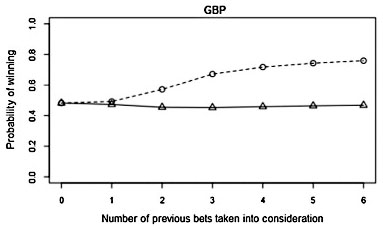
    Juemin Xu and Nigel Harvey, the study’s authors, took a sampling of 569,915 bets taken on an online sports-gambling site and tracked how previous wins and losses affected the probability of wins in the future. Over all, the winning percentage of the bets was somewhere around forty eight per cent. Xu and Harvey isolated the winners and tracked how they fared in their subsequent bets. In bet two, winners won at a rate of forty-nine per cent. From there, the numbers go haywire. A player who had won two bets in a row won his third bet at a rate of fifty-seven per cent. His fourth bet won sixty-seven percent of the time, his fifth bet seventy-two.

    ….Winning and losing streaks had no correlation with the skill or risk aversion of the gambler…. What the research did find was that gamblers on streaks—good or bad—acted under the influence of the gambler’s fallacy. Winning bettors began placing more prudent bets because they assumed their luck would soon run out. Losers began placing bets with longer odds because they wanted to win big when their luck finally, inevitably changed.

    Can I point out that this makes no sense? If it’s true, it implies that there are “prudent” bets that regularly pay off 72 percent of the time—bets that streaky players identify instinctively. If you could carefully restrict yourself to just those bets, you’d clean up.

    Now, sure, maybe those are short-odds bets that don’t pay much. But it turns out they aren’t all that short:

    Among all GBP gamblers [i.e., those gambling in British pounds], the mean level of selected odds was 7.72. After a winning bet, lower odds were chosen for the next bet. The mean odds dropped to 6.19. Following two consecutive winning bets, the mean odds decreased to 3.60. People who had won on more consecutive occasions selected less risky odds. This trend continued.

    Fine. But odds of 3.60 still don’t pay off more than half the time. The fact that people on a streak place bets with odds like this does not, not, not explain why they’re winning so often. After all, if prudent bets were all it took to win regularly, pros could identify them routinely and place huge sums on these sure winners. A modest payoff would still produce big paydays. This is not the way casinos work.

  • The US Economy Flatlined Last Quarter


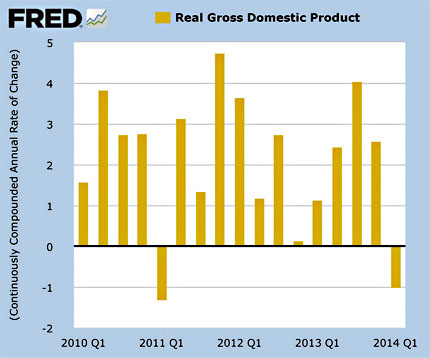
    Yikes. GDP wasn’t just flat in the first quarter. According to the final revision of the numbers, it actually plummeted by 1 percent. But analysts don’t seem too worried:

    The bulk of the downward revision in gross domestic product was driven by reduced additions to inventories by businesses as well as a slightly weaker trade balance than first thought. The smaller stockpiles alone subtracted 1.6 percent from the growth rate.

    “Ouch,” said Ian Shepherdson, chief economist at Pantheon Macroeconomics, in a note to clients immediately after the release of the report. “The bad news is that the headline G.D.P. number is worse than consensus, but the good(ish) news is that almost all the hit is in the inventory component.”

    To be sure, lower additions to inventories by businesses in the first quarter suggest that factor won’t weigh on growth as much in the second quarter, when other economic indicators are expected to pick up. Most economists expect the growth rate to rise to 3 to 4 percent in the second quarter.

    Maybe it was just due to all that bad weather everyone was talking about when the initial estimate was released. I sure hope so.

  • Mitch McConnell Digs Himself Deeper and Deeper Over Obamacare


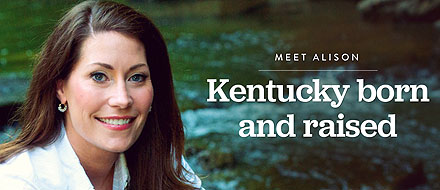
    I don’t usually spend too much time on local horse race stuff, but Kentucky is a little different. After all, Mitch McConnell is the minority leader in the Senate, and his Democratic challenger this year, Alison Lundergan Grimes, is running a surprisingly strong campaign. So perhaps Kentucky deserves some extra special attention. Surprisingly, it turns out that Obamacare, of all things, is causing McConnell some serious heartburn.
    You see, unluckily for McConnell, Kentucky has possibly the best, most popular Obamacare exchange in the country—though nobody calls it an Obamacare exchange, of course, since Obamacare is the work of Satan. It’s called Kynect. Everybody loves Kynect. So when McConnell was asked recently if he favored getting rid of Kynect, he had a problem. It’s Obamacare, and he’s on record favoring the root-and-branch repeal of Obamacare. But Kynect is popular. Nobody wants to see a root-and-branch repeal of Kynect. What to do?

    So far, McConnell has taken a creative approach to this dilemma: He basically denies that Kynect has anything to do with Obamacare. McConnell remains in favor of total repeal of Obamacare, but says this wouldn’t cause any problems with Kynect. It would just keep motoring along without missing a beat.

    Now, this is a little peculiar. Politicians tell whoppers all the time, but usually they do it cleverly enough that they can somehow defend themselves. This, on the other hand, is just a flat-out fantasy. Without Obamacare, there’s no exchange; there’s no federal funding; there are no subsidies; there’s no community rating; and there’s no mandatory coverage of people with pre-existing conditions. Kynect is dead, and everyone knows it. It’s hard to imagine even Fox News somehow twisting this to claim that McConnell is staking out a defensible position.

    So far, Grimes has been a little tentative about attacking McConnell over this. After all, she has exactly the mirror-image problem: She wants to express her undying support for Kynect but without ever mentioning the dreaded word “Obamacare.” Greg Sargent says he feels her pain, but nonetheless thinks this is a good opportunity to tighten the screws on McConnell further:

    As Joe Sonka points out in a good piece, McConnell is betting that press coverage won’t clearly explain to voters just how absurd his position really is. But perhaps now that Grimes is engaging on the issue — to some degree, at least — that could serve as a hook for top shelf reporter and commentator types to take a peek at what’s really going on here.

    It should be self evidently newsworthy that the leader of Senate Republicans, who have based their entire 2014 strategy on the idea that Obamacare is a long term political disaster and massive repudiation of liberal governance, refuses to take a clear position of his own on the law’s future in the state he would represent, and on whether hundreds of thousands of his own constituents should continue to enjoy its benefits.

    Well, we’ll see. McConnell is a crafty old survivor, and the odds remain pretty strongly in his favor even if he isn’t making any sense about Kynect. Still, stuff like this makes me wonder if Grimes has a better chance of beating him than I would have thought. There’s some real opportunity here if she can figure out how best to keep McConnell twisted into knots over this.

  • Obama: Some of America’s “Most Costly Mistakes” Come From Relying Too Much on the Military


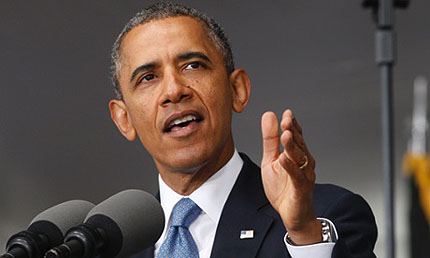
    President Obama today:

    To say that we have an interest in pursuing peace and freedom beyond our borders is not to say that every problem has a military solution. Since World War II, some of our most costly mistakes came not from our restraint but from our willingness to rush into military adventures without thinking through the consequences, without building international support and legitimacy for our action, without leveling with the American people about the sacrifices required. Tough talk often draws headlines, but war rarely conforms to slogans. As General Eisenhower, someone with hard-earned knowledge on this subject, said at this ceremony in 1947, “War is mankind’s most tragic and stupid folly; to seek or advise its deliberate provocation is a black crime against all men.”

    ….America must always lead on the world stage. If we don’t, no one else will. The military that you have joined is, and always will be, the backbone of that leadership. But U.S. military action cannot be the only, or even primary, component of our leadership in every instance. Just because we have the best hammer does not mean that every problem is a nail.

    It’s nice to hear Obama say this so directly. Oh, the usual suspects will howl, but no one who has paid even the slightest attention to the history of the past 50 or 60 years can really question this. Our world isn’t yet beyond the need for war, but for war to be an effective instrument of policy it needs to be used judiciously. It needs to be used when core interests are at stake and, equally importantly, it needs to be used only when it’s likely to succeed on its own terms. If we don’t know how to win, or if we have unrealistic ideas of what it even means to win—both of which were the case in Afghanistan and Iraq—then we shouldn’t fight. This isn’t a matter of deep foreign policy thinking, it’s just common sense. Like it or not, there are lots of problems in the world that US military force can’t solve.

    On another note, I was intrigued, toward the end of Obama’s speech, at the parts that got applause from the West Point cadets. Here’s a sample:

    Having other nations maintain order in their own neighborhoods lessens the need for us to put our own troops in harm’s way. It’s a smart investment. It’s the right way to lead. (Applause.)….What makes us exceptional is not our ability to flout international norms and the rule of law; it is our willingness to affirm them through our actions. (Applause.)

    And that’s why I will continue to push to close Gitmo, because American values and legal traditions do not permit the indefinite detention of people beyond our borders. (Applause.) That’s why we’re putting in place new restrictions on how America collects and uses intelligence, because we will have fewer partners and be less effective if a perception takes hold that we’re conducting surveillance against ordinary citizens. (Applause.)….We’re strengthened by civil society. We’re strengthened by a free press. We’re strengthened by striving entrepreneurs and small businesses. We’re strengthened by educational exchange and opportunity for all people and women and girls. That’s who we are. That’s what we represent. (Applause.)

    The cadets were applauding multinational engagements, international law, closing Guantanamo, cutting down on the surveillance state, and the use of soft power. I confess that I wouldn’t have guessed that these points would get the strongest response from an audience of West Point graduates. But I’m not sure if that says more about them or me.

    David Corn has some more thoughts about Obama’s speech here, and Max Fisher has a pretty good rundown here of both the benefits and the pitfalls of Obama’s approach. I think he goes too far when he describes it as a “superdove foreign policy doctrine,” but his criticisms are worth reading anyway.

  • The Scorecard in Ukraine Is Murkier Than Most Pundits Think


    Doyle McManus says that Vladimir Putin has played a shrewd game in Ukraine:

    Here’s the score card: Putin has pocketed Crimea, the first territory in Europe to be seized by force since World War II. (On paper, the United States and the European Union are still demanding that he give the peninsula back to Ukraine, but in private, their leaders concede that’s unlikely to happen.) He has forced the European Union to put the brakes on Ukraine’s progress toward membership in the Western economic club. He has kept most of Russia’s business with the West intact and signed a big new natural gas deal with China. Now all he has to do is wait for Western attention to Ukraine’s travails to wane, as it probably will.

    ….”Even [Petro] Poroshenko is saying it’s time for normalization with Moscow,” she noted. “He knows who’s going to call the shots over Ukraine’s future: not Brussels, not Washington. It’s Moscow.”

    This isn’t a ridiculous read of the situation, but I think it’s missing something key: compared to what? Sure, Putin might have found a way to salvage his disastrous intervention in Ukraine, but the right way to look at this is to compare Russia’s situation now to its situation in, say, October of last year. It’s true that Putin scuttled Ukraine’s free-trade deal with the EU, but look at the fallout. In order to turn things around after his incompetent diplomatic efforts failed, Putin was forced to intervene so clumsily that it inspired the Maidan protests that ended up causing Ukraine’s president to flee. He massed troops on Ukraine’s borders and used Russian special forces—again, disguised so clumsily that no one was fooled for even a second—to try to force a secession of the east. When that failed, Putin was forced to back down. He can pretend that he never had any intention of using military force in the first place, but no one takes that seriously and he knows it. His threat failed because the Russian military is weak and the American/EU sanctions had already begun to bite. He was hoping for a bloodless takeover, but he miscalculated badly and failed to get it.

    So what’s the scorecard? On the plus side, Putin has Crimea. Maybe all by itself that was worth it—and if he’d been smart enough to stop there he might have come out ahead. But on the downside, Putin has demonstrated once again that Russia isn’t a reliable supplier of natural gas and will use it as a club whenever it feels like it. He’s earned the enmity of most of his neighbors. He’s gained nothing in Ukraine except the end of the EU association agreement, which was never a huge threat in the first place and will probably end up being implemented piecemeal over the next few years anyway. He’s damaged the Russian economy and set back relations with Europe. And sure, Poroshenko is saying it’s time for normalization with Moscow, but Putin had that back when Viktor Yanukovych was president.

    So….Crimea. And possibly a slowdown in the pace of Ukraine’s integration with the West. That’s about it. But I wouldn’t underestimate the cost of this to Putin. Threats of military force are flashy, but unless you’re willing to back them up regularly, they do a lot more harm than good. I’m not sure why so many people who are generally clear-sighted about the drawbacks of military action suddenly get so smitten by it when it’s wielded by a thug like Putin. Hell, he doesn’t even use it well.

    When the dust settles, it’s hard to see Putin gaining much from all this in the places that count. Regardless of the brave face they put on it, I’ll bet there aren’t many people in the inner sanctums of the Kremlin who think of the past six months as much of a triumph for Russia.

  • Obama Makes Pointless Gesture on Immigration. But Why?


    President Obama has decided to delay action on a recommendation to reduce the number of deportations along the border:

    President Obama has directed the secretary of Homeland Security to delay until after the summer a deportation enforcement review that officials feared would anger House Republicans and doom any lingering hopes for an immigration overhaul in Congress this year, officials said Tuesday night….“There are a number of folks suggesting that anything that the administration does could become an excuse for inaction in the House,” said Cecilia Muñoz, the director of the White House Domestic Policy Council and the president’s top immigration adviser.

    There are several ways to read this. The first is that it really is an olive branch for Republicans, a demonstration that Obama doesn’t want to do anything to derail the prospects of immigration reform. The second is that it’s a threat: pass immigration reform or else Obama is going to do it on his own—and Republicans will end up with none of the things they wanted. The third is that this is basically aimed at voters. Obama is once again trying to show that he’s the most reasonable guy in Washington, bending over backward to make concessions even in the face of total intransigence from Republicans.

    I suppose there’s a bit of all of these, but I suspect it’s mostly #3. My read of the political situation is that comprehensive immigration reform is absolutely, irrevocably, completely dead, and there’s nothing anyone can do about it. So neither concessions nor threats make any difference. Obama isn’t a fool and must know this, which means the real audience for this announcement isn’t on Capitol Hill. It’s voters, pundits, interest group, and the media. In a nutshell, Obama doesn’t want to give the Ron Fourniers of the world any excuse to pretend that he’s the one who scuttled the chances of passing a bill.

  • For Some, 13 Years Still Not Long Enough in Afghanistan


    President Obama has finally announced his plan to withdraw from Afghanistan:

    Under the plan, outlined by Mr. Obama in the Rose Garden, the United States would leave 9,800 troops in Afghanistan after 2014, but cut that number by half in 2015. By the end of 2016, it would keep only a vestigial force to protect the embassy in Kabul and help the Afghans with military purchases and other security matters.

    That’s fine. The part that’s going to be hard to take is the inevitable knee-jerk bellowing it provokes from the McCain/Kristol faction. What’s it going to be this time? America losing its standing in the world? A lack of guts from a weak-kneed president? Emboldening our enemies? Well, here’s Rip van McCain:

    The President’s decision to set an arbitrary date for the full withdrawal of U.S. troops in Afghanistan is a monumental mistake and a triumph of politics over strategy…..Today’s announcement will embolden our enemies and discourage our partners in Afghanistan and the region. And regardless of anything the President says tomorrow at West Point, his decision on Afghanistan will fuel the growing perception worldwide that America is unreliable, distracted, and unwilling to lead.

    Got it. How about Rip van Kristol? He doesn’t seem to have weighed in yet, but here’s Gary Schmitt subbing in for Kristol at the Weekly Standard:

    The decision to halve and then zero out those forces by 2016 is a reminder not only of how seriously unserious this president on strategic matters can be but also how cynically partisan he is….I suppose if there is any positive thing that might come out of the president’s ploy it’s that conservatives will get to see pretty quickly which of the GOP contenders in 2016 has a strategic backbone.

    There you have it: no cliche left unturned. We’re emboldening our enemies. America is unwilling to lead. Obama is unserious about national security. Conservatives need to stand up and show some backbone. It’s as if these guys jerked awake after ten years and started reciting whatever anti-liberal boilerplate happened to be most recently on their minds.

    I guess it’s nice to know that some things never change, regardless of facts on the ground. After 13 years (!), we still haven’t stayed in Afghanistan long enough. I’m pretty sure that it could be 2114, and the McCain crowd would continue to insist that if we just gave it a few more years we could finally wipe out the Taliban once and for all.

    UPDATE: I just caught a few minutes of Kristol on Crossfire. He usually keeps his cool pretty well, but not this time. He was hot, hot hot. From memory, a few of his comments were “unbelievably irresponsible,” “Obama has sent tens of thousand of troops there and now he’s making their sacrifice in vain,” and “what’s the lesson for anyone around the world who wants to stand with us?” It’s the cliche trifecta!