
• A Health Care Scandal That’s Way Bigger Than the VA


    The VA hospital scandal is basically composed of two separate things:

    1. A longstanding problem of excessive wait times for non-urgent appointments as well as problems with access to the VA system in the first place.
    2. A specific and recent case of hospital officials allegedly gaming the system by putting some vets on a “secret” waiting list so that the performance reports they submitted to Washington would look better than they really were.

    We’ve heard a lot about #1, but this is largely a policy problem, not a scandal. No administration has ever secured enough resources from Congress to properly staff the VA system, and the result has been waiting lists and backlogs. In the past few years this has started to improve as more vets have been allowed into the system; funding has increased; mental health has become a bigger priority; the paper-based approval process has become more automated; and the backlog of vets waiting for approval has been cut in half.

    The real scandal—in the normal sense of “scandal” as opposed to inefficiency and underfunding—is #2. As scandalous as these charges are, however, they’re localized; small; and entirely nonpartisan. Everyone agrees that heads need to roll if they’re confirmed. That’s in stark contrast to a far, far larger denial of medical services to sick Americans that could be fixed instantly if there were the political will to do it. Ezra Klein explains:

    It’s a relief to see so much outrage over poor access to government-provided health-care benefits. But it would be nice to see bipartisan outrage extend to another unfolding health-care scandal in this country: the 4.8 million people living under the poverty line who are eligible for Medicaid but won’t get it because their state has refused Obamacare’s Medicaid expansion.

    As appalling as the wait times are for VA care, the people living in states that refused the Medicaid expansion aren’t just waiting too long for care. They’re not getting it at all. They’re going completely uninsured when federal law grants them comprehensive coverage. Many of these people will get sick and find they can’t afford treatment and some of them will die. Many of the victims here, by the way, are also veterans.

    ….All in all, the Kaiser Family Foundation estimates that more than 7.5 million uninsured adults would be eligible for Medicaid but live in a state that has refused the expansion….The point here isn’t to minimize the problems at the VA, which need to be fixed — and fast. But anyone who feels morally outraged over the extended wait times at the VA should be appalled by the literally endless wait times the poor are enduring in the states that are refusing to expand Medicaid.

    Fat chance of that, I suppose. Nonetheless, it’s at least as big a scandal as VA #1, and far, far bigger than VA #2.
  • Teenagers Are No Longer the Scary Delinquents of 30 Years Ago


    Sarah Kliff says today’s teenagers are “the best-behaved generation on record”:

    The Centers for Disease Control released a monster report last week on the state of Americans’ health. The 511-page report makes one thing abundantly clear: teens are behaving better right now than pretty much any other time since the federal government began collecting data.

    The teen birth rate is at an all-time low….High school seniors are drinking less, smoking less, and barely using cocaine….

    And, of course, the rate of violent crime has plummeted among teenagers, as Dick Mendel documents here. At the risk of sounding like a broken record, I’d suggest that all of this is at least partially the result of the end of leaded gasoline in America.

    What’s happening today isn’t an aberration. Teenagers from the mid-60s through the mid-90s were the aberration. We managed to convince ourselves during that era that something had gone permanently wrong, but it wasn’t so. The ultra-violent gangs and reckless behavior that became so widespread simply wasn’t normal, any more than expecting teenagers to sit around in kumbaya circles would be normal. Nor had anything gone fundamentally wrong with our culture. It was the result of defective brain development caused by early exposure to lead.

    I’ll never be able to prove this. No one ever will. The data is simply not rich enough, and it never will be. Nevertheless, what evidence we do have sure points in this direction. And here’s why it’s important. Even if we never clean up another microgram of lead, we’ve nonetheless cleaned up most of the lead that we poisoned our atmosphere with in the postwar years. So if the lead hypothesis is true, it means that our default fear of teenagers—beaten into us during the scary lead years—is no longer accurate. They simply aren’t as dangerous or as reckless as they used to be, and that isn’t going to change. We don’t need to be as frightened of them as we used to be. In the same way that we have to get over economic fears rooted in the 70s or the Great Depression that are no longer meaningful, we need to get over our widespread fear of teenagers that’s no longer meaningful either.

    Today’s teenagers have grown up with more or less normal brain development. Some will be nice kids, some will become gang leaders. That’s always the case. But speaking generally, if you meet a group of teenagers today, they’re no more likely to be especially scary than they were in the 40s or 50s. They’re just teenagers. It’s probably going to take a while for everyone to adjust to this, but the time to start is now. Decently behaved teenagers are here to stay.

  • Patent Court Judge Steps Down After Cozy Relationship to Patent Attorney Becomes Public


    Tim Lee writes about a recent scandal at the federal circuit court that specializes in patent cases:

    Last week Judge Randal Rader, the court’s chief judge, admitted that he wrote an effusive email to [patent attorney Edward] Reines. The email praised the attorney’s work and encouraged him to share the email with potential clients, a breach of judicial impartiality. The revelation has forced Rader step down as the court’s chief effective this Thursday. Rader plans to stay on the court as a circuit judge. The Federal Circuit was also forced to re-consider two cases involving Reines after Rader retroactively recused himself from them.

    Rader’s indiscretion is the last straw for Jeff John Roberts of GigaOm (no relation to the chief justice, as far as I know), who writes: “the Federal Circuit looks beyond salvaging. It’s time for Congress to disband the court.”

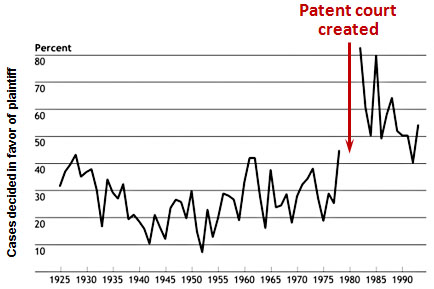
    The problem with the patent court is that it seems to have suffered the equivalent of regulatory capture. I don’t know the backgrounds of the judges on the court, but they’re awfully prone to upholding patent claims. They’re sympathetic both in terms of broad legal interpretations—widening the scope of software patents far beyond what Supreme Court precedent requires (or even suggests)—and they’re sympathetic in terms of specific cases, where they rule in favor of plaintiffs well over half the time (see chart on right).

    I don’t know if getting rid of the patent court and simply allowing patent cases to be heard by ordinary circuit courts is the right answer. That’s how patent cases used to be heard, but there’s been a lot of water under the bridge since then. Besides, that would require congressional action, and what are the odds of that? What’s more, if Congress did rouse itself to do something about this, a better course of action would be legislation that explicitly reins in the scope of software patents and does more to make patent trolling less lucrative. That would be the right thing to do. We can keep hoping, anyway.

  • Friday Cat Blogging – 23 May 2014


    I know that I’ve put up versions of this photo before, but I like it a lot, so here’s another one taken earlier this week. The cat outline is so stark you’d almost think it was a fake shadow dropped in via Photoshop (a la MST3K), but it’s real. My Photoshop skills don’t extend to stuff like this.

    One of these days, I’ll get the perfect photo, taken at just the right time of day to catch the light best and just the right time of year for maximum foliage and with Domino posed in just the right way. Someday! Unfortunately, whenever Domino sees me pointing the camera at her, she gets up and trots over, so I don’t usually have much time to get a good shot. You can’t tell from this photo, but she’s looking straight at the camera, and sure enough, she got up and headed my way just a few seconds later. Catblogging is trickier than it looks.

  • Chris Giles Challenges Thomas Piketty’s Data Analysis


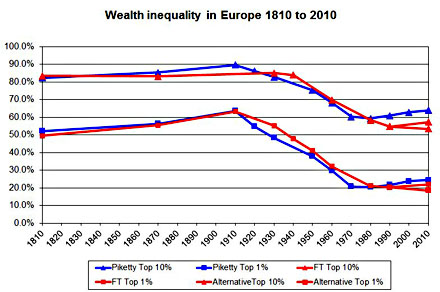
    Chris Giles of the Financial Times has been diving into the source data that underlies Thomas Piketty’s Capital in the 21st Century, and he says he’s found some problems. The details are here. Piketty’s response is here.

    Is Giles right? Experts will have to weigh in on this. But Giles’ objections are mostly to the data regarding increases in wealth inequality over the past few decades, and the funny thing is that even Piketty never claims that this has changed dramatically. The end result of Giles’ re-analysis of Piketty’s data is on the right, with Piketty in blue and Giles in red. As you can see, Piketty estimates a very small increase since 1970.

    Now, if Giles is right, and there’s been no increase at all, that’s important. But it’s still a surprisingly small correction. The fundamental problem here is that the difficulties of measuring wealth are profound enough that it’s always going to be possible to deploy different statistical treatments to come to slightly different conclusions. There’s just too much noise in the data.

    In any case, I’m not taking any sides on this. The data analysis is too arcane for a layman to assess. But it’s worth keeping an eye on.

  • Amazon’s War Against Book Publishers Goes Into Nuclear Territory


    Amazon.com, the company run by the psychopathically competitive Jeff Bezos, is apparently upping the ante into nuclear territory in its contractual dispute with book publisher Hachette:

    The retailer began refusing orders late Thursday for coming Hachette books, including J.K. Rowling’s new novel. The paperback edition of Brad Stone’s “The Everything Store: Jeff Bezos and the Age of Amazon” — a book Amazon disliked so much it denounced it — is suddenly listed as “unavailable.”

    In some cases, even the pages promoting the books have disappeared. Anne Rivers Siddons’s new novel, “The Girls of August,” coming in July, no longer has a page for the physical book or even the Kindle edition. Only the audio edition is still being sold (for more than $60). Otherwise it is as if it did not exist.

    Well, at least this is a war between equals. That makes it a little easier to stomach than Amazon’s routine attempts to strong-arm boutique publishers after sweet talking them into making Amazon such a big part of their business that they can no longer survive without them.

    But it’s also why I’m so unhappy over the inevitable demise of Barnes & Noble. It seems inevitable, anyway, and when it happens Amazon will be essentially the only source left for e-books. At that point, Amazon will no longer have any real incentive to improve its crappy e-reader, but we’ll all be stuck with it anyway. Yuck. I don’t have a ton of choices even now, but at least I have some.

    I dunno. Is there some way for the Justice Department to demand that Amazon figure out a way to make its DRM accessible by third parties so that we can have a thriving market in e-readers? I don’t really understand the tech well enough to know whether that’s possible. But Amazon already has near-monopoly control of the e-book market, and if B&N does eventually die, Amazon will basically have total control. Isn’t that supposed to be a bad thing?

  • Law Enforcement vs. the Hippies


    Paul Waldman writes today about how lefty protest groups get treated differently from right-wing protest groups:

    The latest, from the New York Times, describes how law enforcement officials around the country went on high alert when the Occupy protests began in 2011, passing information between agencies with an urgency suggesting that at least some people thought that people gathering to oppose Wall Street were about to try to overthrow the U.S. government. And we remember how many of those protests ended, with police moving in with force.

    ….If you can’t recall any Tea Party protests in 2009 and 2010 being broken up by baton-wielding, pepper-spraying cops in riot gear, that’s because it didn’t happen. Just like the anti-war protesters of the Bush years, the Tea Partiers were unhappy with the government, and saying so loudly. But for some reason, law enforcement didn’t view them as a threat.

    Maybe this is because lefties don’t complain enough. You may remember the hissy fit thrown by Fox News when the Department of Homeland Security issued a report suggesting that the election of a black president might spur recruitment among right-wing extremist groups and “even result in confrontations between such groups and government authorities similar to those in the past.” As it turns out, that was a good call. But the specter of jack-booted Obama thugs smashing down the doors of earnest, heartland Republicans dominated the news cycle long enough for DHS to repudiate the report under pressure and eventually dissolve the team that had produced it.

    And the similar report about left-wing extremism that DHS had produced a few months earlier? You don’t remember that? I don’t suppose you would. That’s because it was barely noticed, let alone an object of complaint. And even if lefties had complained, I doubt that anyone would have taken it seriously. There’s just no equivalent of Fox News on the left when it comes to turning partisan grievances into mainstream news.

    There’s probably more to it, though. Mainstream lefties just don’t identify with the far left as a key part of their tribe. They’ll get a certain amount of support, sure, but they’ll also get plenty of mockery and derision, as the Occupy protesters did. On the right, though, extremists are all members of the tribe in good standing as long as they stop short of, say, murdering people. They only have to stop barely short, though. Waving guns around and threatening to kill people is A-OK, as Cliven Bundy and his merry band of armed tax resistors showed.

    So when DHS produces a report suggesting that right-wing extremism might turn out to be a growth industry in the Obama era, the ranks of the conservative movement close. An attack on one is an attack on all, and Fox News stands ready and willing to turn the outrage meter to 11. Rinse and repeat.

  • It’s Time to Stop the Immigration Reform Charade


    John Boehner says he’d really, really love to pass immigration reform, but darn it, President Obama’s arbitrary and lawless regulatory changes to Obamacare make that impossible. Republicans no longer trust Obama to enforce whatever law they pass, so they’re stuck.

    This is a contrivance so obvious that I think most five-year-olds could see through it, but that’s Boehner’s story and he’s sticking to it. So Harry Reid has now made official what used to be merely idle chatter:

    “Let’s pass immigration reform today. Make it take effect in 2017. Republicans don’t trust President Obama,” Reid said. “Let’s give them a chance to approve the bill under President Rand Paul or President Theodore Cruz. To be clear, delaying implementation of immigration reform is not my preference. But I feel so strongly that this bill needs to get done, I’m willing to show flexibility.”

    ….“If they don’t take our offer, then we’re going to have to go to the second step, which is not my preference,” Reid said. “Administrative rules cannot trump legislation but we’re going to have to do what we have to do as we proved with DACA,” he said, referring to Obama’s program to grant deportation relief and work permits to young illegal immigrants who came to the United States as children.

    Look: immigration reform is dead. Republicans just aren’t willing to cross their base and pass something. The lawlessness story has never been anything more than a pretense, so Reid’s offer won’t change anything on that front. As for the executive action threat, Democrats have already tried that once before, when they were attempting to pass a cap-and-trade bill. If the bill didn’t pass, they said at the time, Obama would be forced to curb carbon emissions using executive actions. And he’s doing it! So it’s not as if Republicans figure he won’t call their bluff. They know he will. But that’s still not enough.

    Nothing would be enough. The tea party has won. They don’t want immigration reform in any guise, and they control the Republican Party these days. That’s the reality, and I think by now everyone knows it. It’s time to stop the charade and move on.

  • Retired Army General Explains Why We Lost in Afghanistan and Iraq


    Army lieutenant general Daniel Bolger, who recently retired from the service after multiple tours in Iraq and Afghanistan, has written a book called Why We Lost. Long story short, he says we never had a chance:

    “By next Memorial Day, who’s going to say that we won these two wars?” Bolger said in an interview Thursday. “We committed ourselves to counterinsurgency without having a real discussion between the military and civilian leadership, and the American population —‘Hey, are you good with this? Do you want to stay here for 30 or 40 years like the Korean peninsula, or are you going to run out of energy?’ It’s obvious: we ran out of energy.”

    ….“We’ve basically installed authoritarian dictators.” The U.S. wanted to keep about 10,000 troops in Iraq post-2011…and a similar sized force is being debated for Afghanistan once the U.S. combat role formally ends at the end of 2014. “You could have gone to that plan in 2002 in Afghanistan, and 2003 or ’04 in Iraq, and you wouldn’t have had an outcome much worse than what we’ve had,” Bolger says.

    “They should have been limited incursions and [then] pull out — basically like Desert Storm,” he adds, referring to the 1991 Gulf War that forced Saddam Hussein’s forces out of neighboring Kuwait after an air campaign and 100-hour ground war. The U.S. wasn’t up to perpetual war, even post-9/11. “This enemy wasn’t amenable to the type of war we’re good at fighting, which is a Desert Storm or a Kosovo.”

    Hmmm. It seems to me that we had endless discussions about the difficulties of counterinsurgency and the fact that the United States is really bad at it. Books were published, reports were written, and David Petraeus became famous as the guy who finally got it on the counterinsurgency front. For several years it was the hottest topic in military circles, bar none.

    Still, late to the party or not, Bolger’s conclusions are welcome. America’s modern track record in counterinsurgencies is terrible. The track record of every developed country in counterinsurgencies is terrible. I don’t know if anyone will remember this the next time we’re thinking about fighting another one, but the more experienced voices we have reminding us of this, the better.

  • Give Thanks Today That You Aren’t Mike Hudack


    Today you should give thanks that you are not Mike Hudack. Early this morning he decided to deliver an epic rant on his Facebook page:

    It’s well known that CNN has gone from the network of Bernie Shaw, John Holliman, and Peter Arnett reporting live from Baghdad in 1991 to the network of kidnapped white girls….Evening newscasts are jokes, and copycat television newsmagazines have turned into tabloids….Meet the Press has become a joke since David Gregory took over. We’ll probably never get another Tim Russert.

    And so we turn to the Internet for our salvation. We could have gotten it in The Huffington Post but we didn’t. We could have gotten it in BuzzFeed, but it turns out that BuzzFeed’s homepage is like CNN’s but only more so….And we come to Ezra Klein. The great Ezra Klein of Wapo and msnbc….Personally I hoped that we would find a new home for serious journalism….Instead they write stupid stories about how you should wash your jeans instead of freezing them. To be fair their top headline right now is “How a bill made it through the worst Congress ever.” Which is better than “you can’t clean your jeans by freezing them.”

    ….It’s hard to tell who’s to blame. But someone should fix this shit.

    This would be of little note except that Mike Hudack is director of product management at Facebook. For that reason I take this kind of personally. You see, I used to be a director of product management, and I would have fired a product manager working for me who unloaded 500 words of bellyaching about why BuzzFeed does what it does with apparently no clue that the reason is his own product. Facebook. Stupid click-baity headlines rule the internet largely because Facebook’s promotion algorithm chooses them for internet fame.1 Conversely, 10,000-word deep dives into the need for better regulation of the shadow banking system are hastily shoved down Facebook’s memory hole. As Alexis Madrigal says:

    We would love to talk with Facebook about how we can do more substantive stuff and be rewarded. We really would. It’s all we ever talk about when we get together for beers and to complain about our industry and careers.

    The irony of Hudack’s clueless rant is pretty obvious, and so far about a million people have probably pointed this out to him. I doubt that most of them were as polite as Madrigal. So be glad today that you aren’t Mike Hudack.

    1In fairness, it’s ultimately because this is the kind of thing most people want to read, which isn’t Facebook’s fault. It’s been true for millennia. But Facebook does a pretty good job of aiding and abetting this particular failing of human nature, and surely this is something Hudack is aware of. I hope.

    And as long as I’m delivering asides, somebody should also tell Hudack that Tim Russert is no hero of great journalism. By my reckoning, he played a large role in ruining Beltway journalism. So be careful what you wish for.

