• For Republicans, Fear and Confusion Are All They Have Left


    We know that 8 million people have signed up for Obamacare on the exchanges. But how many of them have actually paid their premiums? Yesterday, as part of their long, twilight effort to convince everyone that the Obama administration is lying about the enrollment numbers, Republicans issued a laughable report saying the number was only 67 percent. A third of the enrollees are phantoms!

    As it happens, I didn’t bother writing about this because, as political deceptions go, it was about as sophisticated as a kindergartner throwing a mud pie. The Republican numbers only went through April 15, even though a ton of people signed up at the end of March and don’t even owe their first premium payment until the end of April. Of course there are lots of people who haven’t sent in their checks yet. So how do Republicans justify this dumb talking point? Michael Tomasky asked:

    Talking Points Memo’s Dylan Scott got hold of the questionnaire the committee sent to insurers, and it’s a joke. One industry source—not a Democratic operative—told Scott: “Everyone who saw it knew exactly what the goal was.”

    I asked the GOP staff at the committee if they had a counter to the argument that their numbers were incomplete and in essence rigged. On background, one staffer there basically told me that they didn’t have a counter. The committee press release makes it clear, I was told, that these data represent payments only through April 15, and the committee will seek another report May 20.

    In other words, this staffer is saying: Yep. Which makes it rather hard to avoid the conclusion that the committee knowingly put out a bad number. Why would a committee of the House of Representatives do something like that? Well, what am I saying? We know why.

    Republicans got what they wanted: some headlines suggesting that Obamacare enrollment rates were lower than the White House says. And of course, it became a routine talking point on Fox News. Mud has been thrown on the walls, and by the time the final numbers come out, plenty of people will remain confused.

    And that’s all Republicans care about right now: manufacturing doubt. They know perfectly well that by next month, when the final numbers come out, something like 90 percent of enrollees will have paid their premiums and total signups will be over 7 million. But they don’t care. As long as people are confused, life is good for Republicans. So confusion is what they’re selling.
  • Don’t Take the April Jobs Numbers Too Seriously


    In the previous post, I mentioned that although the unemployment rate was down in April, this wasn’t so much because lots of people had suddenly found work. It’s mostly because a lot of people dropped out of the labor force and were no longer counted in the statistics. Think of it this way: If 93 people out of a labor force of 100 have jobs, the unemployment rate is 7 percent. But if one of those unemployed people gives up and exits the labor force entirely, then the labor force shrinks to 99 people. Now, 93 out of 99 people have jobs. That’s an unemployment rate of 6 percent even though the exact same number of people have jobs.

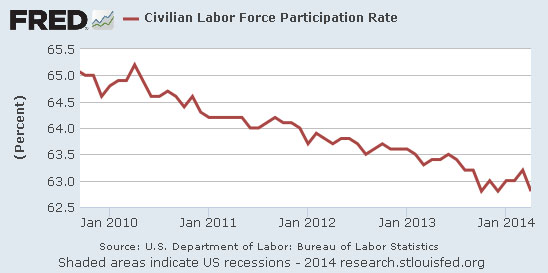
    The labor force participation rate measures how many people in the total population are part of the labor force (i.e., working or looking for work). That number went way down in April. This produced a smaller labor force, which is the main reason the unemployment rate declined so dramatically. But there are two things to keep in mind: (a) the participation rate has been shrinking steadily for a long time, and (b) it’s a pretty volatile number from month to month. The chart below shows both things. The participation rate has been steadily shrinking since 2000, and it’s been shrinking even faster ever since the end of the Great Recession. And the big drop in April? As you can see from the tail end of the chart, the participation rate hasn’t actually changed since October. It’s just been bouncing up and down.

    Bottom line: Don’t take the April numbers too seriously. The long-term trends are important, but there’s so much noise in the month-to-month numbers that you can’t draw too many conclusions from them.

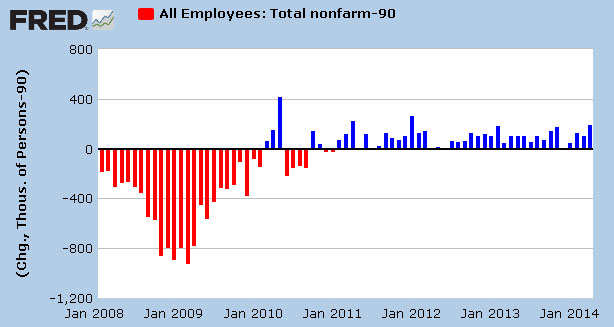
  • Chart of the Day: Net New Jobs in April


    The American economy added 288,000 new jobs in March, but about 90,000 of those jobs were needed just to keep up with population growth, so net job growth clocked in at 198,000. The headline unemployment rate plummeted from 6.7 percent to 6.3 percent.

    This is a decent result except for one thing: the unemployment rate went down because a ton of people dropped out of the labor force and are no longer counted in the totals. Nearly a million people dropped out, causing the labor force participation rate to plunge from 63.2 percent in March to 62.8 percent in April. The participation data is fairly volatile on a monthly basis—it went up 0.4 points during the first three months of the year and then dropped 0.4 points in April—but this is nonetheless a large and disconcerting decline that puts a serious damper on the otherwise good unemployment news.

    Why? Well, some of the decline in the participation rate is just due to older workers retiring, but probably not that much of it. Rather, the BLS suggests that it’s mostly due to an unusual dip in the number of new entrants to the labor force, which is hardly good news. In addition, I suspect a big chunk of it is due to unemployed workers who have given up looking for jobs, though I acknowledge that the data doesn’t support this.

    So: a mixed result. The jobs number is fairly decent. The labor force number is troubling. We’re still puttering along, but not much more.

  • Business Community Gives Putin Green Light in Ukraine


    It appears that doing anything to interfere with Russia’s latter-day Anschluss of eastern Ukraine doesn’t meet with the approval of the Western business community. It might cut into profits, after all. The Wall Street Journal reports:

    Several of the biggest names in German business—including chemical giant BASF, engineering group Siemens AG, Volkswagen AG, Adidas AG, and Deutsche Bank—have made their opposition to broader economic sanctions against Russia clear in recent weeks, both in public and in private….Many of Germany’s largest companies have substantial Russian operations, built in some cases over decades, and worry that tough economic sanctions would rob them of a key growth market when their home market—Europe—is stagnant.

    …..U.S. companies, which have less at stake in Russia compared with their European competitors, are expressing their concerns about further sanctions more privately with the Obama administration. American companies have stressed in Washington that proposed sanctions on broad sectors of the Russian economy, if pursued unilaterally, would cause Russian state-dominated industries to back out of deals with U.S. firms and open the market to competitors from Europe and elsewhere.

    ….Italy and Greece also have resisted a more aggressive response because of the potential impact on their economies. Some of Washington’s closest military allies, including Japan, Egypt and Israel, also are cautioning the Obama administration against taking steps that could permanently rupture Mr. Putin’s ties to the West, according to Asian and Middle East officials.

    Vladimir Putin must be laughing his ass off. I’m sure he’s pleased to know that he’s now got a free hand.


  • A New Obamacare Mystery: How Many Uninsured People Signed Up For New Coverage?


    The fine folks at HHS released some new data on Obamacare signups today. Quick stats: 8 million people signed up; 34 percent are under age 35; and 54 percent are female. But here’s the head scratcher:

    Of the 5.45 million people who selected a Marketplace plan through the [federal exchange]….5.18 million (95 percent) applied for financial assistance and were required to answer a question about their health insurance coverage.  Of these 5.18 million who applied for financial assistance and selected in a plan, 695,011 (13 percent) indicated that they had coverage at the time of application.
    So this means that on the federal exchange, about 4.5 million people signed up who were previously uninsured. If we figure a somewhat lower rate for the 2.6 million who signed up via state exchanges, you can add about 2 million to that number.

    In other words, in total, the exchanges signed up about 6.5 million people who were previously uninsured. This is far, far higher than previous estimates of about 3 million or so. I’m not sure what to make of this given the amount of survey data that produced the smaller figure. Perhaps it’s a difference in what counts as uninsured? Or a difference in how people respond to pollsters vs. how they respond to an official question on an application. Hard to say. The full HHS report is here, and it acknowledges the different estimates but provides no guesses about why they vary so widely.

    For now, just take this as a bit of a mystery. In a month or two we’ll probably have much firmer data on all this stuff.

  • Fox News and the Rise of Racial Animus in the Obama Era


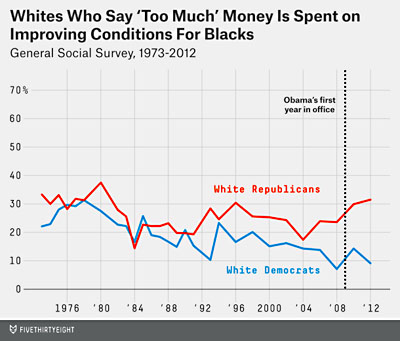
    Today, using questions from the General Social Survey, Nate Silver tries to quantify the effect of Barack Obama’s election on the racial attitudes of white Republicans and Democrats. On several of the most overtly racist questions (“blacks are lazy,” “blacks are unintelligent”) there’s little evidence of change. But on two of the questions with more political salience, there’s evidence of a pretty substantial effect.
    The chart on the right illustrates this. The number of white Republicans who believe the government spends too much money on blacks had been trending slowly downward for years. Based on that trend, you’d expect the number today to be a bit above 20 percent.

    Instead, it took a sharp upward jump in 2010 and again in 2012, ending up a bit over 30 percent. In other words, among white Republicans, it appears that the election of a black president has increased the belief that blacks get too many government bennies by about 10 percentage points. This belief is now at levels not seen since the anti-busing days of the 70s.

    I’m not sure what conclusions to draw from this beyond the obvious ones. As you might suspect from some of my posts over the past few years, I basically blame Fox News and conservative talk radio for this state of affairs. Without Fox fanning the flames of racial animus over the past several years, I suspect we wouldn’t see this effect—or at least, not as strongly. That’s just a guess on my part, but I think it’s a pretty good one.

    UPDATE: Several commenters suggest a different explanation for this: white Republicans get more concerned with money spent on blacks under Democratic presidents and less concerned under Republican presidents. This doesn’t fit the evidence perfectly, but it fits reasonably well. However, it doesn’t explain Democratic attitudes, which you’d expect to be the exact opposite.

    So….maybe. Overall though, I’d note that the trend lines are fairly similar for both Republicans and Democrats until about 2006-08. Then you get a significant divergence. The Obama/Fox News effect seems to explain this best.

    Also, the subsample size for white Republicans and Democrats is fairly small (perhaps 300 or so), so there’s a fair amount of noise in the trend lines.

  • Consumption Doesn’t Matter. Income Does.


    The BEA reports that consumer spending increased sharply in March. Business owners are pleased:

    Consumer spending rose in March at the fastest pace in nearly five years, providing fresh evidence that the U.S. economy gained strength with the arrival of spring. Personal consumption—spending on everything from electricity to sliced bread—surged a seasonally adjusted 0.9% from February, the Commerce Department said Thursday. That was its largest gain since August 2009.

    ….Paint sales are up from a year ago at Koopman Lumber Inc., a Whitinsville, Mass.-based chain of six hardware and lumber stores. “People are starting to spend some money on their houses. They’re saying, ‘We’ve put it off long enough,’ ” co-owner Tony Brookhouse said. “There are definitely signs of improvement.”

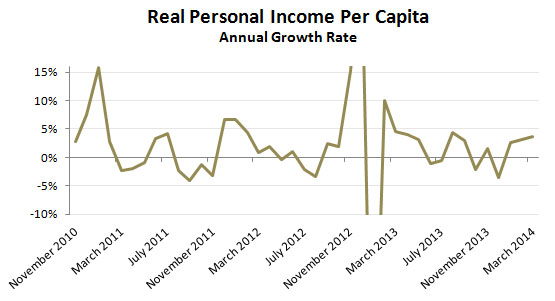
    Maybe. But look: consumers can only spend money they have, and the only way for consumer spending to rise steadily is for personal incomes to rise steadily too. But that’s not happening. Here’s the chart since the beginning of the recovery:

    There’s a small uptick in February and March, but it’s nothing special. A few months from now, if we’re still seeing a sustained increase in personal income, then we should expect a sustained increase in personal consumption too. But without that, this is just a bit of catch-up spending due to low levels in the previous few months.

    Don’t pay attention to consumption. Pay attention to income. That’s what matters. A sustained recovery won’t be based on drawing down savings or cash-out refis or running up the credit card. It will be based on steadily rising incomes. So far we haven’t seen that.

  • Iraq Delusion Syndrome Is Alive and Well


    Max Boot writes today that over the past couple of years, Iraq has spiraled ever downward into outright anarchy and civil war:

    Contrast that with Afghanistan, which I visited last week. While violence, corruption, drug production and government dysfunction remain very real problems in what is still one of the world’s poorest countries, Afghanistan is making real progress. Kabul is bustling and, notwithstanding some high-profile Taliban attacks, far safer than Baghdad….Even more impressive, the security forces managed with virtually no coalition presence on the ground to secure the April 5 presidential election despite Taliban attempts to disrupt it.

    ….Just a few years ago, Iraq appeared to be in much better shape: President Obama bragged on Dec. 14, 2011, that “we’re leaving behind a sovereign, stable and self-reliant Iraq.” In hindsight, however, it is obvious that Iraq began to unravel the minute the last U.S. troops left.

    ….There is an important lesson to be learned here: It’s vitally important to keep a substantial commitment of U.S. troops in Afghanistan after this year. Military commanders are asking for at least 10,000 personnel, and if that request isn’t granted by the White House (as leaks suggest it may not be), the odds will increase that Afghanistan, like Iraq, will descend into a civil war that undoes everything U.S. troops sacrificed so much to achieve.

    I should say at the outset that I don’t necessarily oppose a long-term commitment of a small US peacekeeping force to Afghanistan. Fifteen years after the Kosovo war, NATO still has several thousand troops there, about a thousand of which are American. That’s how long this stuff takes sometimes.

    That said, I’m endlessly flummoxed by the attitude of guys like Boot. After ten years—ten years!—of postwar “peacekeeping” in Iraq, does he still seriously think that keeping a few thousand American advisors in Baghdad for yet another few years would have made a serious difference there? In Kosovo there was a peace to keep. It was fragile, sure, but it was there. In Iraq it wasn’t. The ethnic fault lines hadn’t changed a whit, and American influence over Nouri al-Maliki had shrunk to virtually nothing. We had spent a decade trying to change the fundamentals of Iraqi politics and we couldn’t do it. An endless succession of counterterrorism initiatives didn’t do it; hundreds of billions of dollars in civil aid didn’t do it; and despite some mythologizing to the contrary, the surge didn’t do it either. The truth is that we couldn’t even make a dent. What sort of grand delusion would persuade anyone that yet another decade might do the trick?

    Maybe things are different in Afghanistan. Tribal conflicts are different from sectarian ones. The Taliban is a different kind of enemy than al-Qaeda. Afghanistan’s likely next leader will almost certainly be more pro-American than Hamid Karzai. And strategically, Afghanistan plays a different role than Iraq ever did.

    But Iraq? In 2003, maybe it was reasonable to think that the US could not just topple a dictator, but change the culture of a country. We can argue about that forever. But to still believe that in 2014? That’s the stuff of dreamland. Why are there still people around who continue to cling to this fantasy?


  • China Is Still Just a Jumbo Version of Albania


    I don’t want to pretend to some kind of faux naivete here, but can someone tell me why there’s suddenly a big frenzy about whether China is now the biggest economy in the world? China has 1.3 billion people. Of course they’re eventually going to eventually be bigger than the US. If not this year, then next year or the year after. Everyone knows this. Everyone has always known this. It’s no surprise, and it’s no big deal. They’ve still got about the per capita GDP of Albania, and it will be decades before they become even a middle-income country.

    So who cares if they’re fudging the official numbers or the PPP calculations are being done wrong or whatever? Why does anyone even remotely care about this supposed milestone?

  • We’re Americans, Please Don’t Bother Us With Facts


    A British diplomatic report from Ronald Reagan’s second year in office was released publicly today:

    “The White House are certainly concerned that the president could acquire a national image as a bumbler which, like [former President] Ford’s image as a stumbler, could not be eradicated once firmly established in the public mind,” the UK embassy told London in March 1982, referring to persistent “mistakes of fact” made by Reagan.

    Silly Brits. Americans don’t care about mistakes of fact. I wonder whatever gave them the idea that we do?