• Should Democrats Boycott the Benghazi Committee?


    Nancy Pelosi wants John Boehner’s select committee on Benghazi to have equal representation from Democrats and Republicans:

    “If this review is to be fair, it must be truly bipartisan,” Pelosi said in a Tuesday morning statement. “The panel should be equally divided between Democrats and Republicans as is done on the House Ethics Committee. It should require that witnesses are called and interviewed, subpoenas are issued, and information is shared on a bipartisan basis. Only then could it be fair.”

    ….House Democrats have not yet committed to appointing members to the committee. Her call for the committee to be evenly split could set the stage for boycotting the panel if Republicans rebuff her suggestion.

    Good luck with that. I’d say the appointment of Trey Gowdy—a tea party attack dog with a grand total of 40 months of seniority—to lead the committee is a pretty good indication of just how bipartisan Boehner wants this thing to be. In short, not even the teensiest, tiniest little bit bipartisan. This is going to be a made-for-Fox extravaganza, and that’s that.

    So should Democrats just boycott the committee and let Republicans howl into the wilderness all by themselves? That’s a really hard question, isn’t it? My first instinct is to say yes: it’s obvious that Democrats will have no influence on the committee, and attending does little except provide it with a veneer of legitimacy.

    On the other hand, it’s pretty easy to cherry-pick witnesses and testimony, and having someone there to cross-examine the Republicans’ pet conspiracy theorists might prevent more than a few bad news cycles. Then again, it might not. It’s not as if the reporters covering this stuff aren’t already well aware of the timelines of what really happened.

    Decisions, decisions. I’m not sure that boycotting sets a good precedent, but if ever there was a committee that deserved it, this is the one. In the end, though, I’ll bet Democrats show up. Not only are they afraid of the possible damage from a committee run amok, but they’re probably loath to give up their chance for TV time. Brace yourselves.

  • Climate Change is Already Here, and It’s Not Pretty


    A new government report confirms what’s been obvious for many years: climate change is already affecting us. It’s not just an issue for our grandchildren:

    The effects of human-induced climate change are being felt in every corner of the United States, scientists reported Tuesday, with water growing scarcer in dry regions, torrential rains increasing in wet regions, heat waves becoming more common and more severe, wildfires growing worse, and forests dying under assault from heat-loving insects.

    ….“Climate change, once considered an issue for a distant future, has moved firmly into the present,” the scientists declared in a major new report assessing the situation in the United States. “Summers are longer and hotter, and extended periods of unusual heat last longer than any living American has ever experienced,” the report continued. “Winters are generally shorter and warmer. Rain comes in heavier downpours. People are seeing changes in the length and severity of seasonal allergies, the plant varieties that thrive in their gardens, and the kinds of birds they see in any particular month in their neighborhoods.”

    The full report is here. Just to give you a taste, here’s a map showing water supply risk over the next few decades with and without the effects of climate change. If you live anywhere in the southwest quarter of the country, things are getting ugly fast.

  • The Latest Benghazi Freak-Out in 10 Sentences

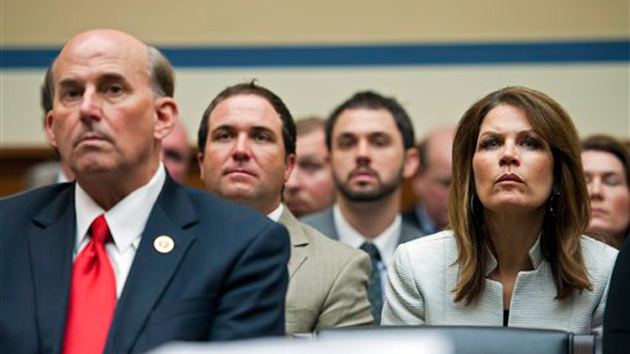
    Reps. Louie Gohmert and Michele Bachmann sit in the audience during a hearing on Benghazi on Capitol Hill. This was May…of last year.Cliff Owen/AP


    Last week, in response to a Freedom of Information request filed by Judicial Watch, the White House released a memo related to Benghazi that was authored by Ben Rhodes, the deputy national security adviser for strategic communication. The four-page memo, written a few days after the attacks, was designed to prep Susan Rice for her upcoming appearances on several Sunday talk shows. Among other things, it addressed the anti-American protests that had first sprung up in Egypt and then spread throughout the Middle East, including this line as one of the goals of her appearances:

    To underscore that these protests are rooted in an Internet video, and not a broader failure of policy.

    Republicans say this is a “smoking gun” of a White House cover-up on Benghazi. But is it? Here are 10 things you should know:

    1. First things first: this memo should have been released earlier, and conservatives are fully justified in asking why it took a FOIA request to finally shake it loose.
    2. That said, as an adviser for “strategic communication”—what the rest of us call spin—Ben Rhodes’ job is explicitly political, providing guidance on how to put the administration’s foreign policy actions in the best light.
    3. Nine hours before Rhodes sent his email, the CIA had provided its assessment of what caused the attacks in Benghazi: “We believe based on currently available information that the attacks in Benghazi were spontaneously inspired by the protests at the US Embassy in Cairo and evolved into a direct assault against the US consulate and subsequently its annex.”
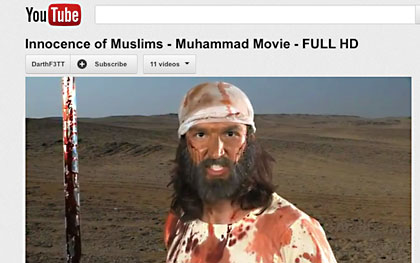
    4. The Cairo protests, in turn, were inspired by the YouTube video “Innocence of Muslims,” which is why Rhodes mentioned the video in his memo.
    5. As it happens, it turned out that there were no protests earlier in the day in Benghazi—but at the time, that was what the CIA believed.
    6. However, multiple sources—including McClatchy, Al Jazeera, the New York Times, and then deputy CIA director Michael Morell—have confirmed that anger toward the YouTube video did play a role in motivating the initial attacks.
    7. Multiple sources also confirm that that the Benghazi attacks were opportunistic—organized hastily to take advantage of the Cairo protests, not planned days or weeks ahead of time.
    8. Susan Rice, in all her Sunday show appearances, was properly cautious about the role of the video, the nature of the attacks, and the fact that everything she said was tentative and based on “the best information we have to date.”
    9. Like any administration, the Obama White House wanted to put the best face on its Middle East policy, and there’s no question that their public statements were designed to do just that.
    10. Nevertheless, the Republican theory that Obama was afraid to blame Benghazi on terrorism has never really made any sense; there’s simply never been any evidence of anything more than a fairly routine amount of spin in the aftermath of the attacks.

    So: A “smoking gun”? “Cold, hard evidence” of an Obama cover-up? Just like Watergate? Hardly. Even George Will doesn’t believe that. The video really did play a role in the Cairo protests and then the Benghazi attacks, and there was never anything wrong with saying so. It’s inexplicable that Republicans think this memo proves anything more damning than that.

  • Surprise! Better Health Insurance Saves Lives.


    Does health insurance save lives? Since death is the least frequent outcome of poor medical care, I’ve never believed that mortality is an especially good way of measuring the value of different interventions. Even if an intervention is high value, the odds are good that it will have only a small effect on mortality.

    This makes the results of a recent study in Massachusetts all the more impressive. Three researchers studied the effect of Mitt Romney’s universal health care plan and concluded that it’s saved a lot of lives so far. Adrianna McIntyre provides the summary:

    Benjamin Sommers, Sharon Long, and Katherine Baicker estimate that overall mortality in Massachusetts declined 2.9 percent relative to control counties between 2007 and 2010; mortality amenable to health care declined 4.5 percent. This translates to one death prevented for every 830 people who gain insurance, and the effects were larger in counties with low income and low pre-reform insurance rates—the counties we would expect to be most favorably impacted by reform.
    ….If you think the study’s primary findings are impressive, consider their implications: “mortality amenable to health care” does not just magically decline. If fewer people are dying, that is almost certainly because diseases are being better treated, managed, or prevented—because of improved health. It’s hard to come by data on objective measures of health at the state level, but the “improved health” story is consistent with other findings in the paper: individuals had better self-reported health, were more likely to have a usual source of care, received more preventive services, and had fewer cost-related delays in care.

    What makes this even more impressive is that the elderly in Massachusetts were already covered by Medicare. These results are strictly for those under the age of 65, who don’t die very often to begin with. Within this group, a reduction of 4.5 percent in mortality amenable to health care (the only kind we care about in this context) is a lot.

    The implications for Obamacare are obvious since Obamacare was explicitly modeled on the Massachusetts program—though it’s unlikely that it will produce quite such dramatic mortality improvements since its coverage isn’t as universal as the Massachusetts plan. Still, Obamacare has so far shown that it has a lot in common with Romneycare, so there’s good reason to hope that it will demonstrate mortality improvements as well.

    But don’t hold your breath for study results. Given the way research like this works, we probably won’t get them until 2020 or so.

  • Is the US Economy Becoming Dangerously Lethargic?


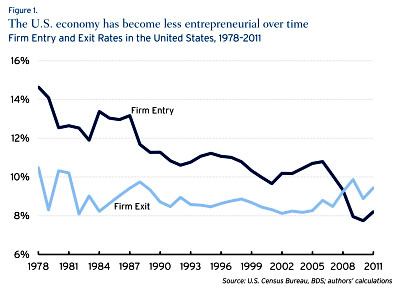
    Jim Pethokoukis highlights an interesting chart today from a Brookings report. The authors are concerned about a declining rate of entrepreneurship in the United States:
    Business dynamism is inherently disruptive; but it is also critical to long-run economic growth. Research has established that this process of “creative destruction” is essential to productivity gains by which more productive firms drive out less productive ones, new entrants disrupt incumbents, and workers are better matched with firms. In other words, a dynamic economy constantly forces labor and capital to be put to better uses. But recent evidence points to a U.S. economy that has steadily become less dynamic over time. Two measures used to gauge business dynamism are firm entry and job reallocation. As Figure 1 shows, the firm entry rate—or firms less than one year old as a share of all firms—fell by nearly half in the thirty-plus years between 1978 and 2011.

    So fewer people are starting up new businesses, and this trend has been evident for several decades. Pethokoukis speculates that the problem might be too little uncertainty in the economy: “Maybe the U.S. private sector has become too conservative and cautious….The U.S. still generates lots of innovation overall, but maybe too much is of the job-killing sort rather than job-creating kind that marks a dynamic economy.”

    Maybe. But I’d really like to see a breakdown of what kinds of business creation have declined. My first guess here is that the decline hasn’t been among the sort of Silicon Valley firms that drive innovation, but among more prosaic small firms: restaurants, dry cleaners, hardware stores, and so forth. The last few decades have seen an explosion among national chains and big box retailers, and it only makes sense that this has driven down the number of new entrants in these sectors. When there’s a McDonald’s and a Burger King on every corner, there’s just less room for people to open up their own lunch spots. But if there’s been a decline in the number of new small retailers, that may or may not say anything about the dynamism of the American economy. It just tells us what we already know: national chains, with their marketing efficiencies and highly efficient logistics, have taken over the retail sector. Amazon and other internet retailers are only hastening this trend.

    But is this what’s really driving the downward trend in new business creation? The Brookings report doesn’t give us any clues. But it sure seems like this is the absolute minimum we need to know in order to draw any serious conclusions about what’s really going on here.

  • Gallup: Uninsurance Rate Plummets in April


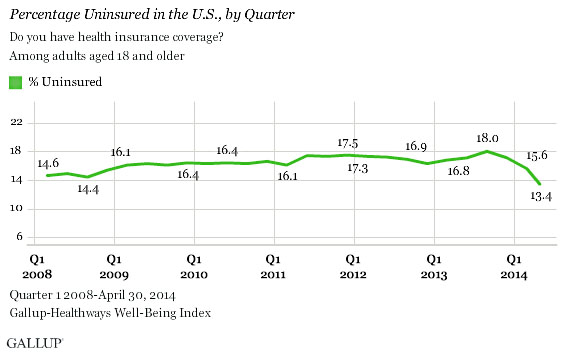
    Gallup has released its latest poll of the uninsured, and it shows a dramatic drop compared to a month ago. The uninsurance rate among adults now stands at 13.4 percent, a drop of about 4 percentage points from its 2011-12 baseline. This represents roughly 10 million people, and confirms the 4 percent number that Gallup reported a few weeks ago. It’s also starting to close in on the CBO estimate of 13 million newly insured adults by the end of the year.

    Add to this the number of children and sub-26ers who are newly insured, and you’re probably up to 12-13 million who are newly insured under Obamacare. Some of this comes from people buying insurance through the exchanges; some comes from Medicaid signups; and some comes from people signing up for insurance at work thanks to the individual mandate.

    More and better data will be available over the next few months. But this is yet another indication that after a rocky start, Obamacare is performing pretty well. It’s getting harder and harder to pretend otherwise.

  • The Most Important Economic Number Isn’t GDP or Unemployment. It’s Wages.


    A few days ago I urged everyone to pay less attention to consumer spending (which was up in March) and more attention to personal income (which wasn’t). After all, income is the key to everything else. Spending may go up for a single month or two even if incomes are flat, but it won’t rise steadily unless incomes are rising too.

    Over at The Upshot, Binyamin Appelbaum passes along a new research study that comes to the same conclusion:

    Ignore April’s sharp drop in unemployment. Pay no attention to the creation of 288,000 jobs announced on Friday. The most important number in the latest jobs report did not change at all.

    Average hourly wages for American workers held steady at $24.31 last month. They have increased just 1.9 percent over the previous 12 months. But after adjusting for inflation, real wages have increased by something like 0.5 percent.

    David G. Blanchflower, an economics professor at Dartmouth College, and Adam S. Posen, president of the Peterson Institute for International Economics, argue in a new paper that the slow pace of wage growth is the best indicator of an incomplete economic recovery. Until wages start rising more quickly, the economy remains far from healthy.

    Measures of unemployment are inherently tricky. But the authors of the paper point out that you can cut through a lot of the uncertainty by simply looking at wages. “Wage inflation, after all, is basically a summary of the balance between supply and demand. Employers raise wages as they find it harder to hire and retain qualified workers, so the market, in effect, is constantly judging the extent of labor market slack.” Translation: Unless people have more money to spend, the economy just isn’t going to grow.

    If wages aren’t rising, then there’s still a lot of labor market slack no matter what the headline unemployment numbers say. And right now, wages aren’t rising. It’s no time for the Fed to be thinking about putting its foot on the brake.

  • Friday Car Blogging – 2 May 2014


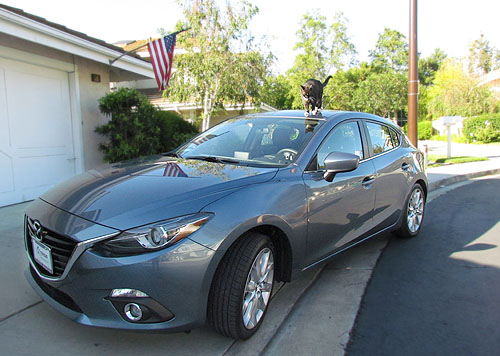
    Some of you may recall that I’ve been threatening to buy a new car for a while. Well, I finally did. It’s a blue-gray Mazda 3 with all the modern amenities, and I like it a lot. Unfortunately, Domino doesn’t. As you can imagine, I had grand plans for her to perch regally on the hood for Friday catblogging this week, but she was having none of it. In fact, she couldn’t get back to solid ground fast enough. So I’m afraid this is the best I could get. Technically, it’s still catblogging, though. After all, the car is merely a technologically advanced cat platform. Right?

  • Yes, the “Innocence of Muslims” Video Really Did Play a Role in the Benghazi Attacks


    The Republican obsession with Benghazi is about to get yet another airing, and as much as I’m loath to waste time on this, I’d like to make a point that even a lot of liberals still seem to be confused about. It’s about the video.

    First, a quick recap: A few days after the attacks, the intelligence community believed that the initial street protests in Benghazi had been prompted by anger over the Arabic-language version of the “Innocence of Muslims” video, which had been posted on YouTube a few days earlier. The White House repeated this publicly, and conservatives immediately cried foul. Benghazi was a plain and simple terror attack, they said, and the video had nothing to do with it. The White House was pretending otherwise in order to divert attention from its failure to anticipate and stop the attacks, which might have reflected badly on its overall anti-terrorism efforts in the runup to the 2012 election.

    Today, even supporters of the administration acknowledge that the video played no role. Their defense is that at the time the CIA thought the video had inspired protests earlier in the day, and the White House was simply passing along its best knowledge. That turned out to be wrong, but it was the best assessment at the time.

    But here’s the thing: it wasn’t wrong. The CIA was mistaken about the existence of protests earlier in the day, but not about the role of the video. David Kirkpatrick of the New York Times has written about this extensively, starting just a few weeks after the attacks, and last December he put together a definitive account of what happened in Benghazi on September 11, 2012. Here’s a piece:

    The leader of Benghazi’s most overtly anti-Western militia, Ansar al-Shariah, boasted a few months before the attack that his fighters could “flatten” the American Mission. Surveillance of the American compound appears to have been underway at least 12 hours before the assault started.

    The violence, though, also had spontaneous elements. Anger at the video motivated the initial attack. Dozens of people joined in, some of them provoked by the video and others responding to fast-spreading false rumors that guards inside the American compound had shot Libyan protesters. Looters and arsonists, without any sign of a plan, were the ones who ravaged the compound after the initial attack, according to more than a dozen Libyan witnesses as well as many American officials who have viewed the footage from security cameras.

    ….There is no doubt that anger over the video motivated many attackers. A Libyan journalist working for The New York Times was blocked from entering by the sentries outside, and he learned of the film from the fighters who stopped him. Other Libyan witnesses, too, said they received lectures from the attackers about the evil of the film and the virtue of defending the prophet.

    Click here for a fuller account of the video. As Kirkpatrick says, there were a lot of moving parts behind the Benghazi attacks. The entire city was a tinderbox, and plenty of Libyan militants knew the CIA was active there. But the simple fact is that the video played a role. We can argue over how big that role was, and about whether the White House was properly cautious in its public statements. But the best evidence we have from witnesses on the ground is clear: the “Innocence of Muslims” video inspired the initial attacks, which then escalated as armed extremists took over.

    That’s it. Blaming the video wasn’t a mistake. It was a real thing.

    UPDATE: David Corn has a complete timeline here on how Benghazi fever took hold of the GOP yet again this week.