• Aetna CEO: Obamacare Pretty Much On Track


    Aetna is one of America’s biggest health insurers, and it’s currently operating in 17 different Obamacare exchanges. On a call this morning, CEO Mark Bertolini passed along a couple of interesting factlets:

    Bertolini said about half of the company’s premium increases, whatever they turn out to be, will be attributable to “on the fly” regulatory changes made by the Obama administration. He cited as an example the administration’s policy of allowing old health plans that were supposed to expire in 2014 to be extended another three years if states and insurers wanted to.

    ….Aetna has added 230,000 paying customers from ACA exchanges, and it projects to end the year with 450,000 paid customers. It said it can’t yet draw a “meaningful conclusion” about the population’s overall health status.

    The first is interesting because it suggests that Aetna’s premium increases won’t be based on fundamentals. That is, they aren’t rising because the customers Aetna signed up were older or sicker than they expected. That’s good news, even if the regulatory shakeouts of Obamacare’s early days are causing a bit of pain.

    And the second is interesting because Aetna apparently expects to double its Obamacare customer base by the end of the year. That’s roughly what the CBO projected earlier this year, and this is a bit of evidence suggesting that they got it right.

  • Here’s a Great Argument for Easing Up on Professional Licensing Restrictions


    Adrianna McIntyre has a fascinating little tidbit up today about how Medicaid expansion affects access to health care. Here’s the question: By increasing demand for doctors, is it likely to result in longer wait times for everyone?

    A trio of researchers took a look at dental care to get an idea. Some states cover it for adults, some don’t. So what happens in states where adult Medicaid is expanded to cover dental care? The first-order answer is surprising: more dentists participate; their incomes go up; and wait times barely budge. But how is that possible? The second-order answer is even more interesting:

    Dentists accomplish this mainly by making greater use of hygienists: following the expansion of public coverage, dentists employ a greater number of hygienists and hygienists provide about 5 additional visits per week. As a result, dentists’ income increases following the adoption of Medicaid adult dental benefits by approximately 7 percent. These effects are largest among dentists who practice in poor areas where Medicaid coverage is most prevalent.

    We also find that these coverage expansions cause wait times to increase modestly [less than a day, on average]. However, this effect varies significantly across states with different policies towards the provision of dental services by hygienists. The increased wait times are concentrated in states with relatively restrictive scope of practice laws. We find no significant increase in wait times in states that allow hygienists greater autonomy.

    Licensing and “scope of authority” restrictions are sort of a hot topic these days, and this is a pretty good example of why. I haven’t yet dived into the whole thing enough to have a settled opinion, but it’s becoming fairly common to believe that licensing restrictions are far too strict in some professions, acting more as a way of propping up salaries than as genuine public safety measures. Nurses and hygienists could be given more autonomy, for example, but this is often resisted by doctors and dentists who don’t want to give up a lucrative monopoly on the services they provide.

    The arguments are sometimes arcane, but this example brings it down to earth. Ease up on the restrictions placed on hygienists, and dental practices can provide more and better service to the poor—and, in the end, do it without sacrificing income. That’s worth knowing.

  • Here Are Baseball’s 2 Least Loved Teams


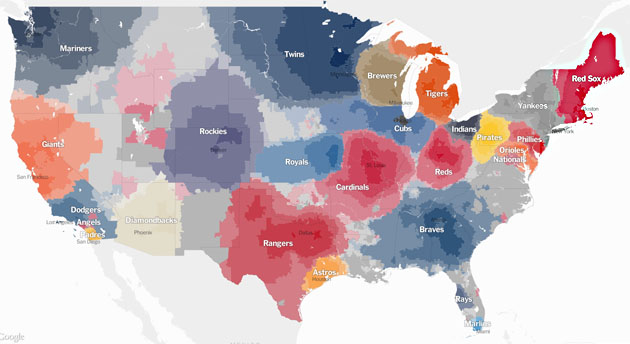
    Over at The Upshot, a crack team of researchers has put together an interactive map showing which baseball teams are preferred in which regions of the country. The overall results are pretty predictable, of course, but the authors make a few interesting points about exactly where the geographical dividing lines are between traditional rivalries. I thought the most intriguing part was which teams were left out completely. Here’s the map:

    There is not a single zip code in the entire country that favors the New York Mets. Even in 11368, the home of Citi Field, fans prefer the Yankees by 53 to 25 percent.

    And the Oakland A’s have it even worse. In 94501, the home of the Oakland Coliseum, fans prefer the San Francisco Giants by a whopping 59 to 18 percent. This is spectacularly embarrassing. The Mets, after all, are at least in the same city as the Yankees, so divided loyalties are natural. The A’s are in Oakland, a different city with a culture of its own. Sure, maybe there’s no there there, but that’s a culture! And yet, even the working-class East Bay has apparently been so taken over by yuppified San Franciscans escaping sky-high rents that the A’s can’t get any love even after being canonized by Michael Lewis and Brad Pitt as the champions of Moneyball. Sad.

    (The Toronto Blue Jays aren’t on the map either, but I assume that’s because the map doesn’t include Canada. I draw no conclusions about Toronto’s fan base, though I suspect we can assume it’s pretty minimal too.)

  • Meet the New Super Working Class


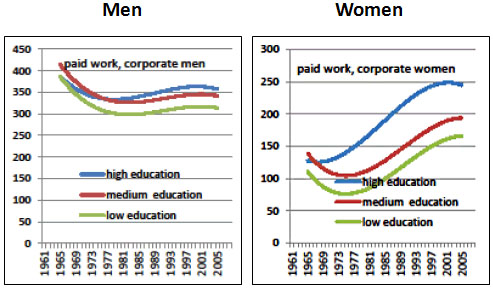
    Via Counterparties, a new study suggests that we now have a “superordinate” working class: highly paid professionals who are so dedicated to their professions that they’d rather work in the office than engage in leisure or vacation time:

    The best educated men used once to work much shorter hours for pay, an echo, still in the 1960s, of the end-of-19th century leisure-class ideology. But by the beginning of the 21st century they are working the longest hours in their exchange-economy jobs. And the best-educated women in each of the regime types, show an even more decisive differential movement into paid work.

    Now add these trends together and we see, unambiguously, the 21st century reversed education/leisure gradient, with the best educated, both men and women, working, overall, a much larger part of the day than the medium-level educated, who in turn do more than the lowest educated. At least from the 1970s onwards, we see no decisive decline in overall work time, perhaps the slightly the reverse, with a small historical increase, particularly for the best educated, in the range 530 to 550 minutes per day. Industrious activities are transferred out of the money economy, and, replacing the 19th century leisure class, we find a 21st century superordinate working class.

    The basic evidence is on the right. I guess I find it only modestly convincing. In 1961, highly educated men in the corporate world worked similar hours to their less-educated peers. By 2005, they were working a bit more, but their total work hours were actually down from their peak. Conversely, although it’s true that highly educated women have very plainly outpaced the working hours of their less-educated peers, this is hardly surprising given the immense change in opportunities allowed to women since 1961, as well as the vastly higher pay that well-educated women can now expect in the corporate world.

    So yes: highly-educated professionals are working more than they used to. Are they working themselves into a new, 21st-century frenzy, though? The evidence for that seems fairly modest. The big story here seems to be a more prosaic one: women are basically catching up to men, which hardly comes as a surprise. Beyond that, though, the evidence for a rising Veblenesque warrior class that views long hours as a status symbol strikes me as weak. Obviously it exists in places like Wall Street and Silicon Valley, but I suspect that its broader impact is fairly limited.

  • Ukraine Beginning to Spiral Out of Control?


    Events in Ukraine are starting to spin out of control:

    Ukrainian security forces killed “up to five” pro-Russian activists Thursday in the restive eastern part of the country, the Ukrainian Interior Ministry said, as Russian President Vladimir Putin condemned any use of the Ukrainian military against its own citizens.

    ….Putin spoke forcefully against the military action as the clashes were underway. “If the Kiev regime has started to use the army against the population inside the country, it, beyond any doubt, is a very serious crime,” Putin said at a media forum in St. Petersburg.

    President Obama sounded glum about the prospects for peace in Ukraine and told reporters this morning that the US has “teed up” a new round of sanctions that could be implemented against Russia if they move troops across the border. This will have a limited impact since US trade with Russia is relatively small, but Reuters reports that EU leaders “have asked the EU executive arm, the European commission, to propose economic, trade and financial restrictions on Crimea for rapid implementation.” If they’re serious, that would hurt Putin considerably worse than anything we could do on our own.

    Stay tuned.

  • Not Everyone Needs to Learn Programming, But Every School Should Offer It


    From the Washington Post:

    In a world that went digital long ago, computer science is not a staple of U.S. education, and some schools do not even offer the course, including 10 of 27 high schools in Virginia’s Fairfax County and six of 25 in Maryland’s Montgomery County….Across the Washington region’s school systems, fewer than one in 10 high school students took computer science this academic year, according to district data.

    That first stat surprises me. My very average suburban high school offered two programming courses way back in 1975 (FORTRAN for beginners, COBOL for the advanced class). Sure, back in the dark ages that meant filling in coding sheets, which were sent to the district office, transcribed onto punch cards, and then run on the district’s mainframe. Turnaround time was about two or three days and then you could start fixing your bugs. Still! It taught us the rudiments of writing code. I’m surprised that 40 years later there’s a high school in the entire country that doesn’t offer a programming class of some kind.

    The second stat, however, doesn’t surprise me. Or alarm me. It’s about what I’d expect. Despite some recent hype, computer programming really isn’t the kind of class that everyone needs to take. It’s an advanced elective. I’d guess that no more than 10 percent of all students take physics, or advanced algebra, or art class for that matter. Ten percent doesn’t strike me as a horrible number.

  • Net Neutrality Finally Dies at Ripe Old Age of 45

    jrwasserman/Thinkstock


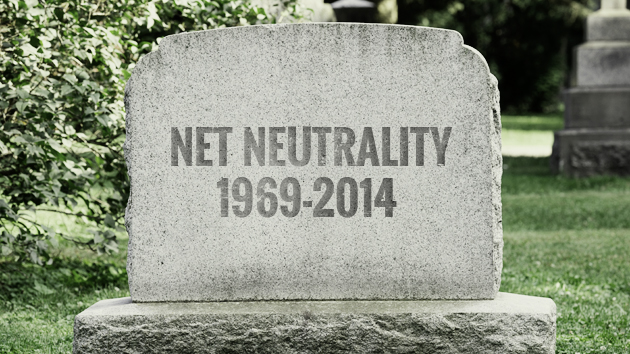
    Apparently net neutrality is officially dead. The Wall Street Journal reports today that the FCC has given up on finding a legal avenue to enforce equal access and will instead propose rules that explicitly allow broadband suppliers to favor companies that pay them for faster pipes:

    The Federal Communications Commission plans to propose new open Internet rules on Thursday that would allow content companies to pay Internet service providers for special access to consumers, according to a person familiar with the proposal.

    The proposed rules would prevent the service providers from blocking or discriminating against specific websites, but would allow broadband providers to give some traffic preferential treatment, so long as such arrangements are available on “commercially reasonable” terms for all interested content companies. Whether the terms are commercially reasonable would be decided by the FCC on a case-by-case basis.

    …The FCC’s proposal would allow some forms of discrimination while preventing companies from slowing down or blocking specific websites, which likely won’t satisfy all proponents of net neutrality, the concept that all Internet traffic should be treated equally. The Commission has also decided for now against reclassifying broadband as a public utility, which would subject ISPs to much greater regulation. However, the Commission has left the reclassification option on the table at present.

    So Google and Microsoft and Netflix and other large, well-capitalized incumbents will pay for speedy service. Smaller companies that can’t—or that ISPs just aren’t interested in dealing with—will get whatever plodding service is left for everyone else. ISPs won’t be allowed to deliberately slow down traffic from specific sites, but that’s about all that’s left of net neutrality. Once you’ve approved the notion of two-tier service, it hardly matters whether you’re speeding up some of the sites or slowing down others.

    This might have been inevitable, for both legal and commercial reasons. But that doesn’t mean we have to like it.

  • The Fourth Amendment Takes Yet Another Body Blow


    This week the Supreme Court has handed down decisions on affirmative action and child porn that have gotten a lot of press. But the affirmative action decision was probably inevitable, and the child porn case is an oddball example of statutory interpretation that probably has no greater significance.

    More important is Navarette vs. California, which has real potential to do some long-term damage. In this case, a 911 caller reported an erratic driver, who was then pulled over and eventually convicted of transporting four bags of marijuana. The police had no probable cause to stop the driver except for that one anonymous phone call, but the Court upheld the conviction anyway. Justice Scalia is typically apoplectic in his dissent, but nonetheless makes some good points:
    It gets worse. Not only, it turns out, did the police have no good reason at first to believe that Lorenzo was driving drunk, they had very good reason at last to know that he was not. The Court concludes that the tip, plus confirmation of the truck’s location, produced reasonable suspicion that the truck not only had been but still was barreling dangerously and drunkenly down Highway 1. In fact, alas, it was not, and the officers knew it. They followed the truck for five minutes, presumably to see if it was being operated recklessly. And that was good police work. While the anonymous tip was not enough to support a stop for drunken driving under Terry v. Ohio, it was surely enough to counsel observation of the truck to see if it was driven by a drunken driver.

    But the pesky little detail left out of the Court’s reasonable-suspicion equation is that, for the five minutes that the truck was being followed (five minutes is a long time), Lorenzo’s driving was irreproachable. Had the officers witnessed the petitioners violate a single traffic law, they would have had cause to stop the truck, and this case would not be before us. And not only was the driving irreproachable, but the State offers no evidence to suggest that the petitioners even did anything suspicious, such as suddenly slowing down, pulling off to the side of the road, or turning somewhere to see whether they were being followed. Consequently, the tip’s suggestion of ongoing drunken driving (if it could be deemed to suggest that) not only went uncorroborated; it was affirmatively undermined.

    The problem here is obvious: the Court has basically said that an anonymous 911 call is sufficient all by itself to justify a police stop and subsequent search of a vehicle.

    In this particular case, it’s likely that the 911 caller was entirely sincere. But that’s surely not always the case, and this decision gives police far greater discretion to stop pretty much anyone they like for any reason. You don’t even need to roll your front bumper a foot over the limit line in an intersection to give them a pretext.

    If we’re lucky, this case will become a footnote, with the precise nature of its facts giving it little value as precedent. But if we’re not so lucky, it’s yet another step in the Supreme Court’s decades-long project to chip away at the Fourth Amendment. When an unknown caller is all it takes to trigger a search, the entire notion of “probable cause” is pretty much consigned to the ash heap of history.

    UPDATE: A regular reader points out that my summary isn’t entirely accurate. Under Navarette, an anonymous tip is enough for police to stop a vehicle, but to search it they still need some suspicion of illegal activity. In this case they “smelled marijuana.”

    That’s true, and I should have said so. The reason I didn’t is that I figure this was basically pretextual. There’s always a post hoc reason if the police decide they want to search your car. And even if you think the cops really did smell something, they never would have gotten there without the stop, and there was no reason for the stop in the first place. This strikes me as a pretty direct line from anonymous tip to search, with only the thinnest pretense of probable cause.

    I admit that my cynicism here isn’t legally relevant. But honestly, once you allow the stop, cops will find a reason the search the car. There’s simply nothing in their way any longer.


  • Rand Paul Apparently Thinks Republicans Controlled Congress in 1978


    Over at the mother ship, David Corn has assembled a bunch of clips of Rand Paul being less than reverential toward Ronald Reagan. Here’s an example from 2009:

    People want to like Reagan. He’s very likable. And what he had to say most of the time was a great message. But the deficits exploded under Reagan….The reason the deficits exploded is they ignored spending. Domestic spending went up at a greater clip under Reagan than it did under Carter.

    Ouch! That’s not just a hit on Reagan, it’s a direct suggestion that his fiscal policy was worse than Jimmy Carter’s. Jimmy Carter’s!

    David has a bunch more along these lines. But here’s my favorite part:

    After this article was posted, Paul’s office sent this statement from the senator: “I have always been and continue to be a great supporter of Ronald Reagan’s tax cuts and the millions of jobs they created. Clearly spending during his tenure did not lessen, but he also had to contend with Democrat majorities in Congress.”

    Um, didn’t Jimmy Carter also have to contend with Democratic majorities in Congress? Bigger ones, in both houses? Or am I thinking about a different Jimmy Carter?

  • Medicaid Expansion Now an Even Better Deal For States


    Need some more good news on Obamacare? How about some mixed news instead? Here it is:

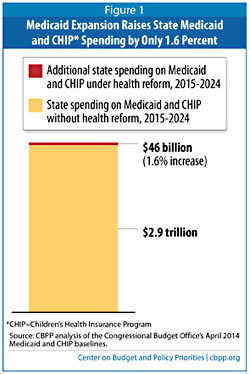
    Congressional Budget Office (CBO) estimates released last week show that health reform’s Medicaid expansion, which many opponents wrongly claim will cripple state budgets, is an even better deal for states than previously thought….CBO now estimates that the federal government will, on average, pick up more than 95 percent of the total cost of the Medicaid expansion and other health reform-related costs in Medicaid and the Children’s Health Insurance Program (CHIP) over the next ten years (2015-2024).

    The good news is obvious: the Medicaid expansion is an even better deal for states than we thought. The federal government will pick up nearly the entire cost of expansion, and when you account for money that states will save from reduced amounts of indigent care and greater help with mental health costs, the net cost of expansion gets very close to zero.

    The mixed nature of this seemingly good news comes from the reason for CBO’s more optimistic budget projection: it’s because they think the program will cover fewer people than they previously projected. There had always been a fear among states that lots of people who were already eligible for Medicaid—but had never bothered applying for it—would hear the Obamacare hoopla and “come out of the woodwork” to claim benefits. Since these folks weren’t technically part of the expansion, states would be on the hook to cover the bulk of their costs.

    CBO now believes this fear was overblown. Apparently most people who didn’t bother with Medicaid before Obamacare took effect aren’t going to bother with it now either. That’s good for state budgets, but obviously not so good for all the people who could be getting medical care but aren’t.

    For what it’s worth, this is a tradeoff we’re going to see a lot of. Unless the actual cost of medical care comes down, the budget impact of Obamacare is always going to depend on how many people benefit from it. If lots of people sign up, that’s good for public health but costly for taxpayers. If fewer people sign up, then government spending goes down but fewer people receive medical care. There aren’t very many ways around this iron law.