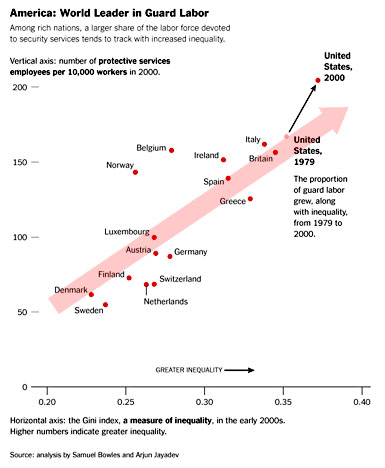
• Income Inequality Has Spurred a Boom in Private Security


    This is a truly fascinating chart: countries with lots of income inequality—driven largely by the gains of the ultra-rich—also spend more and more of their money on security services. Gotta keep the hoi polloi at bay somehow, after all. However, the researchers who produced the chart also add some appropriately scholarly cautions:

    Does the graph show that inequality causes a country to devote more of its labor force to guard labor? It is hard to be sure. It could be that people with a strong commitment to economic justice are, for some unknown reason, also more law-abiding, explaining the difference between Denmark and the United States. But the correlation evident in the graph could be evidence that economic disparities push nations to devote more of their productive capacity to guarding people and property. Fear and distrust of one’s neighbors and fellow citizens fuel the demand for guard labor. Economic disparities can contribute to both. Among the countries shown, a common measure of distrust of strangers is strongly correlated with both the guard-labor fraction and inequality.

    Social spending, also, is strongly and inversely correlated with guard labor across the nations shown in the graph. There is a simple economic lesson here: A nation whose policies result in substantial inequalities may end up spending more on guns and getting less butter as a result.

    Perhaps this is our dystopian, Piketty-esque future: a small class of ultra-wealthy rentiers; a breakdown of public safety because the rich employ their own private security forces and don’t feel like funding anything further; a retainer class of managerial drones; and then everyone else—sullen and resentful, but kept in line by the hard men in dark glasses toting automatic weapons and driving armored limos.

    Actually, probably not. Eventually robots will provide better security services than fragile human beings, so the security forces will be out of jobs too. By then, however, even the ultra-wealthy won’t care if robots produce enough to make life lovely for everyone. Sure, they’ll still want their share of the still-scarce status goods—coastal property, penthouse apartments, original Rembrandts—but beyond that why should they care if everyone lives like kings? They won’t, and we probably will. As long as we don’t all kill ourselves first.

  • Deep Thought


    Isn’t it about time for all of our cranky old white folks to retire from public life and spend the rest of their golden years on the golf course or the shooting range or whatever floats their boat? I suppose we have to continue inviting them to Thanksgiving dinner, what with them being family and all, but that’s about it. Beyond that, they should stick to ranting to their friends about how hard it is to get good help these days and otherwise leave the rest of us alone.

    As for all their slick young white enablers, surely you guys have less nauseating ways of rising in the world? Roger Ailes doesn’t pay that well, does he?

  • Is Rising Wealth Concentration Really an Inexorable Trend?


    Jared Bernstein tries to explain today why Thomas Piketty’s Capital in the 21st Century has become such a cultural phenomenon. The answer, he says, is a growing sense that “something is structurally wrong with both the economy and the practice of economics”:

    Between financial bubbles and busts, the macro-management seems inept and even once the economy starts growing again, the benefits accrue narrowly to the top. In part, it’s a sense that “the fix is in” when it comes to the distribution of growth.

    ….Against that backdrop, we get a long, carefully researched tome with literally centuries of data across numerous countries showing a pretty inexorable trend of income and wealth concentration and providing a cogent analysis of the mechanics behind those dynamics. At the same time, though Piketty clearly knows his economics, he is quick to dismiss a knee-jerk elevation of assumption-based economic analysis that has led so many policy makers astray in recent years. Moreover, he is not a known partisan who can quickly be compartmentalized and thus distractingly plugged into the existing debate that tends to generate more heat than light.
    This puzzles me, because it’s precisely what Piketty doesn’t show. Instead, what he shows is this:

    • For 1800 years, returns on capital were far higher than growth rates, but wealth concentration didn’t budge over the long term.
    • In the 19th century, an era marked by relative peace and the explosive growth of the Industrial Revolution, wealth concentration increased steadily, peaking in the Gilded Age.
    • In the 20th century, following the devastation of the Great Depression and World War II, wealth concentration declined.
    • Starting around 1980, wealth concentration started increasing again.

    Now, Piketty does present good evidence to suggest that the post-1980 trend of rising wealth concentration is likely to continue. With the increasing financialization of the global economy, he believes that returns to capital will stay high; that low inheritance taxes will allow great fortunes to perpetuate themselves; and that sluggish economic growth will limit middle-class earnings gains. This dynamic will take a while to play out fully, but a century from now the relentless forces of r > g will produce a super-rich class with a far, far greater share of global wealth than they have today.

    Now, Piketty may be right about this. I think the case he makes is a strong one. Nevertheless, the lesson I took from the book is that wealth concentration is highly variable. It bounces up and down over the centuries, increasing in certain places and eras, and then dissipating via war, famine, dissolute sons, lavish spending, expropriation, dispersion among heirs, disruptive technologies, and so forth. Right now, wealth concentration has been rising for a few decades, and that’s something worth grappling with for all the reasons Piketty lays out.

    And yet, I can’t help thinking that on the time scales Piketty writes about, a few decades is a historical blip. There’s simply no “inexorable trend” visible in his data. Instead, there’s a highly speculative projection that the short-term trend of the past 30 years will continue for another century.

    It might, but I wish more people would pay attention to just how speculative this is. Perhaps you think that war and expropriation and famine are no longer big threats to concentrated wealth. Perhaps dissolute sons all now have professional money managers and are less likely to squander huge family fortunes. Maybe middle-class wage growth is doomed to stagnate in a world dominated more and more by a highly-educated class managing complex technologies. Maybe disruptive technologies have gotten to the point where they benefit only the 1 percent, shifting wealth from one faction to another but never trickling down to the middle class. (I happen to find this scenario extremely likely, believing as I do that automation is likely to increase returns to capital and depress middle-class wage growth.)

    I understand that I’m playing devil’s advocate here, especially since growing income inequality is a topic I write about frequently and I personally find it likely that Piketty is basically right. But I also recognize that his projections—of growth, of returns to capital, and of the persistence of dynastic wealth—are highly speculative. The past 30 years are hardly unique in human history, and previous waves of wealth concentration have not, in fact, lasted forever. I guess I wish that more people would at least acknowledge this. I feel like we should all be spending more time extending and refining Piketty’s results instead of simply assuming that he’s made a slam dunk case for the future of the economy.

  • Friday Cat Blogging – 25 April 2014


    If Vermeer painted cats, perhaps this is what a Vermeer cat would look like. All Domino needs is a pearl earring and a slightly more beguiling expression on her furry mug. Unfortunately, she’s sporting her all-too-common disdain for the stupid black box that I keep pointing in her direction while she’s trying to take a nice, peaceful nap.

    And now for one last fundraising pitch. We’re getting close to the $100,000 goal for our investigative reporting fundraiser, and we have a few days left to get there. So how about a wee donation? If you value our reporting—or just want me to leave Domino alone so she can get her beauty rest—please donate $5 to the Mother Jones Investigative Fund. If you can afford it, make it $10. We’ll put it to good use. Here’s how to make a contribution:

    Thanks!

  • College Doesn’t Pay Off for Everyone


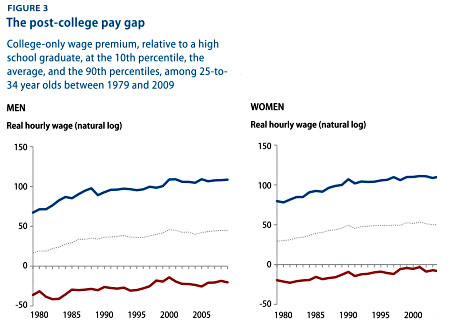
    Why has college enrollment edged downward in recent years? After all, the college premium is still pretty handsome, which makes a university degree a pretty good investment. Dean Baker thinks the answer might lie in how the college premium is distributed:

    Work by my colleague John Schmitt and Heather Boushey shows that a substantial proportion of college grads, especially male college grads, earn less than the average high school grad. They found that the lowest earning quintile of recent college grads (ages 25-34) earned less than the average high school grad. The implication is that many young people may be reasonably assessing their risks of not being a winner among college grads and therefore opting not to get additional education. To get more young people to attend college it is important that most can predictably benefit from the additional education, not just that the average pay of college grads rises.
    I’m not sure I buy this. Schmitt and Boushey present the chart on the right, and sure enough, the lowest ten percent of college grads (red line) earn less than the average high school grad. But this has always been true. What’s more, it’s actually less true today than in the past. Among both men and women, even the lowest-achieving college grad is relatively better off now than in 1980.

    Even if the bottom 10 percent are still worse off than an average high school grad, I’m not sure how a rising trend could lead to lower assessments of the value of college paying off. It seems like there must be more going on here than that.

  • John Boehner Speaks Up For Main Street Republicanism


    I’ve always felt a little sorry for John Boehner. In another era—a non-tea party era—he would have been your basic Main Street Republican, willing to cut compromises to keep the country moving along in a tolerably orderly way. The kind of guy who would have taken his cues from the Middletown Rotary Club.

    Speaking of which, Boehner spoke to the Middletown Rotary Club yesterday and let his hair down. For most Republicans, this would have meant getting caught making some kind of incendiary remarks about Obama thuggery and class warfare against job creators. In Boehner’s case, it meant some incendiary remarks about the, um, unrealistic attitudes of the more excitable members of his caucus:

    On immigration: “Here’s the attitude. Ohhhh. Don’t make me do this. Ohhhh. This is too hard,” Boehner whined before a luncheon crowd at Brown’s Run County Club in Madison Township. “We get elected to make choices. We get elected to solve problems and it’s remarkable to me how many of my colleagues just don’t want to … They’ll take the path of least resistance.”

    On Obamacare: “(To) repeal Obamacare … isn’t the answer. The answer is repeal and replace. The challenge is that Obamacare is the law of the land. It is there and it has driven all types of changes in our health care delivery system. You can’t recreate an insurance market over night.”

    On the tea party: “I don’t have any issue with the tea party. I have issues with organizations in Washington who raise money purporting to represent the tea party, those organizations who are against a budget deal the president and I cut that will save $2.4 trillion over 10 years….I made it pretty clear I’ll stand with the tea party but I’m not standing with these three or four groups in Washington who are using the tea party for their own personal benefit.”

    This is all about pragmatism, a cri de coeur against the Foxification of the Republican Party. And I guess it means one of two things. Either Boehner doesn’t really care much about holding onto his leadership position anymore, or else he’s sensed that there’s a burgeoning Main Street backlash against the radicalism of the tea party wing of the modern GOP.

    Boehner has always wanted to govern, and he’s never believed that compromise was surrender. That’s not the kind of pol he is. But he’s been hemmed in by the demands of the tea party, and now maybe he’s starting to think it’s time to bust out. The Middletown Rotary Club is probably more interested in keeping things on an even keel than in endless confrontation and hostage taking that does nothing except hurt the economy. They think immigration reform is good for business, and even if they don’t like Obamacare, they probably understand by now that it’s not a catastrophe and it’s time to make the best of it. Maybe they’re finally starting to find their voice.

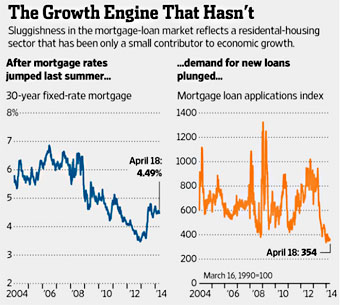
  • The Housing Market Is Stalling, and Stagnant Wages Are to Blame


    Although the economy has shown signs of life lately, growth is still pretty sluggish. The primary culprit appears to be housing: as Neil Irwin points out today, even after recovering from its Great Recession nadir, investment in residential property remains anemic compared to its average level over the past few decades. People just aren’t buying new houses—or refinancing old ones—fast enough to power a serious recovery.

    The proximate cause for this is twofold. First, median incomes have been pretty sluggish: household income today is only about 2 percent higher than it was before the start of the recession. That’s just not enough income growth to get young couples confident enough to move out from their parents’ basement and strike out on their own. Second, as the Wall Street Journal reports, rising interest rates have killed off the refi market:

    Mortgage lending declined to the lowest level in 14 years in the first quarter as homeowners pulled back sharply from refinancing and house hunters showed little appetite for new loans, the latest sign of how rising interest rates have dented the housing recovery.

    ….The decline in mortgage lending last quarter stemmed almost entirely from the slide in refinancing. Loans for home purchases were basically flat from a year earlier and down from the fourth quarter.

    Mortgage loans were basically flat, which is bad enough. But refinancing is important too, since it puts money in people’s pockets, which they can use to either pay down debt or spend on consumer goods. Either one is good for an overleveraged economy. But now that’s coming to an end.

    Housing is the single most important driver of economic growth. In the past, pent-up demand for new housing following a recession would eventually overwhelm financial trepidation, causing young families to start buying new houses. This time that hasn’t happened, and sluggish median incomes are almost certainly to blame (along with high debt levels among college grads, who are one of the prime markets for starter homes). The virtuous circle of rising incomes leading to new home buying—which in turn stimulates the economy and raises wages further—simply hasn’t happened. We are learning the hard way that there’s a stiff price to be paid when virtually all of the economic gains of a recovery go to the well off. Life may be good for them, but without broadly shared prosperity, the larger economy is stuck in a rut.

  • Russia Offers Deal on Ukraine — Maybe


    Here’s the latest on Ukraine:

    The Russian foreign minister, Sergei Lavrov, appears to have offered a deal to resolve the crisis in eastern Ukraine, suggesting that if the country’s government clears out the nationalist protest camp in Kiev, then pro-Moscow separatists will lay down their arms.

    ….Lavrov’s comments came as the Ukrainian government launched further military operations against some of the pro-Russian separatists who have seized government buildings across eastern Ukraine, having killed up to five rebels on Thursday.

    He said the pro-Russian militias in the east “will be ready” to lay down arms and vacate the buildings “only if Kiev authorities get down to implementing the Geneva accords, clear out that shameful Maidan [Independence Square] and liberate the buildings that have been illegally seized”.

    This sort of gives the game away, doesn’t it? It’s not as if anyone in the world believes the Russian denials that they’re behind the militant actions in eastern Ukraine, but they’ve been resolutely denying it anyway. Now, though, they’ve as much as admitted that they can tell the pro-Russian militias to stand down if they want to. I’m glad we cleared that up.


  • Another Criminologist Takes On the Lead-Crime Hypothesis


    Mark Kleiman points me today to a critique from criminologist Phil Cook of the lead-crime hypothesis. Unlike some others, however, this is a sensible one:

    Even a fairly casual glance at the data demonstrates that whatever the cause of the crime surge, and then the crime drop, it was not associated with particular cohorts. It was an environmental effect — 10 cohorts were swept up in the crime surge simultaneously, and the drop has the same correlated pattern.

    There is a natural inclination to assume that the reason the murder rate is increasing is because there are more murderers, and the reason we have fewer is that there are fewer murderers. It’s not that I rule out such explanations — I’m open to the idea of lead removal and abortion legalization — it’s just that I don’t think it explains the actual pattern of the youth violence epidemic, either up or down. More generally, my instinct is to look to the social and economic environment to explain large shifts in population outcomes.

    Cook is arguing that because ambient lead levels changed over time (rising from 1945-70 and then falling after that), different age cohorts were affected differently. This means we should see different crime rates from different age groups. In fact, we see rises and then falls in lots of cohorts at the same time.

    I’ve scanned through Cook’s paper (originally published in 2002) but I haven’t read it thoroughly. However, it’s focused primarily on the mid-80s through the mid-90s, which might skew things since there are quite a few age cohorts during that era which suffered from pretty severe childhood lead poisoning. It’s also worth pointing out that lead poisoning affected every age cohort born from about 1950 through 1980, and the differences in lead exposure between those cohorts are significant but not overwhelming. The crime wave that started in the 60s got steadily worse through the early 90s not just because 18-year-olds got progressively more poisoned (though they did) but because more and more age cohorts were suffering the effects of childhood lead exposure at the same point in time. In other words, seeing a rise and fall in multiple age cohorts is about what you’d expect to see if the lead hypothesis is correct.

    That said, I’d emphasize, as I often do, that crime is a complex affair and lead is only a part of the story. We shouldn’t expect any single theory to explain the data perfectly. There are just too many moving parts for that.

    In any case, don’t take my response to Cook’s critique too seriously. I’m an amateur, and it needs attention from experts who can evaluate his argument more rigorously. However, a few days ago I was complaining about the low quality of critics of the lead hypothesis, and now I have a high-quality critic. So I wanted to pass it along.

  • Why Was the Right Caught Flat-Footed By Cliven Bundy’s Cranky Racism?


    By now I assume you’ve all heard about Cliven Bundy’s remarks to the New York Times yesterday? In case you’ve been vacationing on Mars, here they are:

    “I want to tell you one more thing I know about the Negro,” he said. Mr. Bundy recalled driving past a public-housing project in North Las Vegas, “and in front of that government house the door was usually open and the older people and the kids — and there is always at least a half a dozen people sitting on the porch — they didn’t have nothing to do. They didn’t have nothing for their kids to do. They didn’t have nothing for their young girls to do.

    “And because they were basically on government subsidy, so now what do they do?” he asked. “They abort their young children, they put their young men in jail, because they never learned how to pick cotton. And I’ve often wondered, are they better off as slaves, picking cotton and having a family life and doing things, or are they better off under government subsidy? They didn’t get no more freedom. They got less freedom.”

    I don’t have anything to add that (a) isn’t obvious and (b) hasn’t already been said by someone else, but I do share Paul Waldman’s reaction: “Is anyone surprised that Cliven Bundy, the Nevada rancher who has become a Fox News hero because of his stand-off with the Bureau of Land Management, turns out to be a stone-cold racist?”

    That’s a good question. Is anyone on the right surprised by this? (I think it’s safe to say that exactly zero lefties are surprised.) That’s not a rhetorical question on my part. Look: conservatives should never have rallied around Bundy in the first place, but if they’re even minimally self-aware about his particular niche in the conservative base, surely they should have seen something like this coming and kept their distance just out of sheer self-preservation. But apparently they didn’t. They didn’t have a clue that a guy like Bundy was almost certain to backfire on them eventually. They seem to have spent so long furiously denying so much as a shred of racial resentment anywhere in their base that they’ve drunk their own Kool-Aid.

    On a tangential note, as near as I can tell Paul Ryan never embraced Bundy publicly. Does anyone know if that’s right? It’s one reason I think he could be a dangerous presidential candidate. Despite his “inner city” gaffe of a few weeks ago, he’s smarter about this stuff than most folks who have managed to stay on the right side of the tea party.