Shopping Around Is the Key to Low Prices in Obamacare

Get your news from a source that’s not owned and controlled by oligarchs. Sign up for the free Mother Jones Daily.


Abby Goodnough writes today about switching health care coverage each year during Obamacare’s year-end open enrollment period:

The Obama administration is encouraging switching as a way to avoid steep increases in premiums — and to promote competition among insurers, as the law intends. Next year will be no different: The price of plans will rise in most states, and the administration says that 86 percent of people who currently have coverage through the federal exchange can find a better deal by switching.

“This may be just one of those environments where there’s a new normal,” said Sabrina Corlette, a professor at the Health Policy Institute of Georgetown University.

For many consumers, the volatility in the markets has been a source of anxiety and disruption. To have any choice at all is a welcome development, many say. But switching plans is also becoming an unwelcome ritual, akin to filing taxes, that is time-consuming and can entail searching for new doctors and hospitals each year.

This is unquestionably a downside to encouraging competition in the health insurance marketplace. As carriers jostle for position, the lowest-price coverage is going to change from year to year—and if you’re a price-sensitive shopper, that means your coverage is going to change from year to year too.
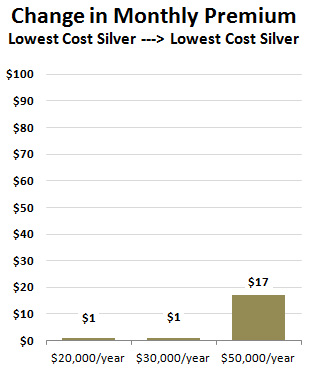
I suspect this problem will settle down after a couple more years, as insurance companies get more experience with the Obamacare pool and get better at pricing their policies. In the meantime, though, it really does pay to shop around. A new Kaiser study of 2016 rate increases provides some concrete numbers. If you bought the cheapest silver plan in 2015 and then you stick with it in 2016, your premium may go up quite a bit. But if you shop around for the plan that has the lowest price in 2016, your premium will barely change at all. The chart on the right tells the story. For low-income buyers, shopping around means virtually no premium increase at all. For middle-income buyers, it means a larger but still pretty modest increase.

Moral of the story: If price is a major issue for you, shop around! It’s a pain in the ass, but it pays off.
From the desk of Mother Jones CEO, Monika Bauerlein...

Newsrooms can be funded in many ways. One of the most controversial (and volatile) ways is by a for-profit corporation or a billionaire owner. We see it across the headlines on a weekly basis: the claw backs in public media, the gutting of The Washington Post, the bending over backwards to appeal to Trump and his allies.

But not here.

When Mother Jones first started publishing 50 years ago, our founders made a critical decision: to be a reader-supported nonprofit. They knew that no corporate owner would be interested in a muckraking newsroom; they also knew that no muckraking newsroom would be interested in following the agenda of a corporate owner.

And so, we’ve been reader-funded for half a century. We rely on contributions from our readers—readers like you—whether it’s $50, or $15 a month, or whatever fits your budget. People give what they can, and every donation makes a difference for our newsroom, which has grown tremendously—in size and reach and renown—since its inception in 1976.

You may be wondering: What does it take to publish an investigation? And what does my donation actually fund? The answers are one and the same: It takes people, resources, and time. And that’s what your donation funds directly.

Every donation Mother Jones receives from readers fortifies our newsroom, whether we’re covering underreported scandals out of Washington, DC, or the most important news of the day. And right now, each donation will be doubled because of our $50,000 match. So when you make a donation—$5, $50, any amount—it’ll go twice as far.

Your support keeps us going. If you’re able, donate today.

Thanks for reading.

—Monika

From the desk of Mother Jones CEO, Monika Bauerlein...

Newsrooms can be funded in many ways. One of the most controversial (and volatile) ways is by a for-profit corporation or a billionaire owner. We see it across the headlines on a weekly basis: the claw backs in public media, the gutting of The Washington Post, the bending over backwards to appeal to Trump and his allies.

But not here.

When Mother Jones first started publishing 50 years ago, our founders made a critical decision: to be a reader-supported nonprofit. They knew that no corporate owner would be interested in a muckraking newsroom; they also knew that no muckraking newsroom would be interested in following the agenda of a corporate owner.

And so, we’ve been reader-funded for half a century. We rely on contributions from our readers—readers like you—whether it’s $50, or $15 a month, or whatever fits your budget. People give what they can, and every donation makes a difference for our newsroom, which has grown tremendously—in size and reach and renown—since its inception in 1976.

You may be wondering: What does it take to publish an investigation? And what does my donation actually fund? The answers are one and the same: It takes people, resources, and time. And that’s what your donation funds directly.

Every donation Mother Jones receives from readers fortifies our newsroom, whether we’re covering underreported scandals out of Washington, DC, or the most important news of the day. And right now, each donation will be doubled because of our $50,000 match. So when you make a donation—$5, $50, any amount—it’ll go twice as far.

Your support keeps us going. If you’re able, donate today.

Thanks for reading.

—Monika

We Recommend

Latest

Sign up for our free newsletter

Subscribe to the Mother Jones Daily to have our top stories delivered directly to your inbox.

Get our award-winning magazine

Save big on a full year of investigations, ideas, and insights.

Subscribe

INDEPENDENT. BECAUSE OF YOU.

Mother Jones has no billionaires calling the shots—just readers like you making fearless reporting possible

Donate