I Got Married At the Perfect Age

Get your news from a source that’s not owned and controlled by oligarchs. Sign up for the free Mother Jones Daily.


Via Christopher Ingraham, we have some new research showing when to get married if you want to minimize your risk of divorce. Here is Nicholas Wolfinger: “My data analysis shows that prior to age 32 or so, each additional year of age at marriage reduces the odds of divorce by 11 percent. However, after that the odds of divorce increase by 5 percent per year.”
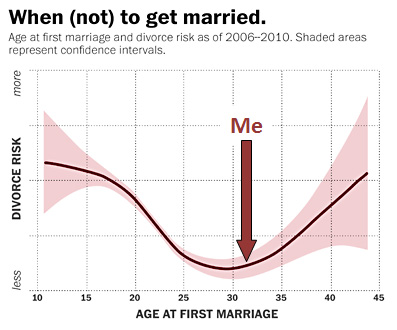
Hmmm. In the chart it looks more like 29 is the ideal age, but I got married at 32, so I’ll take it. Unfortunately, this is for people getting married now. For people who got married back when I got married, the older the better. Today, for some reason, it’s the older the better until age 32, and then the divorce risk curves back up. Why the change? After a bit of statistical argle bargle, Wolfinger admits he can’t really figure it out. But he’s willing to guess:

My money is on a selection effect: the kinds of people who wait till their thirties to get married may be the kinds of people who aren’t predisposed toward doing well in their marriages. For instance, some people seem to be congenitally cantankerous. Such people naturally have trouble with interpersonal relationships. Consequently they delay marriage, often because they can’t find anyone willing to marry them. When they do tie the knot, their marriages are automatically at high risk for divorce. More generally, perhaps people who marry later face a pool of potential spouses that has been winnowed down to exclude the individuals most predisposed to succeed at matrimony.

I totally agree on the congenitally cantankerous observation, but I’m not sure that’s changed much since 1995. There were lots of cantankerous people back then too. So I’ll put my money on some other explanation. I’m just not sure what it is yet.

From the desk of Mother Jones CEO, Monika Bauerlein...

Newsrooms can be funded in many ways. One of the most controversial (and volatile) ways is by a for-profit corporation or a billionaire owner. We see it across the headlines on a weekly basis: the claw backs in public media, the gutting of The Washington Post, the bending over backwards to appeal to Trump and his allies.

But not here.

When Mother Jones first started publishing 50 years ago, our founders made a critical decision: to be a reader-supported nonprofit. They knew that no corporate owner would be interested in a muckraking newsroom; they also knew that no muckraking newsroom would be interested in following the agenda of a corporate owner.

And so, we’ve been reader-funded for half a century. We rely on contributions from our readers—readers like you—whether it’s $50, or $15 a month, or whatever fits your budget. People give what they can, and every donation makes a difference for our newsroom, which has grown tremendously—in size and reach and renown—since its inception in 1976.

You may be wondering: What does it take to publish an investigation? And what does my donation actually fund? The answers are one and the same: It takes people, resources, and time. And that’s what your donation funds directly.

Every donation Mother Jones receives from readers fortifies our newsroom, whether we’re covering underreported scandals out of Washington, DC, or the most important news of the day. And right now, each donation will be doubled because of our $50,000 match. So when you make a donation—$5, $50, any amount—it’ll go twice as far.

Your support keeps us going. If you’re able, donate today.

Thanks for reading.

—Monika

From the desk of Mother Jones CEO, Monika Bauerlein...

Newsrooms can be funded in many ways. One of the most controversial (and volatile) ways is by a for-profit corporation or a billionaire owner. We see it across the headlines on a weekly basis: the claw backs in public media, the gutting of The Washington Post, the bending over backwards to appeal to Trump and his allies.

But not here.

When Mother Jones first started publishing 50 years ago, our founders made a critical decision: to be a reader-supported nonprofit. They knew that no corporate owner would be interested in a muckraking newsroom; they also knew that no muckraking newsroom would be interested in following the agenda of a corporate owner.

And so, we’ve been reader-funded for half a century. We rely on contributions from our readers—readers like you—whether it’s $50, or $15 a month, or whatever fits your budget. People give what they can, and every donation makes a difference for our newsroom, which has grown tremendously—in size and reach and renown—since its inception in 1976.

You may be wondering: What does it take to publish an investigation? And what does my donation actually fund? The answers are one and the same: It takes people, resources, and time. And that’s what your donation funds directly.

Every donation Mother Jones receives from readers fortifies our newsroom, whether we’re covering underreported scandals out of Washington, DC, or the most important news of the day. And right now, each donation will be doubled because of our $50,000 match. So when you make a donation—$5, $50, any amount—it’ll go twice as far.

Your support keeps us going. If you’re able, donate today.

Thanks for reading.

—Monika

We Recommend

Latest

Sign up for our free newsletter

Subscribe to the Mother Jones Daily to have our top stories delivered directly to your inbox.

Get our award-winning magazine

Save big on a full year of investigations, ideas, and insights.

Subscribe

INDEPENDENT. BECAUSE OF YOU.

Mother Jones has no billionaires calling the shots—just readers like you making fearless reporting possible

Donate