
The Wall Street Journal says Bernie Sanders’ domestic policy plan would cost $18 trillion over ten years. Is this true?
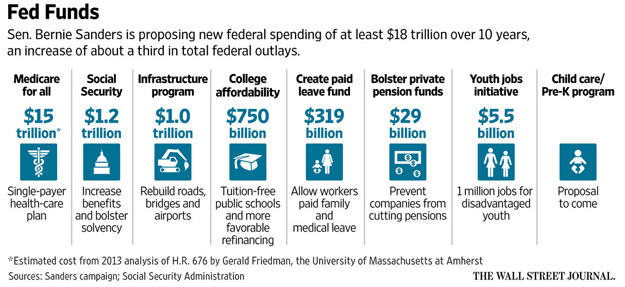
It depends on how you look at it. First, there’s a set of proposals that the Journal estimates would cost about $3.4 trillion. That’s not pocket change, but it’s about as much as Jeb Bush’s tax cut. The big difference is that Jeb’s tax cuts mostly benefit the rich, while Bernie’s proposals mostly benefit the poor and the middle class. You can decide for yourself which you prefer.
Then there’s the $15 trillion price tag for universal health care. Is this a fair estimate? It’s probably in the ballpark. Private health insurance accounted for about $1 trillion in spending last year, and assuming reasonable growth that will probably come to around $15 trillion over the course of a decade.
But here’s the thing: this is money we already spend. Right now, employers and workers pay insurance companies $1 trillion for health care. Under Bernie’s plan, we’d instead pay that money to the federal government. Generally speaking, this would be invisible to most of us. Behind the scenes, our dollars would flow to a different place, and that’s about it.
So the Sanders plan wouldn’t actually take money out of our pockets. It’s a wash. It needs to be evaluated instead on all the usual metrics. Would the government do a better job of holding down costs? Would government control distort market signals? Would innovation suffer? Would most of us have more choice in health care providers? Would more people be covered? Etc.
Bottom line: You should think of the Sanders plan as costing about $3.4 trillion. You may or may not like the idea of universal health care, but it wouldn’t have much impact on how much money you actually take home each week.
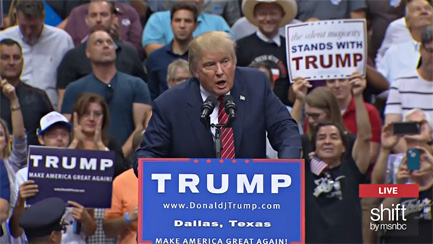
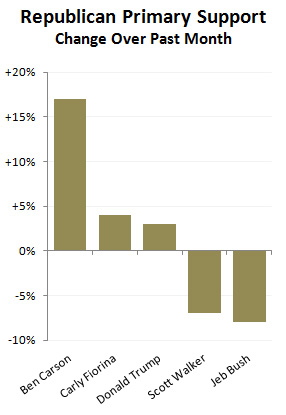 Last night Donald Trump was whining about how badly the media mistreats him—yes, seriously—and Exhibit A was a bunch of recent headlines saying that Ben Carson was surging in the polls. “Everybody’s surging but me,” he griped.
 I see that President Obama has waded in to the
 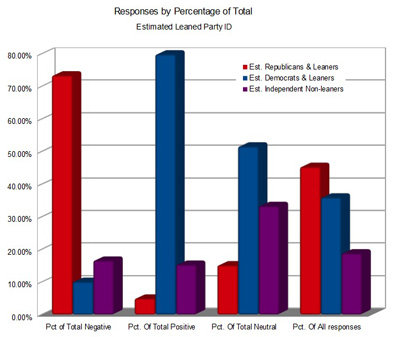 gory details, but here it is in a nutshell: roughly speaking, the only people who described Hillary as a liar were Republicans. And the reason that word so badly outnumbered the others is that Republicans used it in lockstep. The positive descriptions of Hillary were all over the map, so no single one of them racked up big numbers.
 Which of these countries is not like the others?
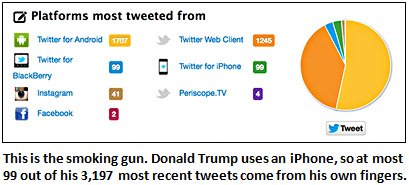 time. Only 3 percent of @realDonaldTrump’s tweets comes from his own actual fingers.
 Steve Benen reports on the swan song of conservative plans to prove that



