College-Educated Millennials Don’t Have It So Bad

Get your news from a source that’s not owned and controlled by oligarchs. Sign up for the free Mother Jones Daily.


Quoctrung Bui of the New York Times writes today about perceptions of massive unemployment among young college grads:

We asked: “What would you guess is the current unemployment rate for four-year college graduates between the ages of 25 and 34?”…The most common answers for college graduates were between 20 and 30 percent. Perhaps an understandable mistake….But what surprised us was that the majority of people thought that unemployment rates for those with college degrees were higher than for those without.

….We posed the same question to our friends and parents. Many have college degrees themselves; some are educators. They, too, mostly guessed that college graduates would be more likely to be unemployed than nongraduates….We ran the quiz one last time with the same question and anchor, structured as a multiple-choice quiz. This time, nearly half of the people in the survey guessed that college graduates had higher unemployment rates. We had to concede that we weren’t witnessing a mirage.

Are we — the news media — to blame?

Yes! Yes you are!

But I’ll cut you some slack. The range of 20-30 percent seems to be the American public’s go-to guess for just about everything in the news. What’s the percentage of gay people in the US? 20-30 percent. The inflation rate? 20-30 percent. Illegal immigrant population? 20-30 percent. Amount of the federal budget dedicated to foreign aid? 20-30 percent. Bird deaths from wind turbines? 20-30 percent.

As near as I can tell, anytime something becomes familiar enough to intrude on the public consciousness, it falls into the 20-30 percent trap. That seems to be the all-around perception of “a smallish but still newsworthy amount.”

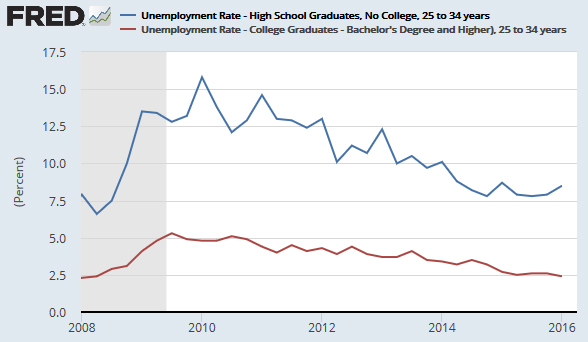
That said, the news media still shares a lot of the blame for this, because they’re the ones who collectively decide how much to cover stuff. By over-covering the alleged employment woes of college-educated millennials, they encourage people to think the problem is worse than it is—and they distract attention from where the problem really is. The truth is quite different: even at the height of the Great Recession, the unemployment rate of college-educated millennials never cracked 5 percent other than momentarily. It was young high school grads who suffered from astronomical joblessness:
But wait! Maybe college grads got jobs, but they were all crappy jobs that paid peanuts. Not really. College-educated millennials took a beating during the Great Recession, just like everyone, but rebounded to their 2003-05 level after three years and have rebounded even further since. Young high school grads, by contrast, are still making about 10 percent less than they did in 2003-05:
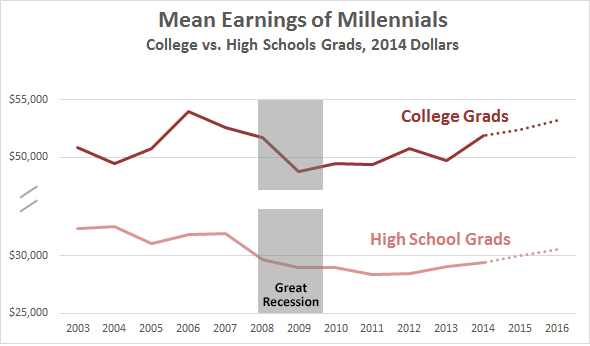
(This is from Census table P-28 here if you feel like checking it out yourself.)

College-educated millennials get all the attention, but that’s not because they have it so bad. It’s largely because they loom large in the minds of the press corps—who are all college educated themselves—and because they’re verbal enough that they write a lot about themselves. High school grads, not so much. But they’re the ones who were really hit hard by the Great Recession.

From the desk of Mother Jones CEO, Monika Bauerlein...

Newsrooms can be funded in many ways. One of the most controversial (and volatile) ways is by a for-profit corporation or a billionaire owner. We see it across the headlines on a weekly basis: the claw backs in public media, the gutting of The Washington Post, the bending over backwards to appeal to Trump and his allies.

But not here.

When Mother Jones first started publishing 50 years ago, our founders made a critical decision: to be a reader-supported nonprofit. They knew that no corporate owner would be interested in a muckraking newsroom; they also knew that no muckraking newsroom would be interested in following the agenda of a corporate owner.

And so, we’ve been reader-funded for half a century. We rely on contributions from our readers—readers like you—whether it’s $50, or $15 a month, or whatever fits your budget. People give what they can, and every donation makes a difference for our newsroom, which has grown tremendously—in size and reach and renown—since its inception in 1976.

You may be wondering: What does it take to publish an investigation? And what does my donation actually fund? The answers are one and the same: It takes people, resources, and time. And that’s what your donation funds directly.

Every donation Mother Jones receives from readers fortifies our newsroom, whether we’re covering underreported scandals out of Washington, DC, or the most important news of the day. And right now, each donation will be doubled because of our $50,000 match. So when you make a donation—$5, $50, any amount—it’ll go twice as far.

Your support keeps us going. If you’re able, donate today.

Thanks for reading.

—Monika

From the desk of Mother Jones CEO, Monika Bauerlein...

Newsrooms can be funded in many ways. One of the most controversial (and volatile) ways is by a for-profit corporation or a billionaire owner. We see it across the headlines on a weekly basis: the claw backs in public media, the gutting of The Washington Post, the bending over backwards to appeal to Trump and his allies.

But not here.

When Mother Jones first started publishing 50 years ago, our founders made a critical decision: to be a reader-supported nonprofit. They knew that no corporate owner would be interested in a muckraking newsroom; they also knew that no muckraking newsroom would be interested in following the agenda of a corporate owner.

And so, we’ve been reader-funded for half a century. We rely on contributions from our readers—readers like you—whether it’s $50, or $15 a month, or whatever fits your budget. People give what they can, and every donation makes a difference for our newsroom, which has grown tremendously—in size and reach and renown—since its inception in 1976.

You may be wondering: What does it take to publish an investigation? And what does my donation actually fund? The answers are one and the same: It takes people, resources, and time. And that’s what your donation funds directly.

Every donation Mother Jones receives from readers fortifies our newsroom, whether we’re covering underreported scandals out of Washington, DC, or the most important news of the day. And right now, each donation will be doubled because of our $50,000 match. So when you make a donation—$5, $50, any amount—it’ll go twice as far.

Your support keeps us going. If you’re able, donate today.

Thanks for reading.

—Monika

We Recommend

Latest

Sign up for our free newsletter

Subscribe to the Mother Jones Daily to have our top stories delivered directly to your inbox.

Get our award-winning magazine

Save big on a full year of investigations, ideas, and insights.

Subscribe

INDEPENDENT. BECAUSE OF YOU.

Mother Jones has no billionaires calling the shots—just readers like you making fearless reporting possible

Donate