 Keith Humphreys emails to say that his latest piece in the Washington Post is “Drum bait.” That’s my favorite kind of bait! Let’s take a look:
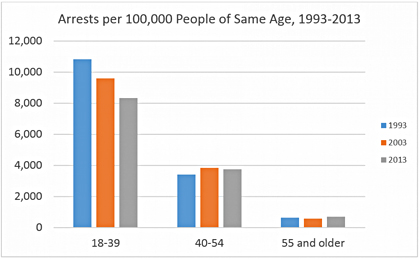
In absolute terms, arrests (like crime) are as expected consistently concentrated among the young at each historical time point. But surprisingly, the drop in the arrest rate over time is entirely accounted for by the current generation of young adults, who are busted 23 percent less frequently than prior generations were at their age. Remarkably, despite the national drop in overall crime and arrest rates, the arrest rate among older Americans is higher than it was 20 years ago.
The reason this is Drum bait is that it’s consistent with the lead-crime hypothesis. If you were age 18 in 2013, you grew up in the 90s, a low-lead era. That means you were likely to commit far fewer crimes than someone who was age 18 in 1993 and grew up in the 70s, the peak era for gasoline lead contamination.
But it’s different for older folks. People who were age 40 in 2013 grew up in the highly lead-contaminated environment of the 70s. However, the cohorts who were age 40 in 1993 and 2003 grew up in the 50s and 60s, which were also high-lead eras. It’s no surprise that there’s not much difference between them. (Their absolute crime rate is lower than it is for younger people because people tend to become less violent as they get older. The key here is that there’s very little difference between these three age cohorts because they all had similar exposure to lead in childhood, while there is a difference between the three age cohorts of 18-year-olds.)
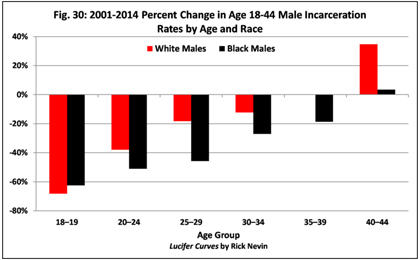 I would be remiss if I didn’t mention that Rick Nevin has made similar observations before:
From 1980 to 2011, the USA juvenile (under 18) index crime arrest rate fell by 57%, and the age-18-24 index crime arrest rate fell by 21%, but the index crime arrest rate increased by 32% for ages 35-49. The fall in the juvenile arrest rate from 1980-2011 compares youths born in the 1960s — near the peak in leaded gasoline exposure — with those born after leaded gas was eliminated in the mid-1980s. The 1980-2011 increase in the age-35-49 arrest rate compares adults born before the 1950s surge in leaded gas use with those born near the peak in leaded gas exposure.
(Note: “index crime” is a term that refers to an aggregate of four different violent crimes—murder, rape, robbery, and aggravated assault.)
If you’re interested in reading more about this, and more about the full case for the lead-crime hypothesis, Nevin has put it all together in a short e-book, The Lucifer Curves. You can find it here for a mere $2.99!