• Scientists Undervalue Meticulousness By a Lot


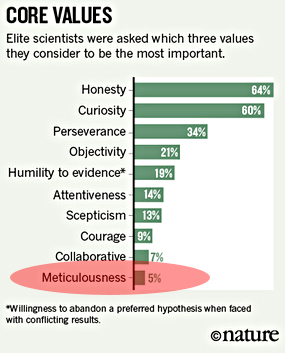
    According to a note in Nature, honesty and curiosity are the most highly prized traits among scientists.

    That’s all well and good. I’m also happy to see perseverance and objectivity on the list. Also humility, attentiveness, skepticism, courage, and willingness to collaborate. But I’m a little dismayed that meticulousness barely even cracked the top ten. Most of the greatest scientists in history were extraordinarily meticulous: Newton, Darwin, Galileo, Feynman, etc.

    Meticulous attention to detail is how you turn all that curiosity and perseverance into lasting results. It’s also how you maintain your objectivity, your humility, and your skepticism. I hope that in their daily lives, scientists value meticulousness more than they do when they answer survey questions.

  • Friday Fundraising and Catblogging – 8 April 2016


    April is an important fundraising month here at Mother Jones, and my colleague David Corn—you may remember him as the guy responsible for Valerie Plame and Mitt Romney’s 47 percent snafu—wrote a pitch called “Trump, the Media, and You,” explaining how our model of reader-supported journalism allows MoJo to report on substantive issues (like actual policy proposals and digging into candidates’ pasts!) that are largely missing from this year’s election coverage. Here’s David:

    IN A WORLD OF RATINGS AND CLICKS, financially pressed media outlets frequently zero in on the shining objects of the here and now. Merely covering Trump’s outrageous remarks—did you see his latest tweet?!—has become its own beat. Even the best reporting that does happen can become lost in the never-ending flood of blogs, tweets, Facebook posts, and stories that appear in increasingly shorter news cycles.

    At Mother Jones, we try each day to sort out what to cover—and where to concentrate our reporting in order to make a difference. Yes, we need to follow the daily twists and turns. But we recognize it’s important for journalists to get off the spinning hamster wheel and dig where others do not.

    Donate Now

    Hmmm. It kinda sounds like I’m MoJo’s resident hamster. It’s a tough job, but I guess someone has to do it. After all, with me on the hamster wheel, David and the rest of our reporters can focus their work on the in-depth, investigative journalism that might not make us rich in advertising dollars, but that voters and our democratic process desperately need.

    If you’re reading this, I’d bet that you like both—coverage of the circus, and smart, probing journalism. They both matter. If you agree, I hope you’ll pitch in a couple bucks during our fundraising drive—and since we’re a nonprofit, your contributions are tax-deductible. You can give by credit card, or PayPal.

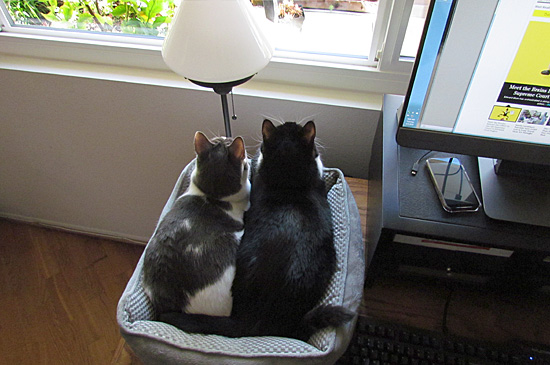
    Still, hamster though I may be, we all know that Friday afternoon is reserved for cats. And I know what you’re thinking: That pod I bought last week looks lovely and comfy, but it only has room for one cat. What’s up with that?

    Pshaw. There is always room for another cat. It’s the magic of cat physics, far more astounding than black holes or quantum mechanics. No matter how many cats you have, somehow you can always squeeze in one more.

  • Paul Krugman Is Annoying


    Paul Krugman doesn’t think much of Bernie Sanders. Krugman being Krugman, that means he’s been flooding the zone with anti-Bernie columns and blog posts. This hasn’t gone over well with many of his erstwhile fans:

    Greg Sargent gets this right. These days, nobody is allowed to be anti-Bernie or anti-Hillary simply because they disagree with them. There has to be some hidden, crypto-conservative agenda involved. In reality, though, this is just Krugman being his usual self. It’s what he does. Lefties are now learning why conservatives find him so annoying.

  • Benghazi Committee Passes 700-Day Milestone


    House Democrats pointed out today that the Select Committee on Benghazi has now been cranking along for 700 days. Steve Benen comments:

    To put this in context, the 9/11 Commission, investigating every possible angle to the worst terrorist attack in the history of the country, worked for 604 days and created a bipartisan report endorsed by each of the commission’s members….Rep. Trey Gowdy’s (R-S.C.) Benghazi panel has also lasted longer than the investigations into the federal response to Hurricane Katrina, the attack on Pearl Harbor, the assassination of President Kennedy, the Iran-Contra scandal, Church Committee, and the Watergate probe.

    What Steve fails to acknowledge, of course, is that Benghazi is far more important than any of these other events. So naturally it’s going to take longer. I’m guessing that 914 days should just about do the trick.

  • Bernie Sanders Has Really Pissed Off Margaret Archer


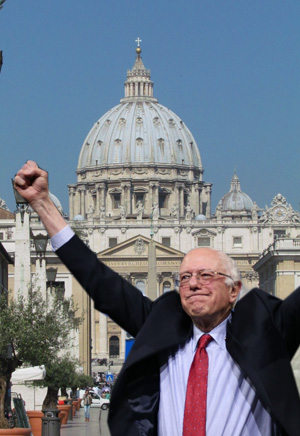
    Bernie Sanders is headed to the Vatican:

    Whether or not the pope shares the Vermont senator’s enthusiasm for Eugene Debs, he’s “feeling the Bern” enough to have invited the Jewish presidential candidate to speak at the Pontifical Academy of Social Sciences, during a conference on social, economic, and environmental issues. Sanders will head to Rome immediately after the April 14 Democratic debate in Brooklyn.

    But apparently the Pontifical Academy of Social Sciences is decidedly not feeling the Bern:

    Democratic presidential candidate Bernie Sanders reached out to obtain his invitation to the Vatican and showed “monumental discourtesy” in the process, a senior Vatican official said.

    “Sanders made the first move, for the obvious reasons,” Margaret Archer, president of the Pontifical Academy of Social Sciences, which is hosting the conference Sanders will attend, said in a telephone interview. “I think in a sense he may be going for the Catholic vote but this is not the Catholic vote and he should remember that and act accordingly—not that he will.

    Huh. I wonder what Bernie did to piss off Margaret Archer? Maybe it has something to do with his views on conflation:

    Margaret Archer argues that much social theory suffers from the generic defect of conflation where, due to a reluctance or inability to theorize emergent relationships between social phenomena, causal autonomy is denied to one side of the relation. This can take the form of autonomy being denied to agency with causal efficacy only granted to structure (downwards conflation). Alternatively it can take the form of autonomy being denied to structure with causal efficacy only granted to agency (upwards conflation).

    …In contradistinction Archer offers the approach of analytical dualism. While recognizing the interdependence of structure and agency (i.e. without people there would be no structures) she argues that they operate on different timescales. At any particular moment, antecedently existing structures constrain and enable agents, whose interactions produce intended and unintended consequences, which leads to structural elaboration and the [etc. etc.]

    Does that help? No? Sorry about that. I guess someone will have to ask Archer just what Bernie did that was so monumentally discourteous. Was it merely asking for an invitation in the first place? Is it the fact that Bernie is pro-choice? Or something more? We need someone to dig into the Vatican gossip machine and let us know.

    UPDATE: Apparently this is all part of some vicious infighting among the Vatican’s social scientists:

    U.S. Democratic presidential candidate Bernie Sanders was invited to speak at an April 15 Vatican event by the Vatican, a senior papal official said on Friday….He said it was his idea to invite Sanders.

    A Bloomberg report quoted Margaret Archer, president of the Pontifical Academy of Social Sciences, as saying that Sanders had broken with protocol by failing to contact her office first. “This is not true and she knows it. I invited him with her consensus,” said [Monsignor Marcelo Sanchez] Sorondo, who is senior to Archer.

    An invitation to Sanders dated March 30, which was emailed to Reuters, was signed by Sorondo and also included Archer’s name.

    Well then.

  • CEO Pay Down in 2015, But Still Higher Than Its Bubble Heights


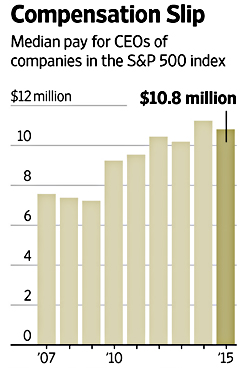
    Sad news today from the Wall Street Journal. Among CEOs of big companies, stock-based pay was up 7 percent last year and cash pay was up 2 percent. But thanks to slower growth of CEO pensions, overall compensation was down 4 percent.

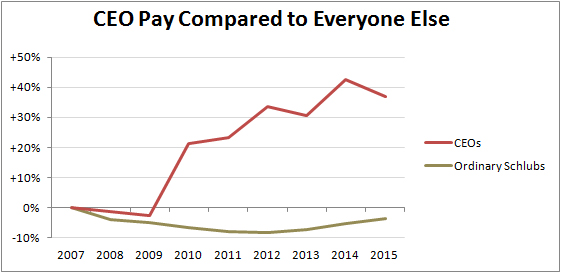
    But perhaps CEOs will be mollified by the broader picture, which you can see in the chart on the right. CEO pay is up about 44 percent since 2007 in nominal terms, and up about 38 percent when you account for inflation. For ordinary workers, pay has decreased 5 percent since 2007 when you account for inflation.

    For anyone wondering why Bernie Sanders has struck such a chord with the electorate, this pretty much tells the story. The Great Recession sure didn’t affect everyone equally, did it? Ordinary schlubs paid a high price, but the folks with the most lavish pay to begin with just shrugged it off like it never happened. If the rich wonder why calls to tax high incomes at 90 percent sound pretty good to a lot of people, this should clue them in.

  • Yawn. Yet More Good Obamacare News


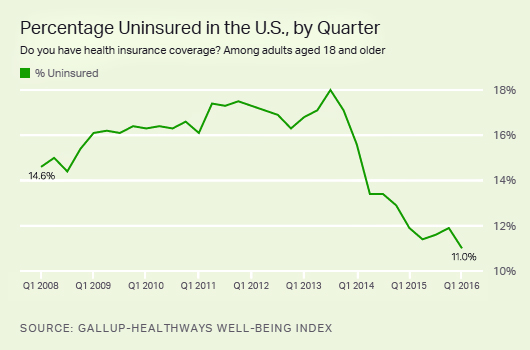
    There’s so much good news about Obamacare, you really are getting tired of winning all the time, aren’t you? Well, here’s the latest:

    This is courtesy of Gallup. It shows that after a couple of modest increases in the uninsured rate at the end of 2015, the start of a new year produced a new surge of people into Obamacare, driving the uninsured rate down to 11 percent. That’s a new record low.

    As always, don’t try to compare this directly to the CDC figures for the uninsured. Gallup counts everyone over 18. CDC counts everyone under age 65. Because of this, the Gallup number is generally about one percentage point lower than CDC.

  • Maybe Atrios Is Right About Driverless Cars


    A couple of weeks ago we bought a Neato robotic vacuum. It wouldn’t operate for more than five minutes at a time, so I called tech support. They were very nice, and said I had to “calibrate the battery.” Huh. I did that, and it got better, but then it wouldn’t return to its base. Calibrate it again, they said. So I did, and it started returning home. But then it started running into a wall and getting stuck. I don’t know why. It was just a bare wall. But the robot apparently wanted to climb up to the ceiling or something, and you know how robots are once they get an idea in their heads. Then it went under a chair and refused to come out.

    So I returned the Neato and went to Fry’s, where I bought a Roomba. Much better! It worked the first time with no problems—except for one thing: it would only clean one room. Apparently some bright spark in the Roomba marketing department asked engineering to write a bit of additional firmware that would cripple the device so they could call it a new model and sell it at a new price point. But this makes it fairly useless, since the whole point of a device like this is to schedule it and forget it.
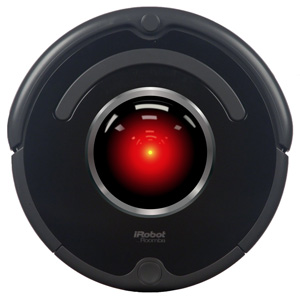
    But I tried it anyway. Oddly, it worked OK upstairs, where there are many hallways and rooms. Downstairs, though, it would only clean the living room. I moved it to the kitchen, but no dice: it made a beeline for the living room and cleaned it again. So I tried one more time. Success! It started cleaning the kitchen. But then it developed a grudge against our dishwasher. I wish I had video of this, but basically it went nuts. It banged into it, circled around angrily, got up on its hind wheels (seriously) and banged away some more. It was pissed. I watched it do this for more than five minutes before I shut it off. I was afraid it would eventually wreck the dishwasher. It’s going back to Fry’s tomorrow.

    For some time Atrios has been saying that driverless cars are a fantasy. I think he’s crazy. But I have to score this round in his favor. Robotic vacuums travel at about 1 mph; they don’t have to avoid other robotic vacuums; nothing in their path moves; and all they have to do is crudely recognize obstacles and map a way around them. And yet, after ten years of development, they still can’t do it reliably. Maybe driverless cars really are a fantasy.

    But I have good tech news too. Many years ago I got tired of the lousy keyboards that come with modern computers, and bought an old IBM mechanical keyboard. It was nice, but it was so loud I stopped using it. The noise was so overpowering that it almost made conversation impossible.

    Last week I decided to try again. You may not be aware of this, but thanks to gamers there’s been a renaissance in high-quality mechanical keyboards. The one I bought was insanely expensive (about $150), but also had some other features I wanted, and it’s killer. For the cognoscenti among you, it uses Cherry MX brown switches, and I love it. It has a great feel, but the sound is muffled just enough that it won’t wake the neighbors.

    It even advanced the cause of journalism. Once I tried it out, I was so eager to type something substantial that I finally got back to a story I’m writing for the next issue of the magazine. It’s all finished now, and you’re probably going to hate it. Everyone’s going to hate it. But at least it was created using a really nice keyboard.

  • Does It Really Matter if Bernie Called Hillary Unqualified?


    Josh Marshall weighs in on the flap over Bernie Sanders saying that Hillary Clinton is unqualified to be president:

    Various things Clinton said can be reasonably interpreted as questioning whether Sanders is up to the job of the presidency. But it is an entirely different matter when an opponent, in his own voice, says flatly his challenger is “unqualified” to serve as President of the country. That’s something that cannot be unsaid. If Clinton is the nominee, it will undoubtedly be a staples of GOP stump speeches in the Fall. These are simple realities of political campaigns.

    I’m curious about something: is this actually true? I hear it every four years. At some point, the primary races always get a little (or a lot) nasty, and the candidates start saying things that seem like they’d be great fodder for attack ads by the other side in the general election. But are they? Do these kinds of comments ever end up as a major theme in political ads?

    I never see it. Of course, I live in California, and nobody ever bothers advertising here. Still, I never really hear about it elsewhere either. By the time the general election comes along, both sides have far more important attacks to make. And they probably assume—rightly—that most undecided voters don’t care much what some angry primary opponent said six months before.

    I’d prefer that both Bernie and Hillary dial it back a notch. But is Donald Trump really going to attack Hillary by showing footage of Bernie saying she’s not qualified to be president, nyah nyah nyah? I doubt it. Even low-information voters know that this is the kind of thing that happens in the heat of campaigns, and it doesn’t really mean anything.

    Does anyone know the answer to this? In 2012, for example, did the Obama campaign run attack ads featuring Newt Gingrich saying that Romney kept money in the Cayman Islands? Did the McCain campaign in 2008 use footage of Hillary attacking Obama? Just how common—or not—is this?