Here’s a good-news-bad-news bit of research for the day. In Florida, the cost of a speeding ticket jumps if you’re cited for going 10 mph over the limit. However, it turns out that Florida cops have a heart, so a large number of tickets are written for 9 mph over the limit in order to give drivers a break. As you can see in the chart below, there’s a huge spike in tickets written for 9 mph over the limit:
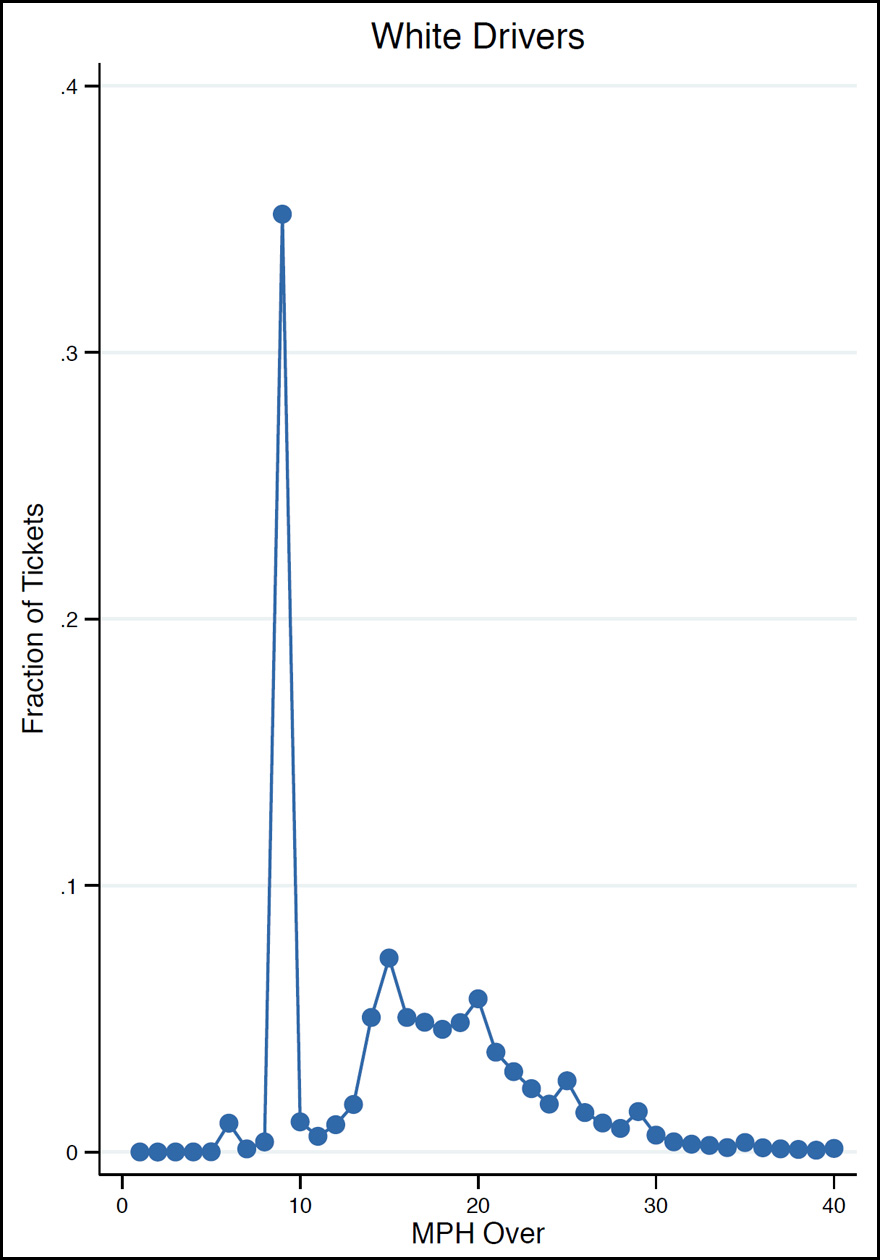
The “white drivers” title on this chart tells you where this is going. It turns out that 35 percent of white drivers get the 9 mph break. However, only 25 percent of black and Hispanic drivers get the same break:
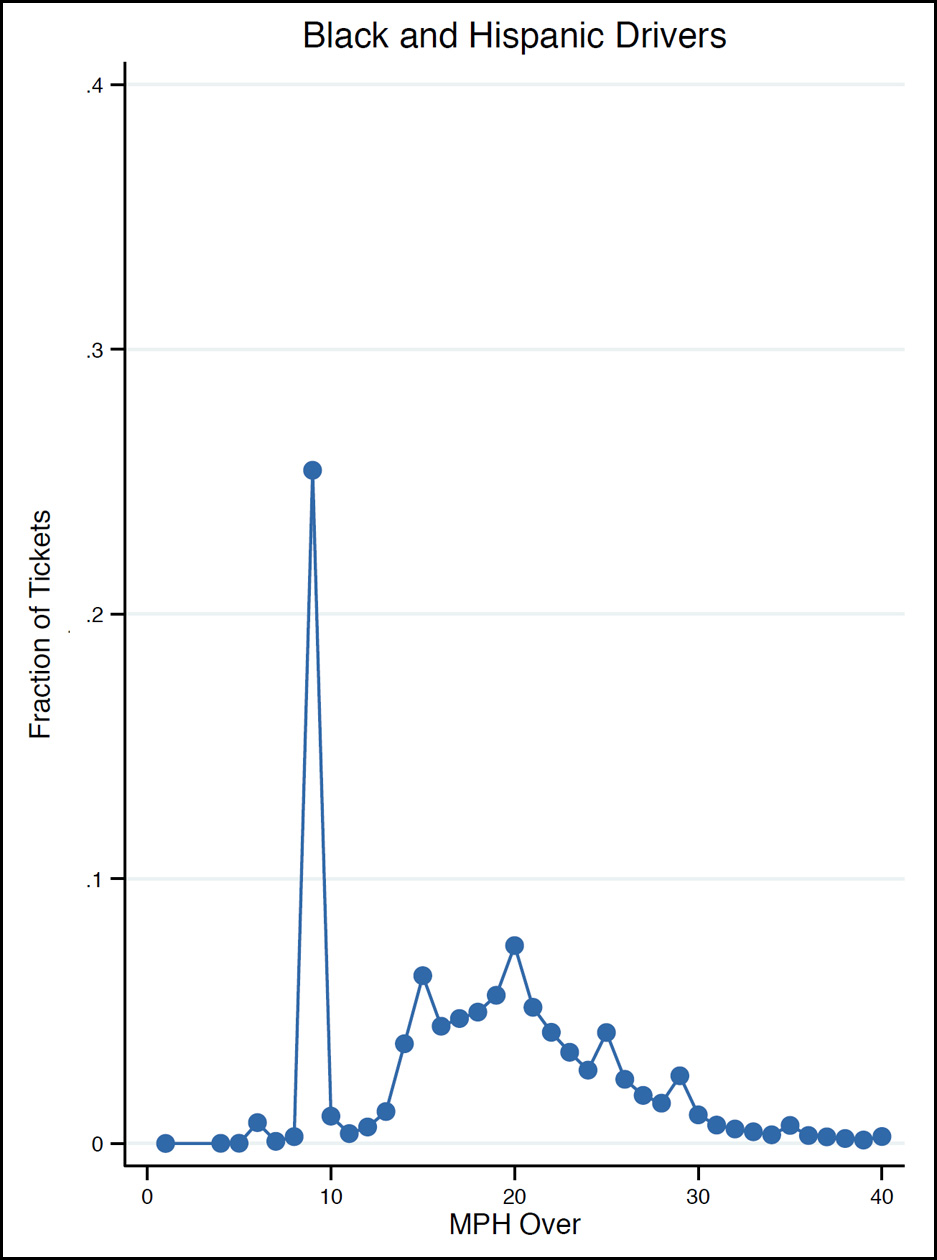
That’s the bad news: white drivers are generally treated with more leniency than black and Hispanic drivers. But this is just raw data. There are also nonracial reasons why we might see this difference. So the authors controlled for things like age, income, actual speed, type of car, etc. Here’s what they found:
In Column 1, we estimate that black and Hispanic drivers are, respectively, 3.8 and 14.9 percentage points less likely than white drivers to be cited at 9 MPH above the limit. In Column 2, we add controls….In all regressions, we find at least a 2 percentage point difference in treatment between whites and blacks and a 1.37 percentage point difference between whites and Hispanics.
….Across Tables 4 and 5, the greatest drop in magnitude comes from adding county-zone fixed effects, reducing the coefficient on driver black (Hispanic) from -.0276 (.-131) to -.0205 (-.0289). This reduction suggests that a large part of the disparity comes from the fact that minorities live in areas where officers are harsher to all drivers.
So the bad news is that blacks and Hispanics are treated worse than whites. The good news is that the effect is—to me, anyway—surprisingly small: about 2 percent or less in the final model. I would have expected more. Returning to the bad news front, however, it turns out that the leniency difference is due not to lots of officers who are slightly biased, but to a subset of officers—about 10 percent or so—who are significantly biased against black and Hispanics.
Now, it’s possible that this understates the problem because more black and Hispanic drivers are stopped in the first place, but that appears not to be the case. It’s also possible that lots of white drivers are let off with a warning, and therefore don’t show up in this data at all. The authors acknowledge this and say only that “we think these concerns do not invalidate our results.”
The bottom line is that this kind of research confirms two points of view: that we’ve made a lot of progress in racial justice, but that we still have more progress to make. I know how banal that sounds, but that’s pretty much what this particular study suggests.
One more note: I would be very interested to see the same technique used to estimate racial bias in ticketing for a northern state like New Jersey or Pennsylvania. I wouldn’t be at all surprised if it turned out to be worse.