A couple of days ago I wrote about the mystery of why my camera refuses to let me set a shutter speed longer than one second when it’s in “silent mode.” Thanks to the hive mind of the web, I have an answer. Sort of. This is a little long, and probably of little interest to any but camera geeks, so you’ve been warned. Here we go.
In the past, cameras had mechanical shutters. The usual type was the focal-plane shutter, which is basically a piece of cloth with a small slit that zips across the plane of the film. The faster it moves, and the smaller the slit, the higher the shutter speed. A high shutter speed like 1/1000th of a second is good for stopping motion. Here is my camera, for example, taking a picture of a ceiling fan:
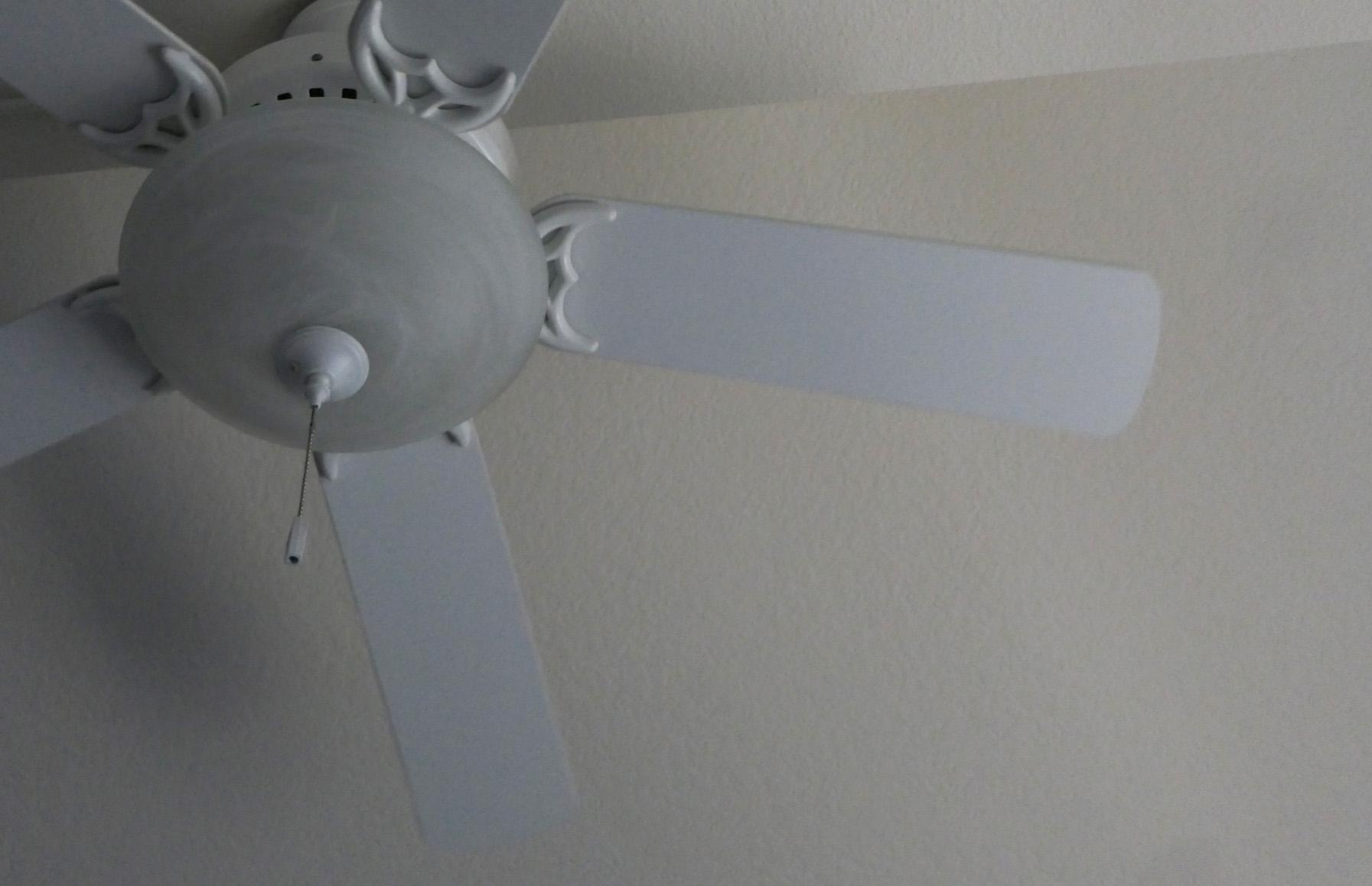
The quality is so-so because the light was dim, but the motion is stopped.
Digital cameras, however, don’t really need a mechanical shutter. They use electronic sensors to capture light, so all you have to do is turn the sensor on for 1/1000th of a second and then turn it off. As it turns out, though, this is not how it works.
Instead, digital cameras turn each row of pixels on for 1/1000th of a second. This process starts with the top row and then moves down, until eventually (on my camera) it gets to row 3648. The entire process takes about a twentieth of a second (compared to 1/250th of a second for a mechanical shutter), and this creates a problem: by the time we get to the bottom row, the object has moved. Here’s the ceiling fan with the electronic shutter activated:
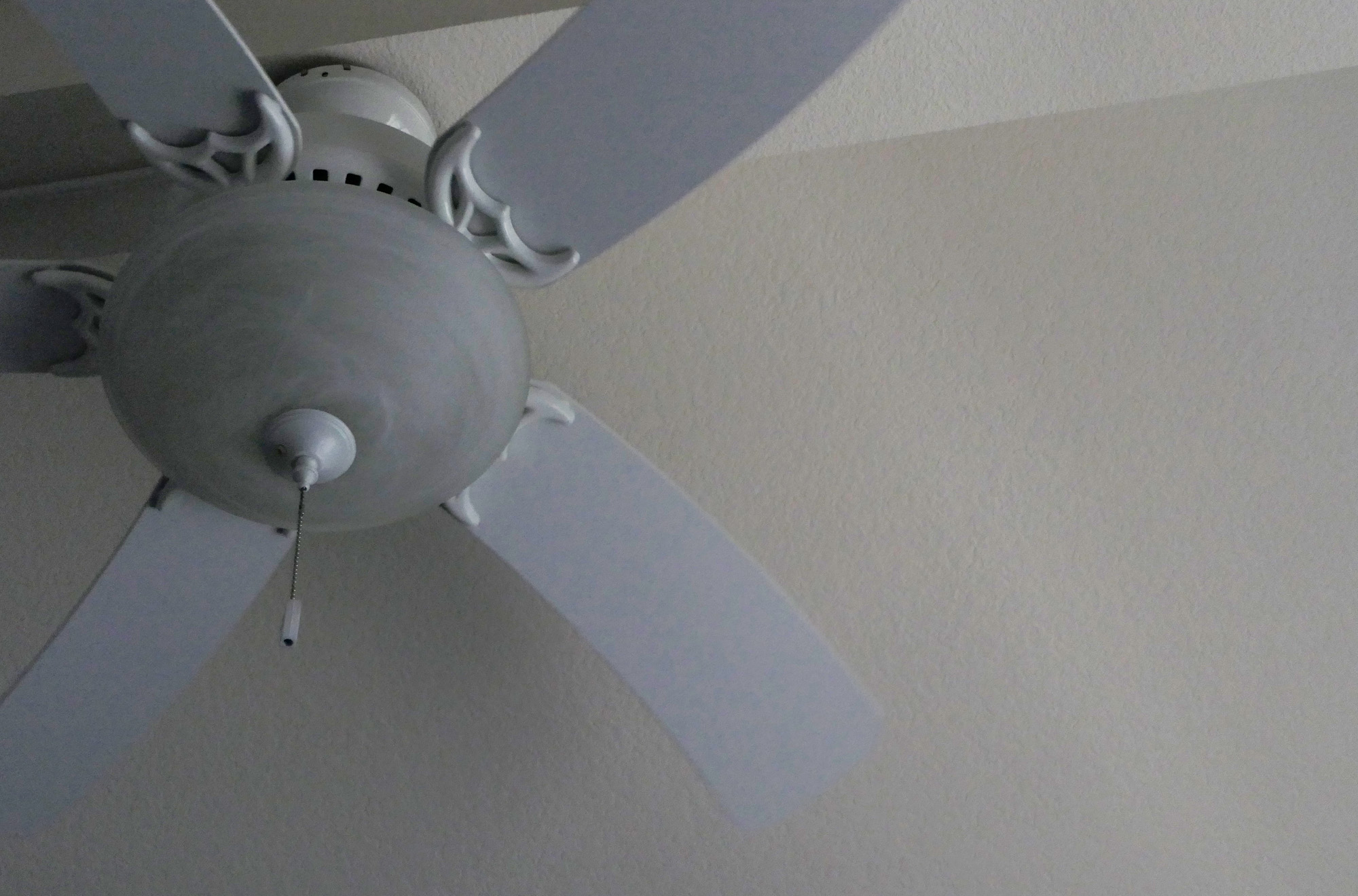
The fan blades are curved. Each individual row of pixels is sharp because it’s on for only 1/1000th of a second, but the entire picture isn’t. With fast-moving objects, you get both motion blur and distortion.
I didn’t know this until yesterday. I vaguely knew that my camera had both a mechanical and an electronic shutter, but I didn’t really know when one was used vs. the other. And I thought that “silent mode” merely meant that the camera turned off the fake noise it normally generated to make itself sound like an old-school SLR.
Not so. In silent mode, the electronic shutter is used. Turn it off, and the mechanical shutter is used. And the sound isn’t fake, it’s actually the sound of the mechanical shutter.
Normally, when I take pictures of birds and butterflies and whatnot, I put the camera in silent mode. Don’t want to scare off the critters! But in silent mode there’s really no such thing as a high shutter speed. A setting of 1/1000th of a second will produce the right exposure, but it doesn’t stop motion as well as it should. For that I need to use the mechanical shutter. So today I tried that out. The local honeybees were not very cooperative, but here’s one anyway:

Not too bad. The wings are blurry, of course. I’d probably need something like 1/10,000th of a second to stop those. This might be possible if I play around with exposure and fill flash, and perhaps I’ll do that later.
So does this answer my question from Thursday? Sort of. In silent mode, the electronic shutter is activated, and Panasonic’s engineers have decided that the electronic shutter shouldn’t work for longer than one second. This moves the ball a bit, but still leaves an open question: why is the electronic shutter limited to one second? I still don’t know the answer to that. It appears to be a problem limited to Panasonic cameras.