• The 2017 Trump Christmas Ornament Explained

    Will Fischer is not excited by the design of the official Trump Christmas ornament:

    No, I don’t think so. What it really reminds me of is something old fashioned. This kind of imagery was popular in the late 19th and early 20th centuries, and it seems like that was the probable inspiration for whoever designed this.

    But what I’m really curious about is the initials at the bottom center. It looks like a D, an A, and an…I? Or maybe an F? What’s this all about? The answer will probably suprise you:

    The Official 2017 White House Christmas ornament honors the administration of Franklin D. Roosevelt, who served as the thirty-second president of the United States from 1933 to 1945 and his remarkable journey to restore the faith of the American people….The eagle cartouche emblazoned on the speaker’s stand at President Roosevelt’s first inauguration is the inspiration for the main element of the 2017 ornament. The two flags below have forty-eight stars each….The shape of the ornament is reminiscent of the silhouette of a tabletop radio – similar to those many Americans had in their homes and used to listen to the president’s reassuring Fireside Chats. Roosevelt’s beloved Fala is pictured on the back of the ornament.

    Right. The initials are F, D, and R. But why is Donald Trump honoring the Democratic Party’s greatest president? Well, it turns out that the White House Historical Association designs the ornaments. In 2016 it was inspired by Herbert Hoover. In 2015 it was Calvin Coolidge. In 2014 it was Warren G. Harding. I detect a pattern!

    The first White House ornament, in 1981, was Angel in Flight. In 1982 it honored George Washington. Then the Historical Society worked its way though the rest of the presidents, with occasional interruptions, until 2002. In 2003 they did Ulysses S. Grant, and it’s been presidents every year since then. So this year it was just FDR’s turn.

    Trump will get his own ornament in 2030—unless he decides to disband the Historical Society and direct that all future ornaments should honor himself. But no. He wouldn’t do that, would he?

  • Conservatives Are Scared to Death of Robert Mueller

    Conservative calls to fire special prosecutor Robert Mueller are really getting crazy. The Fox News gang has gone gaga over the idea that Mueller is actually a liberal mole who’s hellbent on getting rid of Donald Trump. Republicans in Congress are going down the same path. The news that Mueller fired an investigator who supported Hillary Clinton prompted Rep. Steve Chabot to claim that the “depths of this anti-Trump bias” on Mueller’s team was “absolutely shocking.” Trump’s lawyers, says Roger Stone, “are entirely unrealistic about the enmity toward the president from the political establishment.” The Wall Street Journal insists that Mueller is “too conflicted” to lead the investigation. Rush Limbaugh believes the whole thing “is all manufactured from leaks in the deep state.”

    I don’t have any big point to make here except this: It’s pretty obvious that conservatives are petrified of what’s coming out. They have no idea what’s coming next, but it’s starting to look like practically everyone in the Trump campaign had relationships of some kind with Russians of some kind. Their only recourse is to invent wild stories about the deep state and conflict of interest and the long arm of Hillary supporters in the FBI. As Mueller continues to tighten the noose, we can expect these attacks to get ever louder and crazier.

  • Chart of the Day: Net New Jobs in November

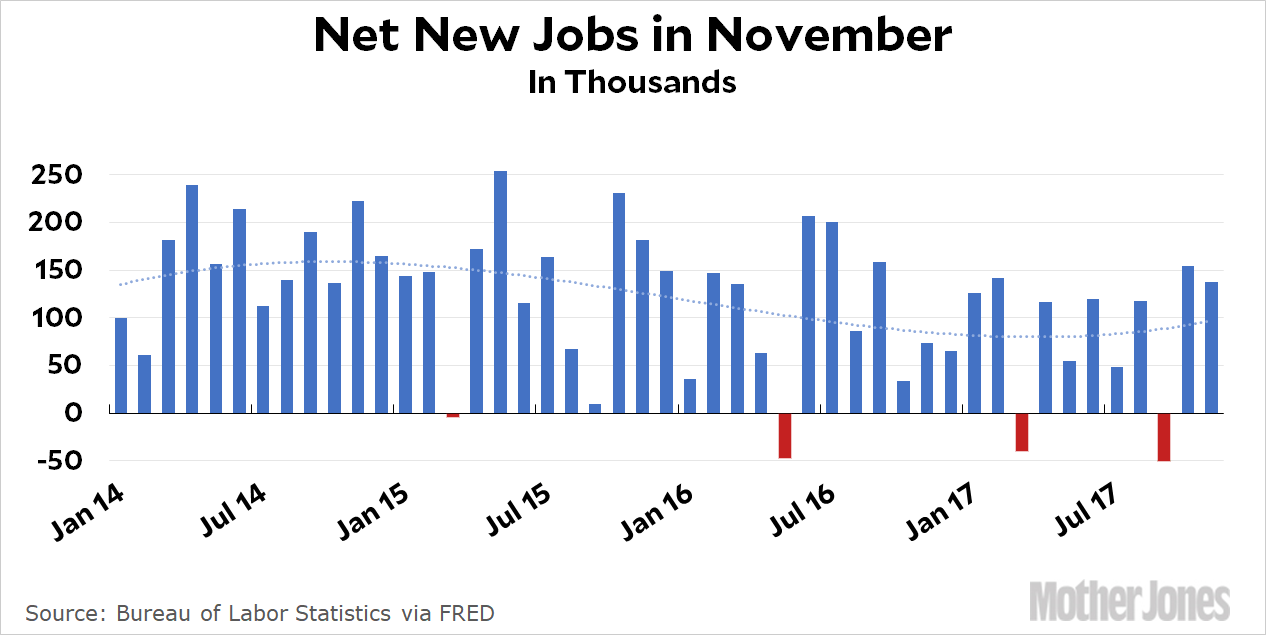
    The American economy gained 228,000 jobs last month. We need 90,000 new jobs just to keep up with population growth, which means that net job growth clocked in at 138,000 jobs. That’s not bad. The headline unemployment rate stayed steady at 4.1 percent. However, the number of unemployed was up and the employment-population ratio ticked down. Overall, this is a solid but not spectacular employment report.

    Wages of production and nonsupervisory workers was up 2.8 percent. That’s a little higher than the inflation rate and makes up for last month’s dip. Over the past 12 months, wages have increased 2.3 percent, slightly higher than the inflation rate of 2.05 percent. For the working and middle classes, wages remain very sluggish.

  • Labor Productivity Is Just Terrible These Days

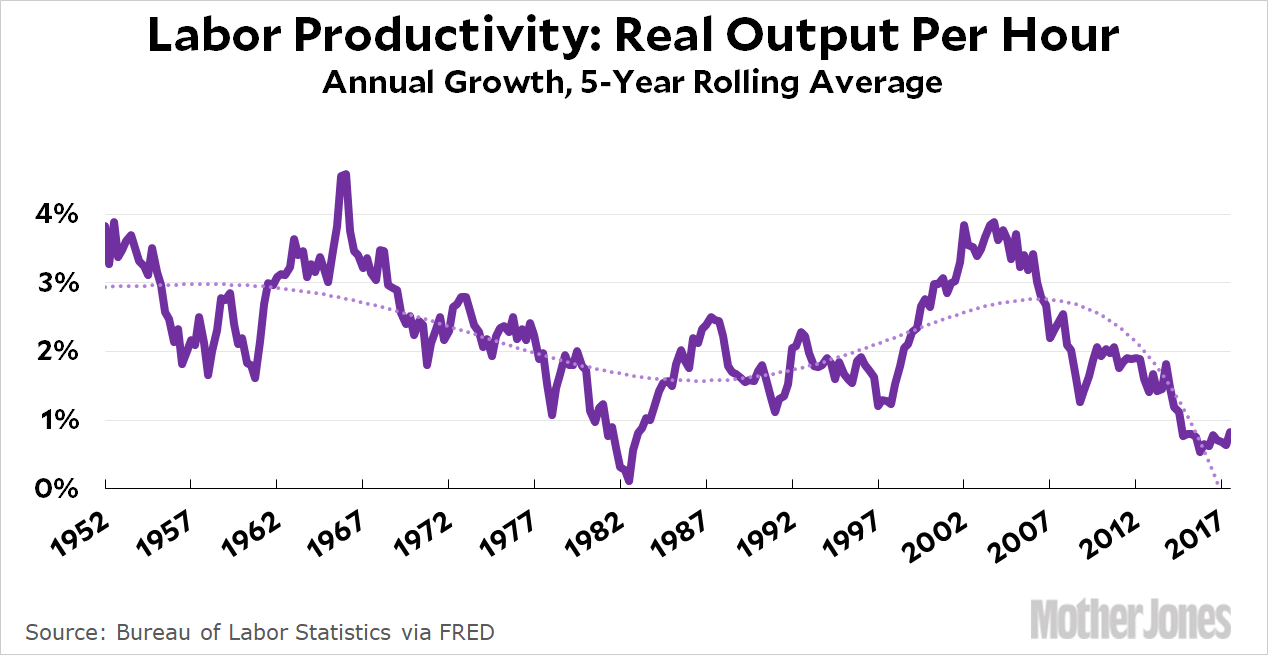
    Jobs figures for November will be released in a couple of hours, and the consensus forecast is that they’ll be fine. While you wait, however, here’s another chart to look at:

    Productivity growth has dropped like a stone since 2005, and is currently hovering around 1 percent per year. That’s terrible. Unemployment is at 4 percent, which means businesses are employing a lot of people, but low productivity growth means this employment is only in lieu of investing in labor-saving machinery. After all, why bother with a big capital expenditure when future growth looks iffy and wages are flat? It’s easier and more flexible to just hire some cheap workers who can be laid off if business sours.

    There’s probably something of a pent-up demand right now for labor-saving equipment, and the Republican tax bill’s bizarrely enormous incentive to pull all investment into 2018 might be just the thing to kick it off. If that’s really the case, we can kiss off any chance of sustained wage growth in the near future.

  • There Has Been No Surge In Violent Crime Since Ferguson

    Hey, remember the great crime surge of 2015-16? It was all about the “Ferguson Effect,” as police officers became afraid to do their jobs properly for fear of being unfairly dragged into court by lefty activists. Hoodlums all realized this meant they could have a field day, and crime soared.

    Well, about that. Actual data for violent crime is now available through 2016, and at first it seemed like there really was a big increase in violent crime last year. But as Keith Humphreys pointed out today, this turned out to be mostly a mistake caused by a decennial redesign of the NCVS crime survey that added a whole lot of new counties. The folks at the Bureau of Justice Statistics explain:

    When the 2016 NCVS data collection was complete, a comparison of the 2015 and 2016 victimization estimates showed that the violent and property crime rates had increased. Given recent patterns in NCVS data, these increases seemed too large to be a result of actual growth in crime, suggesting that the sample redesign may have affected the victimization rates. To better understand these results, the 2015 and 2016 victimization rates for new and continuing sample counties were examined separately. These comparisons showed that from 2015 to 2016 there were no statistically significant differences for continuing sample counties in the rates of total property crime, total violent crime, and total serious violent crime.

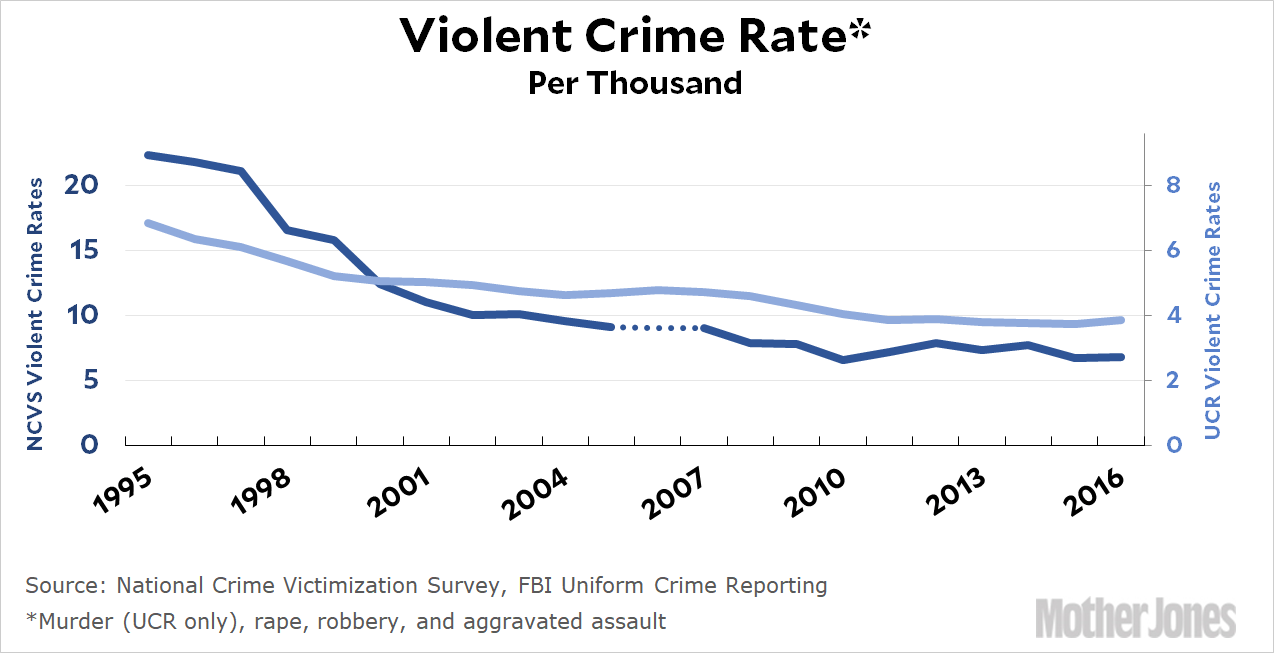
    Oh. Good to know. Of course, there’s also the FBI’s Uniform Crime Reporting, which relies on crimes reported to police. Here’s both of them:¹

    As you can see, there was a violent crime increase in 2016, but it was basically noise level: UCR pegs it at 3.4 percent and the corrected NCVS report pegs it at 1.5 percent. And in the two year period 2015-16, there was essentially no increase at all.

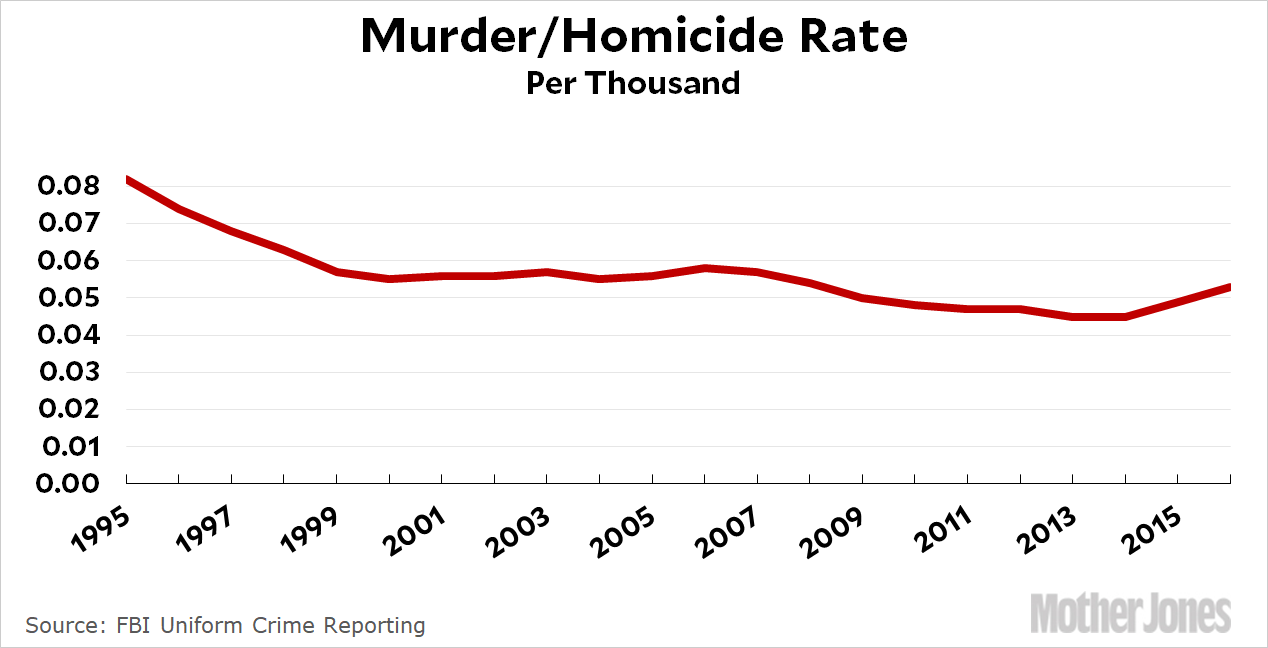
    Before you get too comfortable, though, there are a few cities that really have seen significant increases in their murder rates. A survey of crime victims obviously can’t include murder, so we have only one source for this data, the FBI’s UCR. Nationally, it reports that we saw an increase in the murder rate of 9 percent in 2015 and then another 8 percent in 2016:

    The good news, such as it is, is that this isn’t truly a national rise. The big increases are limited to about half a dozen large cities, and those are big enough to affect the national rate.

    Bottom line: There are a handful of big cities that have seen a big increase in murder rates. Aside from that, however, violent crime has been flat or down for the past couple of years. In the post-Ferguson era, there simply hasn’t been a surge in violent crime.

    ¹NCVS data through 2015 here. NCVS comparable data for 2016 here. UCR data through 2014 here. UCR data for 2015-16 here.

  • Fox News: Men Are All at the Mercy of Anonymous Accusers Now

    Jaap Arriens/NurPhoto via ZUMA

    Over at the Washington Post, Callum Borchers rounds up the reaction on Fox News to the forced resignation of Al Franken from the Senate. First up is Tucker Carlson:

    Imagine being accused by someone whose name you didn’t know of something that supposedly happened more than a decade ago. How would you respond? How could you respond? What if you were innocent, by the way? And what if nobody cared?”

    ….“What you saw today was a lynch mob,” Fox News contributor Newt Gingrich said Wednesday on Laura Ingraham’s show. The former House speaker argued that Democrats’ mind-set is, “Let’s just lynch him because when we are done, we will be so pure.”

    ….“They have now determined that it is worth sacrificing Franken, just like they did John Conyers — throw him overboard to save the political Titanic that is their party,” Ingraham said.

    ….“Don’t be fooled by any of this,” Sean Hannity added on his show Wednesday night. “This Democratic decision today obviously was coordinated, and to turn on Franken, it’s purely political.”

    It is not a coincidence that they’re all saying the exact same thing, and it’s not because they have a soft spot in their hearts for the author of Rush Limbaugh Is a Big Fat Idiot. But just in case there’s anyone left in the United States who’s too naive to see what’s happening here, let’s make it clear: conservatives are using Franken as evidence that liberals will come after anyone—maybe even you—and send them off to reeducation camps at the mere whisper of an accusation. The social justice warriors don’t care about anything other than ridding the world of straight white men, and any old anonymous story from someone with a grudge could be enough to set them off.

    There are lots of Fox News viewers who are already convinced of this. Tell a risque joke and someone will anonymously complain to HR and you’ll get fired. It happened to a friend of mine! Well, a cousin of a friend of mine. That’s what my next door neighbor told me anyway.

    Our reckoning with the piggish behavior of powerful men is very much not a bipartisan affair. In Hollywood, for example, it’s full speed ahead. Why? Because once the dam broke, Hollywood is full of liberals who are willing to call out this behavior once they finally get up their nerve. But how about, say, Wall Street? Does anyone think it’s any less full of powerful men with digusting habits than Hollywood? Of course not. And yet, the silence from the conservative world of high finance is almost deafening. Nine weeks after the Harvey Weinstein story broke, there’s been a grand total of one (1) casualty on Wall Street: Harold Ford, a black former Democratic congressman.

    The conservative take on all this has come into sharper focus over the past few weeks:

    • There sure are a lot creepy liberals, aren’t there?
    • We are all at risk of having our lives ruined by radical lefty feminists who will get us fired over the slightest non-PC remark.

    In a just world, this strategy would be laughable. But in this world? I’m not so sure it won’t work.

  • Do Universities Increase Innovation In Their Communities?

    File this one under “random stuff that came through my Twitter feed today.” It’s a paper from Michael Andrews, a postdoc at Northwestern, and it examines whether universities promote innovation. The methodology is simple, though the work required to gather the data appears to be rather stunning. Basically, Andrews looks at counties that were chosen as sites for public universities (mostly in the 19th century) and examines whether they benefited from a subsquent upsurge in patent activity. The answer turns out to be yes.

    But there’s more to it. Andrews also looks at what he calls “consolation prize” counties:

    Consolation prizes are especially common in western states that were largely unsettled and achieved statehood after the passage of the Morrill Act in 1862. In these states, typically many state institutions were allocated at the same time, including the state capital, the state prison, the state hospital, or the state insane asylum. While numerous localities may have been lobbying to get a state institution, which locality ended up with which institution was as good as random. For one famous example, the Tucson delegation set out for Prescott for the Arizona territorial legislature in 1885 intent on getting the state mental hospital. But flooding on the Salt River delayed the delegation. By the time they reached Prescott, the mental hospital had already been spoken for; Tucson was stuck with state university.

    Poor Tucson! But I suppose things turned out OK for them in the long run. However, these consolation counties provide Andrews with a good natural test of whether universities themselves are responsible for the increase in patents. It turns out they aren’t:

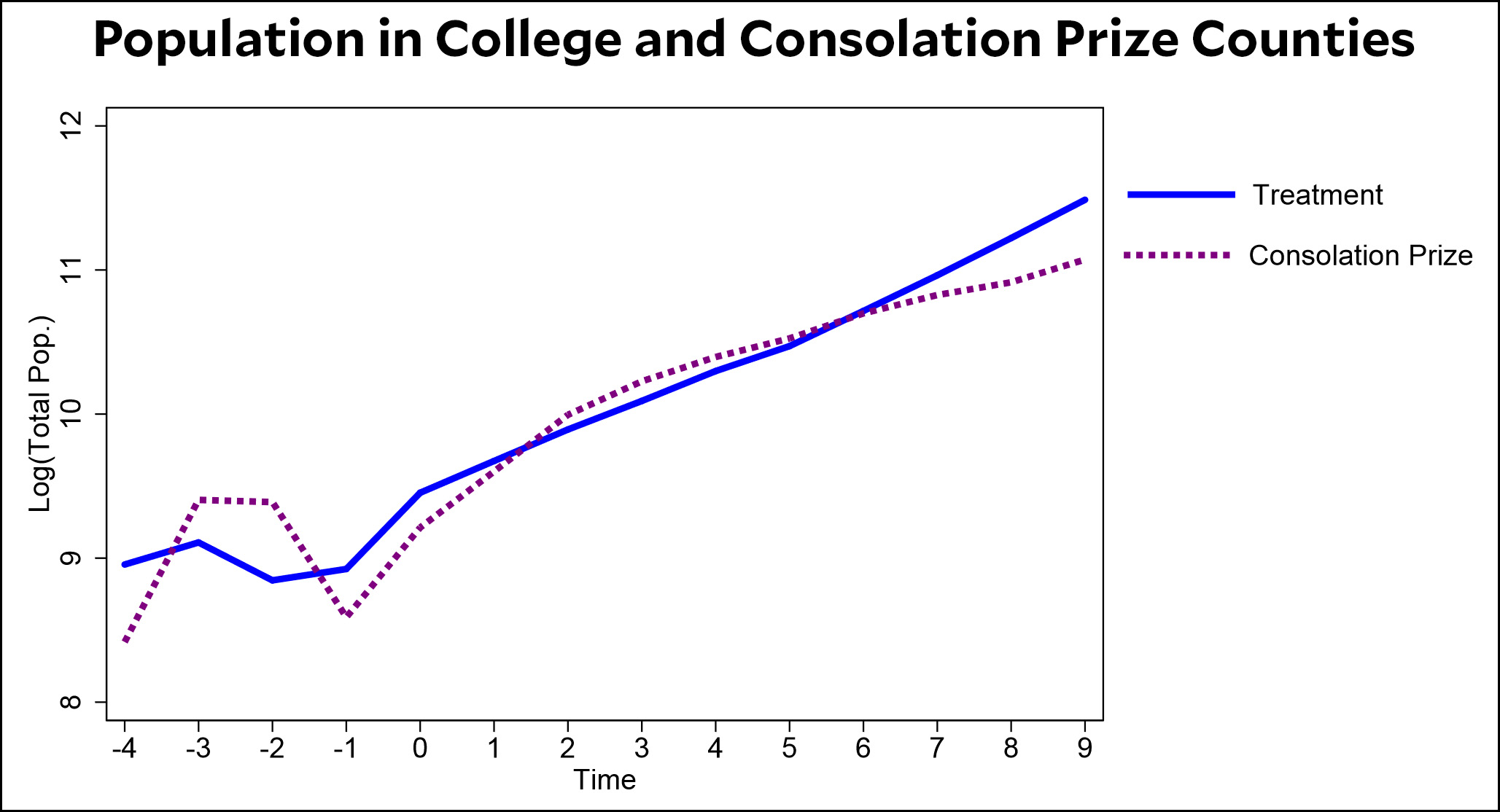
    Table 13 shows results that explicitly consider the consolation prize counties. In column 1, I compare patenting in the college counties to consolation prize counties. The coefficient is a statistically insignificant 16%, smaller than the baseline estimate of 32%. This suggests that college counties do not increase their patenting much faster than counties that received prisons, hospitals, or insane asylums.

    There are some obvious jokes to be made here, but I’ll leave that to others. The surprising conclusion is that universities don’t, in fact, do much to increase innovation locally. Any county that gets a major state facility will see a similar increase in population and a similar increase in patent activity:

    Obviously universities do have an impact on innovation, but apparently it’s diffused all over the country as students graduate and move away. What’s left is usually a nice, bustling town, but not a hub of innovative activity.