I don’t know about you, but I could use something simple and pretty right about now. This hibiscus is growing in my neighbor’s yard, and I love the bright yellows. Much nicer and livelier than your typical red or pink hibiscus, I think.


I don’t know about you, but I could use something simple and pretty right about now. This hibiscus is growing in my neighbor’s yard, and I love the bright yellows. Much nicer and livelier than your typical red or pink hibiscus, I think.
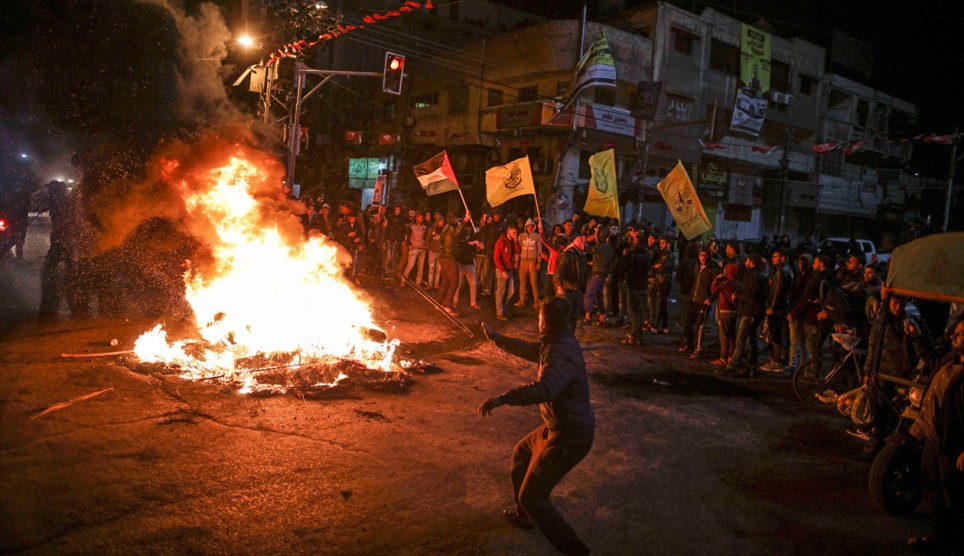
Wissam Nassar/DPA via ZUMA
Like me, Marc Lynch is not especially nervous about the reaction to President Trump’s recognition of Jerusalem as Israel’s capital:
Most likely, the recognition of Jerusalem will have none of the promised benefits for negotiations and relatively few of the threatened costs. This is not because Jerusalem does not matter, but rather because there is no real peace process to disrupt, little meaningful prospect for a two-state solution to squander, and little belief in U.S. neutrality to violate.
….Trump’s Jerusalem gamble is thus less about the prospects for Israeli-Palestinian peace than about whether Arab-Israeli alliance against Iran can be achieved in its absence. Israel’s tacit cooperation with Gulf states against Iran, long kept in the shadows, has increasingly been brought into the open despite the absence of Israeli-Palestinian peace. The Jerusalem gambit may well force a public reckoning over this semiprivate alignment.
The major trends in regional politics could well make this gamble pay off. Saudi Arabia and its key partners have made it clear that they view regional confrontation with Iran as their most urgent strategic priority….The key question is whether Arab regimes do anything more to protest the recognition, or return to cooperation with the United States and Israel against Iran once the passions have faded. The Trump administration is probably right that they will do so quickly, barring the emergence of serious, sustained Palestinian mobilization that forces them into a tougher stance.
This is not to say that there won’t be any blowback from Trump’s announcement. There might well be. But I suspect that most Arab states in the Middle East care a lot less about the Palestinian cause than they claim, and are willing to keep the inevitable protests under tight control. They mostly understand three fundamental facts:
Trump is, fundamentally, asking Arab states to accept this privately, if not publicly, in return for a full-court press against Iran. Likewise, the gift of Jerusalem is primarily a gesture to maintain Israel’s confidence in the United States even as Trump cozies up with the Saudi coalition. Given the realities on the ground, I suspect that nearly all parties in the Middle East are willing to make this deal.
Here’s the latest estimate of Obamacare signups:
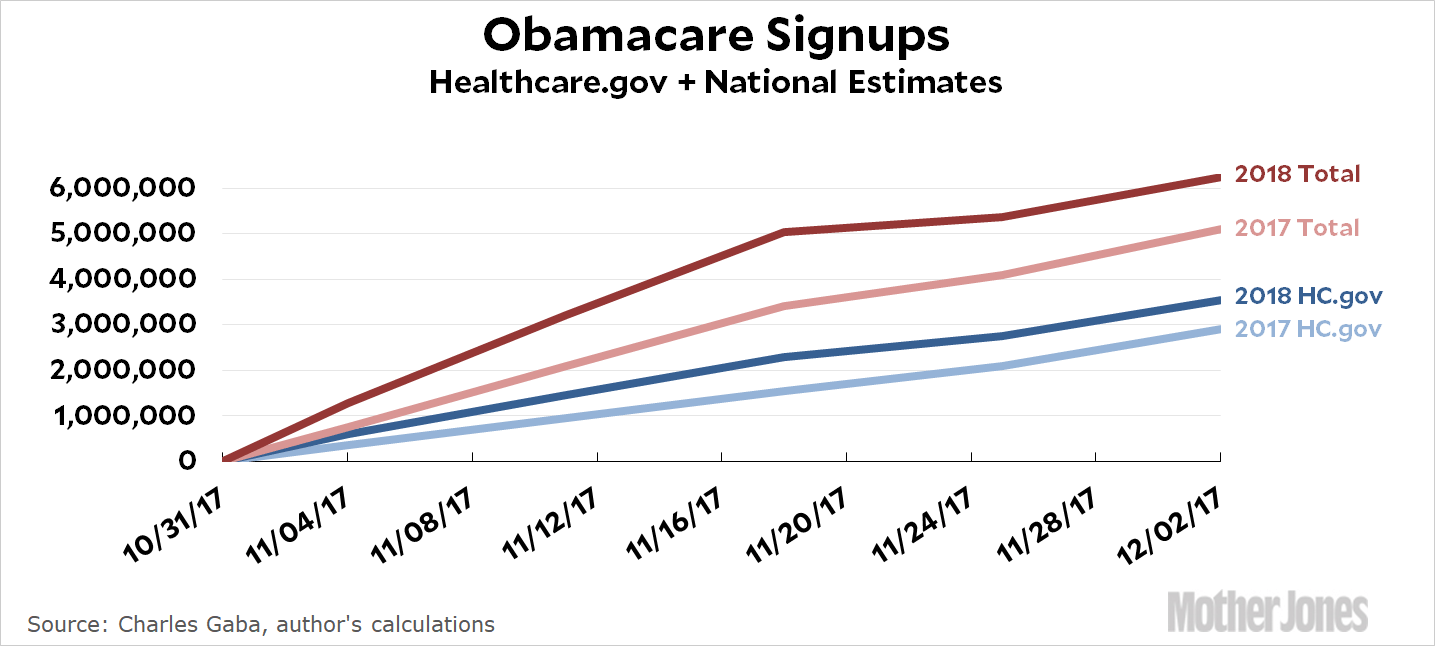
Just a reminder of my seat-of-the-pants methodology here: We know the numbers for the federal exhange (HC.gov), and they’re currently up by 22 percent compared to last year. So I’m projecting that the total number is about 22 percent higher than last year as well. That gets us to just above 6 million total signups.
Charles Gaba, naturally, has much more detail here. He notes that signups this week for HC.gov came in below his expectations, but some of the state exchanges have announced impressively large numbers.
Will we match the 12 million total signups from last year? Auto-renewals will kick in shortly and add 1-2 million to the total number, and next week will presumably bring a flurry of last-minute signups. By then we’ll have a pretty good idea. But the final numbers won’t be available for another month after that, since some state exchanges have signup deadlines in January.
My guess: it will be close, probably around 11-12 million.
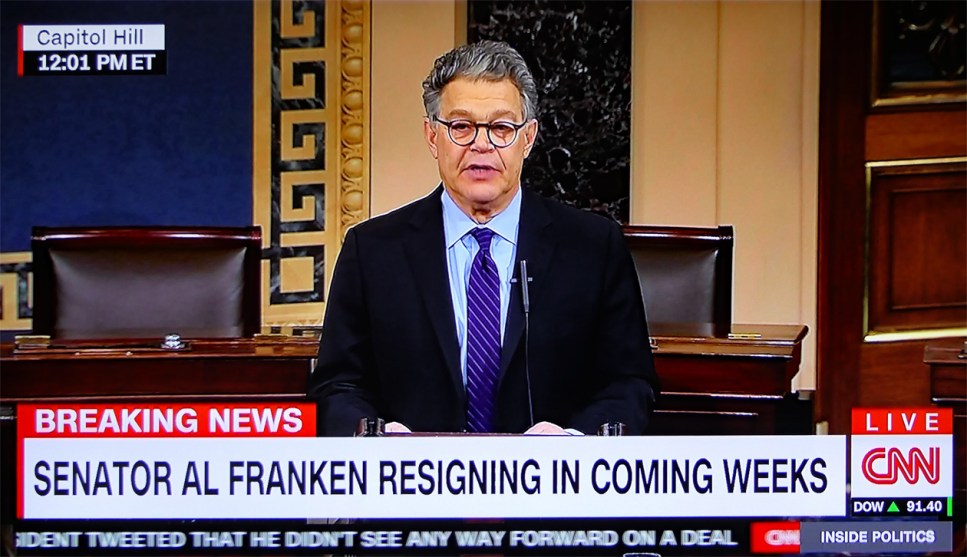
Al Franken has resigned from the Senate, effective sometime in the next few weeks. He says some of the allegations against him are false, while others he “remembers differently.” But, he says, it’s not about him. It’s about what’s best for Minnesotans.
It’s pretty clear that Franken is resigning only under duress. He didn’t admit guilt, and he didn’t apologize. He said he regretted that, in his initial shock, he gave the “false impression” that he was “admitting to things he hadn’t done.” And there’s obviously some bitterness here: bitterness over his forced resignation while Donald Trump remains in office and the Republican Party supports Roy Moore—and, presumably, some bitterness that his Democratic colleagues abandoned him.
This isn’t over. The women who made the original allegations are almost certain to speak out further. Will Franken respond?
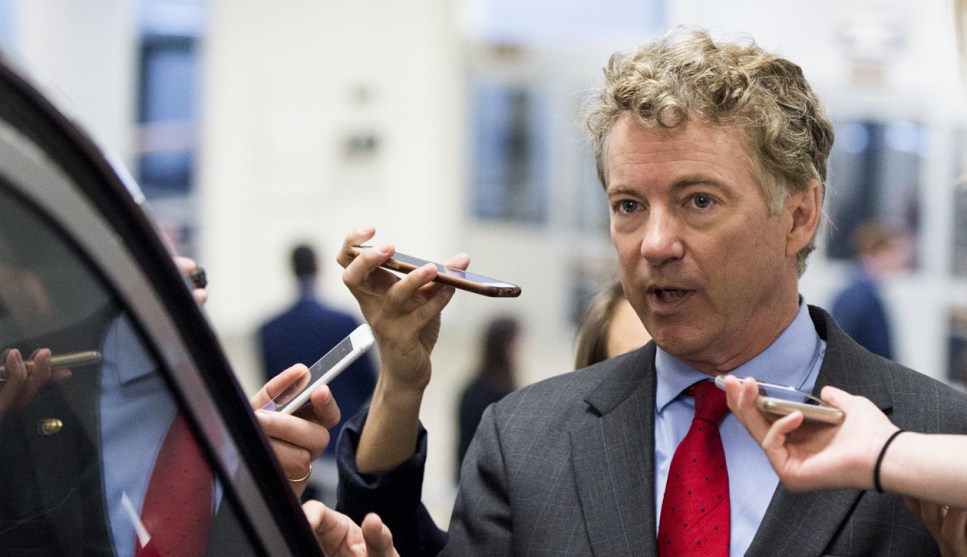
Bill Clark/Congressional Quarterly/Newscom via ZUMA
Why did Sen. Rand Paul’s neighbor attack him early last month? Washington Post reporter Justin Jouvenal persuaded Jim Skaggs to give him a tour of the gated neighborhood where it happened, and thinks he has the answer:
They might have sparred over health care or taxes, but an acquaintance of both said they stood in their yards roughly a decade ago shouting at each other over the grass clippings Paul’s mower had shot on Rene Boucher’s property. “ ‘I ask him, I tell him and he won’t pay attention,’ ” the acquaintance, Bill Goodwin, recalls Boucher saying after the argument. “ ‘One of these days.’ ”
….Skaggs said Boucher was exacting about the standards for his yard — landscaping bags filled with waste were a common site on his property. Neighbors said Paul had a reputation for a more relaxed style that some felt didn’t always jibe with a community that features gas lamps, Greek statuary and a 13-page packet of rules. The senator had a pumpkin patch, compost and unraked leaves beneath some of his trees. Goodwin said it annoyed Boucher that Paul did not consistently cut his grass to the same height, and leaves from Paul’s trees blew on his property.
….[Boucher’s lawyer] said the old tensions over landscaping were triggered on Nov. 3 by a fresh incident he declined to detail.
A friend of mine has a neighbor like Boucher. He vacuums his lawn. He measures the distance between his petunias. He complains when the wind blows leaves into his yard from neighboring trees. He became outraged some years ago when my friend replaced his lawn with native plants, and hasn’t spoken to him since.
This stuff happens. I guess it even happens to famous people.
This is all you're allowed to know about Don Jr's testimony today.Alex Edelman via ZUMA
Donald Trump’s eldest son spent several hours under the klieg lights today testifying in front of the House Intelligence Committee. But he didn’t say much:
Donald Trump Jr. on Wednesday cited attorney-client privilege to avoid telling lawmakers about a conversation he had with his father, President Donald Trump, after news broke this summer that the younger Trump — and top campaign brass — had met with Russia-connected individuals in Trump Tower during the 2016 campaign. Though neither Trump Jr. nor the president is an attorney, Trump Jr. told the House Intelligence Committee that there was a lawyer in the room during the discussion, according to the committee’s top Democrat, Rep. Adam Schiff of California. Schiff said he didn’t think it was a legitimate invocation of attorney-client privilege.
I’m so tired these days. Unlike a lot of people, I recovered pretty quickly from Trump’s election. I didn’t binge eat or have trouble sleeping or find myself unable to concentrate on work. But over the past year he’s steadily worn me down. Every day we get more stuff like this. It’s completely insane, but there’s nothing much any of us can do except acknowledge it and move on. His cabinet won’t stop him. His family won’t stop him. The Republican Party won’t stop him as long as he keeps nominating judges they like. The Democratic Party has no power to stop anybody. And foreign leaders think he’s nuts.
Our country is being run as if the mafia won the presidency last year. There are still plenty of guardrails around to keep us from becoming, once and for all, a banana republic with nuclear weapons, but for how long? Do we really have to spend the next three years praying every day that the guardrails can hold up just a little bit longer?
I learned something new today. Every year, fracking operations in the United States produce more than a billion barrels of oil and gas. And we’re basically just giving it all away:
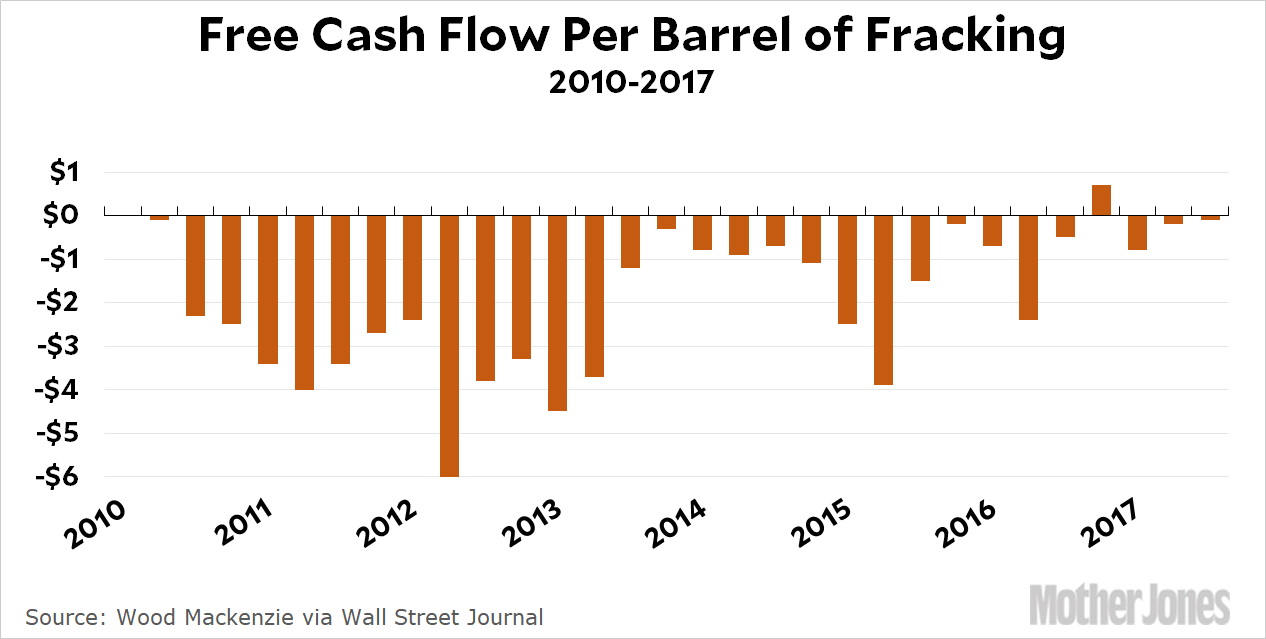
That’s right: the whole industry is a huge money sink. If you invested $100 in the S&P 500 a decade ago, you’d have $180 today. If you invested $100 in fracking, you’d have…
$69.
The Wall Street Journal explains what’s going on:
Returns from individual wells can be good, but shale wells tend to pop online with a gush and then peter out fairly quickly. That has meant operators sink profits back into more new wells that can take another two years to become profitable, with shareholders told to hang on for a payday.
“The mañana never quite materializes,” Mr. McMahon says.
One factor sapping profits is that many shale producers paid extravagantly to lease land for drilling in places such as the Permian Basin in Texas and New Mexico. Many operators drop out those land-acquisition costs from the break-even-price calculations they tout to shareholders. While most shale operators claim they have hundreds, if not thousands, of well locations they say can muster a 10% profit margin or more, the number of in-the-money wells is far smaller when costs for land, pipelines and other infrastructure and overhead is factored in.
Remind me again why we’re doing this? Fracking is bad because it releases methane; bad because it destabilizes fault lines; bad for pumping poisonous dreck into the ground; and of course, bad for climate change. But all along I figured that at least greed could explain why we put up with this. Greed explains a lot of odious human behavior. But what’s the point of frantically digging up all our fossil fuel resources now now now if no one is even making any money from it?
Christopher Ingraham reports today on a new study that says Americans are less happy than they used to be and feel “bodily aches and pains” at the highest rate in the world:
Aware that some of this could be attributable to question translation issues or cultural differences (for instance, Americans may just be more predisposed to complain about pain than members of other nations), the authors ran the numbers controlling for age, gender, marital status, labor force status and education. The United States remained an outlier even when these factors were accounted for.
Hmmm. None of these things are actually related to either translation issues or cultural differences. Let’s go to the source and see what the authors think of possible language problems:
We have considered that and cannot entirely discount it; there must remain a chance that these subjective data on feelings of pain are, in some way, painting a misleading picture. However, a nation like the UK, which also uses English, and has a culture that is somewhat like that of the USA, shows up with similar pain levels — markedly below the American answers — to other west European nations.
That makes more sense. Weirdly, though, it’s just not true. Here’s the chart in Ingraham’s piece:
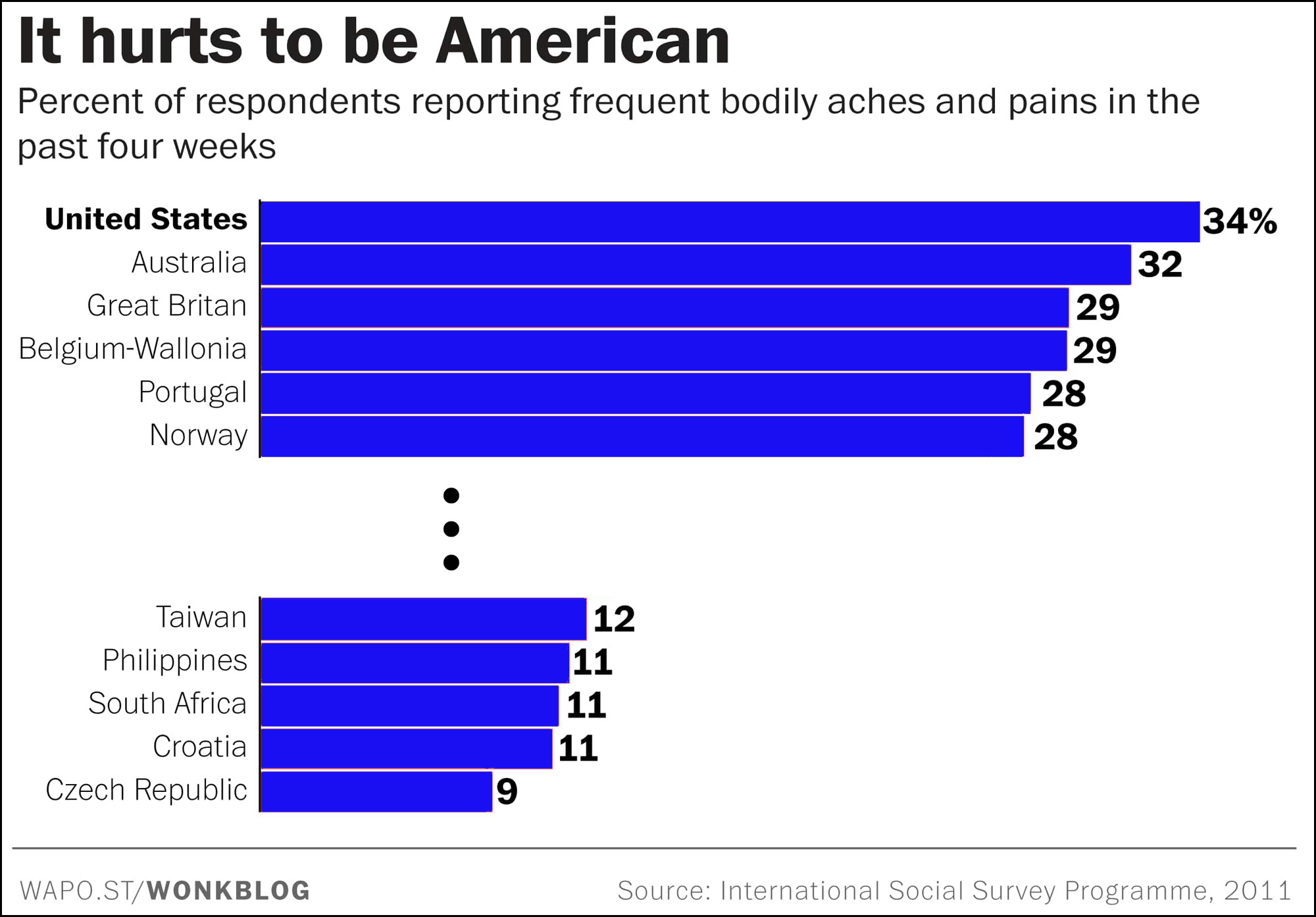
The biggest English-speaking countries in the world (Canada isn’t included for some reason) all score the highest, and both Australia and Great Britain are fairly close to the US, not to Western Europe. If anything, this supports the notion that language might have something to do with it. But there’s also this to consider:
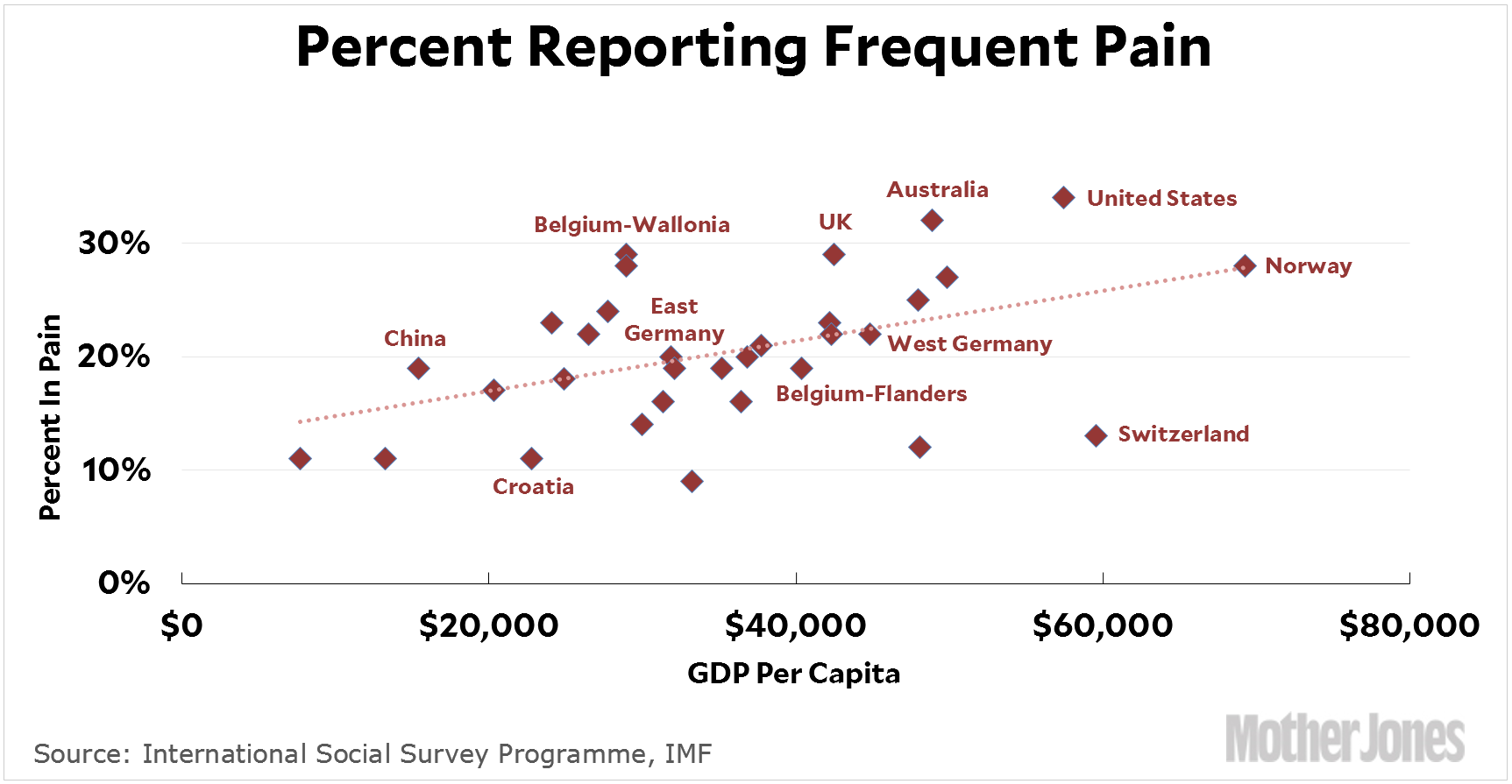
In general, residents of richer countries complain more about pain than residents of poorer countries. This obviously doesn’t explain everything, but it makes the high ranking of the United States a little less surprising. I can think of a few possible explanations for this:
On the “cultural differences” front, there are two interesting cases. The first is Belgium, where the survey team reports results separately for rich Flanders and poor Wallonia. The second is Germany, where they report separately for the regions that were formerly East and West. In both cases, the poor region reports either more pain or the same level of pain. They don’t follow the general trend at all. I have no idea what, if anything, to make of this, but maybe someone else has an idea.
NICKEL SUMMARY: I’m not sure what to think of this. But I’ll bet that the high level of pain reporting in the US is mostly related to something other than actual pain levels.
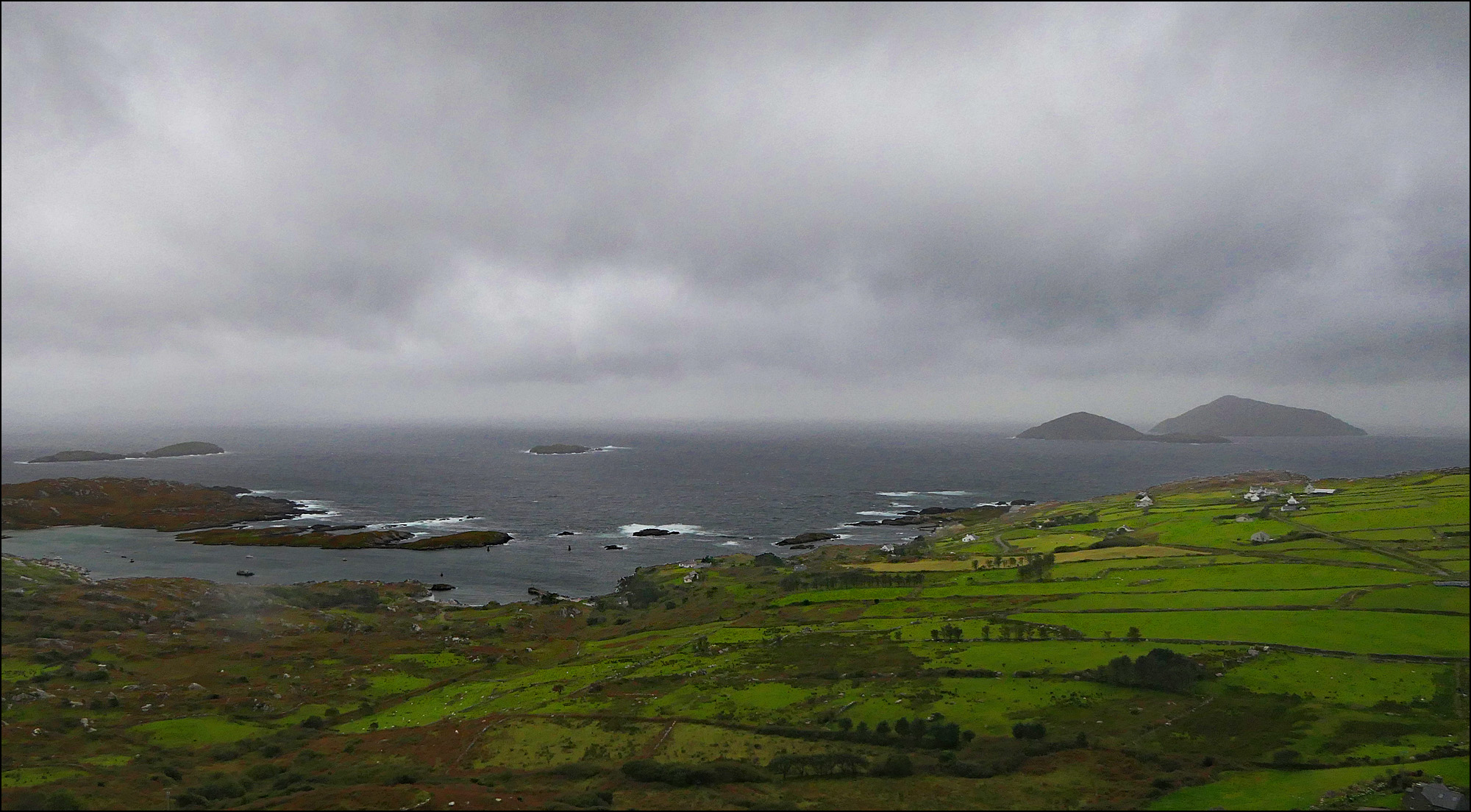
These are the Scariff Islands, taken on a rainy day near Beenarourke. This is, allegedly, “the most famous view in Ireland,” and it might well be so. If it’s not, I’d certainly like to see the winner. The small island on the left is Deenish. The larger island just behind it is Scariff.
The latest on the Republican tax bill:
“It’s death to Democrats,” said conservative economist Stephen Moore, who advised Trump’s campaign on tax policy. “They go after state and local taxes, which weakens public employee unions. They go after university endowments, and universities have become play pens of the left. And getting rid of the mandate is to eventually dismantle Obamacare,” Moore said in an interview, arguing that it would accelerate “a death spiral” in the health-care law’s marketplaces.
Sure, we all knew this, but conservatives aren’t supposed to admit it in public, are they? I guess they just don’t care anymore.

Award-winning photojournalism.
Stunning video. Fearless conversations.


