• The US Brings Up the Rear When it Comes to Reducing Carbon Emissions


    Donald Trump just finished up his speech about pulling out of the Paris climate agreement, and it was garden variety Trump bluster. Other countries are playing us for a sucker. It’s already cost us ONE BILLION DOLLARS. It’s crippling the American economy. They’re all laughing at us. Etc. The usual.

    I was more interested in what EPA chief Scott Pruitt had to say afterward. His remarks were a seemingly endless tribute to the amazing foresight and singular vision of Donald Trump. It was really over the top, although I don’t know how many people noticed it since Pruitt has a fairly bland speaking style. Here’s a taste:

    Your decision today to exit the Paris accord reflects your unflinching commitment to put America first….fulfilling yet one more campaign promise….fortitude, courage, steadfastness….America finally has a leader who answers only to the people….fighting for the forgotten men and women across this country….champion of the hardworking citizens all across this land….historic restoration of American economic independence….it takes courage, it takes commitment to say no to the plaudits of men while doing right by the American people. You have that courage.

    Mussolini could hardly ask for better. But there was a tiny bit of substance in Pruitt’s remarks. In particular, he said that America had reduced its carbon emissions by 18 percent between 2000 and 2014. That’s actually not right: emissions have gone down about 8 percent over that period. Pruitt must have been talking about per-capita emissions or something. He also said that carbon emissions were now lower than 2014 levels, and he actually got that part right. But take a look at what caused this decline:

    Every time the economy goes into recession, carbon emissions decline. When the economy goes into a massive recession, carbon emission decline a lot. That explains most of the reduction, which happened between 2008 and 2012.

    But there are other things at work too. More fuel-efficient cars. More solar and wind. Replacement of coal by natural gas. Less heavy manufacturing.

    So was Pruitt right to say this was accomplished “not through government mandate, but through innovation and technology of the American private sector”? Not really. Fracking lowered the price of natural gas, and that was certainly a triumph of innovation. But that was about it. The decline of heavy manufacturing was mostly a result of globalization. The recession was the result of an unsustainable housing bubble. Cars got more fuel efficient largely because of tighter CAFE standards. Solar and wind were the beneficiaries of improving technology, but also various tax credits and incentives.

    What about Pruitt’s claim that we “do it better than anyone in the world,” “the rest of the world does little,” and “other nations talk a good game” while we lead by action? Compared to other industrialized economies, this is just wrong. Here are reductions in carbon emissions since 1990 for a representative assortment of peer countries:
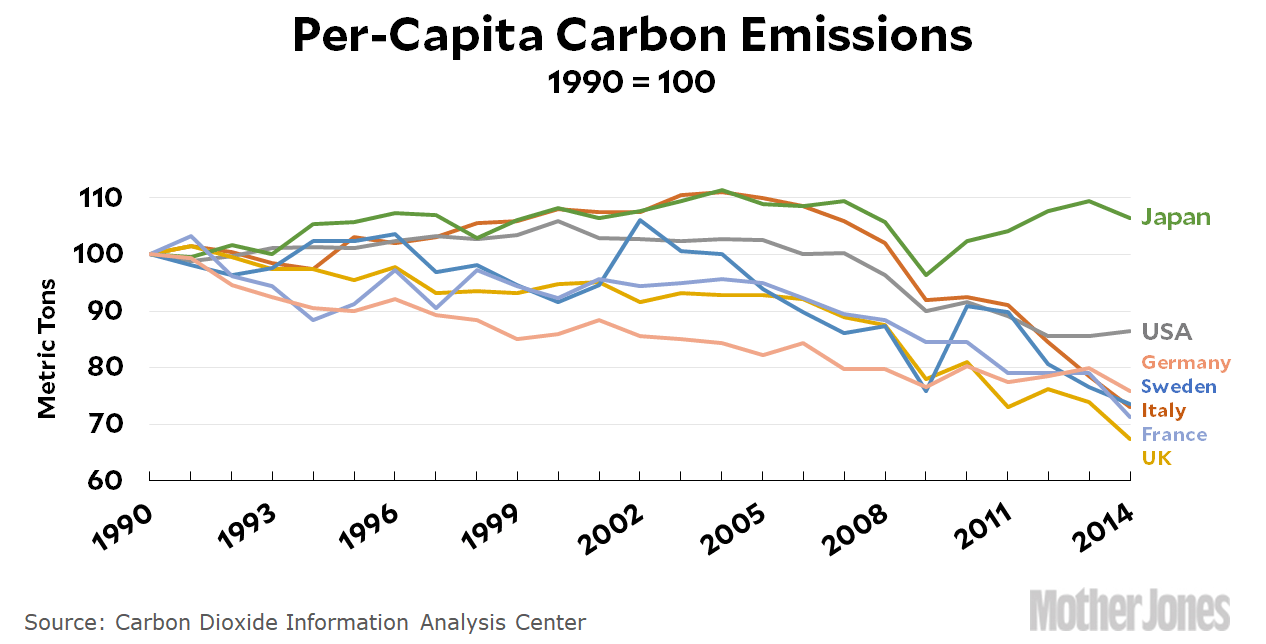
    The only country we beat is Japan. All the rest have reduced their carbon emissions more than us. Of course, this only shows reductions in percentage terms. In absolute terms it’s even worse: the United States emits carbon at nearly double the level of Japan and three times the level of most European countries. The other countries started at lower levels and still managed to cut emissions more than we did.

    On the bright side, we’ve done pretty well at reducing our carbon intensity. In 1990, it took 0.8 kg of carbon to produce a dollar of GDP. Today it takes only 0.3 kg:
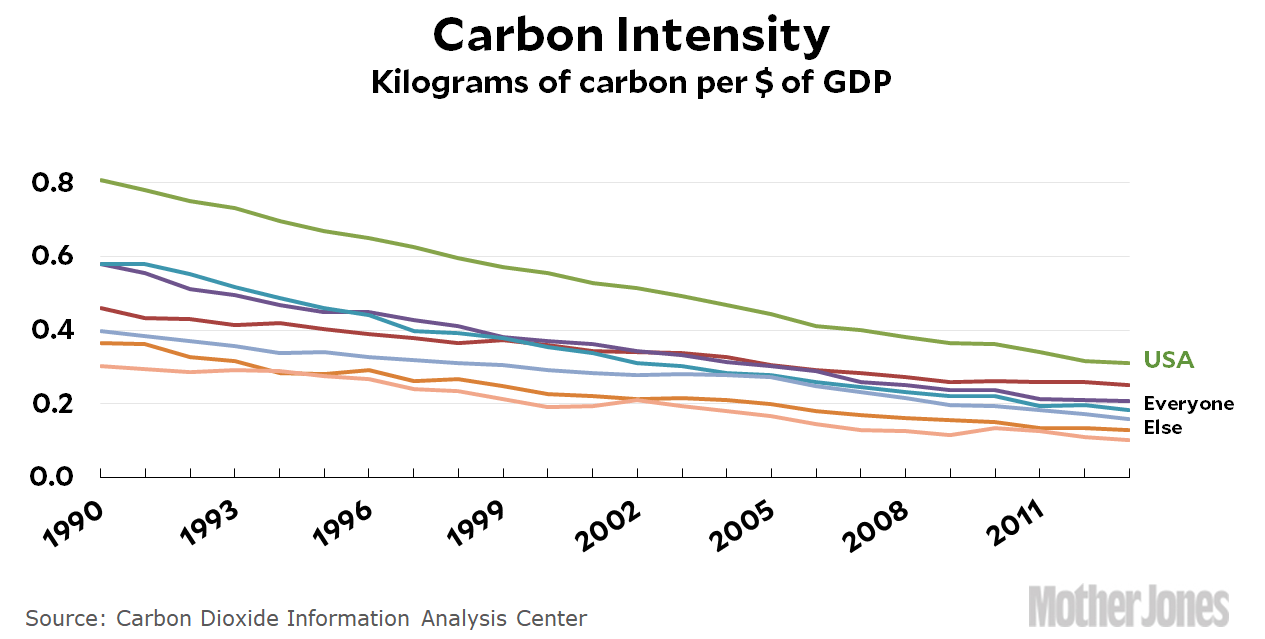
    Sadly for our egos, the other advanced countries have done even better than us. Despite our reliance on private enterprise, we remain one of the least efficient producers of goods and services among our peers.

  • Lunchtime Photo


    Some people have a good eye for composition and color. Throw in some technical skill and lots of practice and they become great photographers.

    But what about those of us who don’t have good eyes? Well, there’s a shortcut: we take pictures of things that are so beautiful you can’t really screw them up. You know, sunsets, snowy mountain peaks, cute animals, the Taj Mahal, etc. That’s what I mostly do. I once took an entire cross-country trip with a friend on condition that we stop every night at sunset so I could take pictures. You’re lucky I don’t just post sunset pictures every day.

    With that in mind, here is Santa Monica shortly after sunset. The road on the right is Pacific Coast Highway.

  • Crime Rates Sure Are Low In Japan. You Know What Else is Low?


    Japan has always been a relatively low-crime country, but lately crime rates have gotten so low that police are getting bored:

    This means plenty of attention for crimes that would be considered too petty to investigate elsewhere, such as the theft of a bicycle or the possession of a tiny amount of drugs. One woman describes how five officers crowded into her cramped apartment after she reported her knickers being swiped from a clothesline. A small army of detectives was assigned last year to apprehend a group of 22 people who had been growing marijuana for their personal use only and smoking it in deserted rural spots.

    In fact, as the police run out of things to do, they are becoming more inventive about what constitutes a crime, says Kanako Takayama of Kyoto University. In one recent case, she says, they arrested a group of people who had shared the cost of renting a car, deeming the arrangement an illegal taxi. Some prefectures have begun prosecuting people who ride their bicycles through red lights.

    Japan was one of the first countries to ban leaded gasoline. The phaseout started in 1972, and by 1980 lead was almost entirely gone. As early as 2000, Japan had an entire cohort of teenagers that had grown up almost entirely lead-free. This only happened in the US a few years ago. Now Japan is moving into their second cohort of lead-free teenagers. Overall, the country has been virtually lead free for nearly four decades, and the lead exposure of today’s Japanese children is “among the lowest in the world.”

    Just sayin’.

  • Maybe Lead Causes Autism Too


    How do you measure exposure to lead? The usual—and most accurate—way is a blood test. The problem is that lead disappears from the bloodstream pretty quickly, so this only tells us about lead exposure in the past few months. What if you want to know about lead exposure several years ago?

    Well, lead builds up in teeth, so you can take a look at that. For example, if you measure lead levels in the teeth of prisoners locked up for violent crimes, you find that their lead buildup is higher than average. This is useful, but it still doesn’t tell you when the lead exposure occurred.

    But what if you could measure lead like tree rings? Then you get this:

    Baby teeth from children with autism contain more toxic lead and less of the essential nutrients zinc and manganese, compared to teeth from children without autism, according to an innovative study funded by the National Institute of Environmental Health Sciences (NIEHS), part of the National Institutes of Health.

    ….The differences in metal uptake between children with and without autism were especially notable during the months just before and after the children were born. The scientists determined this by using lasers to map the growth rings in baby teeth generated during different developmental periods. The researchers observed higher levels of lead in children with autism throughout development, with the greatest disparity observed during the period following birth.

    This is similar to the way lead exposure produces more crime-prone individuals. Basically, lead takes the place of calcium in the brain, which is crucial to normal development. In the autism study, they discovered that lead takes the place of zinc and manganese.

    This was a small study. On the bright side, the researchers looked at twins so they could isolate environmental factors. On the not-so-bright side, they only studied 32 pairs of twins. So this study is suggestive, but far from conclusive. For one thing, if lead poisoning really is a factor in autism, then rates of autism should have gone up during the 50s to the late 70s, and then declined since then. That hasn’t been the case, though there are all sorts of measurement problems that get in the way here. Or, it might be the case that lead has only a small effect and gets drowned out in the historical data by other things.

    But if this turns out to be right, it means that lead poisoning is now implicated in reducing intelligence and increasing the rates of violent behavior, ADHD, and autism. Has one element ever caused so much damage? What does it take for us to make the decision to finally get rid of it once and for all?

  • About That Plan to Annihilate ISIS…


    I’m still sick. Everyone needs to feel sorry for me. What’s worse, I had to drag myself to the doctor’s office yesterday for some lab tests anyway, and my favorite phlebotomist1 cheerfully told me that what I had was “going around.” It always is, isn’t it? “And it lasts four weeks,” she told me. “After a week you might think you’re finally over it, but then it comes back like a freight train.”

    Lovely. So what can I blog about while I’m wooly headed? How about Trump? Yesterday I was wondering what’s up with his secret plan to annihilate ISIS. His generals were supposed to report back to him in February, and now it’s June and nothing much seems to have happened. We armed the Kurds to help us in the battle for Raqqa, and…that’s about it. So this morning I decided to do a quick Google to see if I’d missed anything. This is from Brian McKeon, a former Obama official, writing in Foreign Policy:

    On May 19, a day when Washington was consumed with the latest developments in the scandals enveloping the White House, the Pentagon announced that the chairman and vice chairman of the Joint Chiefs of Staff — Marine Gen. Joseph Dunford and Air Force Gen. Paul Selva, respectively — would be renominated for another term. The commanders leading the military campaigns in Afghanistan, Iraq, North Africa, and Syria — all places with significant Islamic State presences — also remain in place.

    That same day, Dunford and Secretary of Defense James Mattis updated the Pentagon press corps on the counter-Islamic State campaign, which Trump has ordered them to accelerate….They highlighted only two significant changes: delegation of more authority to field commanders, and a tactical shift from shoving the Islamic State out of safe locations to surrounding it in its strongholds.

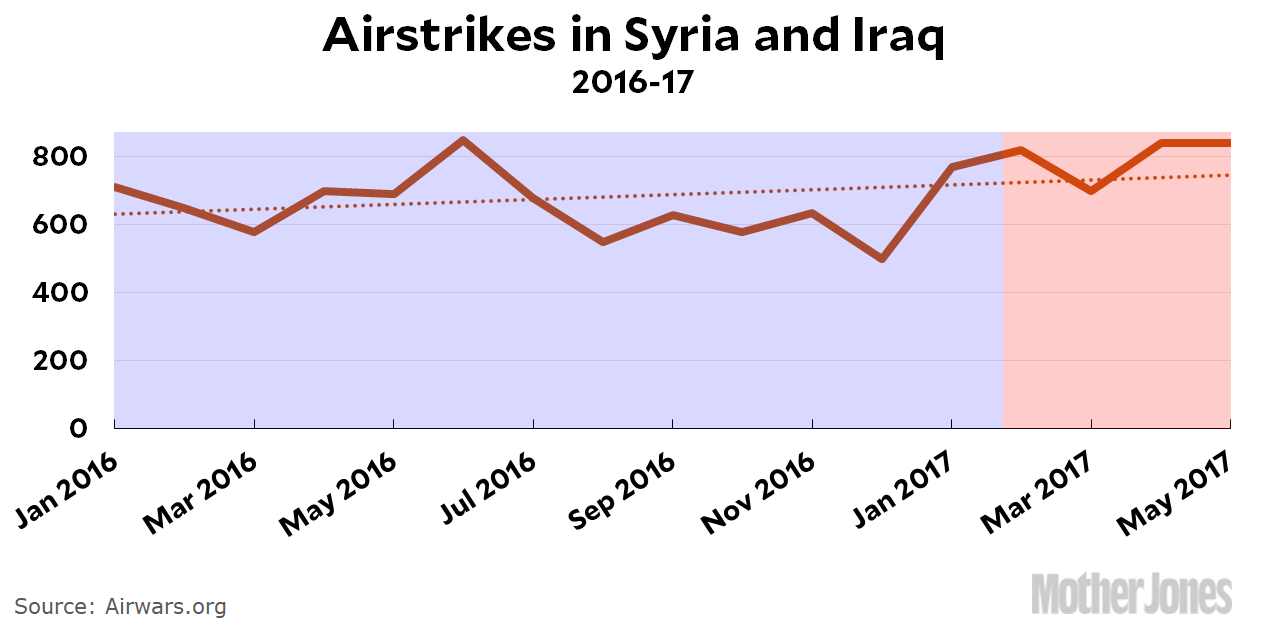
    So all the same generals that Trump ridiculed during the campaign are still running things. There have been a couple of minor tactical shifts, but that’s all. There will be no expanded troop presence. And far from “bombing the hell” out of ISIS, airstrikes have increased at about the same rate as usual:

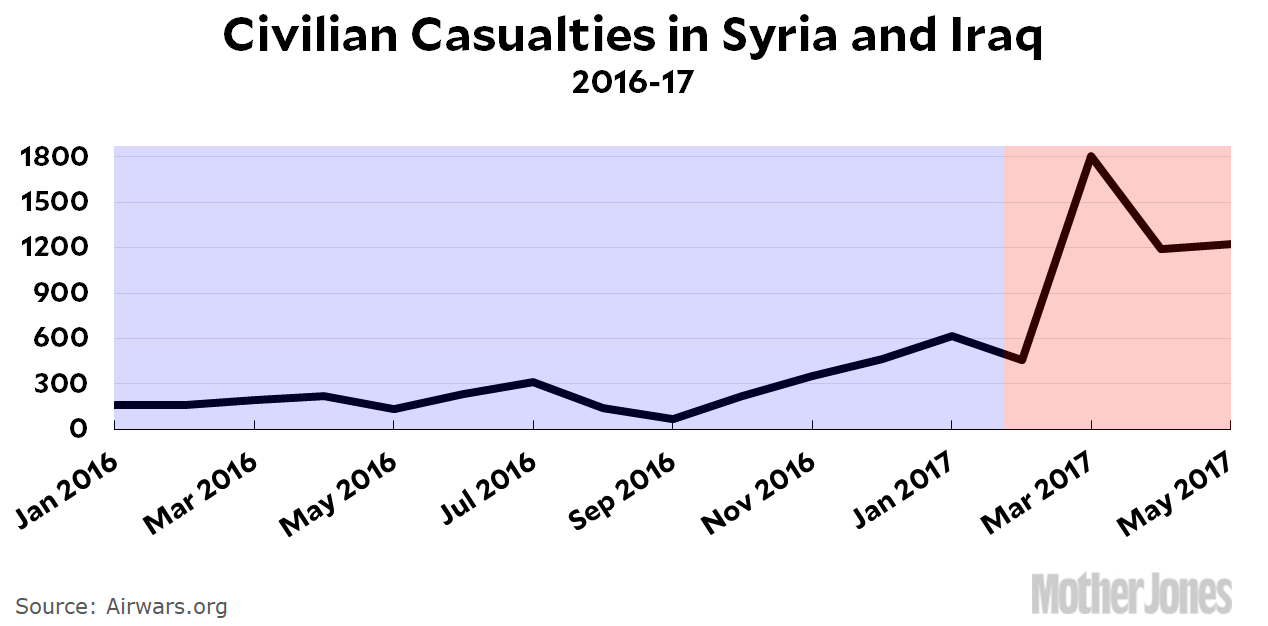
    On the other hand, civilian casualties have skyrocketed since Trump was inaugurated:

    The increase in airstrikes and civilian casualties isn’t surprising on its own. The Battle for Mosul began last October, and a higher battlefield tempo was inevitable. But even in January and February, when the Pentagon was still operating under the Obama doctrine, they managed to keep civilian casualties relatively low even though the number of airstrikes was high. Under Trump, airstrikes have stayed at the January levels, but civilian casualties have more than doubled. According to Defense Secretary James Mattis, this is just a “fact of life.”

    Anyway, that’s what’s happening. As near as I can tell, we’re continuing to fight ISIS with pretty much the same plan we’ve had all along. The only substantial difference is that apparently we don’t care much about civilian casualties anymore.

    Oh, and we dropped a gigantic bomb in Afghanistan. That sure seemed to get the media’s attention. They just love shiny, dramatic new things, even if they don’t actually mean anything.

    1Seriously. One of the side effects of cancer is that you develop relationships with the folks who draw blood. I always go to the lab in the afternoon because that’s when Karen works. (To be totally honest, it’s when Pedro doesn’t work, and I’m actually avoiding him more than anything else.)

  • Morning News Roundup


    Today’s news:

    But don’t worry. White House flack Hope Hicks says everything is going to be OK:

    President Trump has a magnetic personality and exudes positive energy, which is infectious to those around him. He has an unparalleled ability to communicate with people, whether he is speaking to a room of three or an arena of 30,000. He has built great relationships throughout his life and treats everyone with respect. He is brilliant with a great sense of humor … and an amazing ability to make people feel special and aspire to be more than even they thought possible.

    In short, Donald Trump is the kindest, bravest, warmest, most wonderful human being she’s ever known in her life.

    1Unless sources in the White House are lying again just for lulz.

  • Donald Trump Makes a Joke


    Here’s something unusual. Last night Donald Trump wrote a six-word tweet:

    Despite the constant negative press covfefe

    This was obviously a tweet sent in error, but it didn’t get deleted immediately. It stayed up. And up. And up. And it completely took over Twitter. My Twitter feed was about 95 percent covfefe jokes last night.

    But that’s not what’s unusual. This is:

    This is Trump making an actual joke and taking himself less than seriously. I’ve never seen him do that before. I wonder if he wrote the tweet himself?

  • Trump Can Fire People, But He’s Having Trouble Hiring New Ones

    Action P/Rex Shutterstock via ZUMA


    Gloria Borger reports:

    Trump returns to the White House this week just as he left — lonely, angry and not happy with much of anyone. The presidency, Donald Trump is discovering, is not an easy or natural fit. “He now lives within himself, which is a dangerous place for Donald Trump to be,” says someone who speaks with the President. “I see him emotionally withdrawing. He’s gained weight. He doesn’t have anybody whom he trusts.

    Unfortunately, Trump has a big problem hiring new staffers who he might trust:

    The disclosures from investigations stemming from Russian meddling in last year’s election — coupled with the president’s habit of undercutting his staff — have driven away candidates for West Wing jobs that normally would be among the most coveted in American politics, according to people involved in the search.

    By the time the first change in what may be a broader shake-up was announced Tuesday, the White House was left without a replacement. Michael Dubke, the White House communications director, said he would step down, but four possible successors contacted by the White House declined to be considered, according to an associate of Mr. Trump who like others asked not to be identified discussing internal matters.

    At the same time, talks with two former advisers, Corey Lewandowski and David N. Bossie, about joining the White House staff grew more complicated. Mr. Bossie, a former deputy campaign manager, signaled that he does not plan to join the staff.

    I can’t imagine why anyone even semi-competent would be willing to work for Trump, especially in the press operation. Trump undercuts them constantly, and he obviously wants to be the public face of the administration himself. The problem is that he’s afraid to face the press on a regular basis. Even he realizes that his administration is epically incompetent, and reporters have started calling him out on this. So he hides in the Oval Office and feeds his press staff to the lions instead.

    As for every other position, too many people finally understand what Trump is really like:

    There is this storyline about Donald Trump, one longtime Trump watcher says, that he’s a loyal guy. That he sticks with his old friends and defends them and supports them. “You have it all wrong,” he says. “Trump is not loyal, except to his family. He can be solicitous and ingratiating. But if there’s a moment you are not useful, forget it, you’re done. No matter what you have done for him.” Consider: Rudy Giuliani, Paul Manafort, Chris Christie.

    I don’t know what took everyone so long to figure this out, but by now they have. There’s just no upside working for a shitshow of a White House and a shitshow of a man.