• Collins: Eliminating the Individual Mandate Cancels Tax Cuts For Some People

    Sen. Susan Collins doesn’t like the idea of ditching the individual mandate as a way of raising money to offset the deficits from the Republican tax cut:

    “I am no fan of the individual mandate and I very much want to see tax reform,” she said slowly and carefully. “But I believe taking a particular provision from the Affordable Care Act and appending it to the tax bill greatly complicates our efforts. One of my concerns is that it will cause premiums in the individual markets to go up as healthier, younger people drop out.”

    I have new statistics,” Collins added, patting a thick black binder under her arm, “that show that for some middle-income people, it will cancel out their tax cut. The increased premium would be more than the tax reduction they would get from this bill.”

    According to CBO, eliminating the individual mandate will increase premiums about 10 percent. Just think of this as the GOP’s little tax increase on everyone with the gall to buy health insurance via Obamacare.

  • Republicans Are Losing the Middle

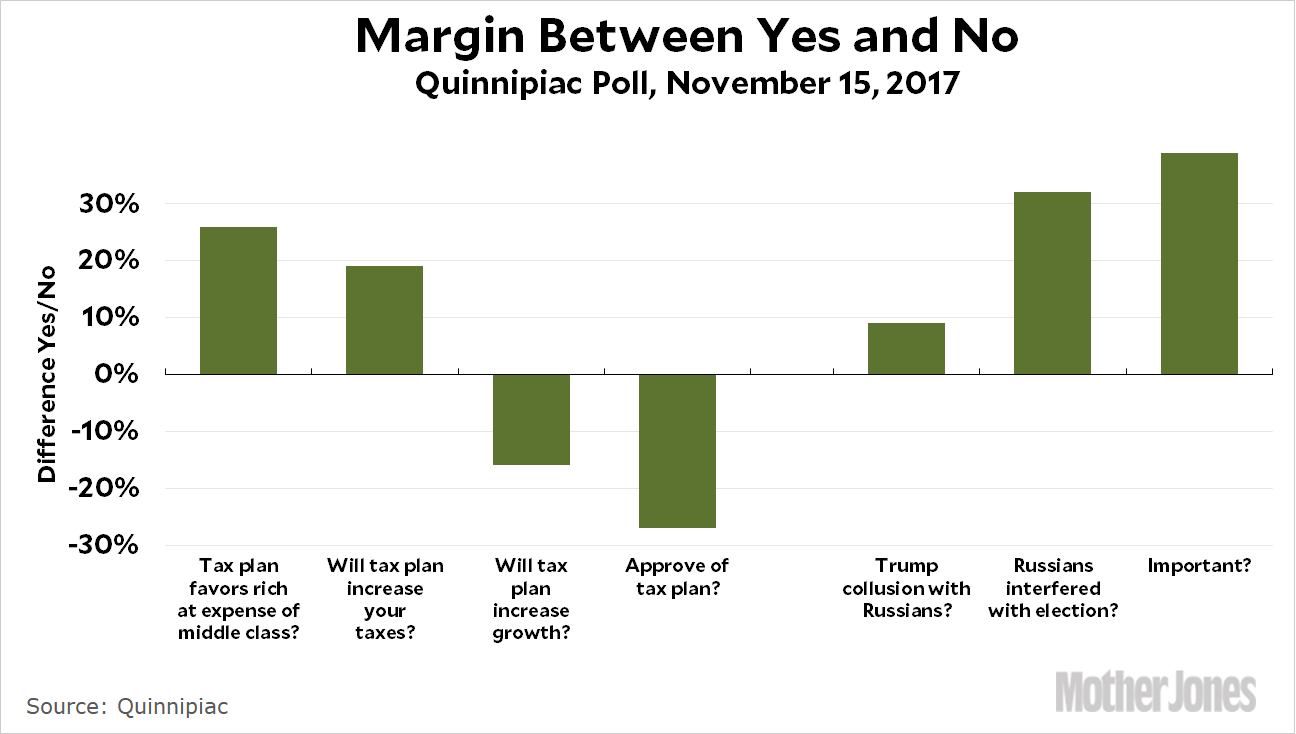
    Quinnipiac called the Virginia governor’s race spot on, so it’s worth taking a look at their latest national poll. Here it is:

    The Republican Party brand relies on two things: cutting taxes and being tough on national security. According to Quinnipiac, they’re squandering both. By large margins, people think the Republican tax plan favors the rich and will likely increase their own taxes. By equally large margins, they don’t think the tax plan will increase growth and they don’t approve of it.

    Similarly, most people think the Russians interfered with the election and most people think it’s important. By itself that’s not a problem, but a smallish majority think the Trump campaign colluded with them. What’s more, people think Trump probably did something either illegal or unethical by a whopping 22 percent margin (57-35). And they think the same about Trump’s advisors by an astonishing 51 percent margin (71-20).

    Needless to say, these results are massively partisan. The reason Republicans are losing so badly is because independents mostly side with the Democratic point of view. Republicans are badly losing the middle of the electorate these days.

  • Republicans Invent Creative New Way to Punish Liberals Via the Tax Code

    Bill Clark/Congressional Quarterly/Newscom via ZUMA

    Who else can Republicans target in their tax bill? How about tech companies? Those are hotbeds of liberalism, and they cluster in the hated state of California. But what’s the best way to screw them over?

    Hmmm. Tech companies often attract new employees by handing out stock options. Basically, you’re given the option of buying a certain number of company shares at a specified price, but you don’t have to do it right away. You can wait for the stock price to go up and then cash in your options. If the stock price goes down, you don’t bother. It’s all upside and no downside, and startups use stock options heavily to attract workers who hope the company strikes it rich and the stock skyrockets.

    That’s all well and good, but when do you tax this windfall? The usual rule for capital gains like this is that you tax them at the time the capital gain actually takes place. That is, when you sell the stock. For stock options, the timeline goes something like this:

    • Grant date: You are hired and the company grants you a thousand options at, say, $1 per share. But those options aren’t yours yet.
    • Vesting date: Two years later the options vest. That means the options are finally yours, even if you quit the company. The value of the stock has risen to $2.
    • Exercise date: Five years later, the stock has risen to $5 and you decide to exercise your options. You pay $1,000 for them, and receive a thousand shares of stock that are now worth $5,000. Ka-ching!
    • Selling date: Ten years later the stock is up to $10 and you decide to sell it. Your profit is $9,000.

    There are two obvious times to tax the options. The first is when you exercise them. You now own the shares, you’ve made a profit on them, and you can sell a few of the shares to pay your taxes. The second obvious time is when you sell the stock.

    Different stock options work different ways, but they’re always taxed after you take ownership of the actual stock. However, the Senate has added a provision to its version of the tax bill that would tax options when they vest. This makes no sense. At this point they’re still just options. You don’t own any stock and don’t have any profits that you can use to pay the taxes. You’d have to dig into savings or take out a loan to pay Uncle Sam, even though the value of the stock might still go down and you could end up with nothing.

    I don’t know anyone, anywhere, who thinks this makes sense. And yet, it somehow made it into the Senate bill. Why? It barely raises any money, after all. It’s hard to come to any conclusion except that it’s a random way of punishing an industry that doesn’t support Republicans. They’re real sweethearts, aren’t they?

    UPDATE: The latest markup of the tax bill was released this morning, and the stock option stuff is gone. Apparently someone had second thoughts.

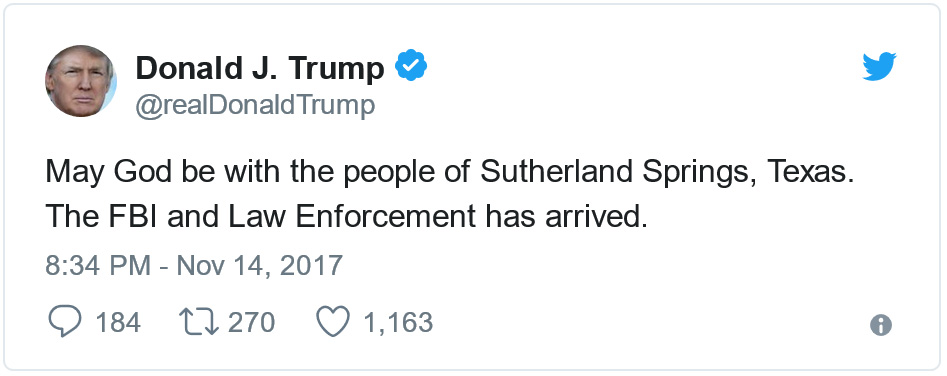
  • Donald Trump Sends Prayers to Wrong Victims of Mass Shooting

    Wut? Didn’t this happen more than a week ago?

    Is Trump thinking of Rancho Tehama, California? Does he really pay that little attention to mass shootings?

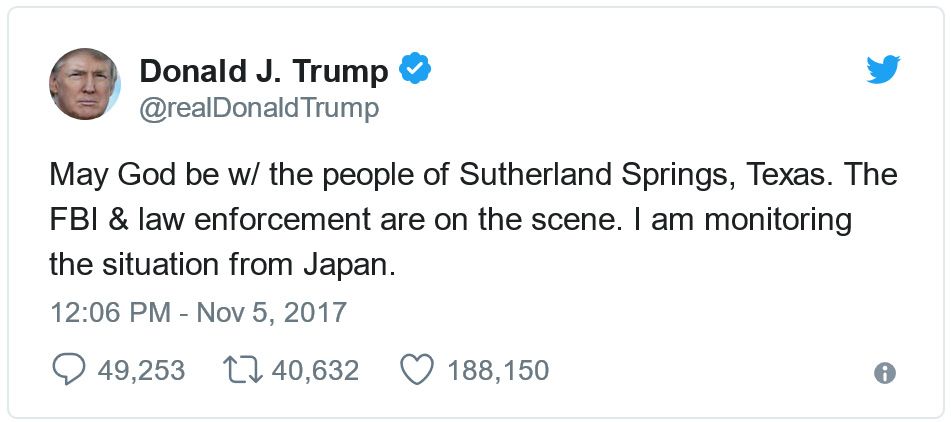
    BTW, here’s his tweet from the actual day of the shooting in Sutherland Springs:

    He really puts a lot of thought into these tweets of compassion, doesn’t he?

    UPDATE: It took a while, but the tweet has finally been deleted. However, nothing has taken its place, since that would be a tacit admission of error on Trump’s part. Apparently the residents of Rancho Tehama will have to make do without prayers from the president.

  • CBO: The Republican Tax Bill Will Trigger $136 Billion in Automatic Budget Cuts Next Year

    Tom Williams/Congressional Quarterly/Newscom via ZUMA

    We already know this about the Republican tax bill:

    • It must increase the deficit no more than $1.5 trillion over the next ten years.
    • It must not raise the deficit at all beyond ten years.

    But there’s always been a third requirement too, and I’ve been waiting for that shoe to drop. Today it did:

    • On net, PAYGO requires that all spending for the year must be deficit neutral. CBO estimates the tax bill will balloon the deficit to about $136 billion next year, which means other spending has to be cut $136 billion.

    These cuts are not optional. OMB is required to automatically sequester both domestic and defense spending in order to meet PAYGO requirements. However, the following programs are exempt:

    • Medicare (limited to $25 billion cut)
    • Social Security
    • All low-income programs (Medicaid, SNAP, SSI, CHIP, TANF, Pell Grants, etc.)
    • VA programs
    • Military personnel accounts
    • Refundable tax credits
    • Federal retirement accounts
    • Medicare Part D (prescription drugs)
    • Federal salaries
    • Anything already legally committed
    • Etc.

    In addition, a bunch of other programs are subject to special treatment. According to CBO, the exemptions are so broad that the total amount remaining is only about $90 billion, which means it would be impossible to sequester the required sum. As a result, we can say that Medicare would lose $25 billion and—what? I guess a bunch of other programs would get zeroed out completely.

    It sure would have been interesting if CBO had named those programs, wouldn’t it? But I imagine someone will get around to that pretty quickly. An awful lot of people are suddenly going to be very, very mad when that list comes out.

    POSTSCRIPT: There’s a gotcha here: sequestration is under the control of the Office of Management and Budget, which is part of the White House. If OMB produces different estimates of the deficit using dynamic pixie dust, it might claim that no sequestration is needed. Or Congress could wait until January to pass the bill, which would kick the sequestration can into 2019. Alternatively, OMB could just decline to trigger the sequester and dare someone to sue them. In the Trump era, who knows?

  • Will Women Save Us From Donald Trump?

    In the New York Review of Books, Judith Shulevitz rounds up some of the current research on the resistance:

    The Harvard political scientist Theda Skocpol [studied] counties that went for Trump in four states that went for Trump: Ohio, Pennsylvania, North Carolina, and Wisconsin. Skocpol says she was startled to find so many flourishing anti-Trump groups in these conservative strongholds. She thinks the resistance is at least as extensive as the Tea Party at its height (a quarter of a million to three hundred thousand active members, according to her estimates). It is certainly as energized. Skocpol hasn’t seen a liberal movement like it in decades, she says.

    ….Probably the greatest misconception about the resistance is that it’s a youth movement. By an overwhelming majority, the leaders of the groups are middle-aged women—middle-aged white women, to be exact. A great many of them have never been involved in electoral politics before.

    ….Resistance groups usually revolve around “a pair of women who are friends,” says Skocpol. “Maybe they weren’t friends before, but they’ve become friends” since Trump’s election…. “They’re in touch all the time, they form a node that the others build around.”

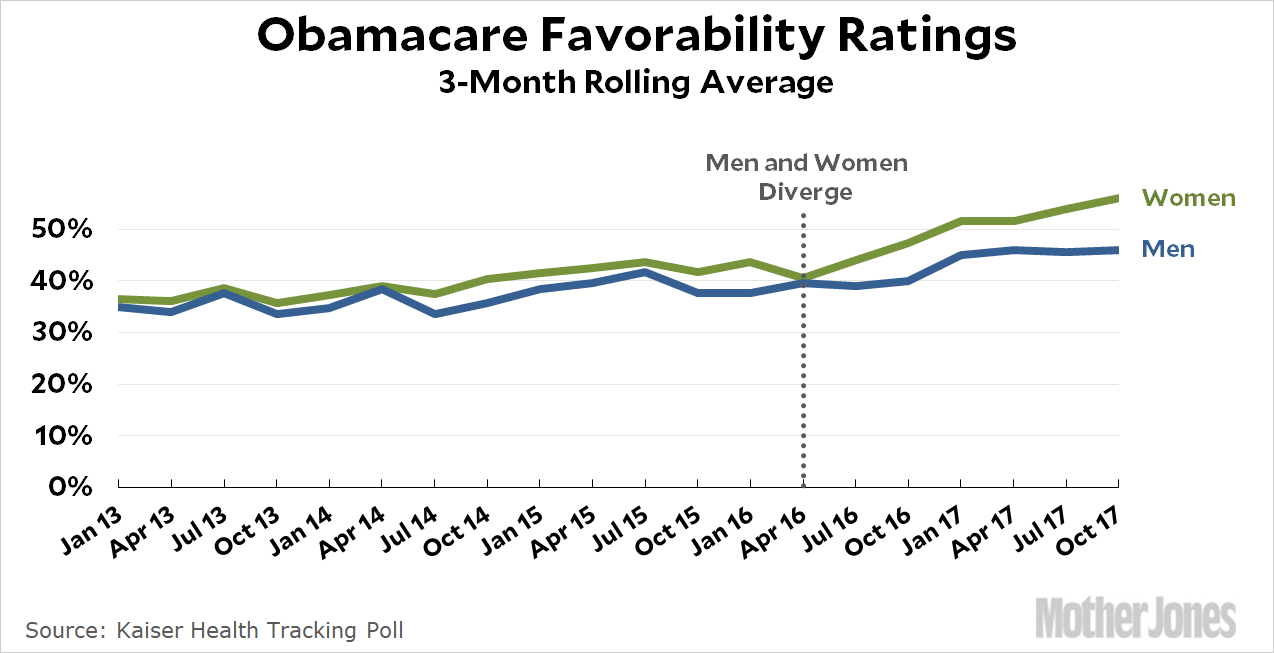
    Two comments. First, this is eerily similar to the origin stories of various conservative movements. They are almost always founded and organized by women who have (allegedly, anyway) been nonpolitical until something sparked their outrage. Second, all of this fits what we know about current events. For example, Trump wants to destroy Obamacare, but women are its biggest fans:

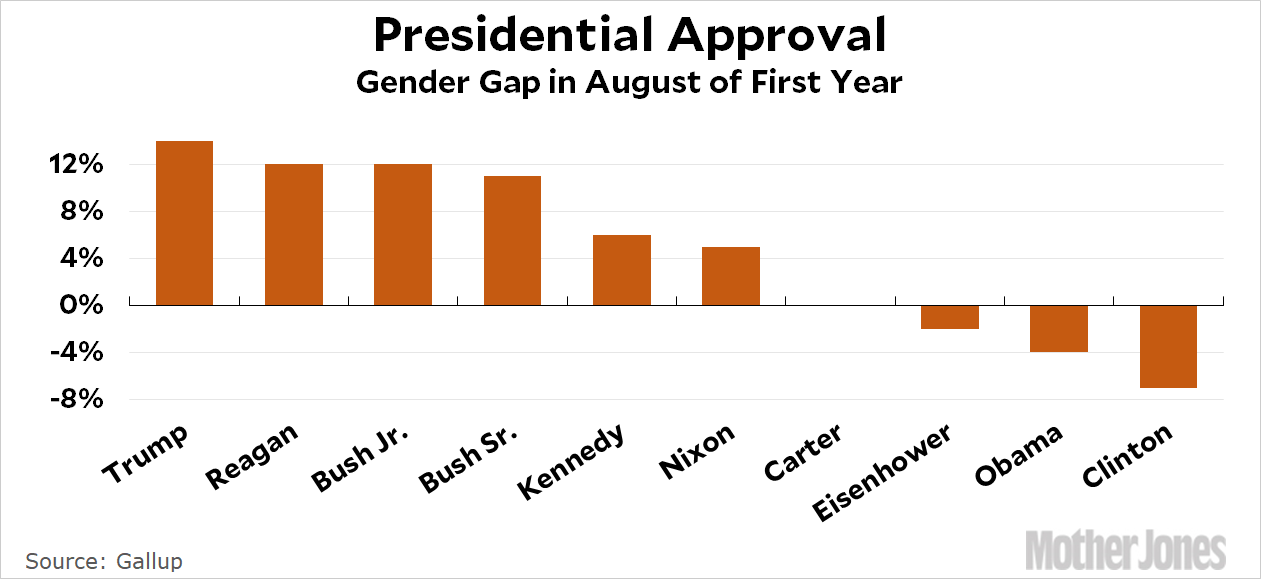
    And Trump has the biggest gender gap of any modern-era president:

    Trump is a serial sexual abuser who wants to destroy the kinds of social programs supported disproportionately by women. It’s no surprise that their emotional energy is considerably stronger than men’s in the resistance movement.

  • Lunchtime Photo

    Sometimes accidents produce interesting results. A few days ago Marian pointed out a spider web in our neighbor’s yard, so I came over and took a few pictures. Then I started diddling around to get something different. This meant leaning over the fence, pointing the camera in an uncomfortable direction, and then manually focusing—all while trying to keep my eye on the LCD screen since I couldn’t use the viewfinder.

    Unfortunately, one of my few complaints about my camera is that it’s really easy to accidentally change the white balance. And that’s what happened here. While I was contorting myself, the white balance got changed to some weird custom setting that defaults to tungsten, which means outdoor light becomes very, very blue. And of course, the sky in the background was already blue. So I ended up with a picture of a spider web that’s a very bright, intense blue.

    That’s not what I was after, but it’s kind of mesmerizing in its own way.

  • IEA: Shale Oil and Gas Are Here to Stay

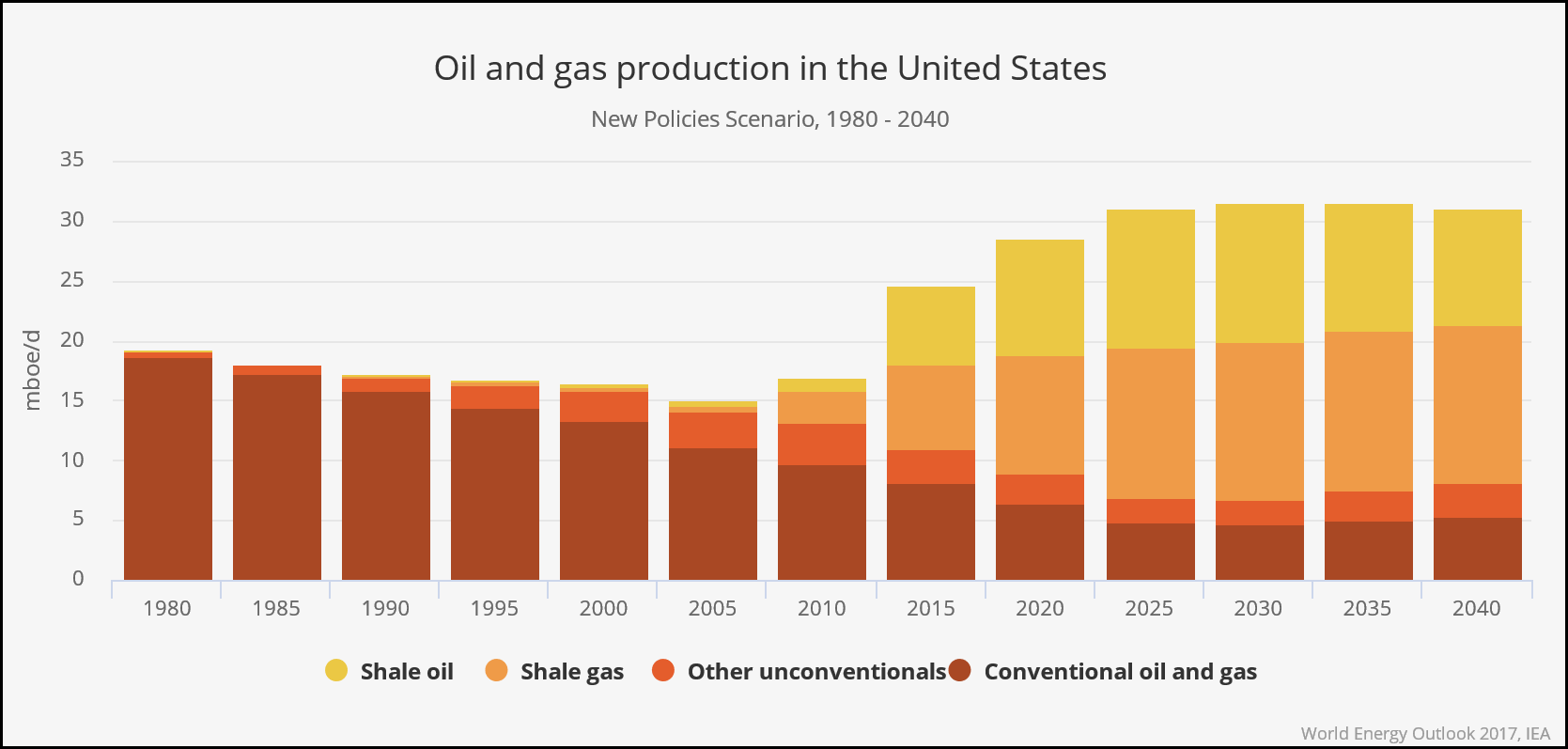
    This chart comes from the International Energy Agency, which has not always had the greatest track record in world when it comes to energy projections, but it’s still worth a look:

    I have long been under the impression that shale oil and gas production is likely to peak and then decline fairly rapidly, but this IEA projection suggests that shale gas production will grow through 2040 and shale oil production will decline only modestly after 2025. I need to take a closer look at this before I offer any comment, but thought it was worth putting it out there while I ponder over it.

    Hat tip to James Pethokoukis at AEI, who misattributes this IEA chart to the EIA.