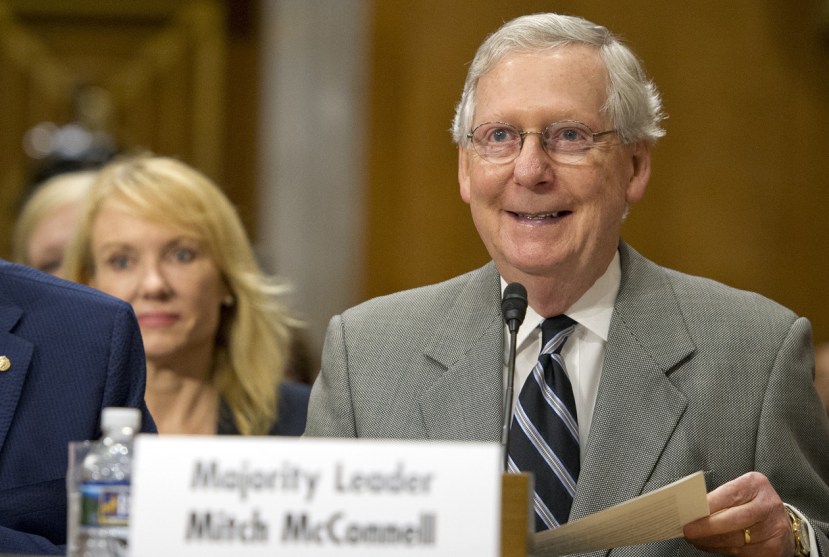
• Mitch McConnell Will Never Admit It, But Democrats Just Gave Him Exactly What He Wants

    Ron Sachs/CNP via ZUMA

    President Trump has “sided with Democrats” in approving a 3-month deal that raises the debt ceiling, funds Harvey relief, and includes a continuing resolution to fund the government through December:

    Trump made his position clear at a White House meeting with congressional leaders, agreeing with Senate Minority Leader Charles E. Schumer (D-N.Y.) and House Minority Leader Nancy Pelosi (D-Calif.) by voicing support for a three-month bill to fund the government and raise the debt ceiling for the same amount of time.

    Senate Majority Leader Mitch McConnell (R-Ky.) said he would add provisions extending government funding and the debt limit through mid-December to legislation passed by the House on Wednesday that would provide $7.85 billion in Hurricane Harvey relief.

    “The president agreed with Sen. Schumer and Congresswoman Pelosi to do a three-month [funding extension] and a debt ceiling into December, and that’s what I will be offering based on the president’s decision, to the bill. And we’ll try to get 60 votes and move forward,” McConnell told reporters Wednesday afternoon. “The president can speak for himself, but his feeling was that we needed to come together to not create a picture of divisiveness at a time of genuine national crisis. And that was the rationale.”

    I suppose all the outrage theater this morning was basically in service of this: pretending that this bill is all Democrats’ fault. That’s not because the Republican leadership has any real objection to it—all of this stuff was inevitable eventually—but because they needed a scapegoat to placate the ultras in their own party. So they pretend to get dragged into this, even though it’s what they wanted all along.

    In fact, it’s better than they could have hoped for. Congress has a ton of stuff on its plate in September, and getting three big things off the table right away is terrific news for them. This gives them some breathing room to consider other things, like FAA reauthorization, Obamacare stabilization, and immigration. I’m not sure how much good it will do them, considering the fault lines in their own party, but honestly, Mitch McConnell must be breathing a huge sigh of relief right now. He’ll never admit it, but he is.
  • Racism Is Not the Explanation for Everything Republicans Do

    Joel Marklund/Bildbyran via ZUMA

    I’m going to replay a Twitter conversation about DACA with Amanda Marcotte from last night. We were talking about Donald Trump’s claim that Obama enacted executive orders with no respect for legal boundaries, and I think it raises an important point:

    Marcotte: Trump accusing Obama of overreach is always rooted in a belief Obama was never a rightful president….Obama didn’t win every court case. But the knee-jerk assumption that he acted without regard for the law is so dumb only racism explains it.

    Me: No, it’s not the only possible explanation. One alternative is that…Obama is a Democrat….Republicans were complaining about Obama’s lawless executive orders long before Trump came on the scene.

    Marcotte: I really think digging one’s heels into the “Trump’s not a racist it MUST be something else” argument is unwise.First of all, racism is endemic to the GOP. Second, you are conflating cheap point scoring with Trump’s single minded obsession….Third, as Sagittarius points out, Trump’s role as chief birther is the linchpin here. Trump refuses to accept Obama’s legitimacy.

    As always, Twitter is a lousy platform for a conversation. This one definitely needs a little more breathing room.

    Is Trump a racist? I sure wouldn’t argue otherwise. There’s not much question that he spends a ton of time appealing to racist sentiments, and this means either that he’s a racist himself or that he’s so cynical he doesn’t mind inflaming white racial resentment in order to maintain political support. Frankly, I don’t think there’s enough daylight between those two possibilities to care much about it. Trump is a racist in practice no matter what’s actually rattling around in that gray matter he uses for a brain.

    It’s also true that the Republican base is full of racists. Trump wouldn’t bother appealing to white racial resentment if this weren’t the case.

    But that doesn’t mean racism is the primary explanation for every bit of opposition to all things Obama. Pretty much every Republican in Congress opposed everything Obama did, and that’s not because every Republican in Congress is a racist. It’s because they’re conservatives and Obama was doing liberal things. Their strategy of unconditional obstruction would have been the same no matter which Democrat had won the 2008 election.

    In the case of DACA, there’s not much question that Obama’s executive action was open to legal question. I happen to think he was on pretty firm ground, but that’s not a slam dunk. Other presidents have also made unilateral decisions about immigration law, but DACA really does go further than anything previously. The same is true of other Obama executive orders, and long before Trump ever came onto the scene this gave Republicans an opening to complain about presidential overreach.

    Was this just a handy argument (i.e., Marcotte’s “point scoring”)? Sure, but that’s politics for you. You pick the argument that has the most oomph, not the one that’s technically what you feel most strongly about. Democrats made similar overreach arguments about George Bush’s signing orders.

    In this case, it’s not that Trump’s argument about DACA representing presidential overreach must be about something other than racism. Who knows what’s in his heart? But there are other explanations. The most likely one, by a mile, is that Trump is an idiot and he’s just parroting something he was told by someone else.

    As for his obsession with Obama, that’s most likely because Obama is his predecessor. Trump’s personality demands that he attack his enemies relentlessly in order to build up his own ego, and in this case it means dismantling Obama’s legacy. Obama’s blackness may or may not play a role in that, but what clearly does play a role is that Obama’s legacy is the only one open to him.

    I think it’s unwise to tiptoe around racism, but I also think it’s unwise to make it the go-to explanation for everything. Trump has plenty of reasons to disparage Obama. If I had to guess, I’d say the main one is Trump’s obvious awareness that Obama was a far better president than he’ll ever be. Likewise, Republicans have plenty of reasons to dislike DACA. Race underlies some of this, but the fact that Obama is both a liberal and a Democrat—and that DACA reduces their leverage in any future debate over immigration reform—plays a much larger role.

    Race is a powerful political weapon. It should be used judiciously.

  • What Is Paul Ryan Outraged About Now?

    Tom Williams/Congressional Quarterly/Newscom via ZUMA

    Politics has gotten to the point that I literally don’t understand it anymore. This is from the Washington Post this morning:

    The House bill does not include language to raise the debt ceiling ahead of a late-September deadline, a relief to conservatives who oppose linking the two issues. But that doesn’t mean the lower chamber will ultimately avoid such a vote: Senate Republican leaders said they plan to attach a debt-ceiling hike to Harvey aid despite conservative opposition.

    Democratic leaders offered support for a combined package on Wednesday provided it only raises the debt ceiling for three months, a plan that would allow the minority party to maintain leverage on issues like government spending, health care and protections for immigrants brought to the United States illegally as children, known as “dreamers,” before the end of the year.

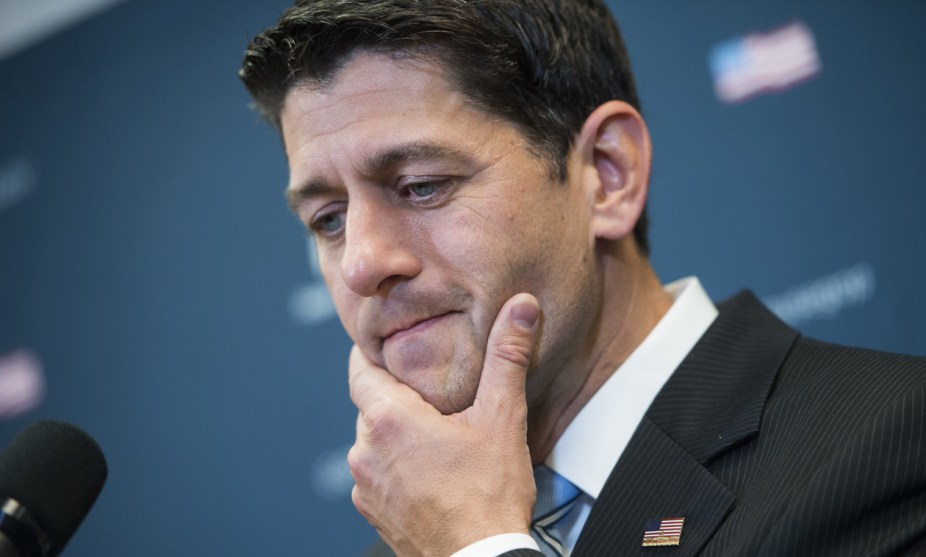
    ….Speaker Paul D. Ryan (R-Wis.) called the offer a “ridiculous idea”….“Let’s just think about this: We’ve got all this devastation in Texas. We’ve got another unprecedented hurricane about to hit Florida, and they want to play politics with the debt ceiling? … I think that’s ridiculous and disgraceful that they want to play politics with the debt ceiling at this moment when we have fellow citizens in need, to respond to these hurricanes so we do not strand them,” Ryan told a news conference on Wednesday.

    Let me get this straight. House Republicans don’t want any debt ceiling increase at all tied to Harvey aid. Senate Republicans do want a debt ceiling increase tied to Harvey aid. Democrats are offering to support the Senate bill as long as the debt ceiling increase is only for three months.

    What exactly is Paul Ryan outraged about? Does he think Democrats should reject any debt ceiling increase? Does he think they should accept a longer debt ceiling increase? What would constitute not playing politics with Harvey aid?

    Maybe my brain has turned to mush, but I don’t get this. I can only assume that Ryan is pretending to be outraged because it makes good theater. Nothing else really makes sense.

  • Is Trump Serious About Revoking DACA?

    Mark Rightmire/The Orange County Register via ZUMA

    What is this supposed to mean?


    Does this mean that Trump’s promise to revoke DACA isn’t for real? That maybe after six months he’ll extend it for another six months if Congress hasn’t acted? Or what?

    I’m a little puzzled about why anyone thinks Congress will act anyway. Back in 2010 every single Republican voted against the DREAM Act. Every one. Today a few of them are saying that DACA should be preserved, but how are we supposed to interpret this? As evidence that they’ve changed their minds? That they voted against it originally just because Obama proposed it? That they were OK with not enacting it in the first place, but not with taking it away once a million people are depending on it?

    And even if a few Republicans really have changed their minds, does DACA now have majority support in the Republican caucus? If it doesn’t, why would leadership even allow a vote?

    Nothing really makes sense here. I can’t figure out why there’s supposed to be a chance of Republicans agreeing on a new DREAM Act when they unanimously opposed it just seven years ago. What am I missing?

  • Attention! “Automation” Is Not the Same as “Artificial Intelligence.”

    People are really pressing my buttons these days on the subject of robots. The latest is Greg Ip in the Wall Street Journal:

    Workers: Fear Not the Robot Apocalypse

    Belinda Duperre, who sold jewelry at Sam’s Club…earns $2 more per hour at Amazon than at Sam’s, in part because she’s a lot more productive. At Sam’s, she served perhaps one to 20 customers a day. At Amazon, she packs 75 to 120 boxes an hour that are then whisked via high-speed automated conveyor belts to fleets of trucks that fan out across the region.

    ….The brick-and-mortar retail swoon has been accompanied by a less headline-grabbing e-commerce boom that has created more jobs in the U.S. than traditional stores have cut. Those jobs, in turn, pay better, because its workers are so much more productive. This demonstrates something routinely overlooked in the anxiety about the job-destroying potential of robots, artificial intelligence and other forms of automation. Throughout history, automation commonly creates more, and better-paying, jobs than it destroys.

    This is not the greatest productivity argument in the world, but my real gripe is something different. Here’s a passage later in the article that really highlights it:

    “Robot apocalypse” is a modern expression, but the underlying anxiety goes back centuries….Those fears have repeatedly proven baseless. James Bessen, an economist at Boston University School of Law, has found in numerous episodes when technology was supposed to annihilate jobs, the opposite occurred. After the first automated tellers were installed in the 1970s, an executive at Wells, Fargo & Co. predicted ATMs would lead to fewer branches with even fewer staff….Today, banks employ more tellers than in 1980 and their duties have expanded to things ATMs can’t do such as “relationship banking.”

    People who write about this stuff need to be very clear on the difference between automation and artificial intelligence. You can’t just casually refer to “the job-destroying potential of robots, artificial intelligence and other forms of automation.” These are totally different things.

    Plain old automation does indeed usually produce more jobs than it destroys. This applies to more than just steam engines and electricity, and an ATM is nothing special in this regard. It’s ordinary, old-school automation even though it relies on microchips and communications networks. Of course ATMs can’t do relationship banking. How could they?

    Artificial intelligence is entirely different. If you don’t believe we’ll ever get it, that’s fine. Make your case. But if you do believe it’s coming in the near future, then you need to treat it as a completely different thing. Pretty much by definition, true AI will be able to do anything a human can do. So no matter what new jobs you think AI will create, then by definition AI will be able to do those jobs too. If true AI is in our future, the robot apocalypse is very much something we should worry about.¹

    So please: can we retire the stale old ATM story? It has nothing to teach us about what AI can and can’t do, and that’s the thing we should be interested in. If you want to write about automation, then feel free to go on at length about how it produces more jobs than it destroys. But if you want to write about AI, historical analogies will get you nowhere. This is something very, very different.

    ¹Not me, of course. I’ll be retired or dead by the time it happens. But if you’re in your 20s or 30s, a little bit of healthy anxiety might be in order.

  • In Huge Surprise, Study Confirms That Cutting Obamacare Advertising Will Cut Obamacare Enrollment

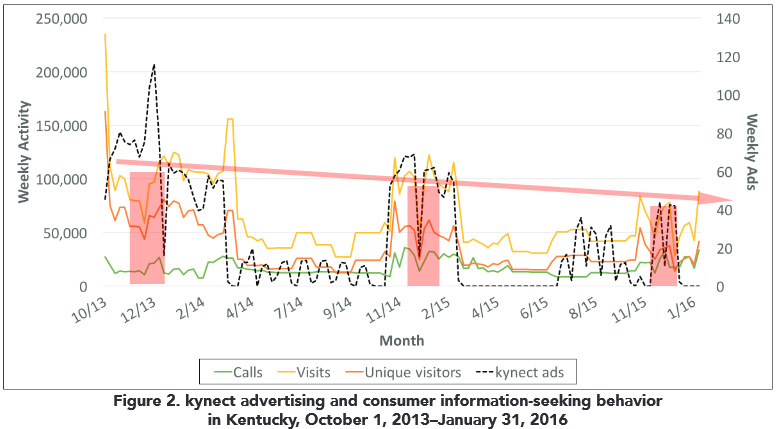
    So how much will Donald Trump’s sabotage of Obamacare actually affect enrollment? Over at the Incidental Economist, a team of researchers looked to Kentucky for answers. In late 2015, Republican Matt Bevin became governor and he immediately cut back on advertising and outreach for Kentucky’s version of Obamacare. In 2016 he cut back even further. The researchers crunched the numbers and concluded that each week without television ads resulted in 450,000 fewer page views, 20,000 fewer visits, and 20,000 fewer unique visitors per week during the open enrollment period.

    But what about actual enrollment? Did that go down too? Or did it turn out—as Trump suggests—that everyone already knows about Obamacare, which makes expensive advertising campaigns a waste of money? As public service, I’ve added enrollment data to the chart the researchers produced. It’s the light pink bars:

    When the previous administration cut back modestly on advertising, enrollment went down from 106,000 to 94,000. Then, when Bevin took office and cut advertising way back, it plummeted to 81,000. Apparently advertising works! Who knew?

    That’s a drop of 14 percent, which is huge. But this might still understate the problem. Trump is planning to stop advertising and outreach at the same time he’s shortening the open enrollment period. A lot of people who think they can wait to enroll until the end of December—or even the end of January—are going to be unpleasantly surprised when they head over to healthcare.gov on December 27th and discover that they’ve missed the brand new deadline of December 15. I wouldn’t be surprised if this ended up affecting half a million people or more, who find themselves unexpectedly unable to buy health insurance for 2018.

    The remarkable thing about all this isn’t just how callous it is, but how obviously callous it is. The cutbacks will save a little over $100 million, which is a pittance for a $100 billion program. There’s plainly no reason to eliminate this spending except as a way of deliberately trying to undermine the program and keep poor people from signing up. But Republicans don’t care if everyone knows it. Voters probably won’t figure it out, after all.

    Now, it’s possible that this will backfire. Liberal groups may go into overdrive working to make sure people know about the new deadline. There’s an analogy here: in states that passed photo ID laws for voting, the backlash got so much attention that the laws had only a minor effect.

    But even if that happens, it’s still a win for Republicans. After all, if liberals are busy with this, it means they’ll have less time to spend on whatever new atrocity Trump is working on during November and December. Merry Christmas, folks.

    UPDATE: The original post was unclear about the dates of the Bevin administration, and I also miscalculated the percentage drop after Kentucky’s advertising stopped. It was 14 percent, not 24 percent. The post has been corrected.

  • Lunchtime Photo

    I don’t remember what this is anymore. It’s a plant of some kind, something I took pictures of but didn’t really care for once I got home and looked at them. At some point, however, I got bored and started futzing around with a whole bunch of Photoshop filters and color settings, and eventually it turned into this. I propose that either (a) it should get an exhibition spot at MOMA or (b) Hallmark should buy it as a wrapping paper design. Alternatively, Steve Schafer can try to figure out what plant it originally was. I betcha he can’t do it.

  • The Joys of Serendipity on FRED

    One of the great things about FRED is its unpredictability. There are lots of things you’d think they’d have, but they don’t. For example, apparently the Census Bureau doesn’t play nice, which means FRED has no Census data on wages or trade deficits. This is especially annoying because the Census data is an unholy pain in the ass, especially for trade data. Bad Census Bureau!

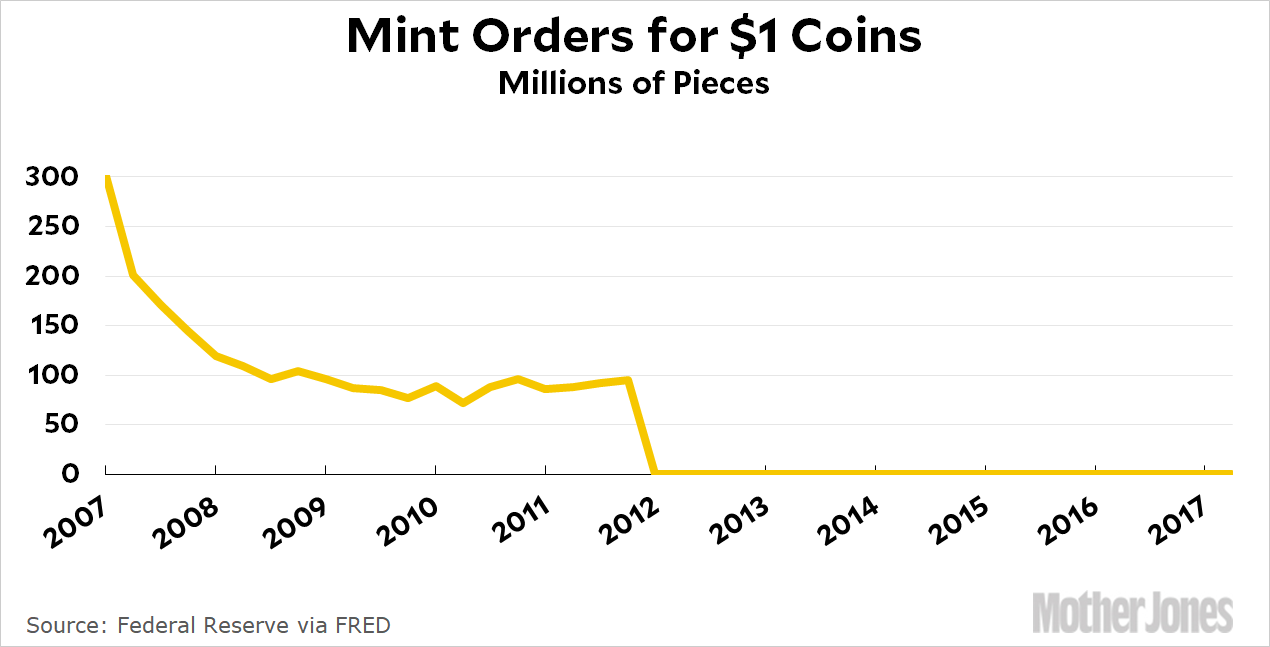
    On the other hand, it’s also got great stuff you can find by accident. I happened to do a search with the string “coin” in it, and got back total orders for $1 coins from the US Mint:

    No one wants $1 coins. There are over a billion of them in reserve, just waiting for banks to order them. But total orders add up to only about 60 million per year—mostly for birthday presents to small children, I imagine. Until we get rid of the one-dollar bill, the one-dollar coin has no audience.¹

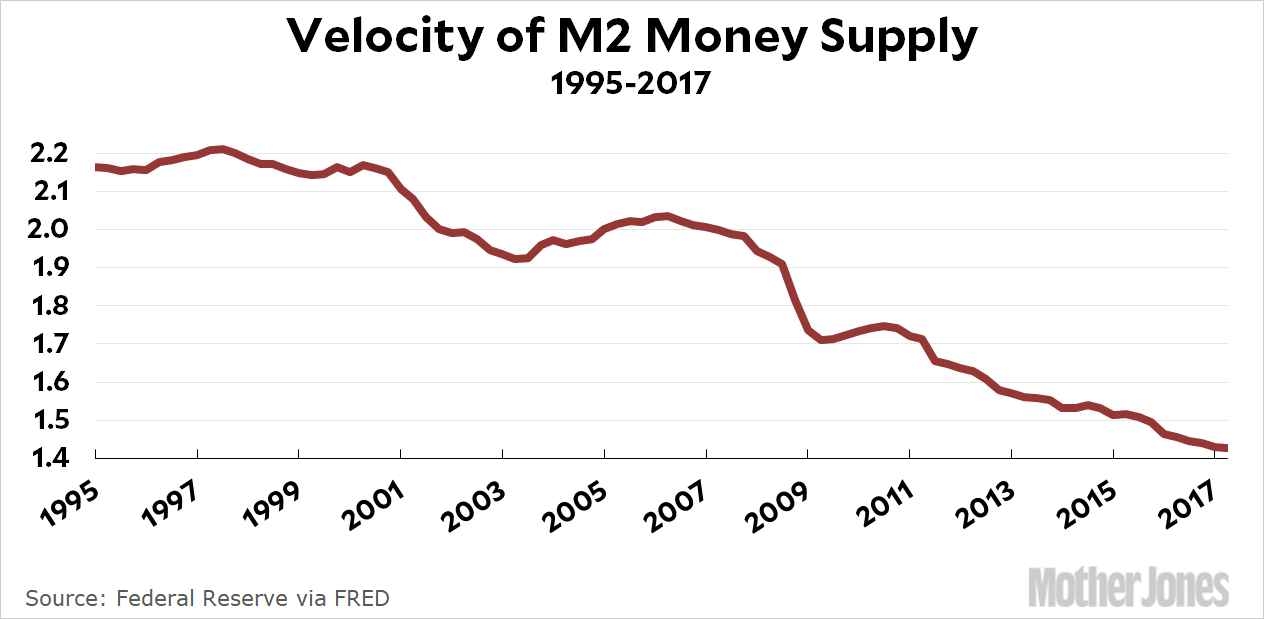
    On a more serious note, I also ran into this chart showing the velocity of money:

    I don’t really know what this means. More accurately, I know what it means—a single dollar circulated an average of 2.2 times per year in 1998 but only 1.4 times in 2017—but I’m not sure what it implies. Certainly it corresponds to lower inflation. But what else? And why has velocity been slowing down pretty steadily for nearly 20 years? This is yet another economic variable that took a sharp downward turn right around 2000, and that always interests me. There’s an awful lot of these inflections in 2000, and I really want to know what happened in 2000 to cause it.

    ¹On the bright side, the “Cheerios” version of the 2000 dollar coin is extremely valuable. Why is it called “Cheerios”? Because 5,500 of them were included in boxes of Cheerios, dummy. But that’s not enough to make them valuable. It turns out that the Cheerios giveaways were struck from a slightly different master die, which means they’re easily identifiable and there are only 5,500 of them. If you got one and tossed it into a drawer, get it out and sell it. You’re rich!

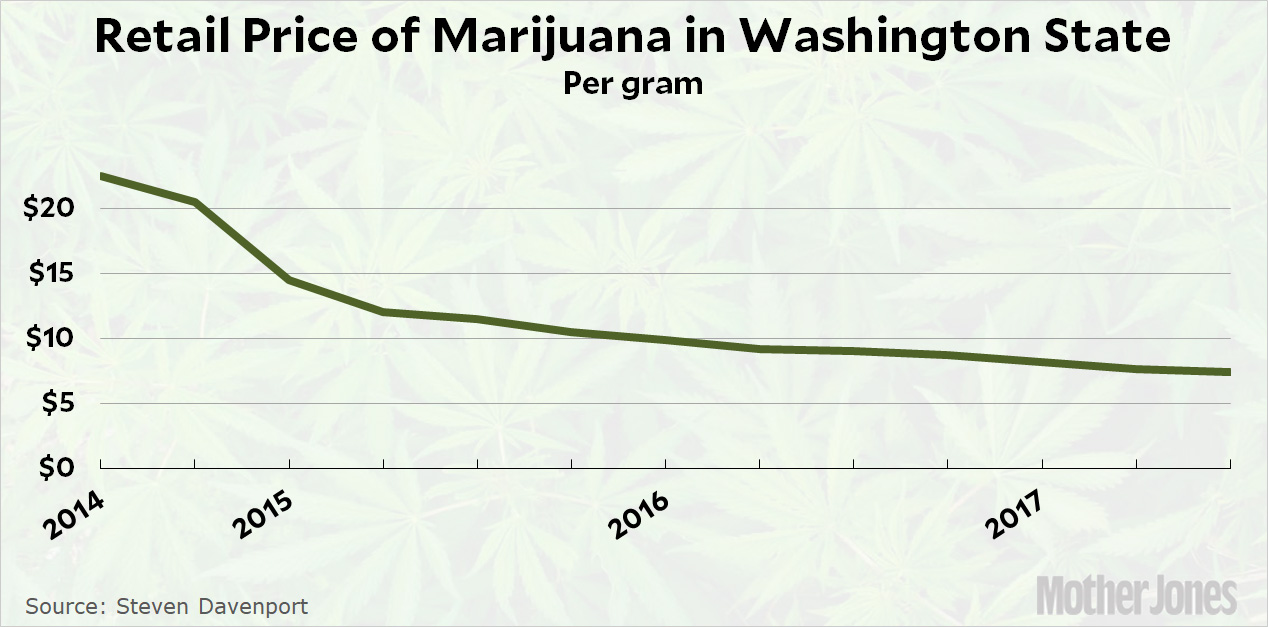
  • Chart of the Day: Marijuana Prices Have Plummeted in Washington State

    Via Keith Humphreys, here’s the result of Washington State’s legalization of marijuana in July 2014:

    Humphreys adds this comment:

    Prohibition imposes huge costs on drug producing industries that are passed on to consumers in the form of higher prices. These higher prices are one of the principal reasons (the others being stigma and fear of punishment) that illegal drugs are used so much less frequently than legal drugs such as alcohol and tobacco. Marijuana is a rare example where we can see the impact of legalizing a drug in real time, which shows that were the production and sale of heroin, cocaine and methamphetamine also legalized, those drugs would also become dramatically cheaper to consume.

    This is a two-sided coin, of course. Advocates for legalization of hard drugs like cocaine and heroin will hail it: if we stop the drug war, prices will fall and drug users will be less likely to resort to crime to raise money for their next hit. Conversely, drug warriors will point out that this shows just how effective drug prohibition is: it keeps prices high and therefore reduces overall consumption.

    So which do you want? Higher consumption but (maybe) lower crime? Or lower consumption with (maybe) higher crime? Marijuana doesn’t cause much crime or much societal damage in the first place, so it’s a relatively easy case. But how about meth? Or opioids? That’s a little harder.

  • Don’t Blame Liberal Foreign Policy on Think Tanks

    D. Myles Cullen/Planet Pix via ZUMA

    Zack Beauchamp has an interesting piece today about the lack of a robust Democratic alternative on foreign policy. Democrats and Republicans differ pretty clearly on social and economic issues, but when it comes to foreign affairs and national security the differences are pretty minuscule. Why?

    On issue after issue, from the war in Afghanistan to the rise of China, Democrats have little exciting to offer. Democratic members of Congress are happy to give fiery speeches condemning Trump’s policies on terrorism or Russia, but that’s not very different from what Republicans did on health care while President Barack Obama was in office.

    ….Why are Democrats so bereft on foreign policy? To find out, I talked to a half-dozen people with experience in the liberal foreign policy world, ranging from congressional staffers to professors to former White House officials. Most of them pointed the finger at something that might not seem obvious: Think tanks.

    ….Another part of the problem appears to be liberalism itself: The liberal base is highly divided over the use of American military power and Washington’s place in the world. No one seems to know how to overcome this. But there’s a clear consensus in liberal circles — even at the highest levels — that the lack of think tank firepower is a real problem.

    This is not really news. The fact that there’s a fairly broad bipartisan consensus on foreign policy is pretty well known—and frequently bemoaned by lefty critics of American military intervention.

    But I think this view understates the problem by looking for uniquely American causes like think tanks. Take a look around the world. There are obviously differences in foreign policy among rich countries. Germany is less hawkish than the US. France is more interested in Africa. Small countries don’t even pretend they have much influence over foreign affairs.

    But those are mostly small differences. Everyone hovers around a fairly similar approach to foreign affairs, mostly following a fairly simple rule: the bigger the country, the more likely it is to throw its weight around. Take a look at the Big Six: the US, Russia, China, Britain, Germany, and France. Is there really much difference? Only Britain joined us in the Iraq War, but others were happy to join us in Afghanistan. Britain voted against intervention in Syria, and that started a chain reaction revealing that America wasn’t really very excited about it either. President Obama was reluctant to take the lead in Libya, so France did so instead. Russia has been aggressive along its border (Ukraine, Georgia, the Baltics) and China has been aggressive along its border (India, the South China Sea). Nobody is really in favor of North Korea having nuclear capability, but no one is really willing to do much about it either. America has a huge spying apparatus that gets a lot of attention, but it turns out that plenty of other countries do too—and our allies work hand-in-glove with the CIA and NSA even if political expediency forces them to occasionally denounce us in public.

    In other words, to say that consensus American foreign policy is American foreign policy is probably wrong. It’s basically just the way big countries work. We tend to be on the aggressive end of the consensus, but that’s more because we’re the biggest, not because Americans are uniquely belligerent.

    So look beyond think tanks. Look beyond America. Look beyond the 21st century. Just ask yourself this: how different is the United States today from powerful countries over the past few centuries? Not much, really. The technology has changed a lot, but the basic worldview hasn’t.

    This is why it’s hard for Democrats to form a really robust counterweight to “right-wing foreign policy.” It’s because consensus foreign policy isn’t really all that right-wing. All the yelling and shouting mostly serves to hide the fact that substantive differences between the parties are fairly modest. Even the biggest foreign policy disagreement of recent times, the Iraq War, was supported by about half of all Democrats. Interventions like Afghanistan, Libya, Syria, and Yemen have fueled plenty of partisan sniping, but hardly any substantive disagreements at all. Democrats and Republicans can switch their views toward Russia with hardly a blink because their views weren’t all that different to begin with. In other words, the reason mainstream think tanks don’t produce a lot of alternatives is because there aren’t many customers asking for them.