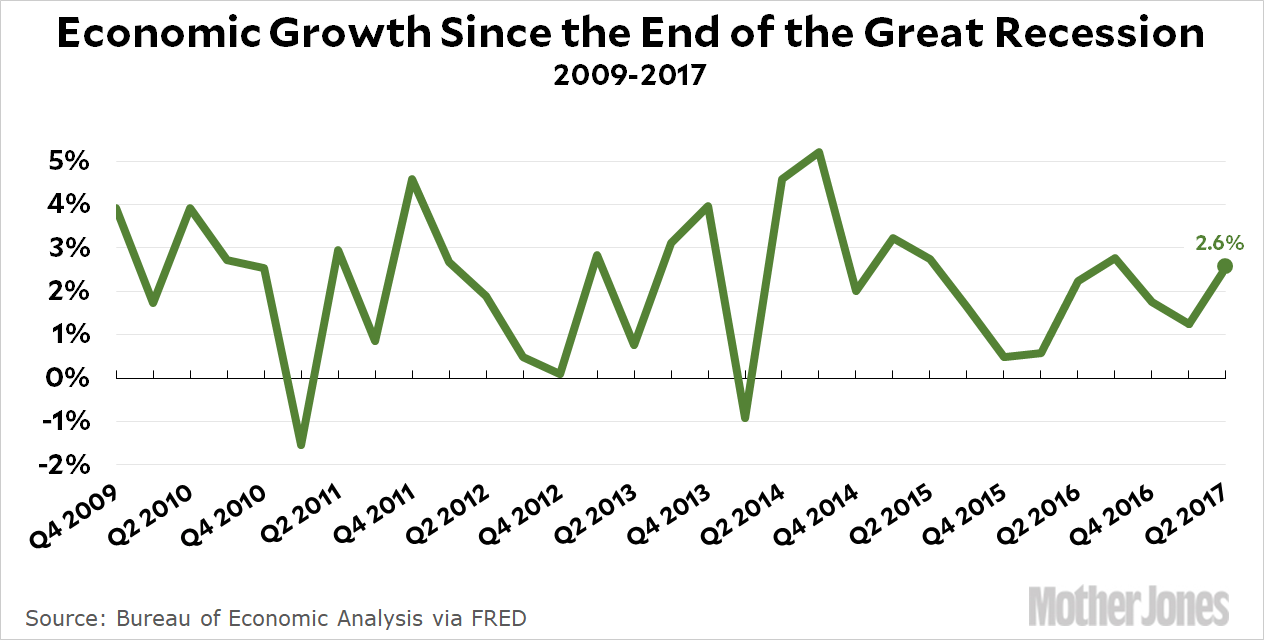
Economic growth has surged to 2.6 percent. Remember, everybody said you won’t bring it up to 1 percent. You won’t bring it up to 1.2 percent.
Fact checking is for suckers. But there are still a few of us who are at least curious about how things are going out in consensus reality. Here you go:
You may now return to the comfortable cocoon of Trumpland, where the economy is surging, terrorists are being wiped out, jobs are plentiful, and Southern heritage is being protected. Don’t you feel better already?
This is a quick note to New York City mayor Bill DeBlasio and everyone else: don’t tear down any statues of Christopher Columbus. Ditto for George Washington, the Puritans, George Custer, or anyone else you can think of who might be problematic. Just don’t.
At the risk of stating the blindingly obvious, this stuff plays into the hands of the Trumpies. The whole “Who’s next?” meme is an almost childishly transparent attempt to distract attention from Confederate statues; build support among moderates; and sow division among liberals. Don’t play the game. The answer to every question about statues is: I don’t know. Let’s tear down the memorials to Confederates who fought a war in defense of slavery, and then we can decide later if we ought to do anything more. OK?
That’s it. Easy peasy. We have a moment right now when we might be able to get some low-hanging fruit and make a difference. Let’s not screw it up by thinking it’s also a chance to redress every historical offense that Howard Zinn ever taught us.
I let this slip by, but Tuesday was my 15th anniversary of being a blogger and my 9th anniversary of working for Mother Jones. You may now commence with the old-man jokes.
When I take pictures of our avian cousins, I’m usually attracted to birds that are interesting in some way. Cute baby geese. Colorful hummingbirds. A lovely egret. A magnificent heron. But what about the blue-collar birds? It’s not their fault that they’re boring. Don’t they deserve pictures too?
You bet. And what’s more ordinary than a finch? So I undertook to photograph one. But precisely because they’re so ordinary, I wanted an extra nice photo and eventually I got this one. And while it’s a nice picture, I have to say that this is one tubby little finch, isn’t it? Irvine must be bursting at the seams with delicious worms. Or whatever it is that finches eat.
UPDATE: Apparently this is a song sparrow, not a finch. How about that? And judging from a few pictures, song sparrows all tend toward the chubby side. This fellow, it turns out, is pretty ordinary.
It’s the summer of 2007….In Washington, D.C., St Petersburg Times bureau chief Bill Adair is brainstorming new ways to cover the upcoming presidential race, motivated in part by a sense of guilt. “I had covered political campaigns,” he would later say, “and felt that I had been a passive co-conspirator in sort of passing along inaccurate information.”
….What Adair thought would differentiate the project, renamed “PolitiFact” by Executive Editor Neil Brown, was a rating system with a silly name (the “Truth-O-Meter”) and a highly structured content management system that would allow for easy sorting of all the published fact checks.
….Over the next decade, PolitiFact would win the Pulitzer Prize for national reporting, partner with more than a dozen newspapers to launch state-level affiliates and build a brand with a larger online following than its parent organization. Along the way, PolitiFact helped shape political fact-checking across the world.
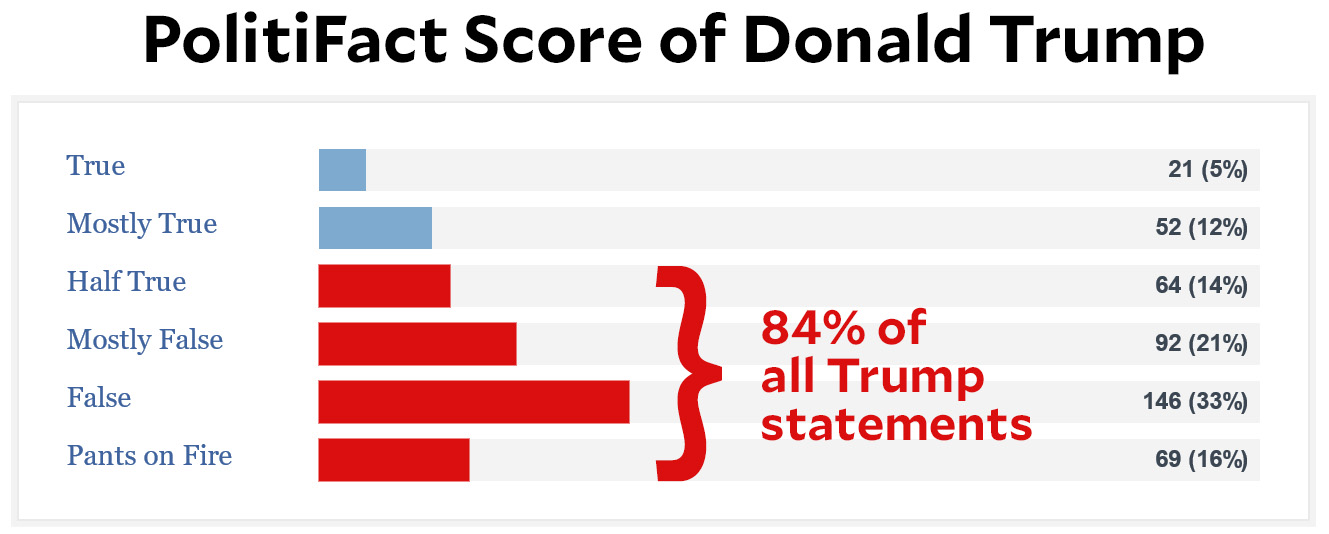
I hate to pick on PolitiFact. I have issues with all the “fact checking” sites, but for the most part I think they do good work. At the same time, the rise of fact checking seems to have coincided not with an overall rise in honesty among politicians, but with the rise of a complete disdain for facts among Republicans. This peaked in 2016 with the victory of Donald Trump, a man who, according to PolitiFact, barely ever opens his mouth to say something true.
Is this just a coincidence? Or is there some kind of relationship here? I don’t know. But it’s hard not to wonder.
It’s official. Every county in America will have at least one insurer participating in the Obamacare exchanges in 2018. Bloomberg reports that “Based on the latest data, most of the 12 million people who got health insurance through Obamacare’s individual marketplaces will have the same number of companies to choose among next year as they did in 2017.” Half of all enrollees will have three or more insurers to choose from, and 77 percent of enrollees will have two or more:
I’m sure this news is breaking some hearts in Washington. The fact that everyone will get coverage and premiums will go up only slightly for the vast majority of consumers might seem like good news to ordinary people like you and me. But Paul Ryan and Donald Trump were really, really hoping that a lot of people wouldn’t get coverage this year. They were really, really hoping for a vast amount of human misery so they could say they told us so. Then they could take away coverage from millions. Because that’s how Republicans roll these days.
What happens when the car needs to pick up a child, senior citizen or someone with a disability who needs help getting in and out the vehicle? That’s something that needs to be dealt with now before it becomes an issue.
I find it hilarious that a society that won’t let kids walk to the park by themselves is thinking about how to let robot cars drive them around.
I mostly get a kick out of the belief that if we just clap louder, driverless cars will never work. But come on. This is weak:
No, we don’t need to deal with the problem of seniors and disabled passengers before it becomes an issue. Why would we? The market will almost certainly take care of this. Maybe companies will spring up that maintain human drivers, or that offer to have a human accompany the car to help you load your luggage or get your wheelchair into the trunk. Maybe driverless taxi companies will include this as an option. Or something. This is a no-brainer.
As for kids, the problem is that lots of modern parents won’t let them walk to the park alone because they don’t trust humans. A driverless taxi would be perfect for them.
There’s a weird game that a lot of people play these days, where they gleefully come up with scenarios they’re sure driverless cars will never be able to handle. Do they really think they’re the first people to think of these things? They aren’t. The folks building these cars are well aware that it snows sometimes. They know that people often drive in stupid ways. They understand that parking lots exist. They know that different states have different traffic laws. Etc.
Driverless cars are coming, folks. The first ones will probably be used in restricted environments (shuttle buses on a fixed route, maybe). Then they’ll get better. And better. And along the way we’ll all get used to them, the same way we all got used to smartphones. Insurance companies will figure out how to insure them. Legislatures will figure out how to regulate them. And they won’t require any changes to infrastructure.
Always remember: driverless cars don’t have to be perfect. They just have to be better than cars driven by humans. As anyone who drives is aware, that’s sort of a low bar these days.
And now the eternal question: stupid or evil? Does Trump really have no idea that tying it to the VA bill would have just meant the VA bill failed? Does he really have no idea that the main holdup is among Republicans? Does he really have no idea that a big reason for this holdup is that his own OMB director rallied the lunatic troops into action until he was finally reined in a few weeks ago?¹ Does he really have no idea that McConnell and Ryan haven’t even seriously discussed this with Democrats yet?
Or does he know all that stuff and he’s just lying about it? In this case, I’m going to vote for stupid. I think he truly has no idea how this stuff works.
¹Mulvaney was all-in on the proposition that Democrats should agree to huge spending cuts in return for raising the debt ceiling. This has now become a rallying cry among ultras in the House. It’s unclear why they think Dems should do anything but laugh at this.
There’s not much going on this evening, so how about a look at Donald Trump’s job approval? Here it is:
Apparently Charlottesville hasn’t done him too much damage. I’m not surprised. We’re getting to the point where Trump’s support is limited to his most diehard supporters, and these are the folks who think his Charlottesville remarks were just fine. So Trump lost a little bit of support around the edges, but race-baiting was never likely to seriously damage him with his base. That’s a big part of why they voted for him in the first place, after all.
Republicans are in a bind. They want to pass a tax bill, but (a) they don’t want to pay for it and (b) they want it to be permanent. Sadly, a combination of PAYGO and reconciliation rules¹ prevent this. What to do? One option is to design a bill that would get some Democratic support, and then pass a deficit-busting bill with 60 votes in the Senate. However, Republicans have no interest in working with Democrats, especially since Democrats would insist on a bill that doesn’t benefit the rich. That’s a nonstarter.
So they’re back to square one. Bloomberg reports on their latest brainstorm for sidestepping the rules:
Under the proposal, the GOP would not account for things like expiring tax breaks when gauging the budgetary impact of tax legislation — giving tax writers more room for cuts. Senate budget and tax panels are discussing the move to a “current policy” baseline — instead of the standard “current law” baseline — said the people who asked not to be identified because the discussions are private. The chief House tax writer, Kevin Brady, also signaled openness to the approach last month, saying it would lead to deeper tax cuts.
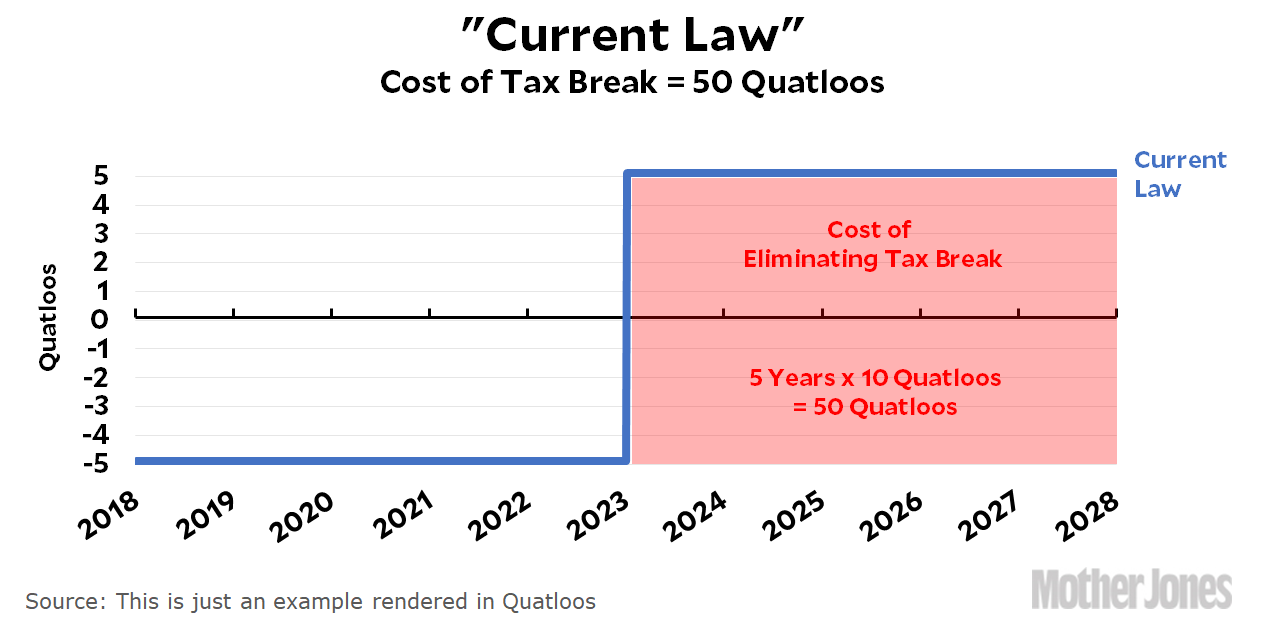
If you’re even close to normal, you’re thinking, “WTF does that mean?” That’s what I’m thinking anyway. But a couple of charts will help us work our way through this. Let’s suppose we have a tax break of five quatloos that expires halfway through the next decade. Starting in 2023, instead of saving five quatloos, you have to pay five quatloos. It looks like this:
If Republicans decide to extend the tax break, it will increase the deficit by 50 quatloos (5 years x 10 quatloos) compared to current law. This is, quite sensibly, how CBO scores things.
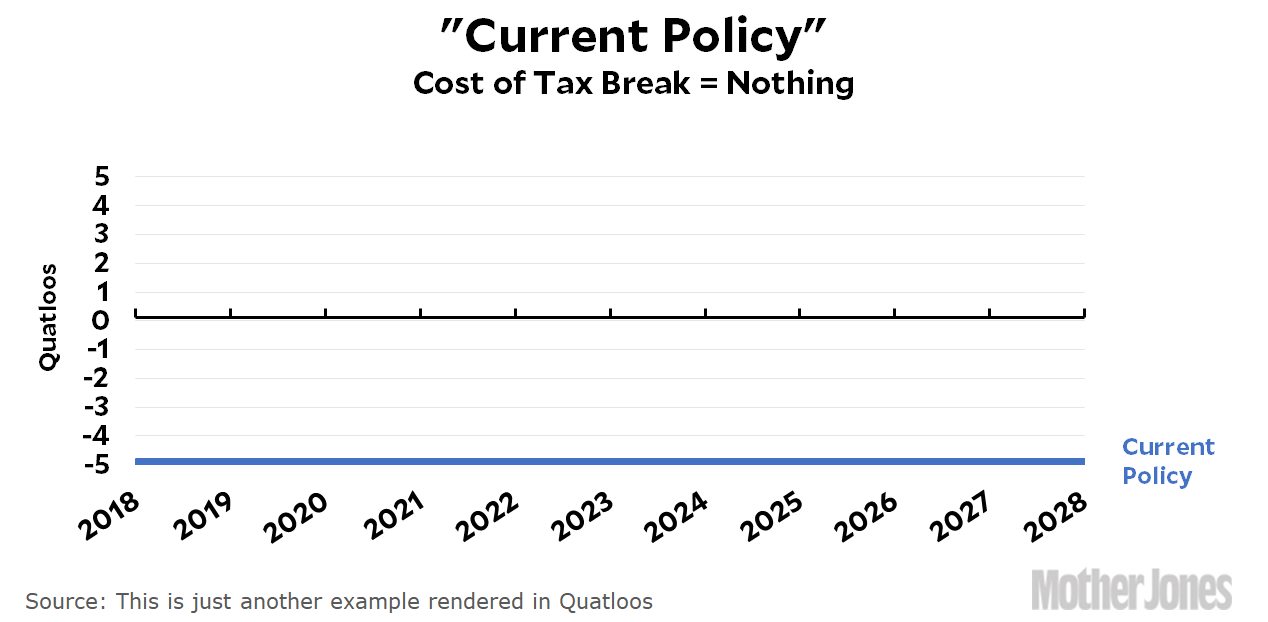
But wait! Suppose Republicans declare that their intention has always been to extend the tax break. In other words, current “policy” is that the tax break goes on forever. Then it looks like this:
The cost of extending the tax break is zero! Republicans are basically saying that since they planned to do this all along, it shouldn’t count against the baseline.
But here’s what I don’t get. This is obviously a fantasy, and it’s one that CBO will never go along with. In the real world, extending a tax break that’s scheduled to expire does indeed increase the deficit. So to do this, Republicans would have to overrule the CBO’s score of their bill.
But if they’re this determined to do what they want to do, why not cut the crap and simply instruct the Budget Committee to declare that their bill has no effect on the deficit? It doesn’t really matter how. Just assume enormous economic growth or something. The Budget Committee has final say over the score, so they can ignore CBO if they want. What’s the point of all this absurd rigamarole?
And we respect that! But maybe you’re of a mind to support our work directly instead? We have until December 31 to raise the last $400,000 we need to keep our nonprofit newsroom running at full strength into 2026. Will you make a gift today?
We noticed you have an ad blocker on. Can you pitch in a few bucks to help fund Mother Jones' investigative journalism?
Billionaires own the media,
but they don’t own us.
At Mother Jones we know these aren’t conventional times, and they require unconventional coverage. That’s what deliver every day: fierce, independent journalism you can’t find elsewhere. Perhaps never in the history of our country has that been more necessary than now. But we can’t do it without reader support—your support. Please chip in today.
Billionaires own the media,
but they don’t own us.
At Mother Jones we know these aren’t conventional times, and they require unconventional coverage. That’s what deliver every day: fierce, independent journalism you can’t find elsewhere. Perhaps never in the history of our country has that been more necessary than now. But we can’t do it without reader support—your support. Please chip in today.