And so it begins:

No, wait, don’t look at it!

Damn.

And so it begins:
No, wait, don’t look at it!
Damn.
This is, once again, apropos of nothing in particular. I just happened to come across it:
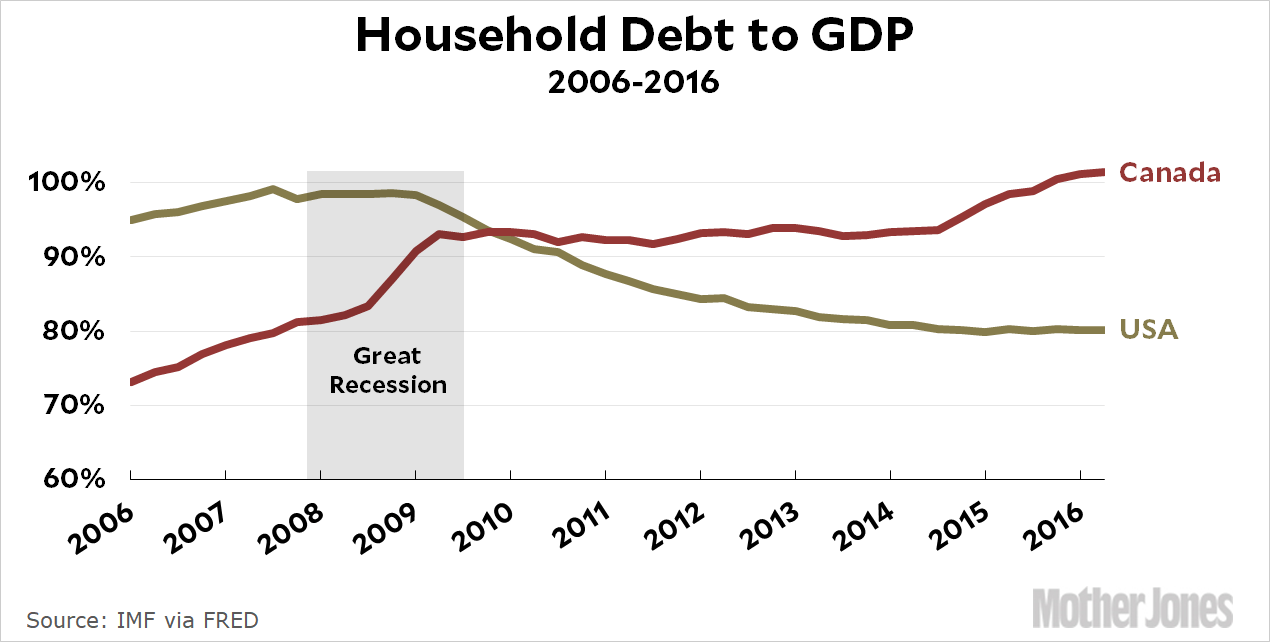
Household debt wasn’t the driver of the financial collapse in the United States, but it certainly played a role. And since the Great Recession, households have delevered considerably, from 100 percent to about 80 percent.
But in Canada, leverage went up during the recession and has kept going up ever since. They’re now above the highest point of the US housing bubble. Is this a problem?
Did the press go overboard on its coverage of Hillary Clinton’s email server?
She was under FBI investigation as a presumptive party nominee. Not sure how that isn’t a story. https://t.co/b2wVevg5NB
— Maggie Haberman (@maggieNYT) August 21, 2017
I wish reporters would honestly engage with this question. I don’t think anyone has ever suggested that the emails and the FBI investigation weren’t a story. Of course they were. The question is, were they this big a story?
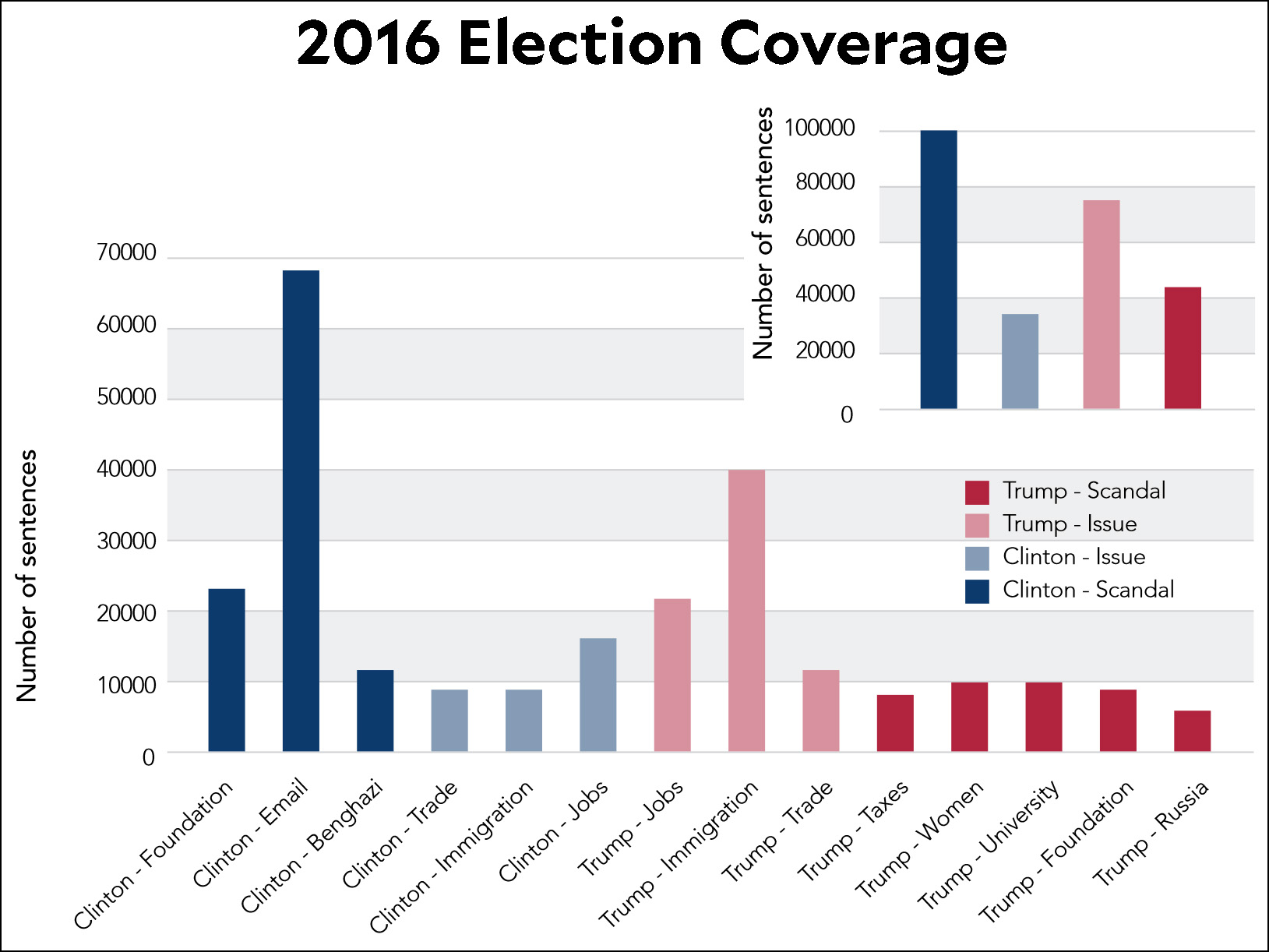
Or this big?
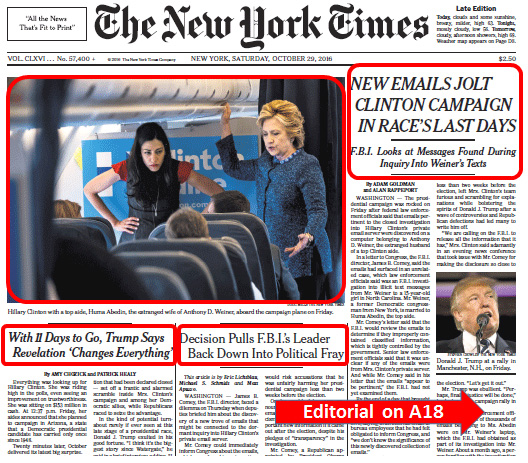
This question isn’t important because it’s worthwhile to relitigate 2016 forever, but because it matters for the future. The press got badly played on the Clinton Foundation story, which was almost completely baseless, and they got played only slightly less on the email story, which was kept alive by a calculated campaign to drip information to the press every week—mostly from sources that should have set alarm bells ringing instead.
Pointing out the failures of Hillary Clinton’s campaign is fine but nonresponsive. The question isn’t whether there were lots of things that decided the 2016 race—there were—or whether Clinton’s emails should have been covered at all—of course they should have been. The question is about editorial judgment in an era of widespread media manipulation. If we don’t want 2020 to be like 2016, political reporters should be willing to ask some hard questions about how and why Hillary Clinton’s emails got such massively outsized attention.
Some of you don’t have eclipse-mania. I’m here to tell you that it’s OK:
Now get back to work.
From Donald J. Trump, commander-in-chief of the armed forces, asked about the collision between an oil tanker and an American destroyer,¹ which resulted in a toll of ten sailors missing and five injured:
That’s too bad.
This is what I’d say if my wife told me the supermarket was sold out of her favorite breakfast cereal. You’d think the president of the United States could come up with something a little more heavy-hearted, even if he had to fake it.
¹Yes, another one.
UPDATE: Perhaps Trump didn’t know the details of what had happened:
Unclear whether @POTUS had been informed of missing and injured sailors when he responded. Media wasn’t aware of that info at the time. https://t.co/np1MALNAH5
— Steve Herman (@W7VOA) August 21, 2017
I still might hope for something better, but perhaps it wasn’t as bad as all that.
I know this won’t make any difference, but just for the record, here is job growth over each 6-month period¹ since the start of Obama’s second term:
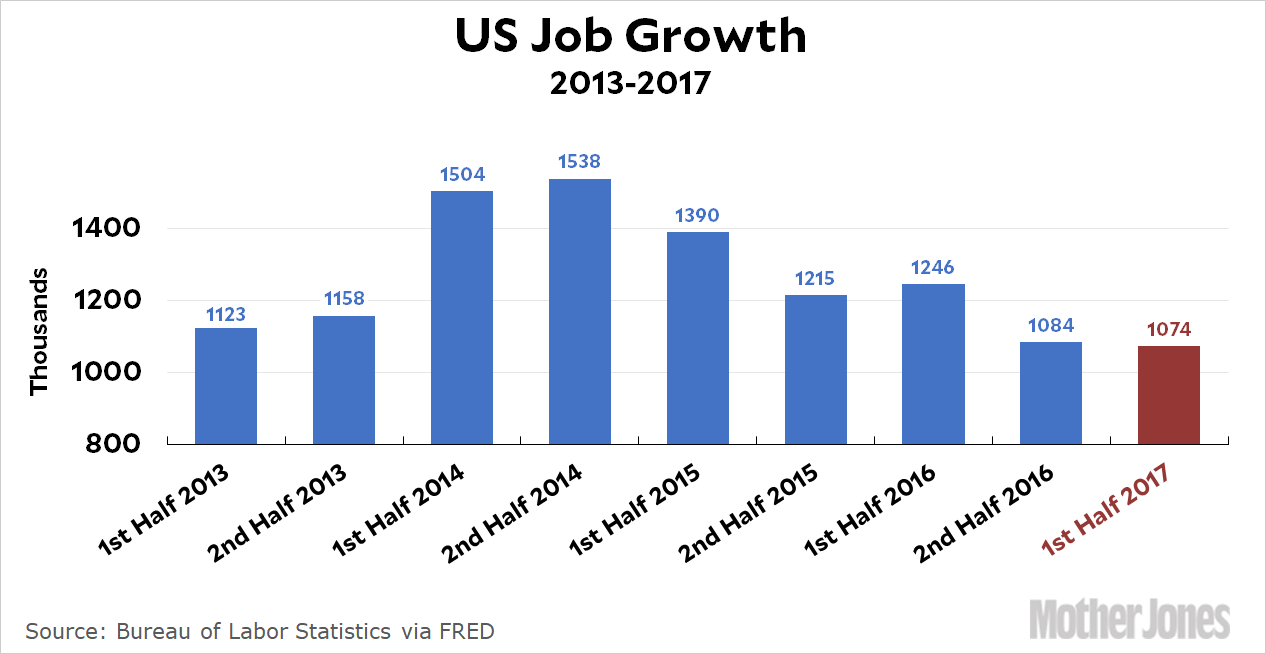
It’s true that we created over a million jobs in the first six months of the Trump era. It’s also true that this was the worst performance of the past five years.
¹The periods I used are actually February-July and August-January in order to capture the first six months of Trump’s presidency.
Here in Southern California, we’ll be getting a 69 percent eclipse at 10:21 am tomorrow. So I figured I should take out my camera and practice today, just to see how hard it really is. And it turns out that all this solar filter stuff is nonsense! I just pointed my camera at the sky and pushed the shutter:

I could barely even see the sun behind all the clouds. What’s all the fuss about?
Yin Bogu/Xinhua via ZUMA
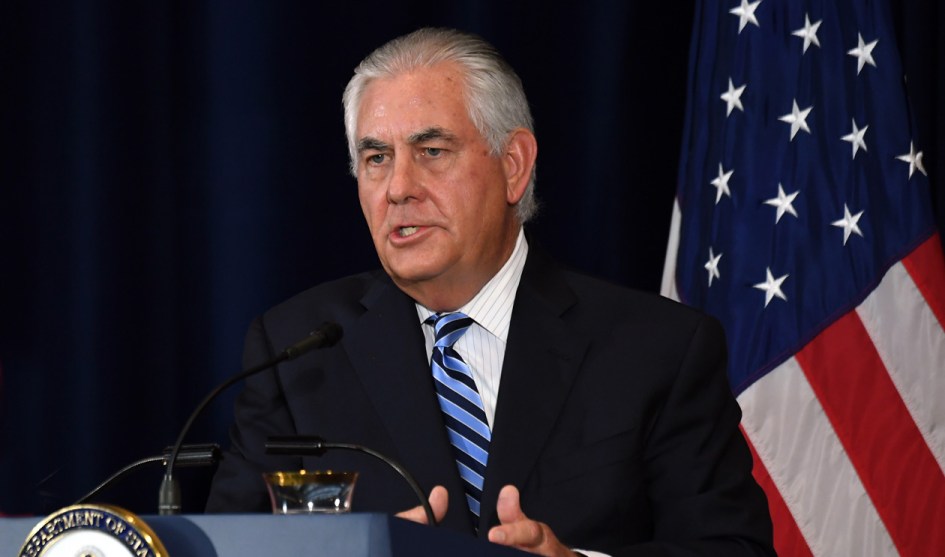
Over at National Review, Roger Clegg is unhappy:
Secretary of State Rex Tillerson has just given an appalling speech. From beginning to end it embraces bean-counting on the basis of race, ethnicity, and sex in order to reach the right percentages of this, that, and the other….Secretary Tillerson specifically promises a State Department “Rooney Rule”: “Every time we have an opening for an ambassador position, at least one of the candidates must be a minority candidate.” Not only is such race-based hiring divisive, unfair, and an endorsement of just the sort of identity politics that we ought to have learned by now is poisonous, but it is illegal.
This must have been quite a speech! So I clicked. Here are the relevant bits:
We have a great diversity gap in the State Department….Only about 12 percent of our senior Foreign Service officers are non-white. That number is about the same for our senior executive service.
To better understand our talent pool, I have directed the relevant committees to adopt a new procedure. Every time we have an opening for an ambassador position, at least one of the candidates must be a minority candidate. Now they may not be ready, but we will know where the talent pool is. A big part of developing our minority leadership is identifying qualified individuals five and 10 years before they are ready to become senior leaders and managing and developing their careers, as we do others, so that they’re undergoing preparations for those senior roles over time.
….We’re also going to re-examine and expand where we recruit from. As some of you know better than most, America’s best and brightest are not just from the Ivy League, but they’re from a lot of other places in the country – Laredo, Texas; Detroit, Michigan; Roanoke, Virginia. They’re kids sitting on the front row of their high school classes, they’re veterans from our military who are coming out of service looking for the next part of their career, and many of them with a strong desire to continue to serve their country. And they’re so gifted in many ways from many walks of life.
Tillerson doesn’t “embrace bean-counting” in order to “reach the right percentages of this, that, and the other.” He merely points out that 88 percent of Foreign Service officers are white. Nor does he really endorse the Rooney Rule. He does say that at least one minority candidate should be interviewed for all ambassador positions, but not because they’re likely to be hired. He wants to do this so “we will know where the talent pool is.” He explicitly says that he’s trying to identify non-white staffers five or ten years “before they are ready to become senior leaders.”
In addition, he wants the State Department to start recruiting from outside the Ivy League, something that any conservative ought to applaud. I certainly applaud it.
This is the problem with conservatives and race. National Review has been pretty good on Charlottesville, but when you turn to lower-profile things like Tillerson’s speech they suddenly become tone deaf. Tillerson is hardly offering anything radical here. He notes that the State Department is a pretty white outfit. He proposes a concrete program to start developing minority talent early. He says they want to start recruiting in places outside the Ivy League. He says they’re going to start recruiting more from the US military. He says diversity is good: “And so whether it’s African American, Latino, Hispanic, women, LGBT, come with experiences I do not know. This enriches the quality of our work. We know we are a stronger organization when we embrace, incorporate diverse points of view into our work product.”
This is a very modest program. It’s not as if Tillerson has invited Black Lives Matter over to advise the State Department. And yet Clegg is outraged. It’s “divisive,” “poisonous,” “illegal,” and “the crudest of stereotyping.” The answer to racial discrimination, he says, is to do absolutely nothing: “This week’s lesson for the Trump administration: It needs to embrace E pluribus unum, and make clear its categorical rejection of identity politics and race-based policy and action, whether politically correct or politically incorrect.”
Nothing. And then conservatives complain that nonwhites all mindlessly vote for the Democratic Party.
Go Nakamura via ZUMA
Over at New York magazine, Jesse Singal makes “The Careful, Pragmatic Case Against Punching Nazis.” Unfortunately, it’s more than 2,000 words long. What we need is Shorter Jesse Singal:
Violence just helps the white supremacists; it’s a great recruiting tool for them; and it can easily spiral out of control. Also, we’re liberals. We’re the ones who think violence is a last resort.
So how do we stop these assholes? For my money, we do it like this:
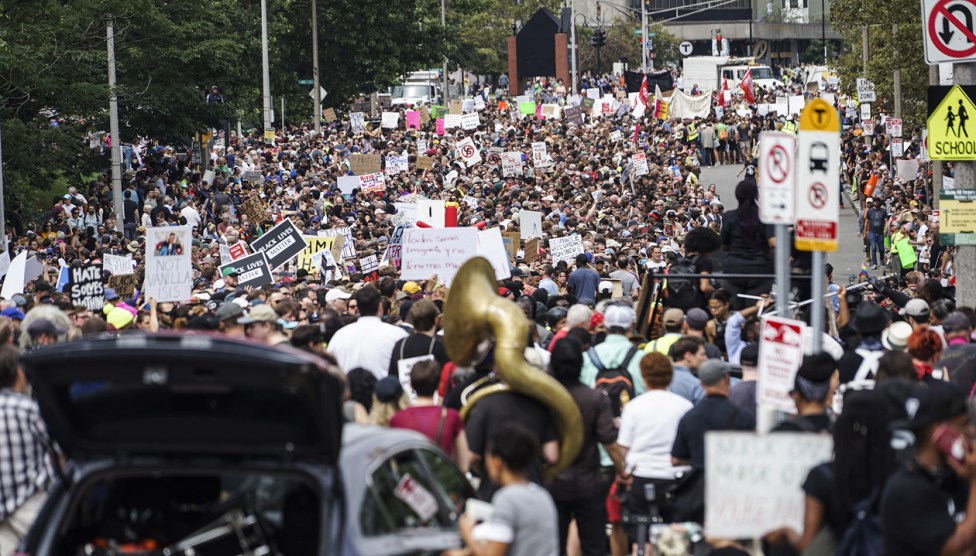
TURNOUT IN BOSTON (AUGUST 19, 2017)
?: 20
??: 20,000+ pic.twitter.com/HcKZDrJeUo— Seth Abramson (@SethAbramson) August 19, 2017
The truth is that white supremacist groups are pretty small. Their views are so obviously vile that they just don’t appeal to very many people. Generally speaking, then, the answer isn’t to fight them, it’s to outnumber them. If they announce a rally, liberals should mount a vastly larger counter-rally and…do nothing. Just surround them peaceably and make sure the police are there to do their job if the neo-Nazi types become violent. If antifa folks show up with counter-violence in mind, surround them too.
Nonviolence isn’t the answer to everything, but it is here. The best way to fight these creeps is to take their oxygen away and suffocate them. Fighting and bloodshed get headlines, which is what they want. So shut them down with lots of people but no violence. Eventually they’ll go back to their caves and the press will get bored.
Of course, all of this depends on our president not doing anything further to support their cause. If that happens, I reserve the right to revise and extend my remarks.
Looks like many anti-police agitators in Boston. Police are looking tough and smart! Thank you.
— Donald J. Trump (@realDonaldTrump) August 19, 2017
For her senior thesis, Berkeley economics major Alice Wu decided to evaluate the conversations in a web forum called Economics Job Market Rumors. All posts in this forum are anonymous, so everyone can let their hair down and say whatever they feel like. Wu’s paper lists the top words associated with conversations about women and the top words associated with conversations about men. Here they are:
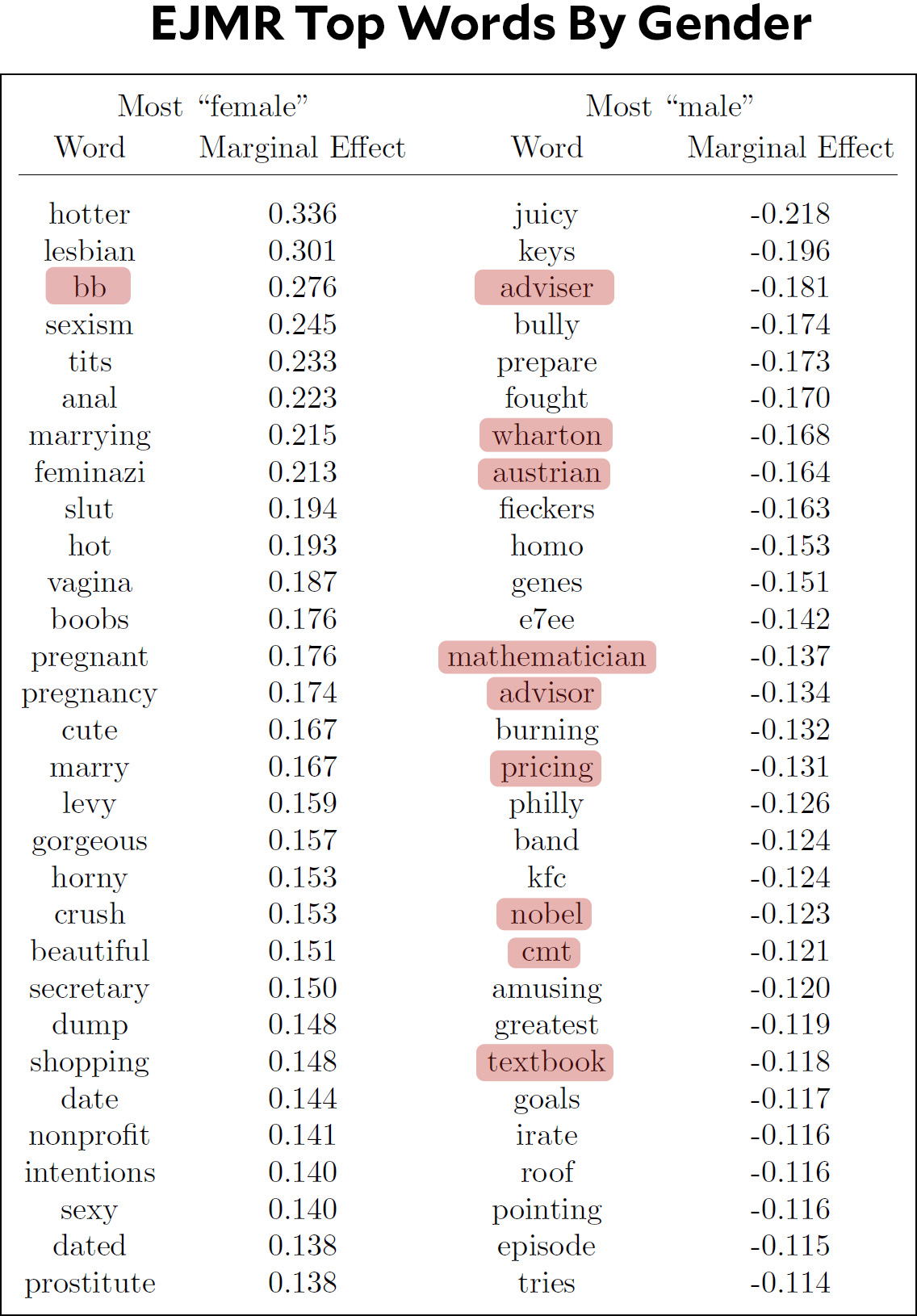
Among the top words that predict a conversation about men, about a third are clearly related to economics. For women, it’s close to zero percent. Elsewhere in the paper, Wu shows that conversations about men contain more academic and professional words, while conversations about women contain more words related to physical and personal attributes. As Berkeley economist David Romer put it, the paper reveals “a cesspool of misogyny.”
As you might expect, the EJMR community is unhappy about all the attention they’re now getting. The conversations range from criticism of the mechanics of Wu’s paper (“I’m tempted to use it my class an example of what not to do when designing research when the dust settles down”) to juvenile racist and sexist comments.
The juvenile crap at EJMR is most likely not the work of economists, though. As an anonymous forum, anyone can sign up and post anything they want—and apparently EJMR has pretty lax moderation. This means that the forum has long been infiltrated by random flamers and other idiots: “EJMR is at least 50% trolls from Reddit and other parts of the internet that want a cool place to hang out,” says one commenter. “These people are not economists and are not representative of the profession. lol @ the thought Wu would get any harassment from any economists. If she gets a single email it will be from a Redditard troll.”
One criticism of the paper, then, is that it has no way to distinguish between the comments of serious users and the comments of flamers. That said, a lot of EJMR posters have noted that nobody should be surprised by the results of the paper. For example:
Just skimmed the paper. Compelling in that it shows this website is a cesspool… But we already knew that. What it says about the profession as a whole is less clear. It’s an undergrad thesis, folks. Let’s be nice- it’s a good exercise in data collection and simple textual/statistics analysis.
How are people so dense. Of course this place is, on average, a cesspool of racism, misogyny, etc. However, does anyone really think this is a representative sample that can be used to make inferences about the broader population of economists. The paper even states such, but EVERYONE is glossing over that fact. And the fact that well-known economists are selling this as “path breaking” demonstrates how dishonest those at the “top” of our profession are. The correct conclusion is, “EJMR is on average a cesspool. However, the results with respect to the broader profession of economics given the non-random selection of users who frequent EJMR. Basically, results that mean nothing.” But let me be clear, that in no way is an attempt to excuse the dirtbags that do in fact post horrible trash in this forum.
This gets at one of the most consistent themes on EJMR: long, ranty posts about the tyranny of HRMs (“high-rank monkeys,” i.e., economists from top programs) in the economics profession. For example:
Fat Broette economist here….Yes, there’s a lot of misogyny here. When I post here I don’t identify as female because of the usual trolls and I think quite a few Broettes do this as well. This is the downside of EJMR.
The anonymity of EJMR does give me the freedom to voice my opinion, which I feel I can’t really do in the real world. In my opinion, the profession has a bigger problem of HRM vs. LRM. Look how the HRMs had a show of force for Reinhart and Rogoff when they had their Excel scandal. According to them, only HRMs are able to come up with innovative ideas. Heaven forbid an LRM much less a female LRM challenges the status quo. We are shut out of the top journals because of this. f**king wankers.
One particular HRM who comes in for a lot of abuse is Justin Wolfers, who brought this paper to wider attention at the New York Times. For example, there’s this: “When people try to glorify a poorly done research with an article on the NYT, it misleads a whole bunch of people who cannot see through the nuances in the study.” And this: “Does Wolfers take Internet polls as valid too?” And this: “Wolfers is a total douchebag.”
In the end, my guess is that what this paper shows is simple: economics is like any other profession dominated by men. The EJMR forum appears to be about 75 percent male, and it sometimes degenerates into locker room talk.¹ It’s not clear how often this happens, but often enough. The next couple of weeks are likely to be painful for EJMR, but they’ll come out of it all right if they eventually figure out that Wu’s paper isn’t an attack on men, just a useful reminder that we should all try to do better.
¹That is, actual locker room talk, not the stuff Donald Trump does.

Award-winning photojournalism.
Stunning video. Fearless conversations.


