• No, There’s No “Trump Effect” In the Stock Market

    Donald Trump whines constantly that newspapers refuse to report how great the stock market is doing on his watch. Today, the Washington Post finally caved in, reporting on its front page about the Dow Jones’ “stunning rise to 22,000.” And Trump deserves the credit:

    The markets’ most recent run-up does indeed have something to do with Trump’s win in November, several analysts said. Back then, some on Wall Street cheered the ascent of a businessman into the White House and his promises to cut taxes, invest in infrastructure and increase military spending. The Dow turned sharply up right after the election and has risen 23 percent since then.

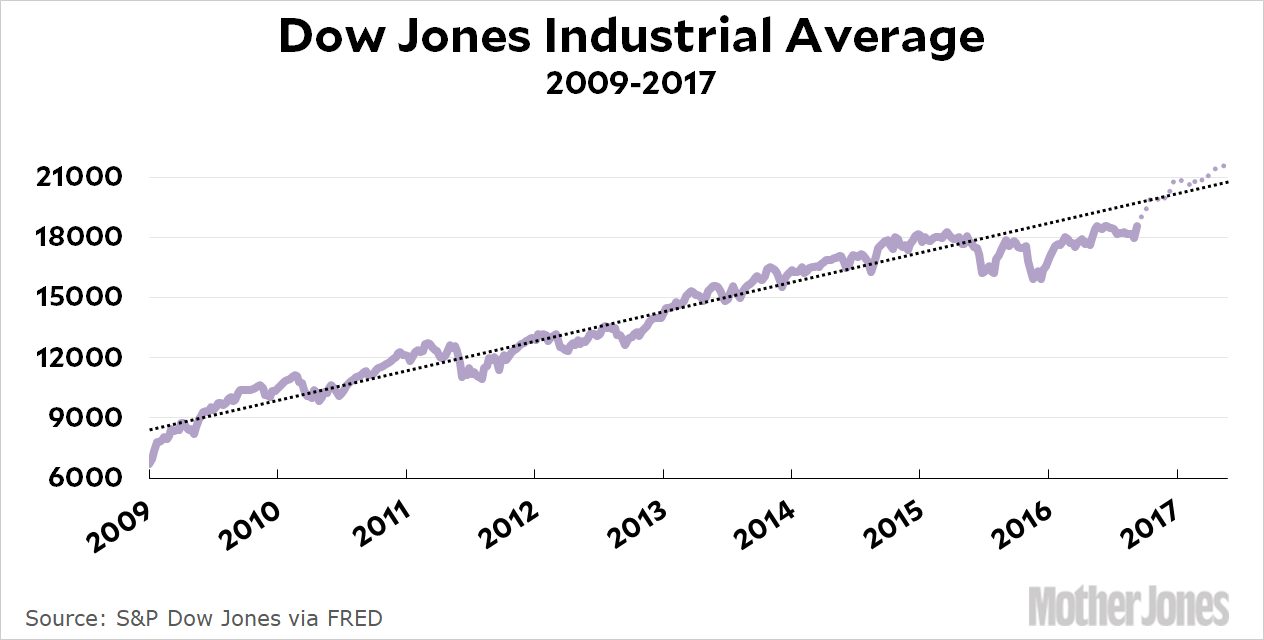
    I wouldn’t bother with this if not for the Trump nonsense, but once again, here’s an up-to-date chart of the Dow’s entire eight-year bull run:

    Yes, there was a brief rally right after Trump’s election. But it was just the Dow catching up to its trendline, and it’s been pretty close to that trendline ever since. Unless the Dow really takes off for the rest of the year, there’s just no evidence of any kind of serious Trump effect.

    Which is actually a little surprising. By all the evidence, Trump and the Republican Congress plan to be very, very friendly to big corporations. Their stock prices should be skyrocketing. But aside from the November bump, there’s not much going on.

  • Single Payer? Take a Look At How South Korea Did It.

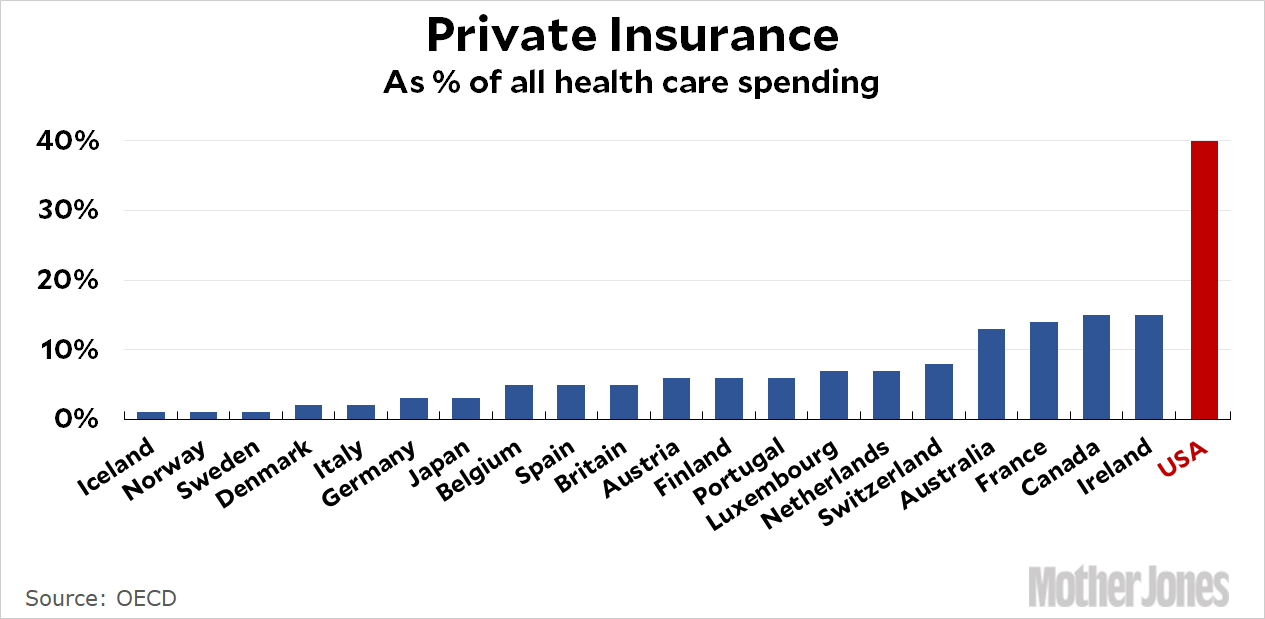
    Joshua Holland writes in The Nation that progressives need to get serious about universal health care. In a presidential campaign, it might be OK to vaguely suggest full-blown single-payer with no copays, implemented by 2018. In real life, every country relies at least partly in private insurance. Every country also requires out-of-pocket expenses: no country literally pays 100 percent of all health care bills. Nor were any of these universal systems implemented instantly, even 50 years ago. Today, health care in America is a $3 trillion business. It’s not even remotely feasible to blow up the biggest industry in the country in only a year or two.

    Holland is right about all this. If the reasons aren’t obvious to you, click the link. The takeaway should be pretty obvious too: the only feasible way to get to single-payer is to do it over a period of a decade or two. Holland mentions this briefly:

    An obvious alternative to moving everyone into Medicare is to simply open up the program and allow individuals and employers to buy into it. We could then subsidize the premiums on a sliding scale. But recent experience with the ACA suggests that this kind of voluntary buy-in won’t cover everyone, or spread out the risk over the entire population

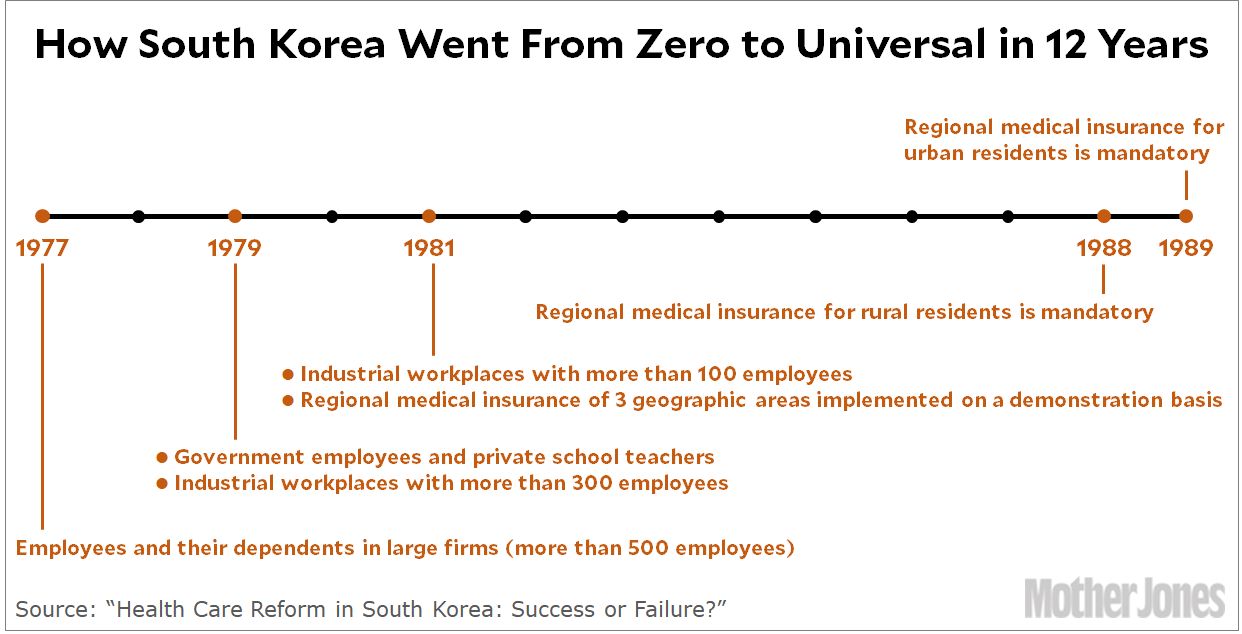
    He then goes on to describe a “Medicare for More” plan from Jacob Hacker. But a better idea might be to look at how other countries have done it. South Korea, for example, began moving to universal coverage in 1977 and finished in 1989. Jong-Chan Lee explains how it happened:

    How did Korea succeed in providing health insurance to the whole nation within 12 years? Before 1977, Korea had only voluntary health insurance. In 1977, President Park Chung-Hee and the legislature passed a law that mandated medical insurance for employees and their dependents in large firms with more than 500 employees.

    Gradually health insurance coverage was expanded to different groups in the society: in 1979 to government employees, private school teachers, and industrial workplaces with more than 300 employees, and in 1981 to industrial workplaces with more than 100 employees. In the late 1980s, health insurance expansion became regionally based, first to rural residents in 1988 and then to urban residents in 1989. Each of these expansions was mandated by government.

    This is roughly the model we need to follow. The first step might be Medicare as an option on the Obamacare exchanges. Then Medicare for everyone up to age 26. Then Medicare for all federal government employees. Then Medicare as an option for all state employees and retirees at a set price. Then Medicare as an option for small employers. Then large employers. Within a decade or two, private insurance would be, to borrow a phrase, so small you could drown it in a bathtub. At that point, the funding model would change—maybe gradually, maybe quickly—so that Medicare eventually becomes free for everyone, paid for fully by taxes.

    Alongside all of this would be gradual changes to Medicare itself. Maybe we’d keep Medicare Advantage, maybe not. We should add long-term nursing care. Negotiated drug prices. Better preventive services. Prenatal and pregnancy services. Etc. Medicare’s 80 percent actuarial rate (i.e., it pays about 80 percent of your medical bills) is in the ballpark of what other countries offer, but because it’s currently aimed at the elderly it would need some changes to make it work well for everyone else.

    I’m not offering this as a proposal, just as an illustration. There are probably better ways to phase in universal health care. But it’s at least feasible to do it this way, and it would be even more feasible (and faster) if we could actually legislate a timeline, rather than just adding bits and pieces whenever we can. That’s pie in the sky right now, but who knows what the future holds? Republicans might eventually get tired of hitting their heads against the health care wall.

  • Donald Trump Only Lied a Tiny Bit on Monday!

    And now for something completely different: I’m going to defend Donald Trump. Sort of. This is a high-wire act, but I think I can pull it off.

    Trump is getting flak for lying about a phone call from the president of Mexico. “As you know, the border was a tremendous problem and they’re close to 80 percent stoppage,” he said earlier this week. “Even the president of Mexico called me — They said their southern border, very few people are coming because they know they’re not going to get through our border, which is the ultimate compliment.”

    There was no phone call. However, this is from the original account in the Miami Herald:

    Mexican officials, including Foreign Minister Luis Videgaray, reached out to American counterparts and noted the presidents spoke about migration at the G20 in Hamburg last month. Pena Nieto spoke cited statistics about migration from Central American to Mexico declining significantly, according to the official, who wasn’t authorized to speak publicly on the matter and demanded anonymity.

    Trump turned a face-to-face meeting into a phone call, because Trump is addicted to the proposition that other people always call him, not the other way around. But that’s it. By the standards of ordinary lies this rates about a 3, and by the standards of Trump lies it rates around 0.1. This is as close to the truth as he ever gets.

    I guess that was a pretty meager defense, wasn’t it? In the end, I couldn’t quite do it. But I came close.

    POSTSCRIPT: The only reason this matters is that Trump’s casual fib caused the Mexican president a lot of trouble. According to the Herald, “Mexican opposition legislators jumped on Trump’s account and complained about what sounded like a ‘secret phone call’ between the pair, and the idea of Pena Nieto praising Trump on migration.”

    But I don’t imagine Trump cares about that.

  • The Rich Sure Do Cheat On Their Taxes a Lot

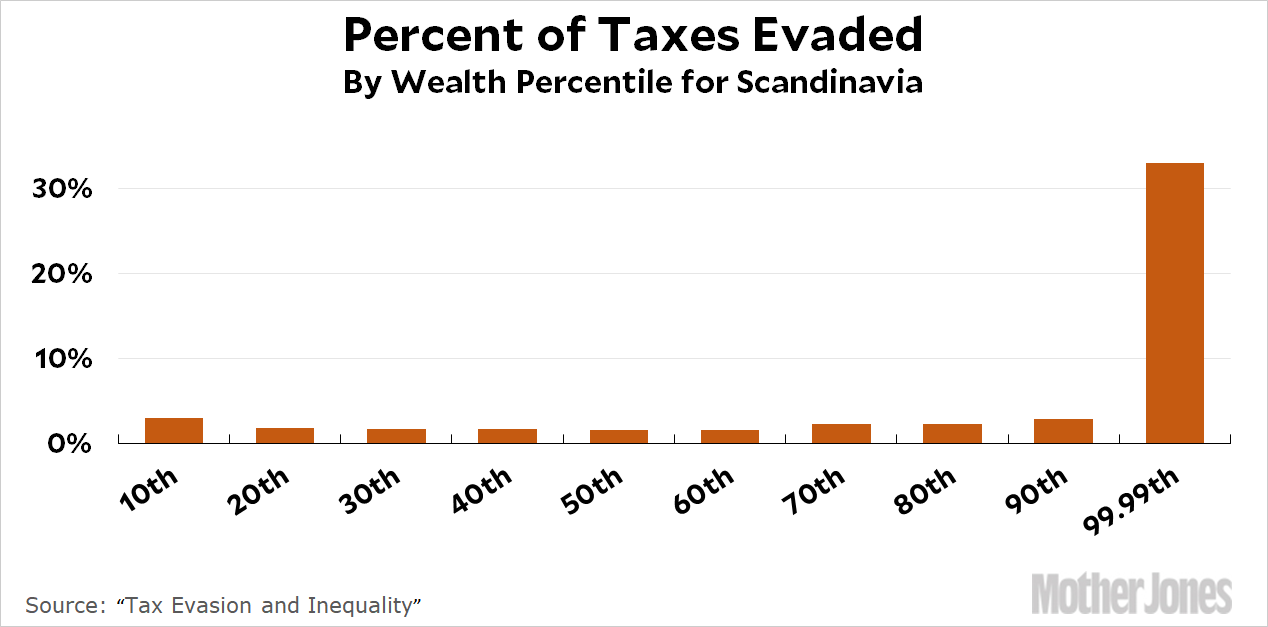
    A team of researchers has combined disclosures from the Panama Papers with administrative tax data and population records in Scandinavia and finds that “tax evasion rises sharply with wealth.” The rich do this primarily by parking wealth in Switzerland and other tax havens. I don’t think this comes as a surprise to anyone, but the size of the tax evasion might:

    Of course, this is just for those infamous scofflaws in Denmark, Sweden, and Norway. American zillionaires are probably a lot more honest, don’t you think?

    POSTSCRIPT: Snark aside, personal tax rates are pretty high in Scandinavia—though not as high as urban legend has it. Still, their high rates do provide a bigger incentive to hide wealth overseas, so it’s possible that American tax evasion is lower than it is in Scandinavia. I wouldn’t bet on it, though.

  • Nobody Wants To Be Uber’s CEO

    Jaap Arriens/NurPhoto via ZUMA

    The LA Times reports that Uber is having a lot of trouble finding a new CEO:

    As the company’s board inches ahead in its search for a new chief executive to run the embattled ride-hailing company, candidates are dropping out before they’ve even met with every board member….“They’re trying to hire someone for two very different roles,” said Bradley Tusk, an early investor in Uber who is not involved with the board’s CEO search.

    The company needs a leader who can implement the recommendations of a report by former U.S. Atty. Gen. Eric H. Holder Jr. to change Uber’s culture of bullying and harassment, secure deals and eventually lead the firm to an initial public offering….On top of that, Tusk said, the incoming CEO must fill the void that Kalanick supporters believe he left — that of a tenacious visionary who can help Uber grow into a company that competes with the likes of Apple, Google, and Amazon.

    OK, sure, that might be part of the reason. But I think there’s another possibility: Uber’s business model depends on cheap, subsidized rides. That means Uber also needs a third kind of leader: someone who can prevent the company from imploding when they stop the subsidies and Uber’s customers face a big price increase.

    I’ve always been sort of puzzled by the idolization of Uber. The problem it faces is one of the most common in the tech industry: once you’ve spent a ton of money to buy eyeballs (or riders), how do you then leverage that into something profitable? Facebook did it. Twitter (so far) hasn’t. So will Uber be another Facebook or another Twitter? What’s the story they’re telling investors about why they’ll be one vs. the other?

    In any case, as near as I can tell they’ve basically admitted that their business model is unsustainable. That’s why they’re betting the company on driverless cars. But if you want to run (or invest in) a driverless car company, would Uber really be your first choice? I’m not sure why. Nor am I sure that Uber can keep those subsidies going long enough to get to the promised land. Driverless cars are coming, but they’re still several years away. It’s all very strange.

  • Can Anything Other Than a Nuclear Strike Stop North Korea?

    I have a question for the national security crowd.

    North Korea clearly wants nuclear capability. They want it very badly because they think—not irrationally—that it’s the only thing that can reliably protect them from an American invasion. It is, right now, their highest priority by far, and nothing will stop them from obtaining it. Not sanctions. Not diplomacy. Not tut tutting from China. Not tweets from President Trump. Not B1 flights or carrier group movements.

    In fact, even a conventional bombing strike wouldn’t be effective at stopping their program. Conventional bombs couldn’t get everything, since much of North Korea’s program is buried underground. And anyway, it would take time and invite massive retaliation, both conventional and nuclear, on Seoul.

    That leaves one alternative: a nuclear strike. Am I right about that? The only way to halt North Korea’s nuclear program would be a surprise nuclear attack on every known nuclear installation in the country.

    I’m asking because I’d like to cut through the fog and understand if we truly have any options here. Are there any other non-fantasy-based alternatives to stopping North Korea’s nuclear program?

    EVENING UPDATE: I see that my point has been missed by some people. So here it is in plainer form: I’m asking if we have any real options with North Korea. We are obviously not going to nuke the Korean peninsula—I hope—so does that mean we don’t really have any choice at this point but to accept a nuclear-armed North Korea?

  • Free TV! Gotta Be Illegal, Right?

    This Wall Street Journal article is inspiring some mockery on Twitter:

    Dan Sisco has discovered a technology that allows him to access half a dozen major TV channels, completely free. “I was just kind of surprised that this is technology that exists,” says Mr. Sisco, 28 years old. “It’s been awesome. It doesn’t log out and it doesn’t skip.”…The antenna is mounting a quiet comeback, propelled by a generation that never knew life before cable television, and who primarily watch Netflix , Hulu and HBO via the internet.

    Ha ha. Stupid millennials don’t know about TV antennas. But wait:

    Carlos Villalobos, 21, who was selling tube-shaped digital antennas at a swap meet in San Diego recently, says customers often ask if his $20 to $25 products are legal. “They don’t trust me when I say that these are actually free local channels,” he says.

    Earlier this year, he got an earful from a woman who didn’t get it. “She was mad,” he recalls. “She says, ‘No, you can’t live in America for free, what are you talking about?’”

    This is…a totally sensible response. What are the odds that TV stations would allow you to watch their shows for free? I mean, come on. This isn’t communist Canada or something. It’s gotta be illegal, right?

  • Republicans Can Fix the CSR Problem in Five Minutes If They Want To

    Bill Clark/Congressional Quarterly/Newscom via ZUMA

    Donald Trump continues to threaten to cut off CSR subsidies in 2018, a move that would significantly increase the cost of health insurance for the poor. But even Republicans are getting tired of his endless gameplaying about this:

    Congressional Republicans moved on Tuesday to defuse President Trump’s threat to cut off critical payments to health insurance companies….Senator Lamar Alexander of Tennessee, the influential chairman of the Senate Health, Education, Labor and Pensions Committee, announced that his panel would begin work in early September on legislation to “stabilize and strengthen the individual health insurance market” for 2018.

    In the House, two Republicans, Representatives Tom Reed of New York and Charlie Dent of Pennsylvania, teamed with Democrats to promote incremental health legislation that would also fund the cost-sharing subsidies.

    The moves were a remarkable response to the president’s repeated threats to send health insurance markets into a tailspin. They offered tangible indications of cooperation between the parties after Republican efforts to scrap the Affordable Care Act collapsed in the Senate last week, all but ending the seven-year Republican quest to overturn President Barack Obama’s signature domestic achievement. Lawmakers from both parties concede that the health law needs improvement, as consumers face sharp premium increases and a shrinking number of insurance options in many states.

    It’s hard not to feel torn about this. On the one hand, obviously I’m happy. A bipartisan bill to keep the CSR subsidies would help millions of people.

    On the other hand, this whole thing is so cynical it makes your eyes bleed. The CSR subsidies are a part of Obamacare, but in 2014 House Republicans gleefully filed a lawsuit claiming that although the subsidies were authorized by the law, they hadn’t been appropriated by Congress. Therefore they shouldn’t be paid. The whole point was to wreack havoc with Obamacare and force it to fail on Obama’s watch.

    But now that Republicans are in charge, they’re not so keen on blowing up health care. That might reflect badly on them, after all. Apparently their constitutional scruples depend a lot on which party controls the White House.

    In any case, if Republicans really want to solve this problem, it’s easy. They just have to pass a bill appropriating the money. That would take about five minutes, and since Democrats would all be in favor it would be veto-proof. There’s no real need to wait until September for that.

  • Donald Trump Knows Nothing About Health Care, Taxes, or Trade

    Is this Mr. Elegant?Dennis Van Tine/UPPA via ZUMA

    Politico has gotten hold of a transcript of Donald Trump’s interview with the Wall Street Journal a few days ago. It started out with a question about the Republican health care bill:

    MR. BAKER: What have you been doing, Mr. President, sort of behind the scenes?

    PRESIDENT TRUMP: A lot. A lot.

    Good to know! Then we got Trump’s thoughts on taxes:

    I want to achieve growth. We’re the highest-taxed nation in the world, essentially, you know, of the size. But we’re the highest-taxed nation in the world. We have—nobody knows what the number is. I mean, it used to be, when we talked during the debate, 2 ½ trillion (dollars), right, when the most elegant person—right? I call him Mr. Elegant. I mean, that was a great debate. We did such a great job. But at that time I was talking $2 ½ trillion. I guess it’s 5 trillion (dollars) now. Whatever it is, it’s a lot more. So we have anywhere from 4 to 5 or even more trillions of dollars sitting offshore.

    Who is Mr. Elegant? Lester Holt? Then this:

    You know, a lot of people say—they say, well, but the United States is large. And then you call places like Malaysia, Indonesia, and you say, you know, how many people do you have? And it’s pretty amazing how many people they have.

    It’s amazing! They have so many people! Then this about trade talks with Britain:

    WSJ: Can you tell us more about what’s going on?

    PRESIDENT TRUMP: No, but I can say that we’re going to be very involved with the U.K. I mean, you don’t hear the word Britain anymore. It’s very interesting. It’s like, nope.

    Wut? Then this about NAFTA:

    WSJ: What are you looking for specifically –

    PRESIDENT TRUMP: I’m looking for fairness.

    WSJ: But what does that—can you give an example?

    PRESIDENT TRUMP: No, it means—look, our automobile industry has just left us and gone to Mexico—I mean, a big chunk of it. And it’s very unfair for them to take our companies, build their cars, and then sell the car back into our country with no tax. It’s very unfair. They fire all our people in Michigan and Ohio, and they take it, and they build a car. And now they sell the car back in with no tax. It’s not fair.

    This demonstrates Trump’s famous command of detail. In just this one interview, in fact, Trump demonstrated that he knows nothing about (a) health care, (b) taxes, (c) trade in general, and (d) NAFTA in particular. On none of these subjects could he dredge up more than the vaguest generalities. It’s like watching a middle-schooler trying to bluff his way through a book report on a book he hasn’t read.

    And for closers, here’s a quick review of Trump’s relationships:

    I have unbelievable relationships with all of the foreign leaders…I have a very good relationship with the prime minister [Theresa May]…I have a very good relationship with the EU people….I was with President Xi, who I have a very good relationship with…I have a lot of respect for Rex and his people, good relationship.

    Everybody loves Donald Trump! Hooray!