Tyler Cowen has an odd Drum-bait headline today:
Why is there no lead-homicide connection in Eastern Europe?
Children growing up in former communist CEE [Central and Eastern European] countries during the 1980s were subjected to horrific amounts of industrial pollution, including extreme levels of prolonged lead exposure. Since lead is theorized to be a primary culprit in exacerbating violent crime, you would assume there would be a sizeable discrepancy in the homicide rate between, say, former East Germany and West Germany, or Western Europe and Eastern Europe as a whole. But the difference in the homicide/violent crime rate is negligible, with many former communist CEE countries having a lower homicide rate than Western Europe. I suspect the same is true when comparing the rate of mental disorders, which is another malady that is supposedly influenced by exposure to high levels of industrial pollution.
The text is from a commenter at Slate Star Codex, who references an ancient Cato study titled “Environmental Problems Under Socialism.” As near as I can tell, it references lead twice: first to note that children from the Upper Silesia area of Poland have “five times more lead in the blood than children from Western European cities,” and second to relate a brief anecdote about officials in the Bulgarian city of Kardszhali who were reluctant to shut down a lead smelter even though it was causing “massive health problems to area residents.”
This doesn’t say anything at all about whether Eastern European lead levels during the 70s and 80s were higher than in Western Europe. How do we figure that out? Generally speaking the biggest source of lead poisoning during that era comes from auto exhaust, so the first thing you’d want to look at is per-capita lead emissions from gasoline combustion. Since Eastern Europe was relatively poor compared to Western Europe during this period, I’d expect lower lead emissions there, not higher, and that’s pretty much what the data shows. Here it is for five big Western and Eastern European countries:

Aside from all the usual measurement issues, there’s also a problem here with different population densities. Lead has its biggest effects where auto density is high, which probably means that Western Europe not only had higher overall lead levels, but that its effects were more concentrated. This would make Eastern Europe’s lead emissions even lower relative to Western Europe than the raw numbers suggest.
Ideally, of course, what you’d really like to see is measurements of blood lead levels, and for Western European countries these are often available. Eastern Europe, by contrast, is pretty much a black hole. However, here are some comparisons from a World Bank report that pulled together a very small number of studies of specific Eastern European locations:
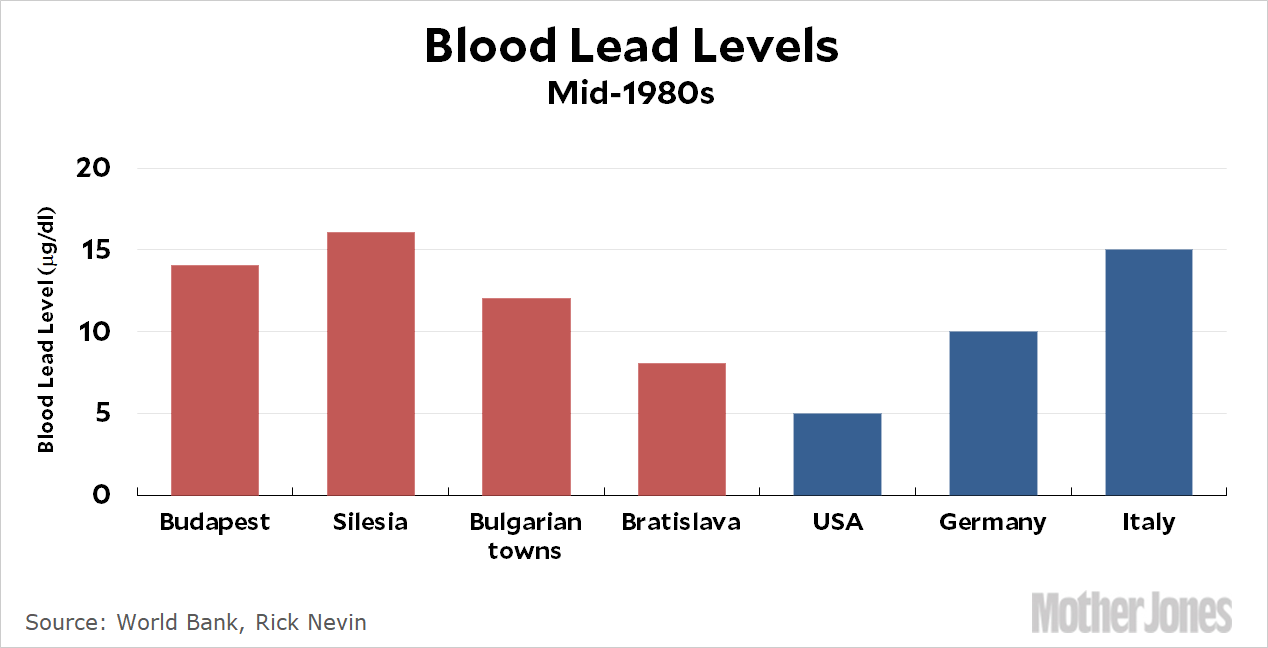
These are very rough numbers. The studies themselves have tiny sample sizes, and all I could pull out of them was a sort of eyeball average of various bits and pieces. That said, there’s nothing special that catches my eye. By the mid-80s, Eastern Europe might have had slightly higher rates of lead poisoning than Western Europe, but not by a lot. And keep in mind that this is a period in which blood lead levels are changing very quickly everywhere thanks to the adoption of unleaded gasoline.
Bottom line: there are specific places in Eastern Europe that had very high lead levels up through the 1980s—usually due to mining, smelting, or lead-based industry of some kind—but overall lead levels seem to have been in the same ballpark as Western Europe. At a guess, this is because of two forces that worked in opposing directions: the fact that Eastern Europe was poor cut down on the amount of lead they produced, but lousy environmental rules increased the amount they allowed into the atmosphere.
Roughly speaking, then, lead levels appear to be about the same in Eastern and Western Europe, so there’s no special reason in the first place to think they should have noticeably different homicide or violent crime rates due to lead poisoning. And even if there were, I imagine that communist-era crime statistics in Eastern Europe are wildly unreliable if they even exist. And if good stats do exist, you still have the problem of trying to compare two very different kinds of policing cultures on opposite sides of the Iron Curtain. Given all this, it seems all but hopeless to seriously address the question originally posed about lead and homicide rates in Eastern Europe.