• A Republican Party Server Was Hacked in April. Oddly, Though, Nothing Was Leaked.

    Was Russia being the GOP server hack? I have no idea. Really. But I'm going to use this sinister stock illustration of Vladimir Putin and a shaky American flag anyway.Jaap Arriens/NurPhoto via ZUMA

    From Politico:

    The House GOP campaign arm suffered a major hack during the 2018 election, exposing thousands of sensitive emails to an outside intruder, according to three senior party officials. The email accounts of four senior aides at the National Republican Congressional Committee were surveilled for several months, the party officials said. The intrusion was detected in April by an NRCC vendor, who alerted the committee and its cybersecurity contractor. An internal investigation was initiated and the FBI was alerted to the attack, said the officials, who requested anonymity to discuss the incident.

    ….None of the information accessed during the hack — thousands of emails from senior NRCC aides — has appeared in public, party officials said. And they said there were no attempts to threaten the NRCC or its leadership during the campaign with exposure of the information.

    INCOMPETENT DEFENSES! EMBARRASSING TO GET HACKED LIKE THIS. EVERYONE IS SAYING DEM CYBERSECURITY MUCH BETTER.

    WHY WASN’T PAUL RYAN NOTIFIED? COVERUP!

    WHERE’S THE SERVER? WHY WON’T REPUBLICANS HAND IT OVER TO THE FBI? HAS IT BEEN ACID WASHED?

    NO EMAILS LEAKED? DID NRCC MAKE DEAL WITH WIKILEAKS AND ASSANGE? MAYBE!

    TOTAL DISGRACE THAT WE’RE ONLY HEARING ABOUT THIS 8 MONTHS AFTER IT HAPPENED!!!

    HUGE $$$ PAID TO GOP LOBBYING FIRM TO INVESTIGATE HACK BUT NO RESULTS! WHAT ARE THEY HIDING?

  • Chart of the Day: Wisconsin Gerrymandering Was Awesome

    Check out the results of Wisconsin’s gorgeous, computer-generated Republican gerrymander:

    Recall that the goal of a gerrymander is to stuff as many opposition votes as possible into the smallest number of districts. In this case, Republicans wanted to create as many districts as possible that were 100 percent Democratic, and boy howdy did they succeed. There are 30 (!) districts that are entirely Democratic compared to only eight that are entirely Republican.

    What this means is that in 30 districts there are a ton of “wasted” Democratic votes. Every vote over 50 percent does nothing except give the Democrat in that district a bigger win. If the district lines were fairer, many thousands of those Democratic voters would instead be in competitive districts giving Republicans a run for their money.

    The end result is that Republicans won 46 percent of the statewide vote but 64 percent of the seats in the state Assembly. Now that’s gerrymandering!

  • Republicans Finally Uncover Some Election Fraud

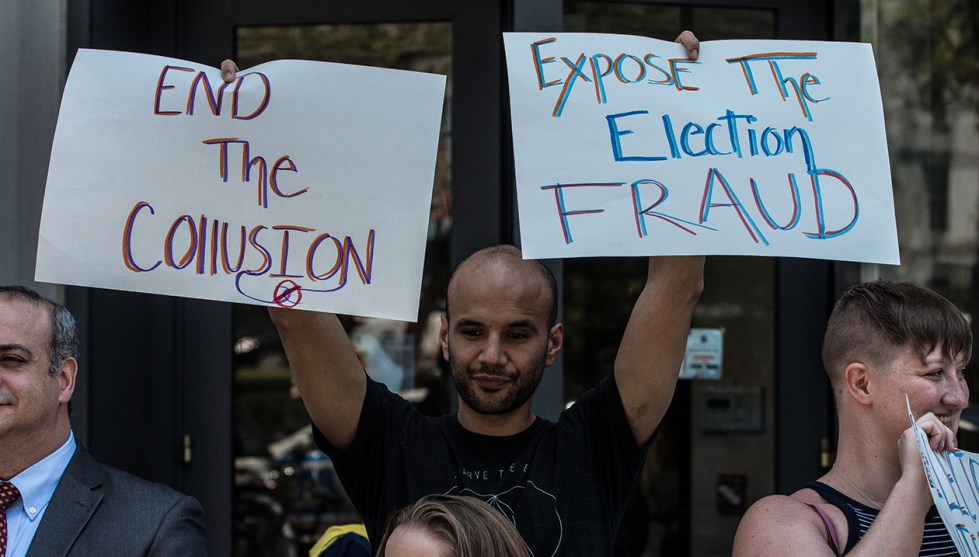
    This is not North Carolina. It's not even 2018. It's a rally against election fraud in Brooklyn in 2017. But it was the best I could do.Sachelle Babbar/ZUMA

    Here’s a super-short North Carolina explainer: A Republican candidate for Congress hired a guy who then hired another bunch of guys¹ to walk neighborhoods asking people for their absentee ballots. They were “picking up ballots,” they said. When they got them, they turned the ballots over to their guy, who presumably kept the ones that voted Republican and tossed out the ones that voted for the Democrat.

    This is probably the most blatant case of election fraud we’ve seen in a long time, and it’s possible that it flipped the race. Note, however, that it is absentee vote fraud, the kind that Democrats keep warning about. It is not in-person vote fraud, the kind that Republicans keep saying we need voter ID laws to stop. I’m sure you are all shocked.

    Here’s the longer version if you want to torture yourself:

    ¹Or whatever the gender-neutral version of “guys” is.

  • Human Nature Is Really Complicated, OK?

    Sculpture: ''Brain G (2018)'' by Michael Sailstorfer; Photo: Christophe Gateau/DPA via ZUMA; Colorizing: Kevin Drum

    I saw this headline in the New York Times on Monday and was immediately annoyed:

    Can We Finally Stop Talking About ‘Male’ and ‘Female’ Brains?

    Later on, spurred by a tweet, I read the piece and got annoyed all over again. But then, while I was stewing over it, I suddenly realized that I was off track. So I went back to read it a second time, and sure enough, I had been annoyed by the wrong thing. Here are a series of excerpted phrases that describe things the authors say are wrong:

    men’s and women’s natures can be usefully and meaningfully carved into two categories or “natural kinds,” that are distinct, timeless, and deeply biologically grounded … “extreme male brain” theory of autism … “the male brain,” that drives ways of thinking, feeling, and behaving that distinguish the typical boy and man from the typical “empathizing” girl and woman … two different classes of brains … “male brains” and “female brains,” and “male natures” and “female natures” … exclusively “female-typical” features or “male-typical” features.

    What’s going on here is subtle—and may not be clear solely from the excerpts—but the authors are being very, very careful. As it turns out, they aren’t saying there are no differences between male and female brains. They are merely arguing against the extreme notion that these differences are overwhelming.

    Years ago it was a pet peeve of mine that the folks who argue about nature vs. nurture spend almost all their time arguing against straw men. In this case—but only if you read fairly closely—Daphna Joel and Cordelia Fine are arguing against the straw man that biological differences are everything. Likewise, when Steven Pinker wrote The Blank Slate a few years ago, the title alone tells you that he’s arguing against the straw man that social differences are everything. Nearly everyone who writes about this topic seems to feel justified in assuming that these opposing straw men are the conventional wisdom, and therefore it’s OK if they overstate their own case since the conventional wisdom is so widespread and so badly needs a righteous debunking.

    At the same time, they’re always careful to acknowledge that they themselves believe that both nature and nurture are important. In fact, since the authors of practically every book and article I’ve ever read on this subject admit that nature and nurture are both important, I’ve come to wonder just who they’re arguing against. We all agree! Hooray!

    I dunno. What is the conventional wisdom these days? Among scientists, I’d say it’s taken for granted that both biology and culture play big roles in nearly all cognitive characteristics. But what about the popular world of chat shows, tabloid magazines, and TED talks? Do most people think that individual behavior is set at birth? Or do they think that children are mostly a product of their upbringing? Or maybe both, in the weird way that people have of believing two extreme opposite views at the same time?

    I’m not sure. But everybody I read tells me that both nature and nurture are important, so that seems fairly likely to be the conventional wisdom. That being the case, it means we should be willing to write more plainly about this stuff. In this case, for example, the authors should say, clearly and up front, that sex differences in the brain are real and important, and then explain just how much practical difference they make and how they interact with social stereotypes and cultural cues. Will some people inevitably take this the wrong way? Probably. But not many. It’s really OK to trust most of us to get the point even if you admit that life is complicated and lots of different things are true at the same time.


  • Peaceful Transfer of Power Update

    This morning I mentioned how excited Republican legislatures have become about stripping state officials of power just before those state officials happen to become Democrats. But I missed one. It turns out that many years ago Florida handed authority over concealed-carry permits to the state’s agriculture commissioner. Why? Because sometimes law enforcement playfully tries to actually enforce the law, and the NRA would prefer that not happen. Instead, they want concealed-carry permits rubber stamped by an elected official. But then this happened:

    The agriculture commissioner’s office attracted unwanted attention in early 2018 after it was found that for 13 months, the department’s Division of Licensing stopped using results from an FBI crime database that ensures those who apply do not have a disqualifying history in other states.

    This wasn’t a problem for the NRA, of course, but even in Florida it turns out that voters were unamused. As a result, they elected a Democrat as agriculture commissioner. A Democrat! This is the NRA’s worst nightmare, so now they’ve proposed that concealed-carry permits be transferred to…

    …the state’s CFO.

    The what?

    Yeah, Florida has a CFO. It’s an odd office that was created just a few years ago, and the CFO doesn’t really seem to do all that much. But he is a Republican, so he’ll do. Democrats have counterproposed that concealed-carry permits be handled by law enforcement, which actually makes sense, but so far Republicans are having none of it. They’re dedicated to stripping the ag commissioner of authority and giving it once again to a Republican.

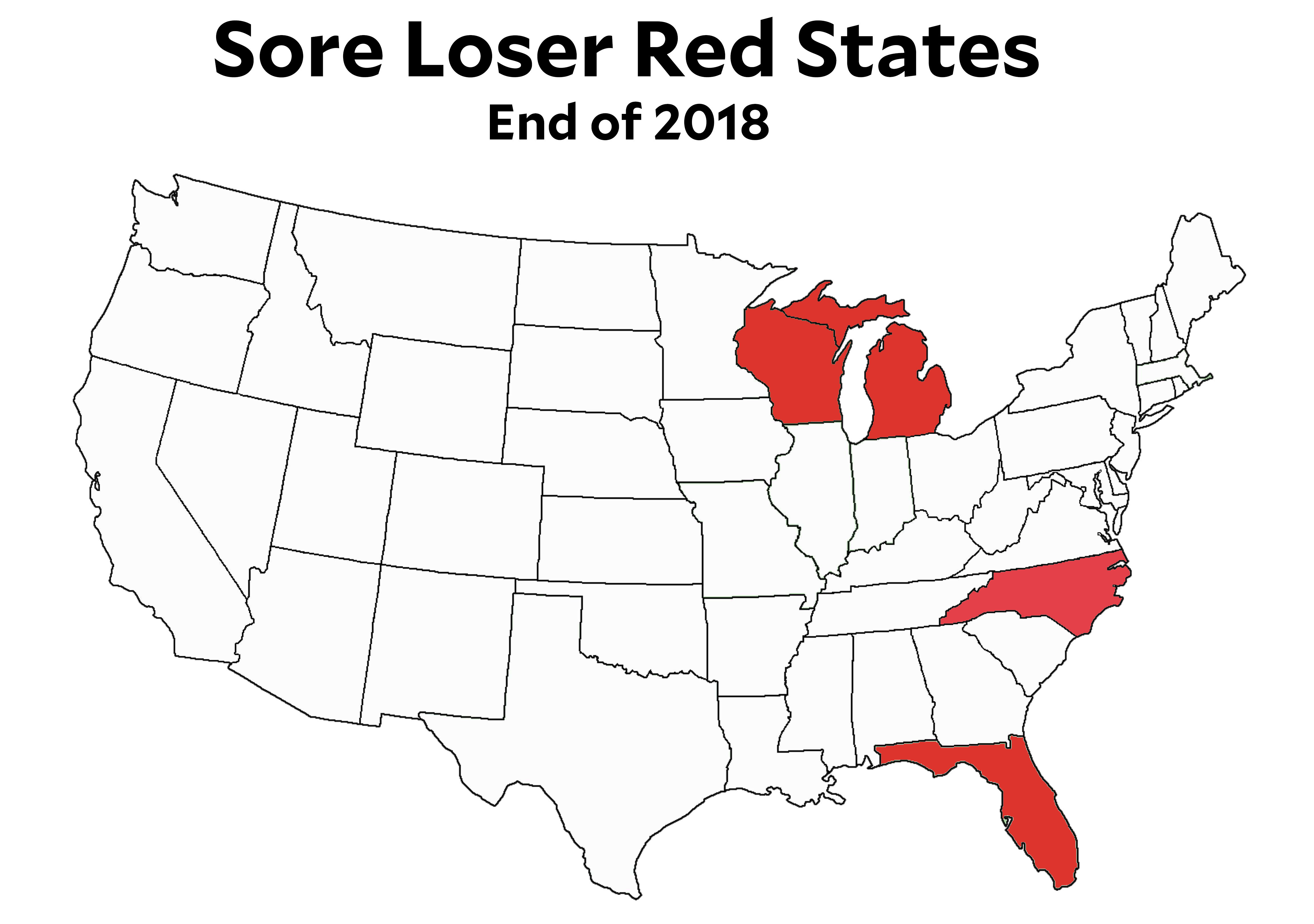
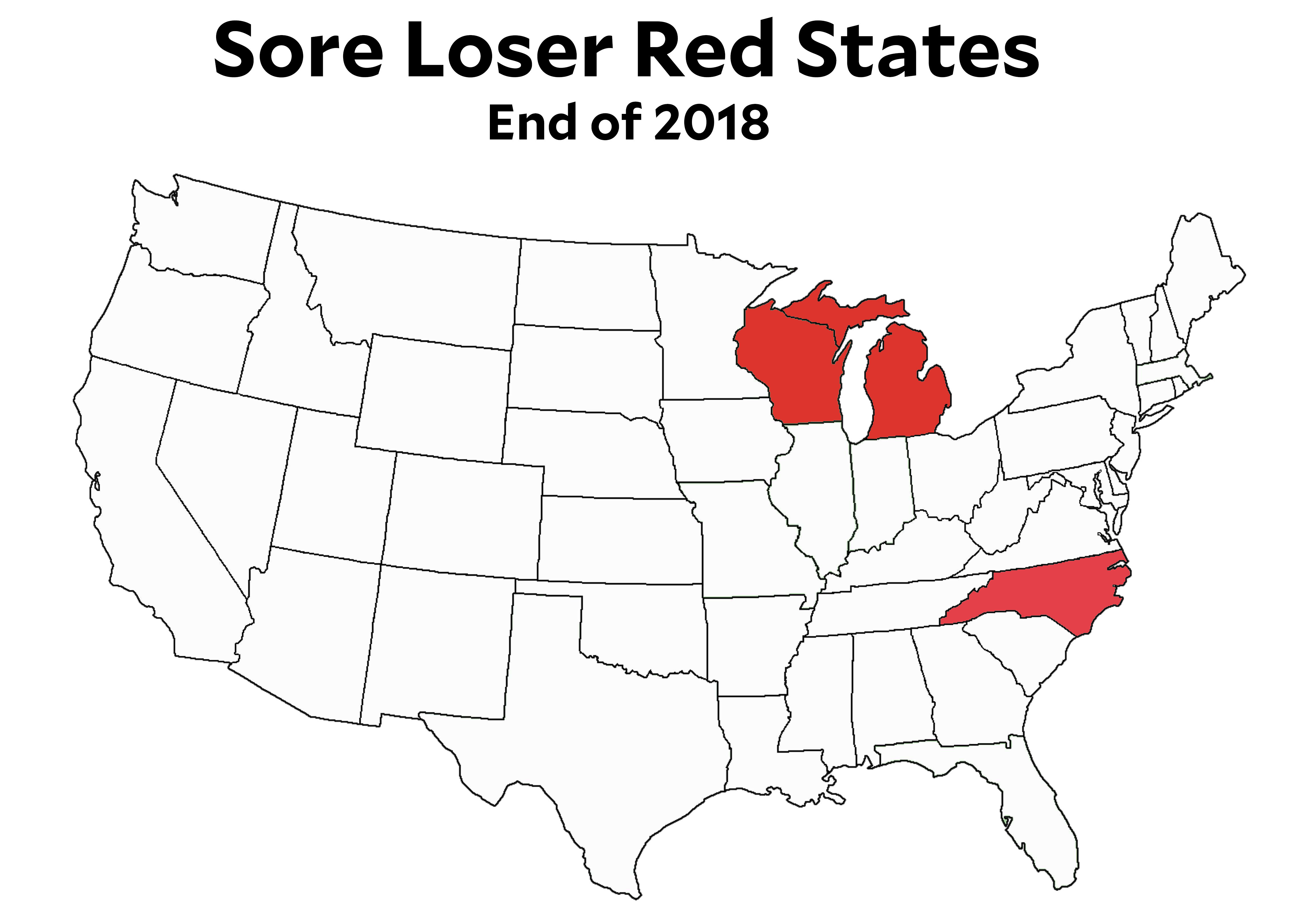
    There’s no telling how hard they’ll kowtow to the NRA on this, but for now it looks like we have four GOP states that are desperately trying to strip elected officials of power in lame duck sessions before Democrats take over. Naturally, I have an updated map:

  • Nobody in Trumpland Knows What’s Going On With China

    President Trump had dinner with Chinese President Xi Jinping on Saturday. On Sunday he tweeted this:

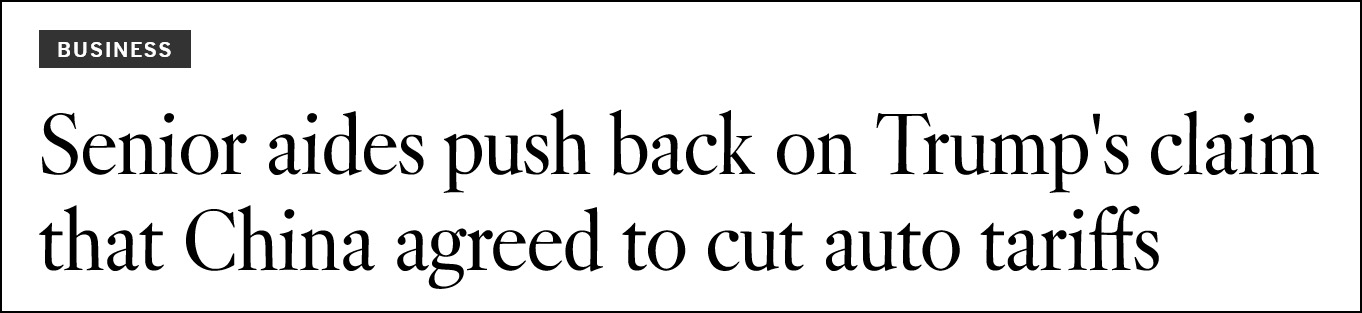
    Oddly, the Chinese didn’t confirm this. Instead we got headlines like this one from the New York Times:

    Hmmm. This is kind of odd, since Trump doesn’t really have much to gain from misrepresenting his agreeement with Xi. But then it got worse as the headlines morphed into weirder ones, like this one from the Los Angeles Times:

    One of the things that makes this whole affair peculiar is that auto tariffs hardly matter. Most cars for the Chinese market are made in China. They aren’t made in America and then shipped over. Still, even if the whole thing is a nothingburger, you’d expect Trump and his gang to at least know what they agreed to. But no:

    On Sunday night, after returning to the White House from the Group of 20 economic summit in Argentina, Trump declared on Twitter that China “has agreed to reduce and remove tariffs on cars coming into China from the U.S.”….But Trump’s top economic advisors made clear Monday that no agreement to reduce and remove the tariffs yet existed, despite Trump’s boast.

    “We don’t yet have a specific agreement on that, but I will just tell you … we expect those tariffs to go to zero,” Larry Kudlow, Trump’s top economic advisor, told reporters in a conference call from the White House….Treasury Secretary Steven T. Mnuchin gave mixed messages, appearing to confirm the auto tariff cut but then backing off….White House trade advisor Peter Navarro also wouldn’t confirm China was lifting auto tariffs.

    Beyond this, it turns out that the White House didn’t even have any idea what level the Chinese might reduce their tariffs to. Auto tariffs used to be 25 percent, but earlier this year China reduced them to 15 percent—except for us. After Trump announced his tariffs this summer, the Chinese raised tariffs on American cars to 40 percent, while leaving everyone else at 15 percent. Assuming that there’s any deal in place at all, this probably means that China has only promised to reduce auto tariffs on American cars to 15 percent, which it was planning to do all along until Trump started his trade war.

    And what about soybeans? Apparently China agreed to buy a “substantial” amount of American food and energy products. But once again, this is something China had already agreed to do before Trump announced his tariffs.

    So is China giving us anything in return for the 90-day tariff truce that both countries agreed to? Hard to say. I guess they’re getting a 90-day tariff truce—although there was even some confusion about when the truce started. Beyond that, who knows?

  • Two Interesting Things About the Internet

    Tyler Cowen links today to “52 things I learned in 2018” from Tom Whitwell—which seems like it’s coming a little early in the year, but whatever—so I took a look at it. Some of them I knew, some I didn’t. Here’s one from Marcel Freinbichler written after new European privacy regulations came into effect:

    And here’s one from Brian Krebs about those occasional books you see on Amazon that are astronomically priced. I always figured they were artifacts of some kind of algorithm screwup, but apparently it’s more sinister than that, as an author named Patrick Reames found out when he discovered a fake book published under his name:

    “Based on what I could see from the ‘sneak peak’ function, the book was nothing more than a computer generated ‘story’ with no structure, chapters or paragraphs — only lines of text with a carriage return after each sentence,” Reames said in an interview with KrebsOnSecurity.

    The impersonator priced the book at $555 and it was posted to multiple Amazon sites in different countries….Reames said he suspects someone has been buying the book using stolen credit and/or debit cards, and pocketing the 60 percent that Amazon gives to authors. At $555 a pop, it would only take approximately 70 sales over three months to rack up the [$24,000] that Amazon said he made.

    “This book is very unlikely to ever sell on its own, much less sell enough copies in 12 weeks to generate that level of revenue,” Reames said. “As such, I assume it was used for money laundering, in addition to tax fraud/evasion by using my Social Security number. Amazon refuses to issue a corrected 1099 or provide me with any information I can use to determine where or how they were remitting the royalties.”

    Internet scams are so inventive.

  • Lunchtime Photo

    Today’s picture shows the sun setting over Big Bear Lake. (Note that the foreground is not a dry lake bed. The lake itself is off in the distance.) This photo is part of a quasi-diptych, and I will put up the second part tomorrow.

    October 20, 2018 — Baldwin Lake, California
  • Republicans Are No Longer Committed to That Whole Peaceful Transfer of Power Thing

    You may not have noticed this when it happened, but North Carolina elected a Democratic governor in 2016. It was a close race, and Republicans demanded multiple recounts, but eventually they conceded and Roy Cooper was declared the winner.

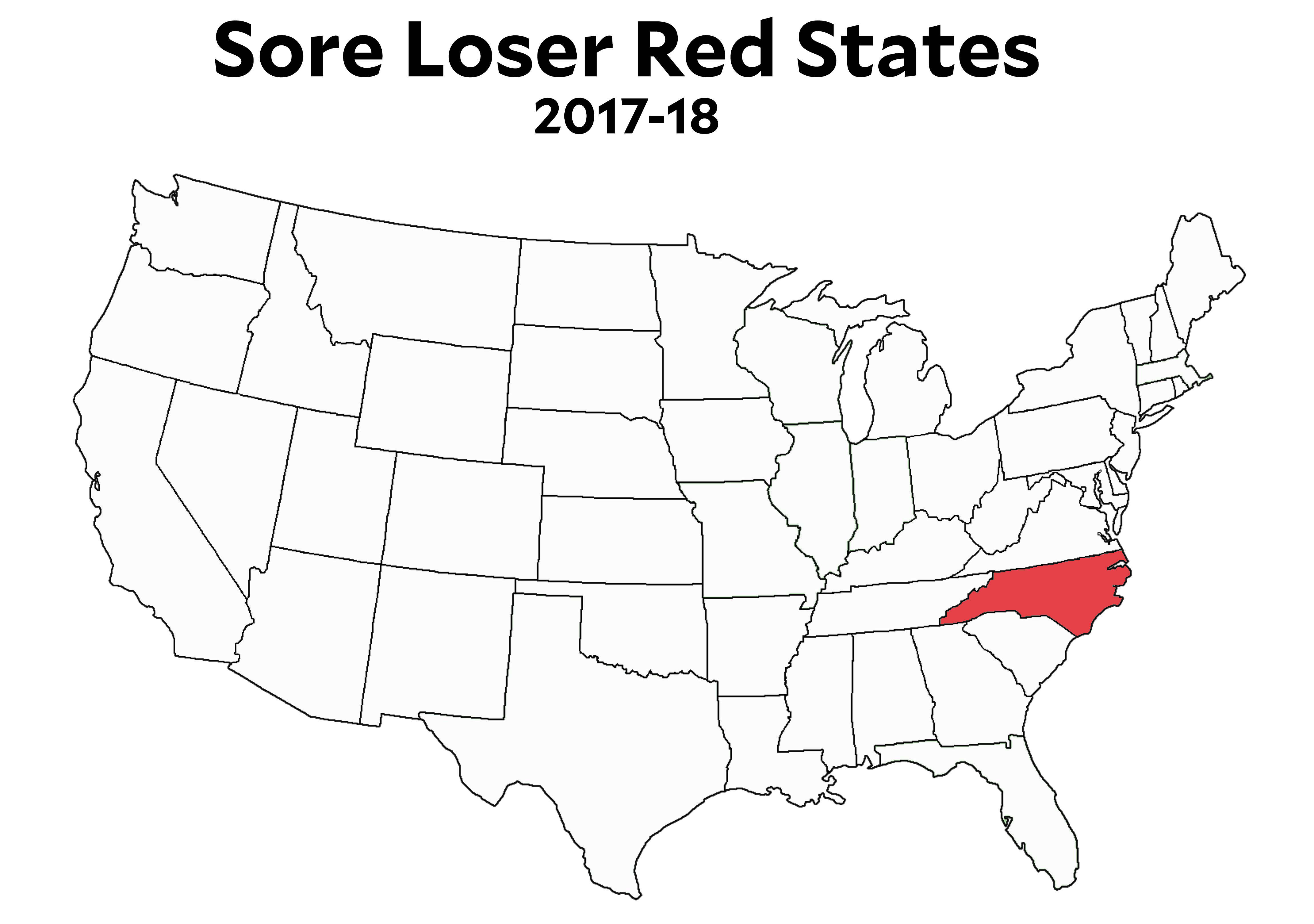
    But that didn’t mean everything was over. After all, there was another month left in which lame duck Republican Pat McRory was still governor and the Republican legislature was still running things. So they did something unique: they passed a series of bills that stripped the governor of some of his powers. Cooper sued after he took office, of course, and the whole mess is currently working its way through the courts. Still, as corrupt as this was, at least it was just North Carolina, which has a recent history of anti-democratic actions barely matched since the end of Reconstruction.

    You’ll be unsurprised to learn that this wasn’t the end of the story. In the same way that voter ID bills spread throughout red states after the first one produced light bulbs all over GOP-land, the same thing is happening here. Republicans who lost reelection bids in November are casting their eyes toward North Carolina and thinking that those Tarheels had a pretty good idea. Here’s Michigan:

    With Democrats set to take over top statewide offices next year, Michigan Republicans are considering proposals that would allow the Legislature to intervene in legal battles and shift oversight of the state’s campaign finance law to a new commission. The lame-duck power plays would limit the power of Gov.-elect Gretchen Whitmer, Attorney General Dana Nessel and Secretary of State Jocelyn Benson. Democrats have not held all three posts since 1990.

    A House bill introduced Thursday by state Rep. Rob VerHeulen, R-Walker, and quickly praised by Republican leaders seeks to guarantee the GOP-led Legislature could intervene in legal battles involving state laws that Democrats may be hesitant to defend. A separate proposal from Sen. Dave Robertson, R-Grand Blanc, would shift oversight of the Michigan Campaign Finance Act from the Secretary of State’s Office to a newly proposed “fair political practices commission.”

    The incoming Democrats had promised a crackdown on dark money contributions, and this is an obvious attempt to stop them. The new commission would be split evenly between Republicans and Democrats, which would halt campaign finance reform in its tracks. And if Michigan can do it, you know that Scott Walker must be looking on from Wisconsin wondering if he can do the same thing. Our own Samantha Michaels has that story:

    Republican lawmakers in Wisconsin are making a last-ditch effort to strip crucial powers from the incoming Democratic governor and attorney general before Republican Gov. Scott Walker finishes his term, in a move that could have sweeping implications for health insurance and voting rights in one of the country’s most important swing states. In a special session on Monday, the Republican-held Legislature will consider a bill that would … take away his ability to approve major decisions by Attorney General-elect Josh Kaul … granting this power to Republican lawmakers instead.

    The 141-page bill was unveiled Friday, and lawmakers are expected to vote on it Tuesday.

    And so the red splotch expands, as Republicans desperately try to thwart democracy and the usual peaceful transfer of power. Will our courts let them get away with this? Stay tuned.

    UPDATE: Yes, I seem to have regressed to the point where I can no longer distinguish between Virginia and North Carolina on a map. Sorry, Virginians! The maps have been corrected.

  • The Yield Curve Has Inverted!

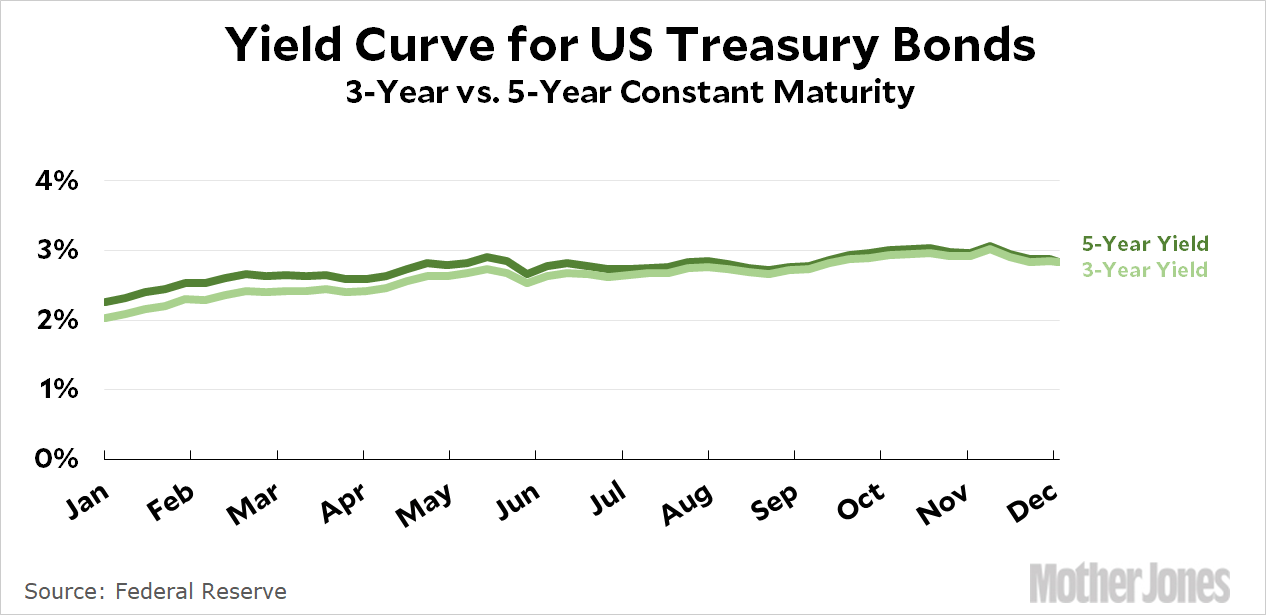
    Generally speaking, the yield on a 5-year treasury bond should be higher than it is on 3-year bond. After all, the longer term means you’re taking on a little more risk. Today, however, after years of breathless waiting, this is no longer true. The yield curve has “inverted,” and as I type this both 3- and 5-year bonds are yielding 2.84 percent.

    The conventional wisdom says that this is because investors are betting on the Fed reducing interest rates in the near future. With lower rates around the corner, investors want to lock in the higher rates currently available for as long as they can, so they’re snapping up 5-year treasurys, which in turn has reduced their yield below the 3-year rate.

    That all makes sense, but why do investors think the Fed will shortly be reducing interesting rates? Because a recession is coming.

    That’s the conventional wisdom, anyway. You may decide for yourself whether to believe it.