• Where Did All the Riots Go?

    Fifty years after the riots that followed the assassination of Martin Luther King Jr., Matthew Desmond wants to know why our cities are so calm these days:

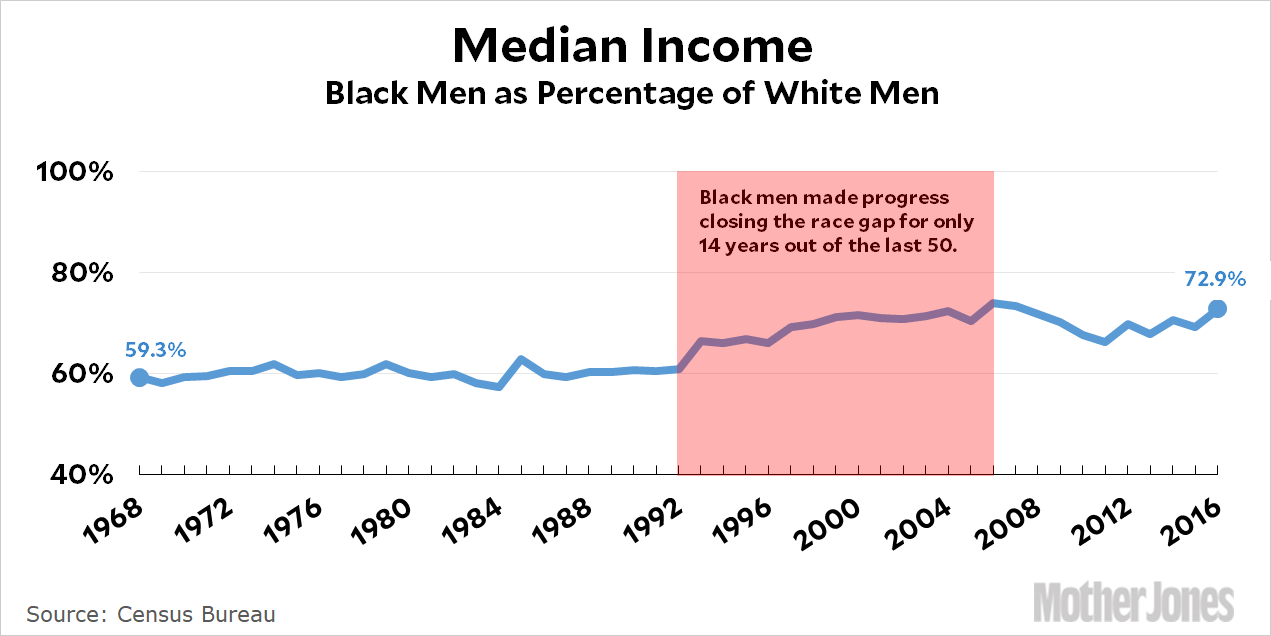
    Fifty years later, our cities, in both the North and the South, remain sharp-line segregated. Not only that, but the decades following the Holy Week Uprising have witnessed a surge in mass incarceration that has disproportionately caged poor black men; a loss of manufacturing jobs that has left many black men unemployed; soaring housing costs and an epidemic of evictions, felt most acutely in low-income communities of color; and the gutting of welfare, which has led to a spike in extreme poverty.

    By these measures, things have grown worse. Yet the streets, for the most part, have remained clear and quiet. Only two significant riots have broken out since the early 1970s: in Miami in 1980 and in Los Angeles in 1992, both of them in response to the acquittals of police officers who had beaten unarmed black men. Recent years have witnessed spates of unrest protesting police violence in Ferguson, Missouri, and beyond, but these have been short-lived affairs resulting in few serious injuries and restrained arson. The 2015 unrest in Baltimore after Freddie Gray died in police custody resulted in an estimated $9 million in property damage and no deaths. The 1992 L.A. riots, by comparison, caused more than $1 billion in property damage and 63 deaths.

    Why don’t American cities burn like they used to?

    Desmond wouldn’t like my answer much, I’m afraid. I don’t even have to say it, do I?
  • Is Anyone Building “Foursquare But For Racism”?

    I’m reading Nick Harkaway’s Gnomon right now, and one of the characters has just decided to create a new app that lets people tag their experiences on the street:

    “So, like Foursquare,” my interviewer said, with the doubt of a young person looking at an old man in front of a computer.

    “Exactly like that,” I said, “except that our users will record incidences of hate. We’ll be working initially to produce a live map—like a traffic congestion map—of more and less racist areas, safe routes home, institutionally racist police forces and local authorities, local populations. We’ll have a star rating system and so on.”

    I immediately wondered if anyone is actually doing this. So far, all I’ve found is a recently launched app from South Africa called ZiRRA, which allows you to report incidents of racism but nothing more.

    I’m surprised. The book was published three months ago, which seems like plenty of time for some hotshot Silicon Valley team to womp together a Foursquare clone in their off hours. What’s the holdup? Or does it already exist and I just don’t know how to find it?

  • Lunchtime Photo

    Family week continues today with a selection from my London-loving sister. This is a view on a hazy day from the top of the Eye, London’s famously huge ferris wheel. It’s highly recommended if you visit. Some of you might be put off by the fact that it’s such a touristy thing to do—and it is—but you’re a tourist. Embrace it. And it really is fun and it really does provide a great view. On the downside, it’s a bit pricey and, in summer, can get crowded at peak times. Plan accordingly.

    October 17, 2017 — London

    BONUS PHOTO! One of our caterpillars just hatched. Here’s our brand new baby Monarch butterfly, contemplating its first flight into the big world.

    April 3, 2018 — Irvine, California
  • Trump Voters Are Worried That Nobody Will Sell Them Health Insurance Next Year

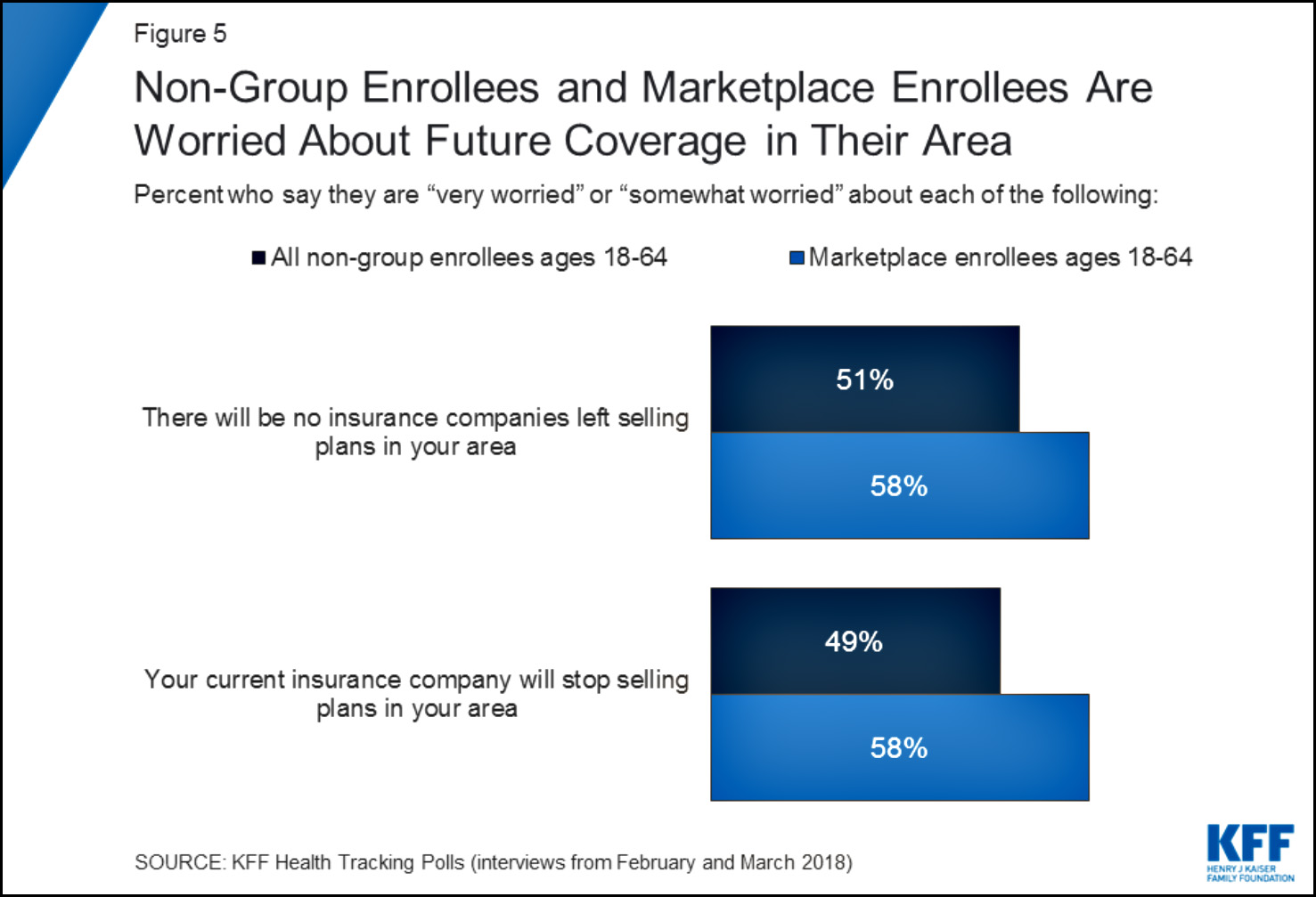
    What’s the main result of Donald Trump’s continuing attempts to sabotage Obamacare? In the latest Kaiser tracking poll, Obamacare users say that the prospect of premiums going up is one of their major fears, though most report that their premiums stayed about the same compared to 2017. What’s more, most of them qualify for government subsidies, which puts a hard cap on how high their premiums can go.

    But there’s an even bigger and more real problem:

    This number is worse than it looks like at first glance. At a guess, at least a third of Obamacare enrollees live in urban areas that aren’t in any danger of losing insurance carriers. Those folks probably all reported that they had no worries about getting coverage. This means that nearly everyone outside of big cities—most of whom voted for Trump—is worried about the possibility of every insurance carrier pulling out of their region in the near future. This fear has become considerably more potent over the past six months, as Trump’s rampage has made more and more insurance carriers reluctant to waste more time on a program that seems destined for destruction.

    Nice job, Mr. President.

  • DOJ Approved Mueller Probe of Manafort Collusion With Russia

    I guess it’s time to fire Rod Rosenstein:

    Special counsel Robert S. Mueller III was authorized by a top Justice Department official to investigate whether Paul Manafort, the onetime chairman of Donald Trump’s presidential campaign, illegally coordinated with Russia to interfere in the 2016 election, new court filings show….A partly redacted memo included in court filings late Monday night revealed that Deputy Attorney General Rod J. Rosenstein authorized Mueller to pursue allegations that Manafort colluded with Russia in 2016.

    The new filings show that Rosenstein specifically approved lines of investigation for the special counsel in an August 2017 memo. A version of the memo filed in court showed that Rosenstein signed off on an investigation of whether Manafort “committed a crime or crimes by colluding with Russian government officials” and of Manafort’s work as an international political consultant in Ukraine before joining Trump’s campaign. Additional sections of the 2½-page memo were blacked out by prosecutors, indicating that Rosenstein authorized other lines of investigation that remain a secret.

    My guess is that special prosecutors almost always have their requests approved, so Rosenstein’s blessing may not mean much. Still, it sure looks like Mueller has a lot of irons on the fire.

  • NeverTrumpers Should Be Blunter About Donald Trump’s Toxic Racism

    In the LA Times today, Jonah Goldberg pushes back against defenses of Donald Trump which rely on the claim that “populism” has always been a part of the Republican message:

    Not all populisms are the same, because though they all claim to be the voice of the people, they invariably speak with a specific voice for a specific subset of the people….Populism is a bottom-up phenomenon, but it is shaped and defined by rhetoric from the top. And just as there are differences between left and right populism, there are different kinds of conservative populism.

    I appreciate the small band of conservative NeverTrumpers. Really, I do. But I sure wish they could be a little more forthright about exactly what makes Trump’s brand of populism so poisonous: namely that the “specific subset of the people” Trump speaks for is explicitly white people. He routinely appeals to white resentment and racial bigotry with barely even a fig leaf to camouflage what he’s doing. This appeal has been a part of the Republican Party for decades, but in recent years its public face has dwindled, mostly taking the form of wink-wink-nudge-nudge innuendo. Trump doesn’t bother. His core base is white people who are mad at blacks and Hispanics and Muslims, and he’s happy to publicly stoke their anger.

    Aside from his chaotic incompetence, this is what makes Trump different and toxic. It’s not his conservative heresies on trade or entitlements or Putin or NATO. It’s his racism. It shouldn’t be so hard to put that front and center.

  • Trump’s Approval Rating Is Historically Low In a Good Economy

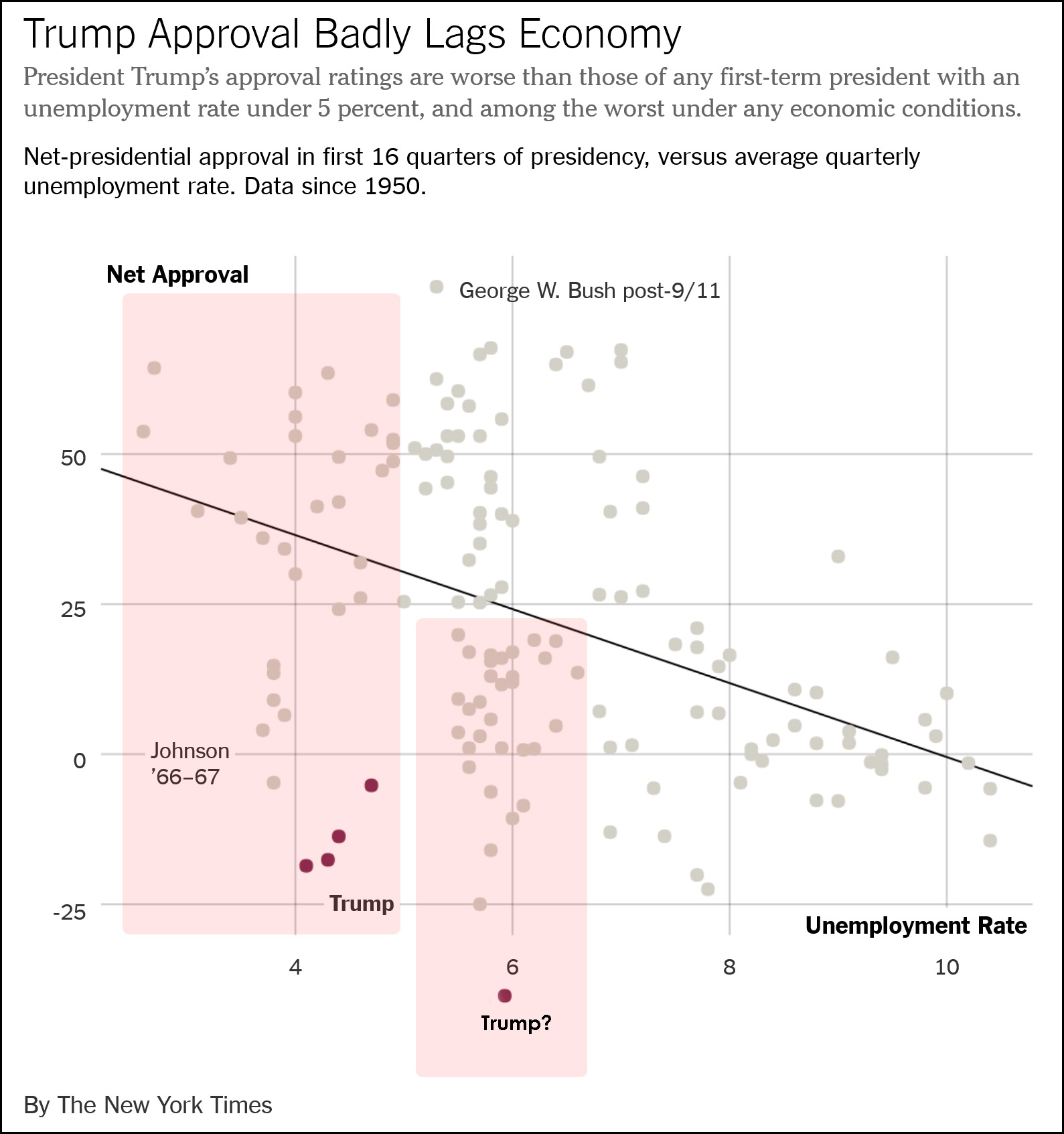
    I mentioned in passing yesterday that Donald Trump’s approval rating is actually quite low considering that the economy is doing pretty well. In fact, it’s historically low. Here’s an annotated chart from earlier in the year put together by Nate Cohn:

    Trump’s approval rating is well below the lowest ever recorded with unemployment below 5 percent. So what happens if the economy turns down? Even a small hiccup could push his approval rating down by a net 10 points. Trump better hope the Fed does its usual best to keep Republicans in office and that Wall Street keeps its cool in the face of trade wars and general economic incompetence.

  • Maybe Politicians Don’t Really Represent Anybody

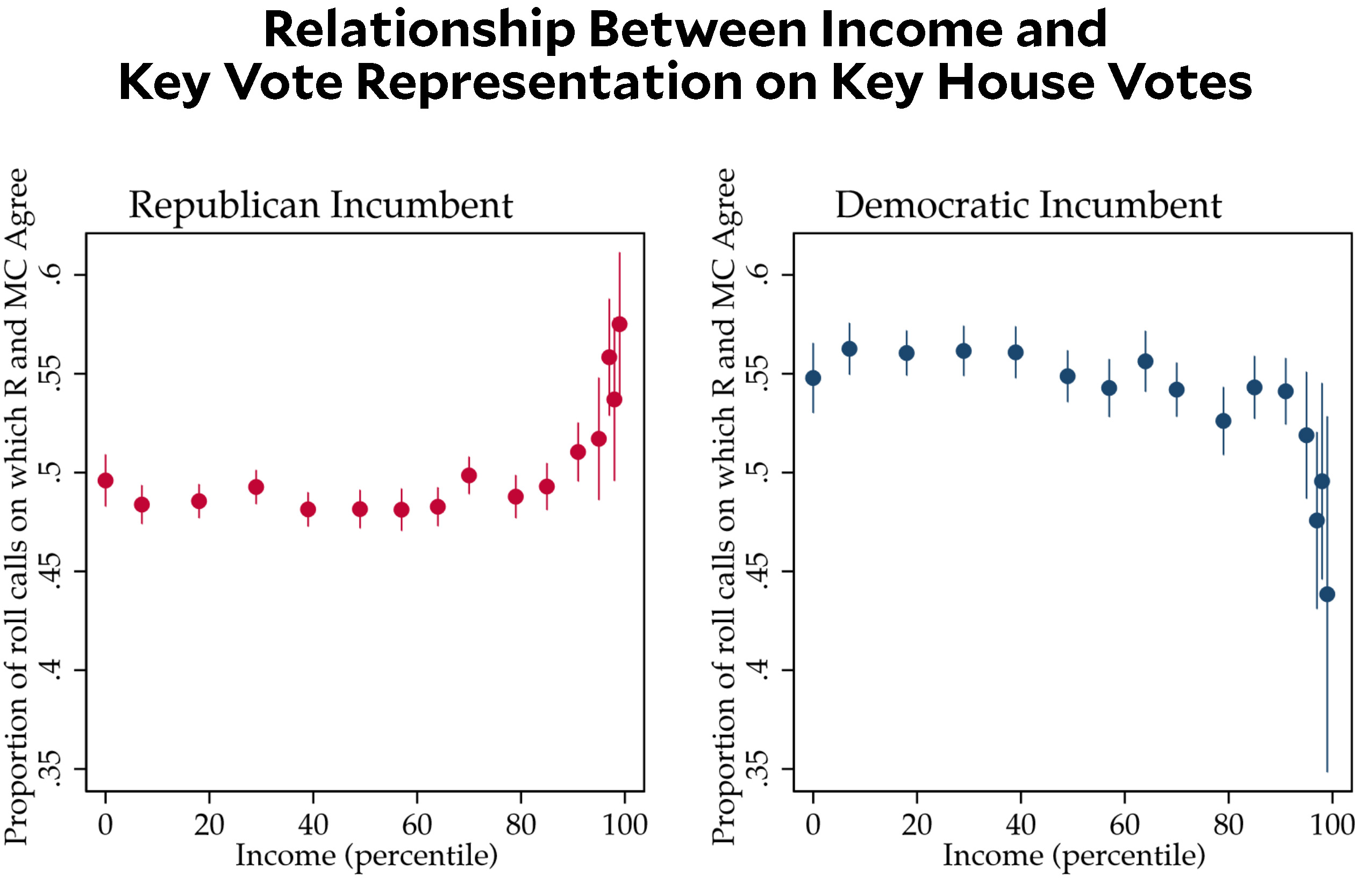
    Here’s some political science geekery combined with some chart geekery. Dylan Matthews has a post up today about a recent paper that compares public opinions on key issues with votes cast by members of Congress. How well do members of Congress represent the views of their constituents? Here’s the chart in the paper:

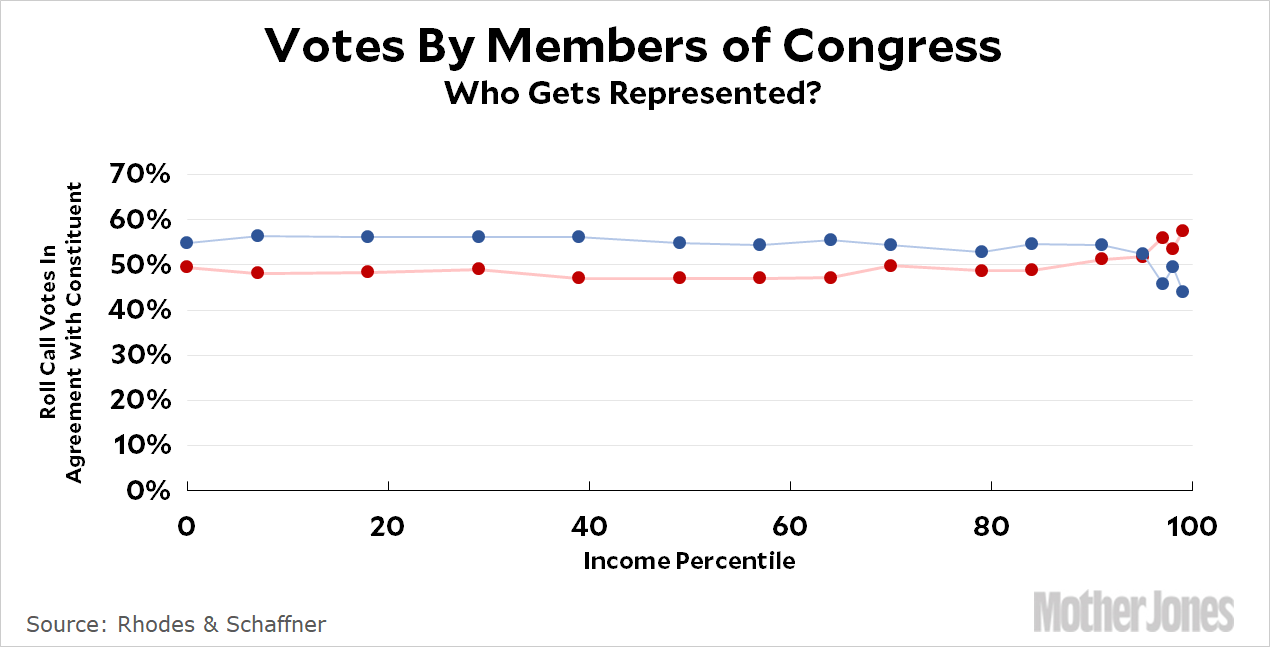
    Basically, it looks like everybody at all income levels gets represented about the same until we get to the very tippy top. The views of rich people get represented a lot better by Republicans and a lot worse by Democrats. But there are two things that make these charts a little misleading. The first is our old friend the y-axis: it goes only from 35 percent to 60 percent, which makes the upward and downward spikes look sharper than they are. The second is the error bars: they get pretty big at the high-income end of the charts, which makes the size of the upward and downward spikes ambiguous. Visually, however, they add to the effect that the spikes are big. Here’s a redrawn version of the charts:

    It’s a judgment call which one of these best represents the data visually, but I suspect it’s the second one. The views of most constituents don’t matter much at all, while the rich wield a very modest influence. Republicans represent rich people about 7 percent better than everyone else, while Democrats represent them about 8 points worse. That’s not much.

    A different paper suggests that members of Congress respond mostly to interest groups, not constituents, but in the end Matthews concludes that we might be making a mistake in thinking that Congress represents constituent views at all:

    It’s not actually clear that Republican and Democratic senators are purposefully taking their views from the public, even when politicians’ views match their constituents’. It’s also possible — even likely — that it’s happening the other way: Politicians are shaping the public’s views. That helps explain why Democratic constituents align their views so closely with Democratic senators, and similarly for Republican constituents.

    ….“Longstanding political science suggests that the path of information from governing elites to the public is stronger than the reverse,” Grossmann and Isaac note. “More troubling, affluent Americans may hear official opinions first, meaning we would observe a greater association between their opinions and policy even if the true channel of influence were from government to the affluent.”

    Bottom line: members of Congress form their views, which are then communicated to their constituents. Only then do constituents form their own views: conservatives adopt the Republican view and liberals adopt the Democratic view. This would explain a number of things:

    • Why conservative voters continue to think that Republicans are better on pocketbook issues despite their long history of catering to the rich.
    • Why voters line up so neatly even on obscure issues that don’t have an obvious ideological component (net neutrality, for example).
    • Why views on issues can reverse so quickly when elite views reverse (Trump on Russia, for example).

    Naturally this doesn’t apply to me or to any of the fine people who read this blog, all of whom are independent thinkers who don’t just follow the crowd. But all those other guys? What a bunch of sheep.

  • Sessions: Immigration Judges Should Complete 700 Cases Per Year

    From the Washington Post:

    Trump administration, seeking to speed deportations, will impose quotas on federal immigration judges

    A new quota system will be tied to the judges’ annual performance reviews, according to Justice Department memos, and judges will be expected to clear at least 700 cases a year to receive a “satisfactory” rating….A union representing the judges called the move “unprecedented,” saying it risks undermining the independence of the judicial process.

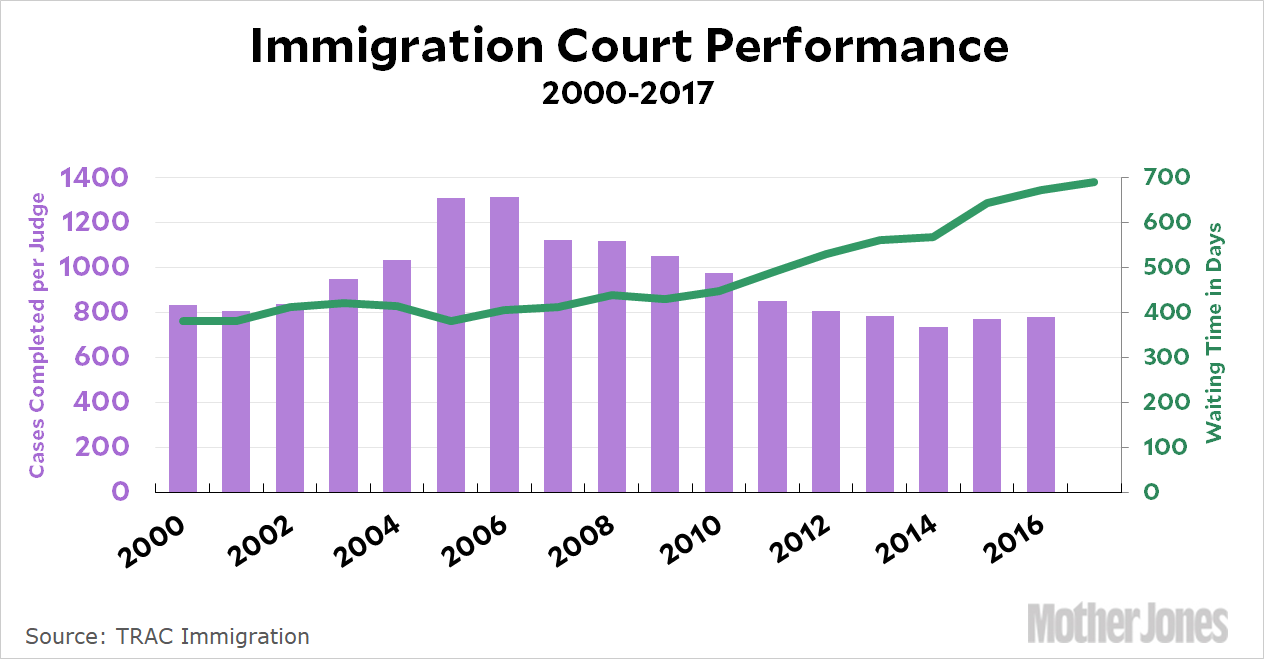
    This has been coming for a while. Immigration courts have been overwhelmed for years, with backlogs skyrocketing from 200,000 cases to 700,000 cases over the past decade. Everyone agrees that we need more judges, but there’s also a question of how productive judges are. Here is one of the recommendations of a recent GAO report:

    Establishing comprehensive case completion goals would help EOIR more effectively monitor its performance. In addition, systematically analyzing the cause of certain continuances, particularly operational continuances, could provide EOIR with valuable information about potential challenges the immigration courts may be experiencing or areas that may merit additional guidance and training. Updating policies and procedures to ensure the timely and accurate recording of NTAs would provide EOIR greater assurance that its case management data are accurate—including the size of its case backlog.

    And here’s the average efficiency of immigration judges:

    As you can see, since 2000 immigration judges have cleared a pretty steady 800 cases per year on average, with an upward spike that started in 2003 but dwindled away starting in 2007. However, the number of new cases has increased substantially over the past decade, and the time to clear each case also increased as motions for continuance rose steadily. This is why the backlog is now so enormous.

    I’m not sure that judge efficiency per se is the big problem here, but in any case, a goal of 700 completed cases per year is probably not out of line. More important, probably, is getting a handle on continuance requests, which have risen from both prosecutors and defense attorneys. Today’s cases aren’t inherently more complex than they were a decade ago, so it’s not clear why wait times have gone up so dramatically.

  • Why Isn’t Donald Trump Polling at 0%?

    Nancy LeTourneau asks the eternal question: is there any amount of fuckuppery that will cause Donald Trump’s supporters to abandon him?

    There will always be the hardcore support for Trump—that can be expected in a country as large and diverse as the United States. But the fact that Trump’s approval rating continues to hover in the 40 percent range is appalling. Is there anything that could chip away at that? I see both good news and bad news on that front.

    When it comes to good news, the one frame of reference for me is that my father, a staunch conservative Republican, continued his support for Richard Nixon through all of the revelations about his lies, corruption and obstruction of justice. In the end, dad finally abandoned him when the Oval Office tapes were published in book form because he couldn’t abide the frequency with which the president swore.

    Holy hell. This is the good news? That even historically insane levels of corruption and abuse of power aren’t likely to move the Republican base?

    Of course, this isn’t much of a surprise, especially these days. As LeTourneau points out (this is the bad news), conservative media mostly shields Trump’s base from even knowing about this stuff in the first place. But I’m not sure that’s really crucial anyway, since it affects only the hardcore Republican base, and that isn’t enough to keep Trump in office. The question is why Trump retains substantial support even from centrist conservatives.

    For now, I think the answer is this: nothing much has gone wrong. What I mean by this is that despite the endless wailing of liberals like me, your average Republican voter hasn’t really seen anything falling apart. They still have jobs. Their 401(k) accounts are doing fine. North Korea is coming to the negotiating table. The Middle East is the same as always. Global warming continues to seem like no big deal. We’re sticking it to China. On TV Trump seemed pretty reasonable about both guns and immigration, so it’s not his fault that nothing is happening on those fronts.

    And look: for people who are right of center and don’t eat and breathe politics, this is a perfectly sensible worldview. Sure, maybe these folks would prefer that Trump tone down the rhetoric and lay off the tweets, but at least his heart is in the right place. Why not give his policies a chance?

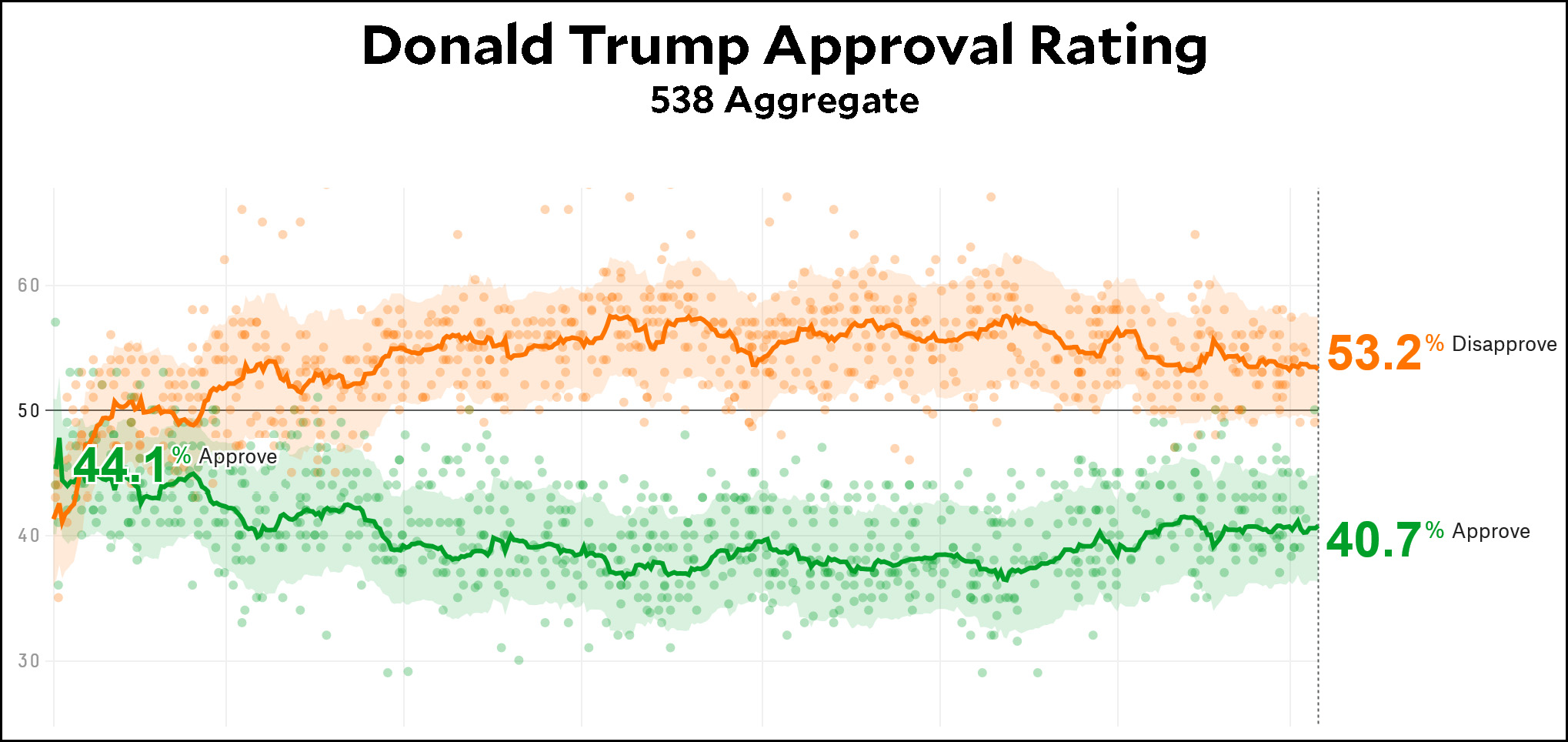
    That said, Trump’s support has fallen over the past year: since his inauguration, Gallup has him down 6 points; 538 has him down 3.4 points; and Pollster has him down 2.4 points:

    Modern American politics is played at the margins. It takes a lot to move voters by as much as 5-10 percent, especially when the economy is doing well. Right now, it looks like there’s a good chance of a huge blue wave in the November midterms even though the economy is growing and unemployment is low, and that says a lot. Trump’s support is more fragile than it seems at first glance.