Facial Recognition Turns Out To Be Not So Great If You Aren’t a White Man

The National Institute of Standards and Technology released a report today about the accuracy of facial recognition software. The news was grim: most algorithms make a lot more errors when the subject is anything other than a white male, which means that women and people of color are more likely to be misidentified. But this got me curious: this might be the average result, but how do different algorithms stack up? Which one is the best at identifying all kinds of people equally well?

The full report is here. Figure 13 turns out to have what I was looking for:
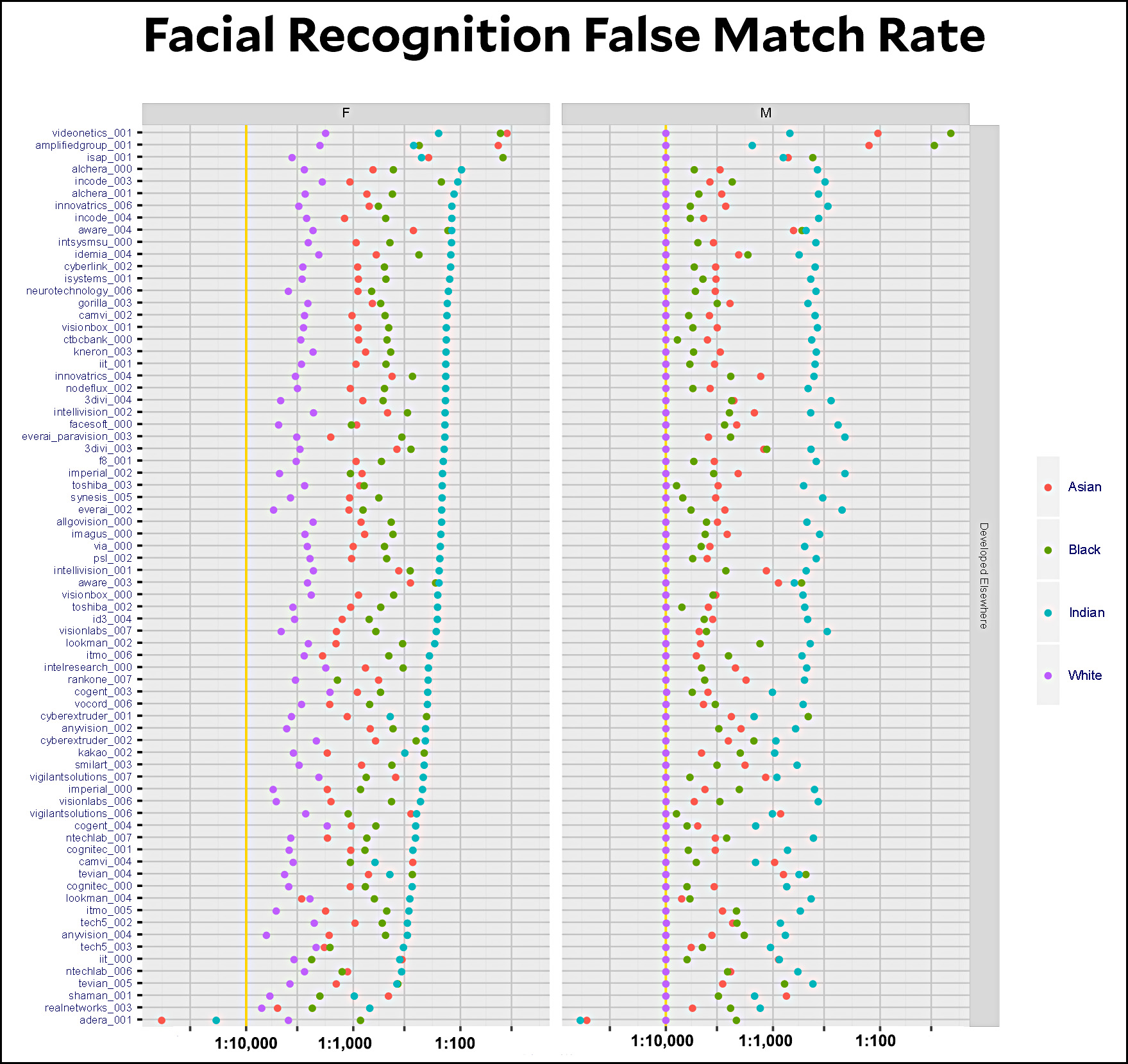
The test was calibrated so that its error rate on white men was 1:10,000 for each algorithm (those are the purple dots on the right). Every other test is run with the same calibration, so the red, green, and teal dots show how much worse the error rate is for anyone who’s not a white man.

What surprised me was that pretty much all the algorithms are equally bad. There are a handful that do OK with Asian and black men (tech5_003, lookman_004, cogent_004, incode_004), but that’s it. With one exception (the adera_001 algorithm at the very bottom) the best that any of them do with American Indian men is five times worse than for white men. Recognition of women is worse than men across the board.

If we want better results, it looks like we’re going to have to use a Chinese-developed algorithm. Here’s how they rate:
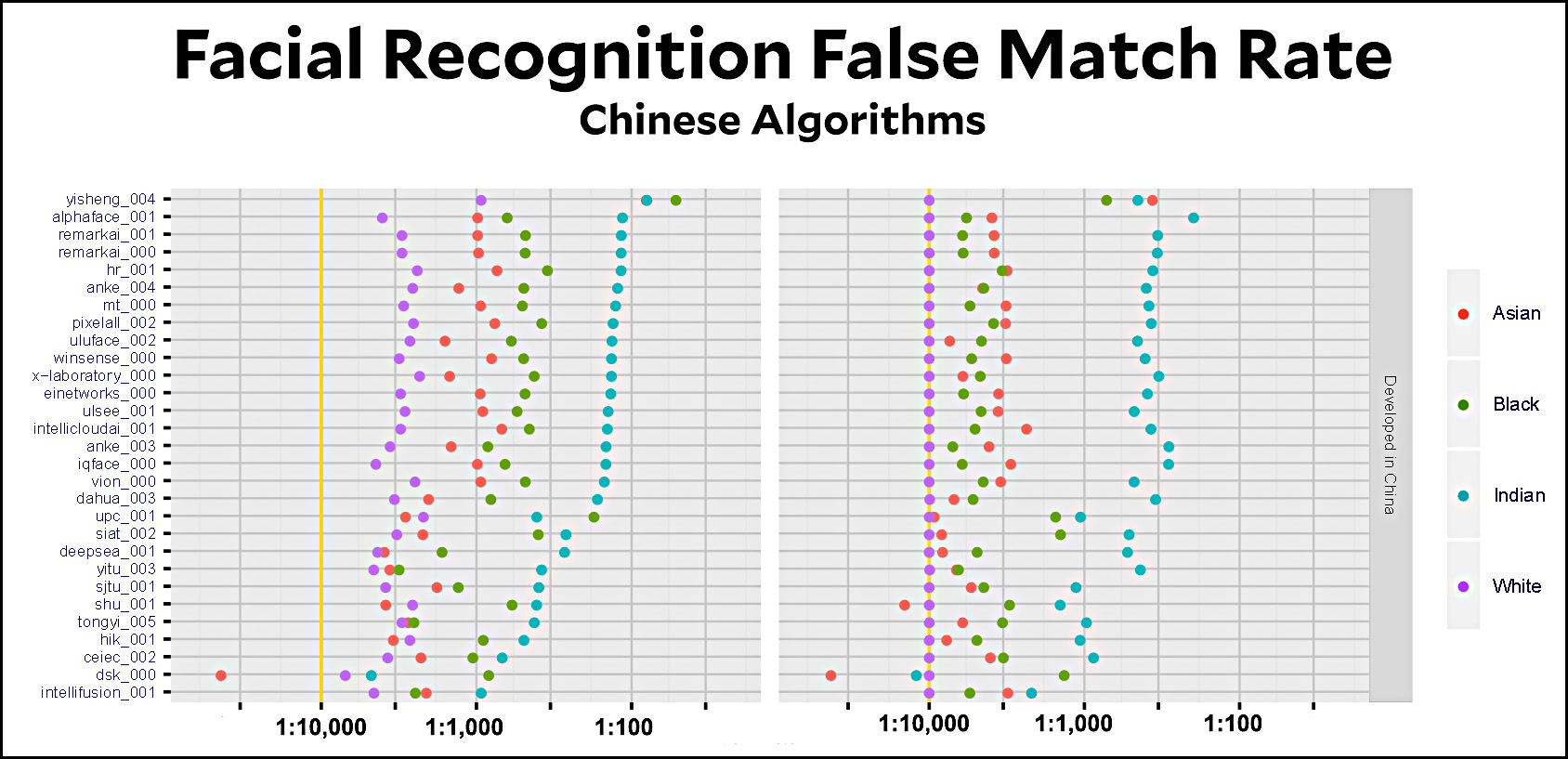
Surprisingly, the Chinese algorithms seem to be no better on average. Especially surprisingly, they appear to be only slightly better even for Asian faces. Is this because of algorithm failures or because they’re training on datasets similar to what everyone else uses? Since the algorithms are all proprietary, there’s no way of telling. But this report sure shows that the facial recognition industry is broken from the roots up.
DECEMBER IS MAKE OR BREAK

A full one-third of our annual fundraising comes in this month alone. That’s risky, because a strong December means our newsroom is on the beat and reporting at full strength—but a weak one means budget cuts and hard choices ahead.

The December 31 deadline is closing in fast. To reach our $400,000 goal, we need readers who’ve never given before to join the ranks of MoJo donors. And we need our steadfast supporters to give again—any amount today.

Managing an independent, nonprofit newsroom is staggeringly hard. There’s no cushion in our budget—no backup revenue, no corporate safety net. We can’t afford to fall short, and we can’t rely on corporations or deep-pocketed interests to fund the fierce, investigative journalism Mother Jones exists to do.

That’s why we need you right now. Please chip in to help close the gap.

DECEMBER IS MAKE OR BREAK

A full one-third of our annual fundraising comes in this month alone. That’s risky, because a strong December means our newsroom is on the beat and reporting at full strength—but a weak one means budget cuts and hard choices ahead.

The December 31 deadline is closing in fast. To reach our $400,000 goal, we need readers who’ve never given before to join the ranks of MoJo donors. And we need our steadfast supporters to give again—any amount today.

Managing an independent, nonprofit newsroom is staggeringly hard. There’s no cushion in our budget—no backup revenue, no corporate safety net. We can’t afford to fall short, and we can’t rely on corporations or deep-pocketed interests to fund the fierce, investigative journalism Mother Jones exists to do.

That’s why we need you right now. Please chip in to help close the gap.

We Recommend

Latest

Sign up for our free newsletter

Subscribe to the Mother Jones Daily to have our top stories delivered directly to your inbox.

Get our award-winning magazine

Save big on a full year of investigations, ideas, and insights.

Subscribe

Support our journalism

Help Mother Jones' reporters dig deep with a tax-deductible donation.

Donate