Do Air Filters Really Improve Student Performance?

Matt Yglesias passes along an interesting study that grew out of the Aliso Canyon natural gas leak, which was big news around here in 2015 as Southern California Gas employees spent months trying to plug a well that had blown out. As a precautionary measure, air filters were installed in schools within five miles of the leak even though measurements showed little deterioration of air quality. This provided Michael Gilraine of New York University with a natural experiment: did the air filters change student performance when you compared schools that were just inside the five-mile boundary with schools that were just outside? Gilraine concludes that the filters had a substantial effect. Here’s the raw data:
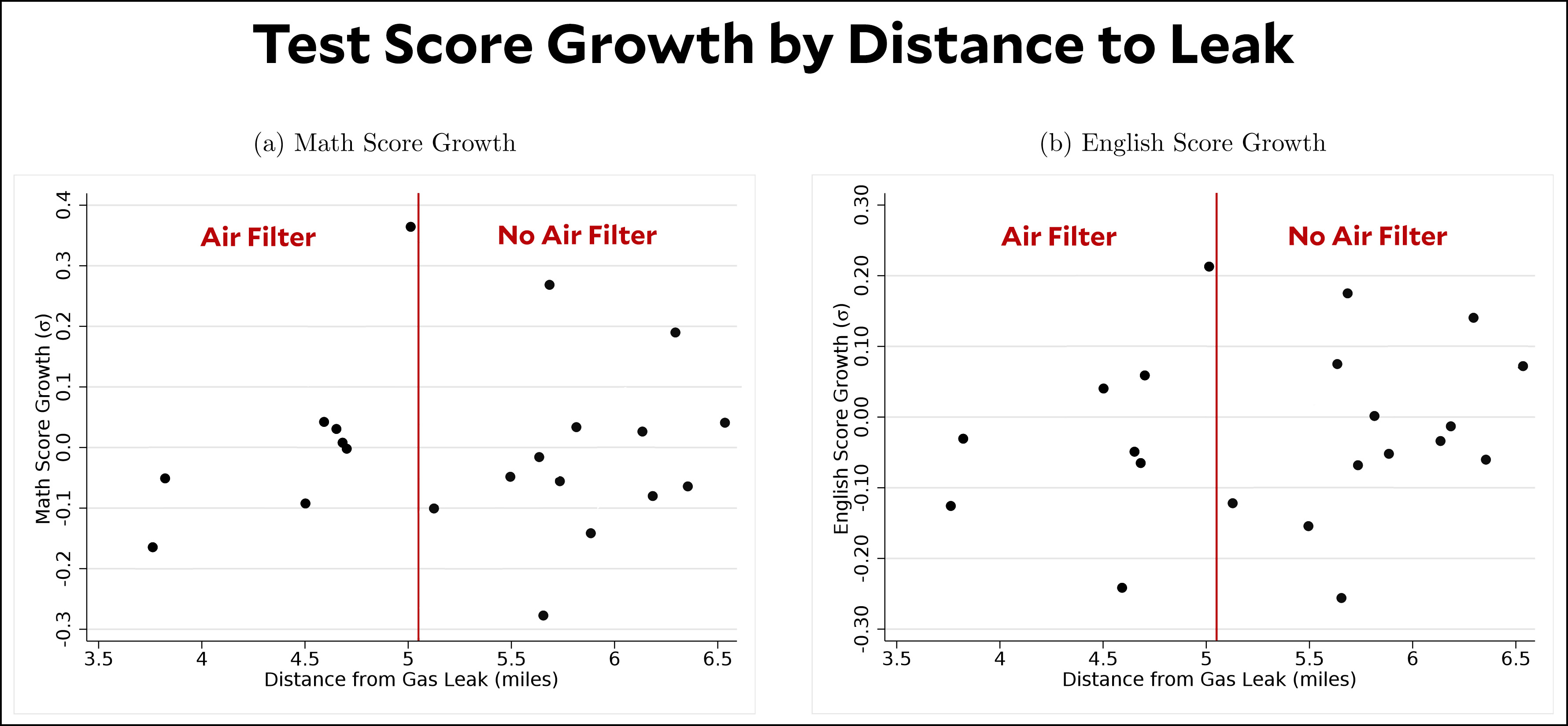
Hmmm. I can’t say that I see much difference in student performance between the schools within and without the five-mile boundary. However, that’s because I modified Gilraine’s chart to show just the data points and nothing else. Here’s the original chart:
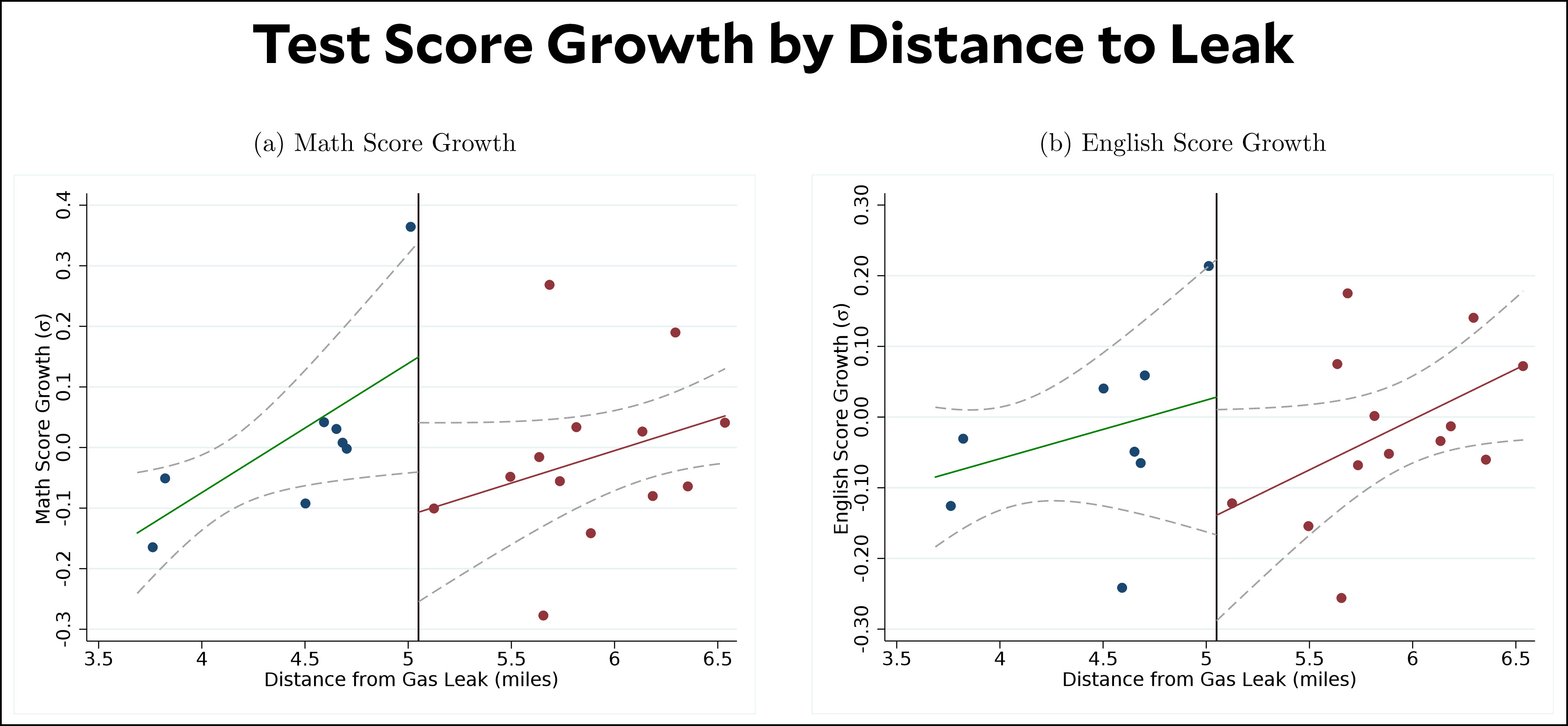
This is known as a discontinuity test, but you can color me skeptical that there’s anything going on here. The sample size is small (about 20 schools on each side of the boundary); the discontinuity is based on a trendline even though there’s no reason to think that student performance should change with distance; the discontinuities are invisible to the naked eye; and only one of them is statistically significant in the first place—and that one just barely.

I’ve come across these kinds of discontinuity tests before, and I’m usually not very impressed with them unless the discontinuity is fairly large and obvious. That said, this result is intriguing and cries out for a more rigorous followup. Unfortunately, this would be fairly expensive: the filtering system runs about $1,000 per classroom, and in the Aliso Canyon schools the cost came to about $100,000 per school. Are there any billionaires out there who’d like to fund this?

BEFORE YOU CLICK AWAY!

December is make or break for us. A full one-third of our annual fundraising comes in this month alone. A strong December means our newsroom is on the beat and reporting at full strength. A weak one means budget cuts and hard choices ahead.

The December 31 deadline is closing in fast. To reach our $400,000 goal, we need readers who’ve never given before to join the ranks of MoJo donors. And we need our steadfast supporters to give again today—any amount.

Managing an independent, nonprofit newsroom is staggeringly hard. There’s no cushion in our budget—no backup revenue, no corporate safety net. We can’t afford to fall short, and we can’t rely on corporations or deep-pocketed interests to fund the fierce, investigative journalism Mother Jones exists to do.

That’s why we need you right now. Please chip in to help close the gap.

BEFORE YOU CLICK AWAY!

December is make or break for us. A full one-third of our annual fundraising comes in this month alone. A strong December means our newsroom is on the beat and reporting at full strength. A weak one means budget cuts and hard choices ahead.

The December 31 deadline is closing in fast. To reach our $400,000 goal, we need readers who’ve never given before to join the ranks of MoJo donors. And we need our steadfast supporters to give again today—any amount.

Managing an independent, nonprofit newsroom is staggeringly hard. There’s no cushion in our budget—no backup revenue, no corporate safety net. We can’t afford to fall short, and we can’t rely on corporations or deep-pocketed interests to fund the fierce, investigative journalism Mother Jones exists to do.

That’s why we need you right now. Please chip in to help close the gap.

We Recommend

Latest

Sign up for our free newsletter

Subscribe to the Mother Jones Daily to have our top stories delivered directly to your inbox.

Get our award-winning magazine

Save big on a full year of investigations, ideas, and insights.

Subscribe

Support our journalism

Help Mother Jones' reporters dig deep with a tax-deductible donation.

Donate