• IRS Says It’s Required to Turn Over Trump’s Tax Returns to Congress

    Nicolaus Czarnecki/ZUMA

    The Trump administration leaks like a sieve. Here’s the latest:

    A confidential Internal Revenue Service legal memo says tax returns must be given to Congress unless the president takes the rare step of asserting executive privilege, according to a copy of the memo obtained by The Washington Post. The memo contradicts the Trump administration’s justification for denying lawmakers’ request for President Trump’s tax returns, exposing fissures in the executive branch.

    ….According to the IRS memo, which has not been previously reported, the disclosure of tax returns to the committee “is mandatory, requiring the Secretary to disclose returns, and return information, requested by the tax-writing Chairs.” The 10-page document says the law “does not allow the Secretary to exercise discretion in disclosing the information provided the statutory conditions are met” and directly rejects the reason Mnuchin has cited for withholding the information.

    Meh. Your puny laws don’t apply to Mr. Trump. This is just the opinion of a bunch of pencil-necked deep-state lawyers, anyway. Trump much prefers the manly advice of his personal attorney, Bill Barr, who says he doesn’t have to give Congress anything.

  • Let’s Avoid a Cold War With China, OK?

    Today brings a couple of pieces of news on the China front. First there’s this:

    Google said on Monday that it would limit the software services it provides to Huawei, the telecommunications giant, after a White House order last week restricted the Chinese company’s access to American technology. Google’s software powers Huawei’s smartphones, and its apps come preloaded on the devices Huawei sells around the world. Depending on how the White House’s order is carried out, that could come to a stop.

    And this:

    The U.S. has sharply slowed approvals for the nation’s semiconductor companies to hire Chinese nationals for advanced engineering jobs, according to industry insiders, who say the delays are limiting access to vital talent….Chinese nationals account for a large share of non-U.S. citizens hired for such technical roles, where the talent supply domestically is often scarce. The slowdown in approvals also shows the conundrum U.S. companies face in navigating the U.S. stance toward China on technology: Decisions aimed at protecting U.S. competitiveness in one way could hamper it in another.

    Along with Trump’s trade brawl, this is inspiring talk of a “technological cold war” with China. But it’s a little hard to see how that benefits us. If China decides that the US can’t be relied on, it will simply turn inward even further and produce its own versions of everything. That would hurt China in the short run, but probably hurt us in the long run.

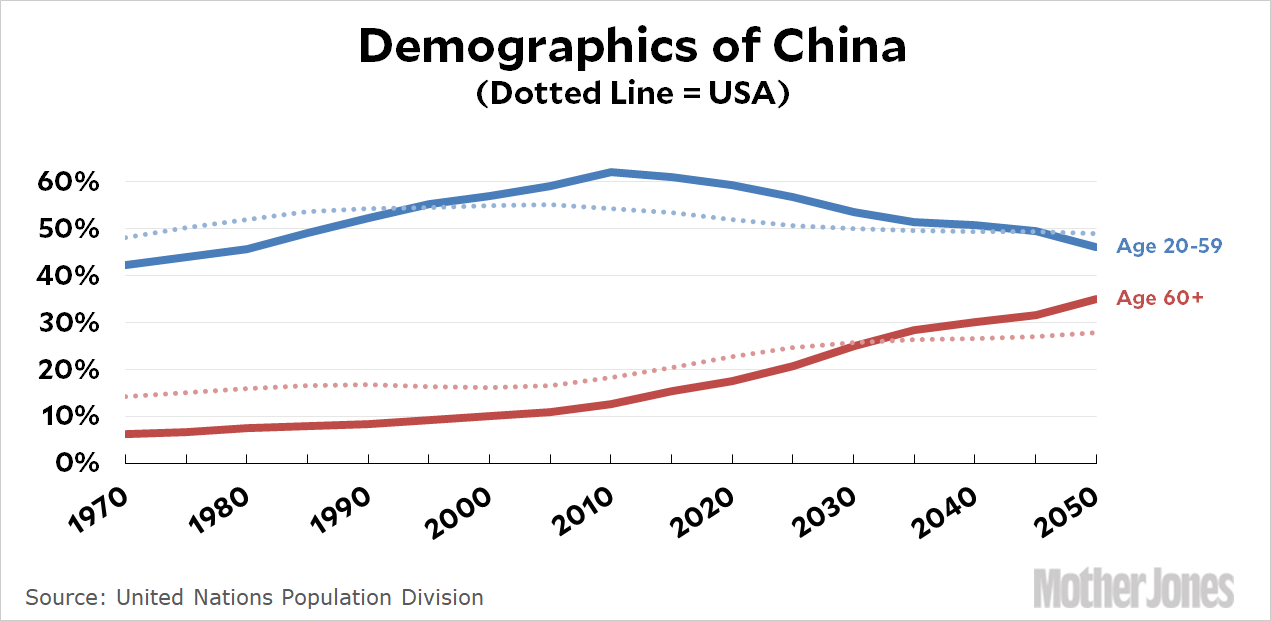
    Besides, how scared of China should we be? Every time that question comes up, I think of this chart and my answer is “not that much”:

    Depending on how you measure it, China’s per-capita GDP is currently around $10-15,000. Ours is about $60,000. China is going to have a helluva hard time getting close to even half the US level given their demographic future and the steadily increasing restrictions on fossil fuel use facing all of us.

    It may not always seem like it, but we’d all be better off engaging China on a more-or-less helpful and friendly basis rather than making them into a bogeyman. They aren’t a huge threat to us, and gaining their goodwill will probably be more important to us in a couple of decades than a point or two of GDP.

  • Support for Climate Change Policies Is a Mile Wide and an Inch Deep

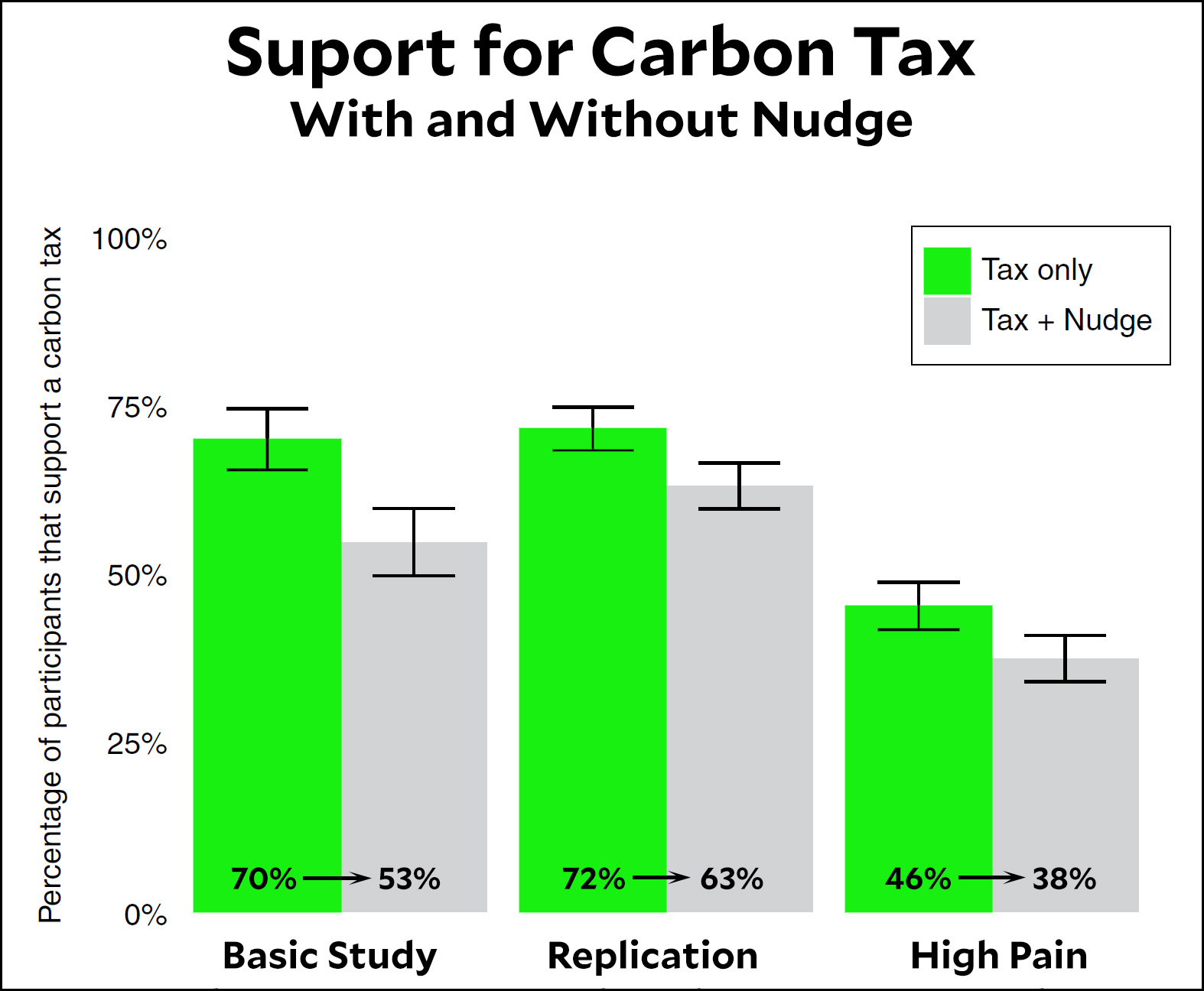
    Here’s an interesting little study about the way public opinion responds to various climate change messages. It’s a survey study with moderate sample sizes, so don’t take it too seriously, but it suggests avenues for further research. The core part of the study asks people whether they support a carbon tax. Then they’re presented with a “nudge” plan that defaults residential consumers into a renewable energy program and asked again about the carbon tax. Here are the results:

    In the first round, 70 percent supported the carbon tax—but after they heard about the renewable energy plan, support dropped to 53 percent. These results were replicated in a second round. Then the researchers performed a third round, this time framing the carbon tax as more painful. Support went down, and when the renewable energy plan was added to the mix, support went down even further.

    The rest of the study added some control questions to get at the reason behind the consistent drop in support when the renewable energy plan was added. Here’s the conclusion:

    It appears that, while people are generally concerned about societal problems such as climate change, they may not be willing to incur large costs to achieve a solution. With the perceived existence of a low-cost solution (a nudge), motivated reasoning may tempt some to exaggerate its ultimately small environmental impact. This may explain why participants generally thought the nudge was as or more effective at reducing pollution than the carbon tax. However, even those who knew that the carbon tax is more effective than the green energy nudge were discouraged from implementing the tax when a nudge became available, suggesting that crowding-out is not merely the result of incorrect perceptions of relative effectiveness.

    I think this is generalizable as support for addressing climate change is a mile wide and an inch deep. Carbon tax? Sure! But add even the smallest reason to abandon it, and people do. Merely reminding them that a carbon tax will raise energy prices cuts support by a third, and if you give people an alternative to latch onto they’ll leap at it. This supports a couple of conclusions:

    • Doomsday climate scenarios are important. Support for change is thin, which probably means that most people simply don’t understand how bad climate change is going to get.
    • Policies that address things like plastic straws or lowering your thermostat might be counterproductive. They’re mostly performative, but they convince people that they’re “doing something” about climate change and gives them an excuse to lower their support for real measures that are actually effective.

    It’s easy to look at polls and declare that big majorities support liberals on climate change. But those polls are nearly meaningless. As this study shows, support for climate policies drops dramatically when faced with even tiny changes in messaging. Just consider how this carbon tax question would have gone if it had instead faced the headwind of an opposition that can fund huge amounts of scaremongering. Support would drop like a stone. That’s the real world we live in.

  • Are Black Voters Really Obsessed With Broken Promises?

    Jim West/ZUMA

    I am perplexed by this story on the front page of the Washington Post today:

    Broken promises of the past weigh on black voters as they consider the 2020 presidential campaign

    Ariana Hawk’s trust in the promises that presidential candidates make to black communities evaporated about the same time the 2016 election ended and the candidates stopped coming to town. Flint’s crisis with lead-tainted water had put Hawk’s hometown in the national spotlight, prompting Hillary Clinton and her rivals, Sen. Bernie Sanders (I-Vt.) and Donald Trump, to make appearances there. Hawk, full of hope, voted for Clinton — but since the election, she has become convinced that all the attention from the politicians was for nothing.

    “The day after she lost, we were like, ‘Where have they gone?’” said Hawk, 29, a mother of five, who says she is fighting cynicism about the 2020 Democratic field. Still, she can’t help but think, “This is some other candidate, saying some bull to get us out here to vote or something like that.”

    First of all, aside from Hawk there’s nobody in the story complaining about broken promises. So where did the headline come from? Second, surely Hawk understands that politicians show up in lots of places during presidential campaigns and then stop visiting when the campaign is over. Third, why does she think the attention was all for nothing? Flint has received (a) $100 million from the EPA funded by the Water Infrastructure Improvements for the Nation Act of 2016, (c) an additional $70 million in other federal aid, (b) $250 million in state aid, (d) a $97 million court settlement to replace lead and galvanized steel water lines, (e) millions more in private aid, and (f) an enormous menu of other federal aid. Altogether Flint has received something like half a billion dollars in aid money.

    Anyway, the rest of the story, which is based on “interviews with dozens of black voters in three competitive states — Michigan, Pennsylvania and North Carolina,” says that some black voters are thinking of voting for Joe Biden, while others are thinking of voting for Kamala Harris or Cory Booker. And . . . that’s about it.

  • Congress Muses About Doing Something Good for Americans

    I wonder if they ever told the story of surprise ER medical bills?Discovery Health Channel

    The LA Times tells a story about my member of Congress:

    Even through the pain of a burst appendix just weeks before election day, Katie Porter made sure her campaign manager took her to Hoag Hospital in Irvine — and not to a closer hospital — because she knew the emergency room was in her insurance network. An appendectomy followed, plus five days in the hospital on IV antibiotics. About $55,000 worth of services was covered by her Anthem Blue Cross insurance policy with only a $250 co-pay from Porter.

    But a few weeks later, she said, she was hit with a $3,231 bill from the surgeon who, despite operating in a hospital in the Anthem network, was not in the network himself. That left Porter on the hook for $2,800 out of pocket. Porter, a Democrat elected in November to represent Irvine in Congress, was hit with a surprise medical bill — a phenomenon that happens in upward of 20% of emergency room visits, according to estimates.

    And that’s in a state that already has some of the toughest surprise billing laws in the nation.

    I am, of course, sorry that Porter had a burst appendix, but there are days when I wish every member of Congress had to go through this. Maybe then we could do something about it. At the moment, though, I’m not optimistic:

    Republicans and Democrats have introduced several preliminary ideas for how to address the problem, including capping out-of-network bills at a certain rate or requiring physicians in such situations to be paid at the in-network rates even if they don’t have a contract with the insurance company. Sens. Lamar Alexander (R-Tenn.) and Patty Murray (D-Wash.) are putting together a more expansive healthcare package that would address the surprise bills as well as try to bring down healthcare costs.

    ….Sen. Chris Murphy (D-Conn.)…is skeptical of giving Republicans any political leverage on the issue. “I worry that Republicans are going to try to distract the American public from the fact that they are repeatedly stabbing you in the leg by putting a Band-Aid on a small cut on your finger,” Murphy said of the bill on surprise billing and healthcare costs. “Maybe I’ll be surprised and there is really groundbreaking stuff in there.”

    We’ll see. President Trump has said he’s in favor of fixing this, but Trump says a lot of things. It was a few weeks ago anyway, so it’s unlikely he even remembers saying it. And if this goes the way things usually go, Republicans will somehow decide that they’re doing Democrats a favor by passing a surprise-billing law and will therefore demand a tax cut on pharmaceutical companies in return.


  • Kris Kobach Needs a 24/7 Government Jet

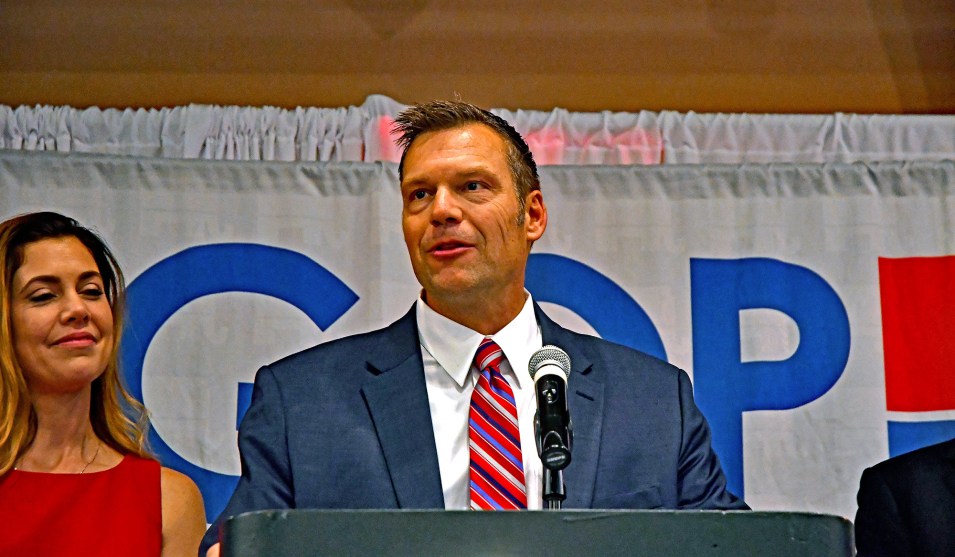
    Kansas Secretary of State Kris Kobach on election night, conceding defeat to Democrat Laura Kelly, who crushed him in a state that Trump won by 21 points.Mark Reinstein/ZUMA

    Everyone’s favorite story from last night is about Kris Kobach’s set of demands before he’d accept a job as Donald Trump’s “immigration czar”:

    24/7 access to a government jet! Just in case the czar needs to conduct an emergency visit to the border at 3 am.

    But the best part is this bland sentence in the New York Times piece: “The list was described by three people familiar with it.” A lot of people must really have it in for Kobach, since leaking this list would obviously doom his appointment—assuming the demands themselves hadn’t already done it.

    Like Ted Cruz, Kobach is truly an odious person who nobody likes. Even his fellow Kansans want nothing to do with him these days. Someone needs to give him a late night gig on Fox News and then the rest of us can forget he ever existed.

  • Court Rules That President Must Obey the Law

    Douglas Christian/ZUMA

    The judicial fight between Congress and President Trump has completed its first round:

    President Trump’s accounting firm must turn over his financial records to Congress, a Federal District Court judge ruled on Monday, rejecting his legal team’s argument that lawmakers had no legitimate power to subpoena the files.

    That’s all well and good, but don’t get your hopes up too quickly. These kinds of decisions are routinely stayed while the case is on app—

    The judge said that the Mr. Trump’s legal arguments were too thin to merit a stay because they did not raise a “serious legal question,” and said that issuing such a stay would amount to interfering with the constitutional powers of Congress.

    “The court is well aware that this case involves records concerning the private and business affairs of the president of the United States,” he wrote. “But on the question of whether to grant a stay pending appeal, the president is subject to the same legal standard as any other litigant that does not prevail.

    Wait. The president is subject to the law just like anyone else? What kind of radical left-wing mummery is this?

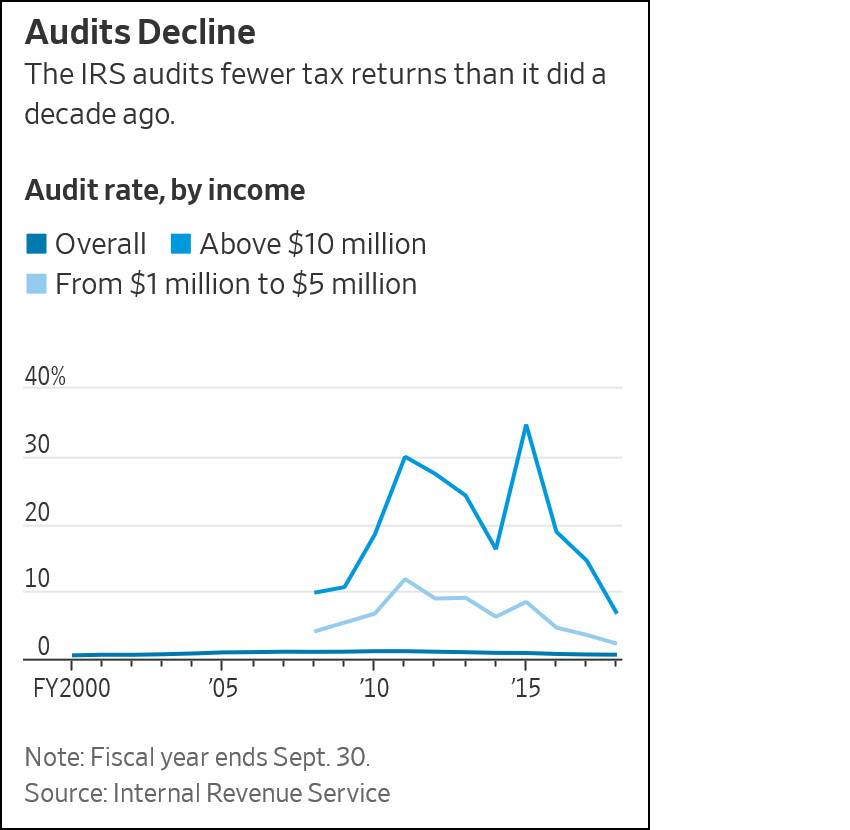
  • Chart of the Day: Audits of Rich People Plummeted Last Year

    Never let it be said that rich people don’t get their money’s worth from the Republicans they vote for:

    This comes from the Wall Street Journal, which reports the following by way of explanation:

    Audits of the highest-income households dropped sharply, to their lowest levels since the IRS began reporting that data in 2008. In fiscal 2018, the IRS audited 6.66% of returns of filers with more than $10 million in adjusted gross income, down from 14.52% in 2017.

    ….The IRS released the data as it is trying to persuade Congress to make long-run investments in the agency’s technology and enforcement staff. So far, however, key Republicans in Congress remain skeptical, and there are mixed signals about whether the government will reverse the steady decline in tax enforcement. “I’m not averse to beefing up their budget a little bit but I want to see results,” said Sen. John Kennedy (R., La.), who heads the subcommittee that oversees the IRS budget. “I’ve got a lot of confidence in the new commissioner and in the new secretary, but I’m not into just throwing money at the wall because the bureaucracy says we need more.”

    ….Many of the recent changes have stemmed from Republican spending cuts after they took control of the House in 2011 and after the IRS said in 2013 that it had improperly scrutinized some conservative nonprofit groups. Adjusted for inflation, the 2019 IRS budget is smaller than in 2000 and is 19% below peak funding in 2010….The number of examiners that performs audits shrunk 38% from 2010 to 2017.

    “Key Republicans in Congress remain skeptical.” Ha ha ha. Good one. Needless to say, reducing the IRS enforcement budget and its number of auditors has been the whole point of Republican policy toward the IRS over the past couple of decades. Rich people are unhappy when they get audited, and we can’t have that, can we?