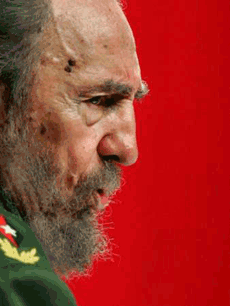
With Fidel Castro at death’s door, Miami is frothing at the mouth. The authorities are bracing for the worst, anticipating that the leader’s death could send an armada of row boats into the seas between Miami and Cuba as some exiles rush home to reclaim lost businesses and properties while others aim to foment a guerrilla war against the weakened regime. “The message we want to send is, ‘Do not throw yourself to the waters,'” Amos Rojas Jr., the South Florida regional director of the Florida Department of Law Enforcement said yesterday. “‘Be patient, the trip is very dangerous.'”
What happens in Cuba when Castro dies is in no way predictable. The nation’s economy is closely tied into an economic coalition with Venezuela and China. In addition to Cuba’s important supplies of nickel, used in the manufacture of various types of specialty steels, there are solid signs of an oil field off the island’s north coast. If so, energy independence could be in sight. (In fact, the Caribbean is becoming something of an energy trove. Trinidad is the center of a major gas field which currently is providing gas for LNG shipments to the east coast of the U.S. where the demand for gas is steadily increasing.)
If the Democrats control the Congress — and with South Dakota Senator Tim Johnson’s sudden illness this is no longer assured — U.S. policy toward Cuba is not likely to change much. In all likelihood it will continue along the same lines it has since 1959, when Secretary of State Christian Herter declared “economic warfare” on Cuba, cutting off the sugar trade and its fuel supply. As Ricardo Alarcon, Cuba’s vice president, recently put it in Counterpunch, the idea has been “to bring about hunger, misery and desperation among the people of Cuba.”
A State Department analysis in April 1960 said that since “the majority of Cubans support Castro, the only foreseeable means of alienating internal support is through disenchantment and disaffection based on economic dissatisfaction and hardship.” To weaken the economic life of Cuba there was a need to take a “positive position which would call forth a line of action while as adroit and inconspicuous as possible makes the greatest inroads in denying money and supplies to Cuba, to decrease monetary and real wages, to bring about hunger, desperation and overthrow of government.”
The policy didn’t work. After 46 years of ceaseless machinations to kill or topple Castro, the U.S. has gotten nowhere. In 2004, the Bush administration’s Commission for Assistance to a Free Cuba put out a report that insisted the Castro government was about to collapse, after which a U.S. transition team could effect an occupation and remake the place in the democratic image of the U.S. — just like in Iraq.
However, as Wayne Smith, a former U.S. diplomat who served in Cuba and who has extensive knowledge of U.S.-Cuban relations, noted, instead of collapsing, the Cuban economy “has shown strong signs of reinvigoration. Even the CIA gives it a growth rate of 8 percent.”