The Horseshoe Crab Economy

Wikimedia Commons

Get your news from a source that’s not owned and controlled by oligarchs. Sign up for the free Mother Jones Daily.


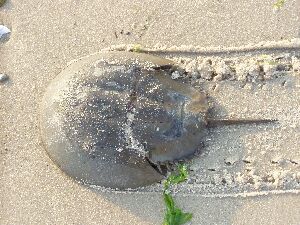
It’s also a global economy that affects millions. Notably, millions of little shorebirds known as red knots, whose numbers have declined 75 percent since the horseshoe crab fishery in Delaware Bay exploded. Prior to 1992, 100,000 crabs a year were caught. In 1997, more than 2 million. The result: 90 percent fewer crab eggs for visiting shorebirds to eat.

Here’s the background: A lot of migrating shorebirds depend on Delaware Bay as a feeding stop. Red knots can’t live without it. Until 1992 the Bay was a dependable fuel station on their annual 18,600-mile migration between the Arctic and the southern tip of South America and back. That’s right, 18,600 miles a year. Fifty percent more flying than the average American drives per year. All from a bird weighing 6 ounces.

Now a new study has found the proportion of red knots visiting Delaware Bay who manage to pack on enough weight to survive the winter in Tierra del Fuego dropped along with the crab eggs. In fact the proportion of birds who made their target weight by their target departure date declined between 50 and 75 percent between 1997 and 2007.

This despite fisheries restrictions enacted in 1997 to help red knots recover. But, tell me, what kind of restrictions allow a 2007 horseshoe crab hunt bigger than the 1990 hunt?

Idiot restrictions. I wrote about other amazing long-distance fliers in Diet for a Warm Planet: how their thriftiness equals their prosperity. We all need to learn from these extraordinary feathered economists. Especially those who practice idiot economics.

Great reporting takes time. Funding it takes less than 60 seconds.

This is the season for packed schedules and long to-do lists. For us too: Mother Jones reporters are busy digging deep into the next powerful investigations that we'll be publishing here soon. So we'll make this quick: We can't do this work without your support.

We're a nonprofit newsroom, which means articles like the one you just read are funded by readers, never by a corporate owner. And if you've read this far down the page, that means the story mattered to you. Help fund more of this essential work by making a donation of any amount today. It'll only take a minute. Thanks in advance for powering the next story.

We Recommend

Latest

Sign up for our free newsletter

Subscribe to the Mother Jones Daily to have our top stories delivered directly to your inbox.

Get our award-winning magazine

Save big on a full year of investigations, ideas, and insights.

Subscribe

INDEPENDENT. BECAUSE OF YOU.

Mother Jones has no billionaires calling the shots—just readers like you making fearless reporting possible

Donate