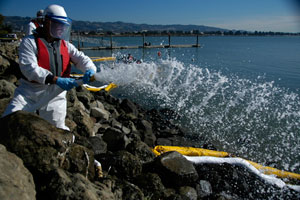
Photo courtesy of the <a href="http://cgvi.uscg.mil/media/main.php?g2_itemId=524487&g2_imageViewsIndex=1">US Coast Guard</a>.
For MoJo environmental correspondent Julia Whitty’s take on the BP dispersants study, click here.
In the weeks after the Deepwater Horizon disaster, BP—with the consent of federal regulators—spread 1.8 million gallons of dispersants on the surface of the Gulf and at the wellhead a mile below. Using dispersants in this volume and at this depth was unprecedented, and there wasn’t a great understanding of the implications. Now a new report indicates that some of the chemical components of the dispersants might remain in the Gulf for months.
The report, from scientists at Woods Hole Oceanographic Institution, finds that dispersant components aren’t breaking down all that fast, lingering in plumes of undersea oil and gas that researchers have been studying. This should “raise questions about what impact the deep-water residue of oil and dispersant—which some say has its own toxic effects—might have had on environment and marine life in the Gulf,” the Institute said in a release this week.
The lead author on the report was chemist Elizabeth B. Kujawinski, and it appeared this week in the American Chemical Society journal Environmental Science & Technology. Researchers found a component of the chemical dispersant, dioctyl sodium sulfosuccinate, up to 200 miles from the wellhead. They were also still finding the chemical two to three months after the injections. This would indicate that the mixture was not biodegrading rapidly, the scientists concluded. The report did not, however, evaluate the toxicity of the lingering components, though it does indicate that there should be more investigation into the effects the chemicals may have on the Gulf.
The EPA acknowledged that BP’s use of dispersants was a massive, real-time science experiment, but has said it believed the use was justified and better than the alternative—not using them at all. A later report from the National Oil Spill Commission also endorsed their use while arguing that the agency should have been better prepared to make informed decisions on dispersants. This latest research is certainly evidence that more work needs to be done to understand the full impacts of these chemicals.