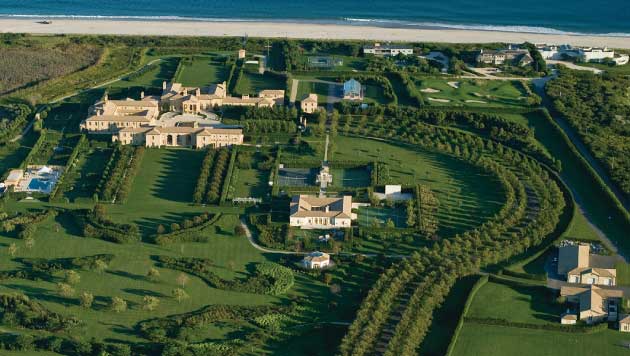
The House That Ate the Hamptons

Ira Rennert's Fair Field<a href="http://commons.wikimedia.org/wiki/File:Ira_Rennert_house.jpg" target="_blank">Wikimedia Commons</a>

Get your news from a source that’s not owned and controlled by oligarchs. Sign up for the free Mother Jones Daily.


This weekend, Mitt Romney made a very profitable swing through the Hamptons. On the agenda: A trio of fundraisers, including a $50,000-a-head party at David Koch’s $18 million estate and a shindig at financier Ronald Perelman’s 57-acre estate, home to “the most outstanding private conifer collection in the United States.” But those spreads have nothing on billionaire Ira Rennert’s estate in Sagaponack (which, sadly for Romney, did not host a fundraiser). 

Thought to be America’s largest inhabited residence, Fair Field cost $100 million to build and is worth at least $200 million. The 110,000-square-foot complex has 29 bedrooms, 39 bathrooms, three pools, two libraries, a bowling alley, a playground, a full theater, its own power plant, and a garage for 100 cars. The main building is 66,000 square feet, 28 times bigger than the average new house. It’s the third-largest private home in America. (No. 1 is the 174,000- square-foot Biltmore Estate.) The mansion even inspired a novel, The House That Ate the Hamptons. Kurt Vonnegut called it “the greatest book ever written.” In a rare public appearance, Rennert described his mega-mansion as “old age and loneliness insurance.”

A local architect who approved the project praised its “restrained classic design.” Or, as one local put it to MoJo‘s Josh Harkinson, “It’s a fucking monster!” Fair Field is now at the heart of a new controversy between Rennert and his slightly less affluent neighbors, who have accused him of “practicing class warfare” with his noisy private helicopters. Seriously. Check it out.


BEFORE YOU CLICK AWAY!

December is make or break for us. A full one-third of our annual fundraising comes in this month alone. A strong December means our newsroom is on the beat and reporting at full strength. A weak one means budget cuts and hard choices ahead.

The December 31 deadline is closing in fast. To reach our $400,000 goal, we need readers who’ve never given before to join the ranks of MoJo donors. And we need our steadfast supporters to give again today—any amount.

Managing an independent, nonprofit newsroom is staggeringly hard. There’s no cushion in our budget—no backup revenue, no corporate safety net. We can’t afford to fall short, and we can’t rely on corporations or deep-pocketed interests to fund the fierce, investigative journalism Mother Jones exists to do.

That’s why we need you right now. Please chip in to help close the gap.

BEFORE YOU CLICK AWAY!

December is make or break for us. A full one-third of our annual fundraising comes in this month alone. A strong December means our newsroom is on the beat and reporting at full strength. A weak one means budget cuts and hard choices ahead.

The December 31 deadline is closing in fast. To reach our $400,000 goal, we need readers who’ve never given before to join the ranks of MoJo donors. And we need our steadfast supporters to give again today—any amount.

Managing an independent, nonprofit newsroom is staggeringly hard. There’s no cushion in our budget—no backup revenue, no corporate safety net. We can’t afford to fall short, and we can’t rely on corporations or deep-pocketed interests to fund the fierce, investigative journalism Mother Jones exists to do.

That’s why we need you right now. Please chip in to help close the gap.

We Recommend

Latest

Sign up for our free newsletter

Subscribe to the Mother Jones Daily to have our top stories delivered directly to your inbox.

Get our award-winning magazine

Save big on a full year of investigations, ideas, and insights.

Subscribe

Support our journalism

Help Mother Jones' reporters dig deep with a tax-deductible donation.

Donate