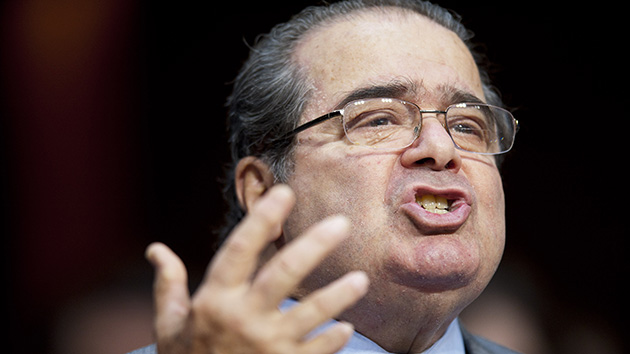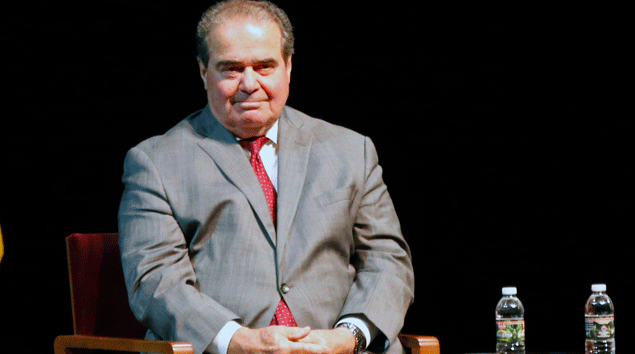
Supreme Court Justice Antonin ScaliaAP Photo/Jim Mone
During oral arguments in a pivotal affirmative action case on Wednesday morning, Supreme Court Justice Antonin Scalia raised the suggestion that African American students might belong at less rigorous schools than their white peers, and that perhaps the University of Texas should have fewer black students in its ranks.
Scalia’s comments came during arguments in Fisher v. University of Texas, a case over whether the university’s use of race in a sliver of its admissions decisions is constitutional. The University of Texas-Austin is being challenged over its use of race in admissions decisions for about 25 percent of its freshman class. About 75 percent of the students at UT-Austin are admitted through what’s known as the Top Ten Percent program, in which any student graduating within the top 10 percent of his or her class is guaranteed admission, regardless of race. The other 25 percent are admitted via a “holistic” process that takes race, and other factors, into account. It’s the “holistic” program that Abigail Fisher—who was denied admission for the university in 2008—is challenging.
The University of Texas has determined that if it excluded race as a factor, that remaining 25 percent would be almost entirely white. During the oral arguments, former US Solicitor General Greg Garre, who is representing the university, was explaining this to the justices. At that point, Scalia jumped in, questioning whether increasing the number of African Americans at the flagship university in Austin was in the black students’ best interests. He said:
There are those who contend that it does not benefit African Americans to get them into the University of Texas, where they do not do well, as opposed to having them go to a less-advanced school, a slower-track school where they do well. One of the briefs pointed out that most of the black scientists in this country don’t come from schools like the University of Texas. They come from lesser schools where they do not feel that they’re being pushed ahead in classes that are too fast for them.
He went on to say, “I’m just not impressed by the fact the University of Texas may have fewer [blacks]. Maybe it ought to have fewer. I don’t think it stands to reason that it’s a good thing for the University of Texas to admit as many blacks as possible.”
After a comment like this, Court watchers will really be looking forward to his opinion in the case.