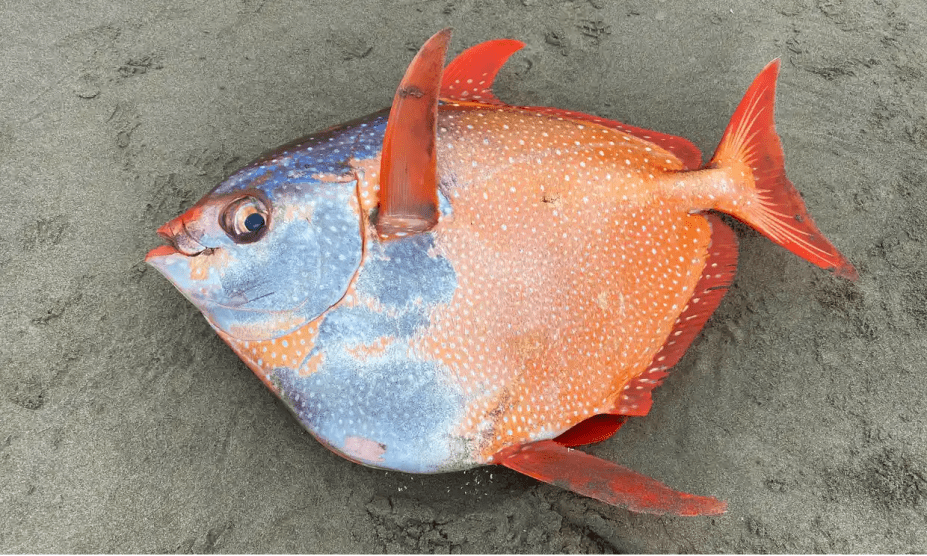
An Opah fish, more than 3.5 feet long, washed up on the coast of Oregon's Sunset Beach.Seaside Aquarium/Facebook
This story was originally published by The Guardian and is reproduced here as part of the Climate Desk collaboration.
An unusual sight has appeared on the usually mild northern Oregon coast: a large, washed-up, colorful opah fish, weighing around 100lb.
The opah, or moonfish, is “rare to the Oregon coast,” according to the aquarium in Seaside, a city in the north of the state where the fish appeared on a beach. The fish is more than 3ft long, with a round, orange and silver body dotted with white spots.
Opah can grow to more than 6ft and weigh more than 600lb, living in the open ocean in tropical and temperature waters where they feast on krill and squid. It is unusual, although not unheard of, for them to venture as far north to the normally chillier waters of northern Oregon.
The fish’s appearance caused “quite the stir,” according to Seaside Aquarium, which will freeze the animal until the new school year starts so that “one lucky school group will get the chance to dissect this large fish.”
The Pacific north-west coast of the US has been baked by record temperatures in recent weeks, while a huge heatwave pulsing off the coast of Vancouver caused an estimated one billion marine creatures to die, mussels and clams cooking in their own shells.
Scientists have said such heat would have been “virtually impossible” without human-caused climate change, although it’s unclear whether this has had a role in the appearance of the opah in Oregon.
“We are seeing some marine organisms moving northward as ocean temperatures increase,” Heidi Dewar, a research biologist with National Oceanic and Atmospheric Administration Fisheries, told the Washington Post, although she added it was hard to say exactly what caused the opah stranding.