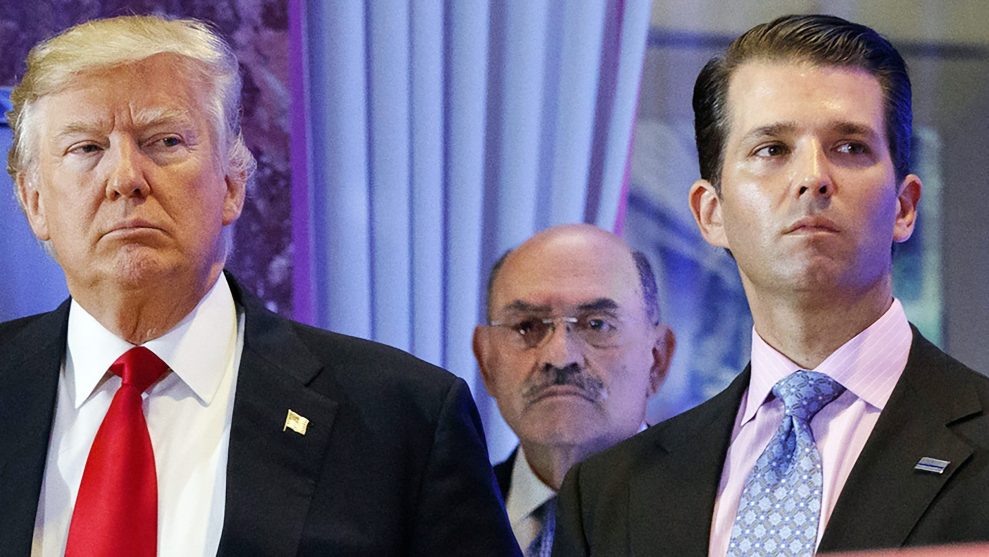
Donald Trump and his son Donald Trump Jr., at a press conference on Jan. 11, 2017, with then-Trump Organization CFO Allen Weisselberg.Evan Vucci/AP
Last year, Allen Weisselberg did everything he could to protect Donald Trump from New York prosectors. With the Trump Organization facing tax evasion charges in Manhattan, Weisselberg—the former president’s longtime CFO—tried to take the fall for his old boss. It didn’t work. On Tuesday, Weisselberg was back on the witness stand, this time as part of the civil fraud trial that threatens to decimate Trump’s business empire. And his testimony suggests that once again, Trump’s legal team could be planning to employ the same “Blame Weisselberg” strategy. It’s probably won’t work this time, either.
Weisselberg’s testimony Tuesday reprised his complicated role as a loyal company man and the fall guy for Trump’s alleged wrongdoing. Last year, during the criminal tax evasion trial, Trump Organization lawyers tried to paint the whole thing as a scheme orchestrated by Weisselberg, with no involvement from Trump family members. Even though prosecutors lacked hard evidence that Trump knew what was going on, they secured convictions against his businesses. (Trump wasn’t charged personally.)
The current case, a $250 million civil lawsuit brought by New York Attorney General Letitia James, has Trump’s handwriting is all over it—literally; he signed the documents in question. And while last year’s tax fraud case involved transactions that benefited others who worked for Trump, the allegations that James has made in the current case—that Trump falsely inflated the value of his properties to secure better deals with banks and insurance companies—strike at the heart of Trump’s identity as a real estate mogul and a political candidate.
In both cases, Weisselberg is a pivotal figure. As CFO of the Trump Organization, he was in charge of most of the daily financial operations, at least the mundane ones like check-writing, bookkeeping, and number-crunching. While Trump and his children appeared on television—and later on the campaign trail—touting their fabulous wealth, Weisselberg pored over the spreadsheets and account balances. In last year’s trial, Trump Organization lawyers argued that Weisselberg—who had earlier pleaded guilty to fixing company books to augment his own salary without paying the correct taxes—acted alone.
“Weisselberg did it for Weisselberg!” one of Trump’s attorneys regularly shouted at the jury throughout the 2022 trial.
In James’ case on Friday, another Trump Organization executive, Jeff McConney, testified that he helped create false valuations for properties because Weisselberg told him to do so, and he was afraid he would be fired if he disobeyed Weisselberg’s orders. On the stand Tuesday, Weisselberg firmly refused to implicate anyone further up the chain—or at least he tried not to—testifying that neither Donald Trump nor any of Trump’s children had ever directed him to inflate numbers.
But, later in the day, Weisselberg was forced to admit that in every year during which false valuations were allegedly created—starting in 2011 and continuing until Trump entered the Oval Office—Weisselberg took the numbers to Trump, who reviewed them, occasionally offered comment, and then signed off on them. After Trump became president, Weisselberg said, he took the numbers to Donald Trump Jr. or Eric Trump, both of whom are co-defendants in the fraud case.
And that’s the problem with this case for Trump—it is very personal to him. While he may not have personally done any granular number-crunching or value-inflating, it was his business, with his name. Trump and his children negotiated the deals with bankers, met with insurance company executives, and signed their names to the various loan applications. And Trump has made it very clear—through his public statements and a deposition he gave earlier this year—that he is intensely interested and invested in the valuations of his properties.
Trump’s former attorney and fixer, Michael Cohen, is set to take the stand next week. Cohen’s testimony before Congress in 2019, in which he described Trump bragging about manipulating the values of properties when it suited him, kicked off James’ investigation. Based on questions from James’ lawyers in court on Tuesday, it seems likely that Cohen will be asked whether he met with Trump and Weisselberg to inflate the valuations of various properties. In his testimony, Weisselberg reportedly denied meeting with Cohen and Trump to talk about values, but he also testified that he couldn’t recall many of the details about his own involvement or the roles of others.