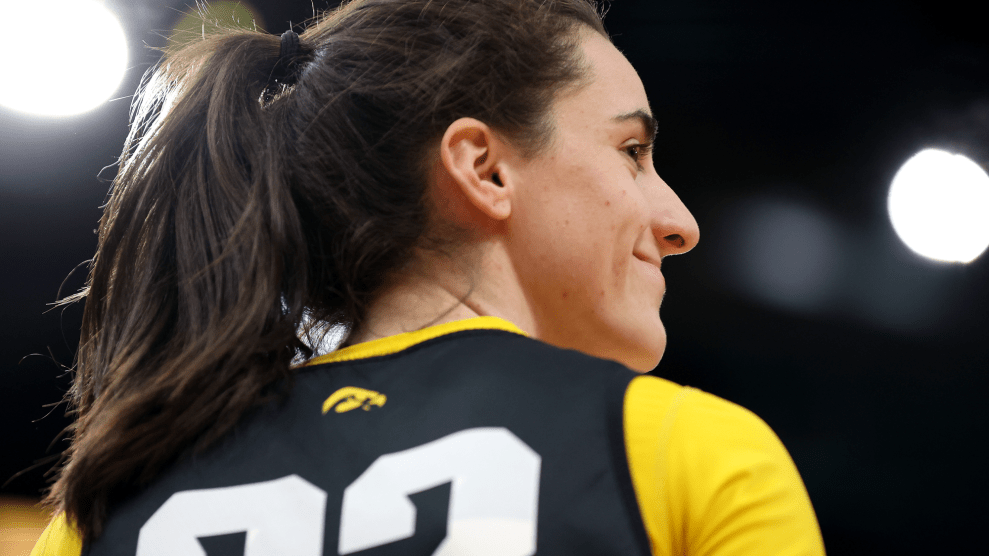
Iowa Hawkeyes star Caitlin Clark during Final Four warmups on Friday.Steph Chambers/Getty
When Caitlin Clark’s historic college career reaches its finale following Sunday’s NCAA championship game vs. undefeated South Carolina, the WNBA will welcome her and her legions of young fans with open arms. Jersey sales, ticket sales, and endorsements will bring in millions of dollars for the team that drafts her—and for the league itself. This is speculative, of course, because nothing in sports is 100 percent guaranteed. Fans are fickle and injuries happen. The only thing players can absolutely count on are the contracts they sign with the teams that draft them. And by that metric, Clark will have to take a pay cut to turn pro.
As a college player, Clark already earns more than $3 million annually thanks to name, image, and likeness deals that now allow collegiate athletes to make money from corporate endorsements. Gatorade and Nike have already endorsed Clark.
Our Player of the Year 🤩@CaitlinClark22 x #Hawkeyes pic.twitter.com/iiyjsdtO6m
— Iowa Women's Basketball (@IowaWBB) April 3, 2024
Women’s basketball has soared in popularity in recent years, with this year’s March Madness tournament dwarfing its men’s counterpart. There are plenty of reasons for this, but one of them is that the game is just fun to watch. Clark’s sharpshooting routinely draws comparison to Steph Curry.
All of this new attention is making it harder to ignore the fact that women’s athletes aren’t paid anywhere near the same level as men. Kelsey Plum, a star point guard for the reigning champion Las Vegas Aces pointed out in an interview that pay equity isn’t even about being paid the same as their male counterparts. “In the NBA, they have percentages of revenue shared [with] the players—so, jersey sales, obviously their TV contracts,” Plum said on the Residency Podcast. But in the WNBA, that’s “not the case.”
As things stand, the base salary, even for the No. 1 pick in the WNBA draft, is a paltry $76,000, while the top players max out at just over $252,000. (The men’s minimum salary for 2023-24 is north of $1.1 million.) For years, the top women players have supplemented their incomes by playing overseas during the off-season. That’s what Brittney Griner was doing in Russia when she was detained for 10 months in 2022, a moment that made fans and casual observers more aware of the pay equity issue in women’s sports. “The whole reason a lot of us go [overseas] is the pay gap…As much as I would love to, you know, pay my light bill for the love of the game, I can’t,” Griner told reporters when she was finally freed and able to return to basketball.
“The whole reason a lot of us go [overseas] is the pay gap … As much as I would love to, you know, pay my light bill for the love of the game, I can’t.”
— WNBA star Brittney Griner says she will never play basketball overseas again unless it’s to play for the U.S. Olympic team pic.twitter.com/nrHDUkXcVS
— The Recount (@therecount) April 27, 2023
The WNBA’s CBA is set to be renegotiated at the end of 2024, which is almost perfect timing for Clark. She will almost certainly be selected first overall by the Indiana Fever on April 15, when the draft is held at the Brooklyn Academy of Music. The venue is just across Barclays Center, home to the New York Liberty, whose star players probably don’t even earn enough to rent the $5,000 luxury one-bedroom apartments near the arena.