


Adam Serwer is a reporter at Mother Jones. Formerly a staff writer at the American Prospect, he has written for the Washington Post, the Root, the Village Voice, and the New York Daily News.
Rep. Michele Bachmann (R-Minn.) thinks the ACLU is in charge of the CIA.
During Saturday night's GOP presidential primary debate on CBS, Rep. Michele Bachmann accused President Barack Obama of "allowing the ACLU to run the CIA." On NBC's Meet the Press the next day, Bachmann doubled down on the assertion that the Obama administration has been manipulated by diabolical civil libertarian groups:
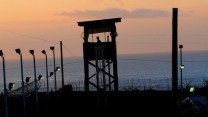
We all know that that isn't a long-term solution to this problem. We aren't adding any new terrorists to Guantanamo Bay. We only have Khalid Sheikh Mohammed, the admitted mastermind of 9/11, who is at Guantanamo Bay, and others as well. But we don't have a place to put Al Qaeda when we pick them up. It's either catch and release, which is a terrible idea, or we have to kill them. What we need to win this war on terror is interrogation. This is where my comment about the ACLU comes in because today the CIA is no longer able to go through the interrogation that yielded such profitable information that saved American lives. That's what I'm interested in, David…The, the, the only thing that we have available to us today is the Army field manual. That's online. So terrorists can go ahead and read ahead of time what will happen to them when we capture them, and it's really, effectively, when we capture them today, it's a slap on the wrist. I want to save American lives, and that's why I want the CIA…
Host David Gregory pointed out that the United States does in fact continue to detain terrorism suspects in Afghanistan, on aircraft carriers, and in secret foreign facilities, but for some reason he neglected to mention the dozens of domestic maximum and supermax facilities available on American soil, which hold hundreds of convicted terrorists. There are more terrorists serving prison terms in the US than there are detainees at Gitmo.
Did you miss the Republican foreign policy debate tonight? So did I, sort of. I spent about a third of the time watching the Stanford-Oregon game, about a third of the time following my Twitter stream—which was far more entertaining than the actual debate—and about a third of the time actually listening to the debate itself. So my insights are limited.
A couple of random notes. Virtually the entire debate was focused on national security: Pakistan, Afghanistan, Iran, and the Middle East. Pakistan was mentioned constantly, and virtually every candidate took the opportunity to demonstrate that they knew the phrase "Haqqani network." However, not a single one of them mentioned the word "India," without which any discussion of Pakistan's motivations is completely worthless. Maybe next time.
Moderators Scott Pelley and Major Garrett did a weak job in general and a terrible job on Europe. Which is to say that in a 90-minute debate taking place while Europe is practically melting down as we speak, they didn't mention Europe once until the last two minutes. They managed to ask Jon Huntsman one question about Europe and Rick Perry half of a question. Nice work, guys.
Herman Cain almost charmingly demonstrated that he simply knows nothing about the outside world, and Rick Perry beat expectations by not imploding spectacularly again. All of the candidates insisted that they'd take a completely different approach to Iran than Barack Obama, but then proposed doing almost exactly what Obama is doing. For the most part, though, as Dan Drezner says, the candidates kept the crazy bottled up fairly well. But not always. Fred Kaplan's review of the crazy is here. Below are my favorite moments from the debate, both good (Huntsman and Paul on torture) and bad (just about everything else). Consider this the Cliff's Notes version of the debate.
Michele Bachmann predicts "worldwide nuclear war" against Israel:
This is a very dangerous time. If you look at Iran and if you look at Pakistan and if you look at the links with Syria — because Iran is working through proxies like Syria, through Hezbollah, through Hamas — it seems that the table is being set for worldwide nuclear war against Israel. And if there's anything that we know, President Obama has been more than willing to stand with Occupy Wall Street, but he hasn’t been willing to stand with Israel. Israel looks at President Obama and they do not see a friend.
Herman Cain demonstrates that he knows nothing about Pakistan:
You have said about foreign policy, "America needs to be clear about who its friends are and who its foes are." So this evening, sir, Pakistan, friend or foe?
We don't know. Because Pakistan is where Osama bin Laden was found and eliminated. Secondly, Pakistanis have a conversation with President Karzai from Afghanistan and President Karzai has said that if the United States gets into a dispute with Pakistan, then Afghanistan's going to side with Pakistan. There is a lot of clarity missing, like Speaker Gingrich says, in this whole region. And they are all interrelated. So there isn't a clear answer as to whether or not Pakistan is a friend or foe. That relationship must be reevaluated.
Rick Perry echoes Sarah Palin's explanation of her military experience:
For ten years, I have been the commander in chief of over 20,000-plus individuals in the State of Texas as we've dealt with a host of either natural disasters or having deployments into the combat zone. So, if there's someone on this stage who has had that hands-on commander in chief experience, it is me, as the governor of the State of Texas.
Herman Cain contradicts himself on torture within 30 seconds:
I believe that following the procedures that have been established by our military, I do not agree with torture, period. However, I will trust the judgment of our military leaders to determine what is torture and what is not torture. That is the critical consideration.
In the last campaign, Republican nominee John McCain and Barack Obama agreed that [waterboarding] was torture and should not be allowed legally and that the Army Field Manual should be the methodology used to interrogate enemy combatants. Do you agree with that or do you disagree, sir?
I agree that it was an enhanced interrogation technique....I don't see it as torture. I see it as an enhanced interrogation technique.
Ron Paul opposes torture:
Well, waterboarding is torture. It's illegal under international law and under our law. It's also immoral. And it's also very impractical. There's no evidence that you really get reliable evidence. Why would you accept the position of torturing 100 people because you know one person might have information? And that's what you do when you accept the principle of torture. I think it's uncivilized and has no practical advantages and is really un-American to accept on principle that we will torture people that we capture.
Jon Huntsman opposes torture too:
We diminish our standing in the world and the values that we project, which include liberty, democracy, human rights, and open markets, when we torture. We should not torture. Waterboarding is torture. We dilute ourselves down like a whole lot of other countries. And we lose that ability to project values that a lot of people in corners of this world are still relying on the United States to stand up for them.
Huntsman schools Romney on how to deal with China:
Romney: Well number one, on day one, it's acknowledging something which everyone knows, they're a currency manipulator. And on that basis, we also go before the WTO and bring an action against them as a currency manipulator. And that allows us to apply, selectively, tariffs where we believe they are stealing our intellectual property, hacking into our computers, or artificially lowering their prices and killing American jobs.
Huntsman: The reality's a little different as it usually is when you're on the ground. And I've tried to figure this out for 30 years of my career. First of all, I don't think, Mitt, you can take China to the WTO on currency-related issues. Second, I don't know that this country needs a trade war with China. Who does it hurt? Our small businesses in South Carolina, our exporters, our agriculture producers.
[Ed. note: Huntsman is right about the WTO.]
Rick Perry says he will by God use torture until the day he dies, but he will never ever call it torture:
Let me just address Congressman Paul. Congressman, I respect that you wore the uniform of our country. But in 1972, I volunteered to serve the United States Air Force. And the idea that we have our young men and women in combat today, where there are people who would kill them in a heartbeat, under any circumstance, use any technique that they can, for us not to have the ability to try to extract information from them, to save our young people's lives, is a travesty. [VOICE RISES] This is war. That's what happens in war. And I am for using the techniques, not torture, but using those techniques that we know will extract the information to save young American lives. And I will be for it until I die.
Michele Bachmann suggests we adopt China's social safety net:
What would I cut? I think, really, what I would want to do is be able to go back and take a look at Lyndon Baines Johnson's The Great Society. The Great Society has not worked, and it's put us into the modern welfare state. If you look at China, they don't have food stamps. If you look at China, they save for their own retirement security. They don't have pay FICA. They don't have the modern welfare state. And China's growing. And so what I would do is look at the programs that LBJ gave us with The Great Society, and they'd be gone.
Rick Perry demonstrates that he only barely knows what the euro is:
How do you prevent the European crisis from become a problem on Wall Street?
The French and the Germans have the economic forewithal to deal with this. They have the economy. When you think about the Euro and when it was established, it was done to be a competitor to the American dollar. They knew what they were doing. And now they find themselves with their overspending and-- and-- the sovereign debt being built up. And--
And that's a wrap! Time ran out at that point, so we'll never know just what painfully ignorant point Perry was about to make. Lucky guy.
For the most part, the Republican contenders responded as expected. Mitt Romney said that "the right course is for us to do our very best to secure the victory that has been so hard-won" through sacrifice and hundreds of American lives, which is exactly what he's been saying about both Afghanistan and Iraq for a while now.
Unsurprisingly, perennial back-runner Jon Huntsman responded by echoing his standard, dovish line on the war: get the troops out ASAP. But what was mildly surprising was that he answered the question in Barack Obama's words.
"We've had free elections in 2004, we've uprooted the Taliban, we've…killed Osama Bin Laden," Huntsman said. "This nation's future isn't Afghanistan; this nation's future isn't Iran."
He went on to state that he has no interest in "nation-building overseas" when "we so desperately need it at home."
During Obama's address to the nation on the Afghanistan drawdown in late June, the president spoke of how it was time to allow foreign allies to "determine their [own] destiny," and how the American mission was rapidly coming to its end. Also, there was this (emphasis my own):
"Now, we must invest in America's greatest resource—our people. We must unleash innovation that creates new jobs and industry, while living within our means. We must rebuild our infrastructure and find new and clean sources of energy...America, it is time to focus on nation building here at home."
Perhaps Huntsman's former employer has been rubbing off on him more than he'd like to admit.
The American Civil Liberties Union is running the Central Intelligence Agency, Rep. Michele Bachmann (R-Minn.) told the CBS GOP primary debate audience Saturday night. Apparently, not CIA Director David Petraeus.
"[Obama] is allowing the ACLU to run the CIA" Bachmann asserted. "We have decided we are going to lose the war on terror under Obama." The ACLU, which issued a scathing report on Obama's civil liberties record earlier this year, would probably disagree. The ACLU concluded that "most [Bush-era] policies...remain core elements of our national security strategy today." Bachmann also said the CIA was no longer interrogating anyone, which is false. The CIA is part of the interagency High Value Detainee Interrogation Group, or HIG. Also, prior to 9/11, the CIA didn't actually have an interrogation program.
The question that initiated that exchange was posed to Herman Cain, who was asked whether he would allow torture as policy if he were elected president. Cain initially said that "I do not agree with torture period, I will trust the judgment of our military leaders on what is torture and what is not torture." Then Cain contradicted himself—asked specifically whether waterboarding was torture, Cain said that it wasn't. Many prominent military leaders have spoken out against enhanced interrogation techniques, including Petraeus. Rep. Ron Paul and former Utah Governor John Huntsman had very different answers—Paul argued that torture was illegal and didn't work, while Huntsman emphasized that when the United States uses torture, "we lose our ability to project certain values around the world."
The moderators then pivoted to the killing of American extremist cleric Anwar al-Awlaki in Yemen. Mitt Romney said killing al-Awlaki was "absolutely" the right thing to do. Newt Gingrich emphasized that the killing was consistent with the rule of law, because it was approved by the president and a secret unaccountable panel of national security officials. Which is exactly how the ACLU would do things, right?
Saturday night's GOP presidential debate in South Carolina focused on foreign policy, which was bad news for Herman Cain. By his own admission, it's a subject he doesn't know much about. And it showed. Taking the first question of the debate, about how he would address the prospect of a nuclear Iran, he offered a solution to a problem that doesn't exist.
Cain's big point—one he's made before—is that he would defeat the Iranian regime by choking their economy. Specifically, he would develop American energy sources (in the form of offshore oil drilling, among other things) so that we're no longer reliant on hostile nations for resources. That sounds nice. He sounded confident enough as he rattled off his talking points.
But there's a problem: The United States doesn't currently get any oil from Iran. If a Cain administration would try to curb Mahmoud Ahmedinejad's power by increasing domestic oil production, that wouldn't have any impact on the Iranian economy. In the long-term, domestic energy self-suffiency is a positive. But in response to the immediate threat of a nuclear Iran—a long-term energy plan doesn't mean anything.
Former Speaker of the House Newt Gingrich spent much of Saturday's foreign policy debate doing what he does best: haranguing moderators Scott Pelley and Major Garrett for asking him questions he doesn't like. But in the middle of one such effort, he did offer a revealing insight in his views. Gingrich rattled off a list of subjects on which President Obama's policies have been harmful (it was a long list), and then dropped a bomb: President Obama, he explained, was wrong to support something called "Agenda 21."
The response drew loud applause from the audience. Here's why: Agenda 21 is a United Nations agreement that has never been considered by the Senate, and more or less just calls on signatories to promote sustainable development practices. But in the eyes of tea party activists, it's a stepping-stone to a one-world government, which will lead to forced population control and mass displacement. My colleague Stephanie Mencimer covered this subject in an excellent 2010 piece for the magazine:
Virginia activist Donna Holt is among those who believe that Agenda 21—unveiled during the UN's "Earth Summit" in 1992—is really a plot to curtail private property rights and deprive Americans of precious constitutional freedoms. In reality, the document will do nothing of the sort, but it has nevertheless been the target of conspiracy-minded UN haters for years. Holt and other tea partiers are taking their cues from people like Henry Lamb, a WorldNetDaily columnist and founder of Sovereignty International and Freedom21, groups designed to fight Agenda 21 and its ilk. He has been arguing for decades that the UN is secretly plotting to herd humans into crowded cities so that the rest of the world can be devoted to wildlife preservation. (Lamb declined to comment for this story because back Mother Jones once included him in a story called Wingnuts in Sheep's Clothing, and another article that described his role in Astroturf lobbying against the Kyoto treaty.)
Long the subject of fringe groups, Agenda 21 has taken on more prominence in recent years. Michele Bachmann fought against it as a Minnesota state senator, and again as a congresswoman. As she said in 2008 of congressional Democrats, "They want Americans to take transit and move to the inner cities. They want Americans to move to the urban core, live in tenements, [and] take light rail to their government jobs. That's their vision for America." The non-profit education watchdog she worked with in Minnesota even went so far as to oppose International Baccalaureate, the worldwide advanced placement system, on the grounds that it undermines national sovereignty and furthered the goals of Agenda 21.
In Florida, tea party groups are currently fretting that, under the guise of Agenda 21, the United Nations will forcibly displace Americans to protect the endangered manatee. (One Republican congressman, Rep. Rich Nugent of Florida, has even introduced legislation to address these concerns.) Other activists are concerned that they'll be forced to live in underground, earthen "Hobbit homes."
Does Gingrich really believe any of this—or is it just a pander to the far-right?
Obama is "more than willing to stand with Occupy Wall Street" but "not willing to stand with Israel," Bachmann said to loud applause from the South Carolina audience. She added that Israel doesn't see "a friend" in Obama.
Given Bachmann's patented kicked-into-overdrive tendency to say and endorse pretty out-there stuff, neither comment came as much of a shock. However, let's just get some quick debunking out of the way.
As much as many in the GOP would like to tie the president to Occupy Wall Street, the so-called "support" is tenuous at best. What conservatives have seized on are quotes like this:
"Obviously, I've heard of [Occupy Wall Street], I've seen it on television. I think it expresses the frustrations that the American people feel...I think people are frustrated and the protesters are giving voice to a more broad-based frustration about how our financial system works."
The president has also stated the following when asked about the protest movement in mid-October:
In some ways, they’re not that different from some of the protests that we saw coming from the Tea Party. Both on the left and the right, I think people feel separated from their government. They feel that their institutions aren’t looking out for them...The most important thing we can do right now is those of us in leadership letting people know that we understand their struggles and we are on their side, and that we want to set up a system in which hard work, responsibility, doing what you’re supposed to do, is rewarded.
Not exactly a resounding endorsement; just a politician's attempt at empathy. (Occupy protesters, meanwhile, have nixed virtually all positive mention of Obama from Zuccotti Park and erected effigies of the president.)
Lastly, it's fairly obvious that Obama does not want to defriend Israel. Despite talk of the "Jewish backlash" that supposedly came from his recent unflattering comments about Israeli Prime Minister Benjamin Netanyahu and his mention of 1967 borders early in the summer, the Obama administration has stayed steady on military aid, played it super-safe on the Palestinian bid for statehood, and expressed Washington's "ironclad" commitment to Israel's security over and over again.
The Republican foreign policy debate tonight focused almost exclusively on terrorism and the Middle East/Central Asia region. At the very, very end, with the clock ticking down, Scott Pelley finally asked about our biggest trading partner, the European Union. Rick Perry got the nod:
PELLEY: How do you prevent the European crisis from becoming a problem on Wall Street?
PERRY: Well, the French and the Germans have the economic forewithal to deal with this. They have the economy. When you think about the Euro and when it was established, it was done to be a competitor to the American dollar. They knew what they were doing. And now they find themselves with their overspending and-- and-- the sovereign debt being built up. And--
And what?!? How was Perry going to wind this up when he was saved by the bell and Pelley cut him off? He obviously had no clue what to say about any of this and was about to wander off into free association land. All we can say is that at some point during what passes for debate prep in the Perry camp, someone mentioned the term "sovereign debt" and Perry was going to try to make some point about it. But what? In comments, please finish up Perry's remarks for him. You have 30 seconds.
The American Civil Liberties Union is running the Central Intelligence Agency, Rep. Michele Bachmann (R-Minn.) told the CBS GOP primary debate audience Saturday night. Apparently, not CIA Director David Petraeus.
"[Obama] is allowing the ACLU to run the CIA" Bachmann asserted. "We have decided we are going to lose the war on terror under Obama." The ACLU, which issued a scathing report on Obama's civil liberties record earlier this year, would probably disagree. The ACLU concluded that "most [Bush-era] policies...remain core elements of our national security strategy today." Bachmann also said the CIA was no longer interrogating anyone, which is false. The CIA is part of the interagency High Value Detainee Interrogation Group, or HIG. Also, prior to 9/11, the CIA didn't actually have an interrogation program.
The question that initiated that exchange was posed to Herman Cain, who was asked whether he would allow torture as policy if he were elected president. Cain initially said that "I do not agree with torture period, I will trust the judgment of our military leaders on what is torture and what is not torture." Then Cain contradicted himself—asked specifically whether waterboarding was torture, Cain said that it wasn't. Many prominent military leaders have spoken out against enhanced interrogation techniques, including Petraeus. Rep. Ron Paul and former Utah Governor John Huntsman had very different answers—Paul argued that torture was illegal and didn't work, while Huntsman emphasized that when the United States uses torture, "we lose our ability to project certain values around the world."
The moderators then pivoted to the killing of American extremist cleric Anwar al-Awlaki in Yemen. Mitt Romney said killing al-Awlaki was "absolutely" the right thing to do. Newt Gingrich emphasized that the killing was consistent with the rule of law, because it was approved by the president and a secret unaccountable panel of national security officials. Which is exactly how the ACLU would do things, right?
The victims and families of victims of Major Nidal Malik Hasan's shooting rampage at Fort Hood in 2009 are suing the US government for ignoring signs that Hasan was dangerous, the Associated Press reported Friday:
The government bowed to political correctness and not only ignored the threat Hasan presented but actually promoted him to the rank of major five months before the massacre, according to the administrative claims against the Defense Department, the Justice Department and the FBI. Thirteen soldiers and civilians were killed and more than two dozen soldiers and civilians were injured in the Nov. 5, 2009, shooting spree.
Fifty-four relatives of eight of the murdered soldiers have filed claims. One civilian police officer and nine of the injured soldiers have filed claims along with 19 family members of those 10.
The plaintiffs will certainly have plenty of material in the public record to make their case that the government was at fault. A report the Senate Homeland Security and Government Affairs Committee released earlier this year showed that Hasan's superiors knew about his radical beliefs ("An instructor and a colleague each referred to Hasan as a "ticking time bomb.") and promoted him anyway. The investigation found that the Department of Defense "possessed compelling evidence that Hasan embraced views so extreme that it should have disciplined him or discharged him from the military, but DoD failed to take action against him."
Whether this is due to "political correctness," as the plaintiffs claim, is a different question. The FBI anti-Muslim training materials first revealed by WIRED reporter Spencer Ackerman posited that it was normal for "mainstream" Muslims to express sympathy for terrorists. Anyone getting that kind of information might be inclined to overlook, as Hasan's superiors did, outright evidence of extremism. That's why Gen. Jack Keane (Ret.) told the Senate committee in February that "If service members clearly understand the difference between their religion, and the dangerous radicalism of violent Islamist extremism....The patriotic Muslims in our armed services will be protected against unwarranted suspicion."
The Senate report's conclusion—that "political correctness" played a role in Hasan not being stopped sooner—was widely reported. Less widely acknowledged was the report's finding that "ignorance of religious practices" was also to blame. That helps explain why Sen. Joe Lieberman (I-Conn), the chair of the committee, slammed the FBI's anti-Muslim training materials as "lies" while also going after the DoD's supposed "political correctness" with regards to Hasan. Ignorance is dangerous, but just as dangerous is ignorance masquerading as knowledge.
Obama hugs Rep. Luis Gutierrez (D-Ill.) after a meeting with the Congressional Hispanic Caucus.
President Barack Obama's strategy for winning the Latino vote is to let Republicans keep talking.
Elise Foley writes that in an interview with Latino reporters yesterday, Obama said that the GOP debates were winning the Latino vote for him.
I don't think it requires us to go negative in the sense of us running a bunch of ads that are false, or character assassinations. It will be based on facts… We may just run clips of the Republican debates verbatim. We won't even comment on them, we'll just run those in a loop on Univision and Telemundo, and people can make up their own minds.
Why does the president sound so confident? A recent Latino Decisions poll showed that Obama was poised to capture the Latino vote in similar margins as in 2008, between 65 and 70 percent. Latino Decision's Gabriel R. Sanchez, however, says Obama's problem isn't so much that Latinos will vote Republican. It's that they won't vote.
"The majority of Latinos are saying 'not so much,' in terms of being enthusiastic about his candidacy," says Sanchez, who notes that 53 percent of Latinos polled said they are less enthusiastic about Obama after his first few years in office, and 48 percent were "more excited about voting" in 2008 than they are now. Thousands of disillusioned Latino voters staying home in a given state could mean the difference between defeat and a second term. "The numbers might stay roughly the same in terms of vote share, but if turnout drops, that's problematic [for Obama]," Sanchez says.
Obama's other remarks highlight the contrast in rhetoric with his Republican opponents. The president told the group of reporters that Alabama's strict anti-immigrant law, the harshest in the country, was a "bad law" and "not simply anti-immigrant, but I think it does not match our core values as a country."
With little to show in the way of progress on immigration reform, that contrast may be the best argument the president has to offer Latino voters going forward. Whether it actually moves Latino voters to the polls is an open question. After all, Latino voters could say to themselves, "what is a Republican president going to do, deport a million people?"