- ‹ previous
- 326 of 1510
- next ›
Is Calorie Labeling Playing Favorites?
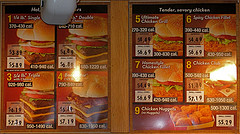
We wrote on Monday about the numerous benefits of calorie labeling on health and consumer choices. Here's an update on how the debate is unfolding throughout the intertubes. Blogger Ezra Klein has a print piece in today's Washington Post praising calorie labeling as a way to wean Americans off foods that will increase our waist size and most likely kill us. An excerpt:
But will putting calorie counts where we can see them make a difference? Possibly. Early studies, along with some anecdotal evidence, show that this practice is driving eaters to choose lighter items.
We're still waiting for the full data from New York's experiment. But the researchers there shared unpublished numbers with the County of Los Angeles Public Health Department, which was preparing an analysis in case Los Angeles wanted to follow New York's lead. Based on those numbers, Los Angeles researchers settled on a "conservative" estimate: 10 percent of chain restaurant patrons would order meals that were merely 100 calories lighter.
Surprisingly, that mild change in behavior has a huge and immediate effect: It would avert 38.9 percent of the county's expected weight gain in the next year. If 20 percent of patrons order meals with 150 fewer calories, it would avert 116 percent of the expected weight gain, which is to say that the County of Los Angeles would actually lose weight.
On his blog, Matt Yglesias agreed, but argued that "what seems really wrongheaded about the NYC law is to limit its effect to chain restaurants." Atrios responded that New York's labeling law is limited to chain restaurants because "requiring it of every restaurant for every item would really place a really large burden on small establishments." He added, "It's more reasonable for large chains because their menu items are standardized and the cost can be spread over their entire chain.
So the netroots seems to agree that calorie labeling is beneficial. But is it appropriate to force it on some restaurants, and let others off the hook?















Yes, it's appropriate
For a small restaurant, it's a big chunk of change to come up with the numbers. They'd need a reduced rate or tax credit or something, or otherwise it'd be too serious a dent in their business.
Agreed with above
Food scientists don't come cheap. Could you imagine paying $500+ and having to wait a month for the results every time you came up with a new dinner special?
How we count calories
tagged as:- result
The New Scientist had an interesting article on calorie counting; essentially we're still counting according to a 19th century method, which involves incinerating food. Given that we digest our food maybe it's time we used a better method:
http://www.newscientist.com/article/mg20327171.200-the-calorie-delusion....
Food News has it right
I definitely agree with the posting by Food News that our system for determining calorie content is seroiusly flawed. The use of a calorimeter will give you an idea of the energy in a item but not how much our bodies can get from it. Keep in mind that a calorie is an old unit from physics (joules replaced calories) not a biological one. There are plenty of calories in my shirt but you won't catch me eating it. Instead we should have a method for determining digestable calories. This is obviously more difficult because everyone digests food differently. But if you use a calorimeter pre- and postdigestion by in vitro bacteria found in the human gut then you would have a roughly a better idea of how much energy we are taking in from food.
As for the other two posts, while the cost of determining a foods energy content with current methods is expensive smaller restaurants might be able to get away with doing some quick calculation to determine the values based on ingredients and then have an agency like the FDA do random checks every now and then.
At least in California, the
At least in California, the labels are not always clear. For instance CPK lists its pizzas at around 250 calories, which is clearly impossible. My guess was that this was per slice, while a server told me that there was a legal loophole allowing them to leave out the calories from the crust and cheese.
Also, as a college student who eats out once every month or two, I will be very disappointed if this sort of law leads to reduced serving sizes. On the other hand it is convenient in the short term because I can be sure to get the best value in terms of calories per dollar so that I can eat leftovers for my next lunch or two. I don't understand how so many people can prefer a lower-calorie meal to an equivalent higher-calorie meal when nobody is forcing them to eat the whole thing in one sitting and leftovers are so convenient! Admittedly I am a bit odd and, aside from eating out with friends, stick to a food budget of $1/day.
Replica Balenciaga
Replica Balenciaga bags
Replica Bottega Veneta bags
Replica Burberry bags
Replica Chanel bags
Replica Coach bags
Replica Dior bags
Replica Fendi bags
Replica Gucci bags
Replica Hermes bags
Replica Jimmy choo bags
Replica Loewe bags
Replica Louis Vuitton bags
Replica Marc Jacobs bags
Replica Miumiu bags
Replica Prada bags
Replica Valentino bags
Replica Versace bags
Replica Balenciaga bag
Replica Bottega Veneta bag
Replica Burberry bag
Replica Chanel bag
Replica Coach bag
Replica Dior bag
Replica Fendi bag
Replica Gucci bag
Replica Hermes bag
Replica Jimmy choo bag
Replica Loewe bag
Replica Louis Vuitton bag
Replica Marc Jacobs bag
Replica Miumiu bag
Replica Prada bag
Replica Valentino bag
Replica Versace bag
Is this gonna happen to all fast food restaurants?
I wonder if the rest of them will follow? Has the trend been set?
low calorie dessert recipes